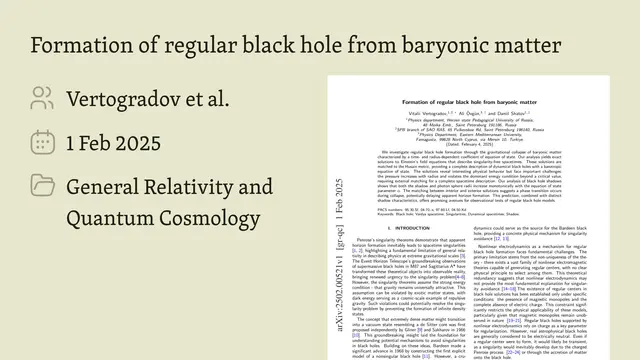
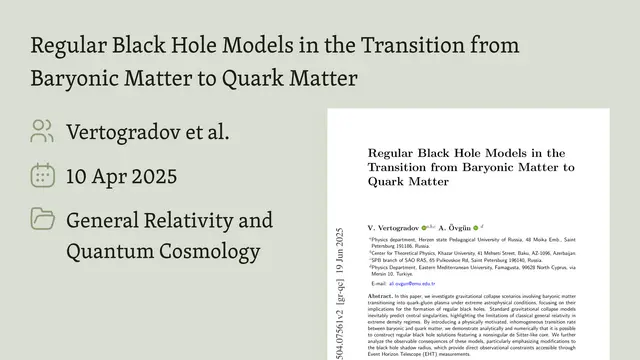
Optical Signatures of Regular Black Holes from Nonlinear Electrodynamics
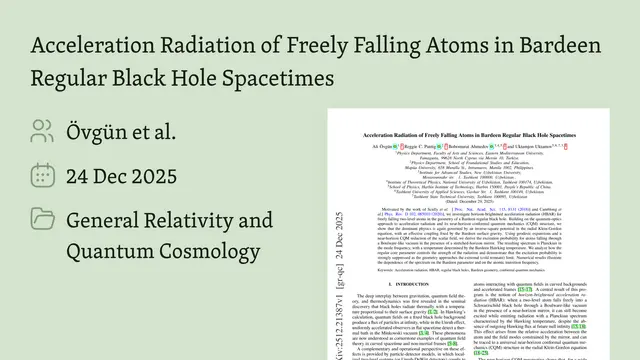
This lightning talk explores how regular black holes—nonsingular solutions arising from nonlinear electrodynamics—produce horizon-brightened acceleration radiation and distinctive optical signatures. The authors derive thermal excitation spectra consistent with horizon temperature, analyze photon spheres and shadow formation, and impose observational constraints using Event Horizon Telescope data. The work reveals deep connections between horizon physics, quantum field theory, and thermodynamics in extreme gravitational environments, offering a fresh perspective on black hole radiation beyond classical singular models.Script
Black holes aren't just cosmic vacuum cleaners—their horizons glow with quantum radiation that reveals profound connections between gravity, thermodynamics, and the fabric of spacetime itself. This paper investigates how regular black holes, shaped by nonlinear electrodynamics, produce distinctive acceleration radiation and observable optical signatures.
Unlike classical models that collapse into singularities, regular black holes achieve nonsingular geometries by coupling general relativity with nonlinear electrodynamics. The authors demonstrate that near-horizon quantum field interactions produce thermal characteristics analogous to Unruh radiation, creating what they call horizon-brightened acceleration radiation.
This horizon radiation isn't just theoretical—it follows precise thermodynamic laws.
The researchers derived a thermal excitation spectrum perfectly consistent with the horizon temperature, establishing an entropy-energy flux relationship that mirrors the Clausius first law of thermodynamics. Using two-level atom models, they traced how quantum transitions near the horizon produce measurable radiation patterns.
The authors calculated how photon spheres and shadow sizes encode the horizon structure of regular black holes, then imposed real observational constraints. Using angular-size data from the Event Horizon Telescope and GRAVITY collaboration, combined with Markov Chain Monte Carlo analysis, they estimated parameters that connect theory to what we actually see in the cosmos.
The work relies on simplified assumptions—static, spherically symmetric black holes only. Rotating solutions, richer field interactions, and deeper empirical connections remain open frontiers that could reveal even more about how horizons radiate and what observers might detect.
Regular black holes turn singularities into thermodynamic laboratories, where horizons don't just trap light—they glow with the quantum secrets of spacetime. Visit EmergentMind.com to explore more cutting-edge research and create your own video presentations.