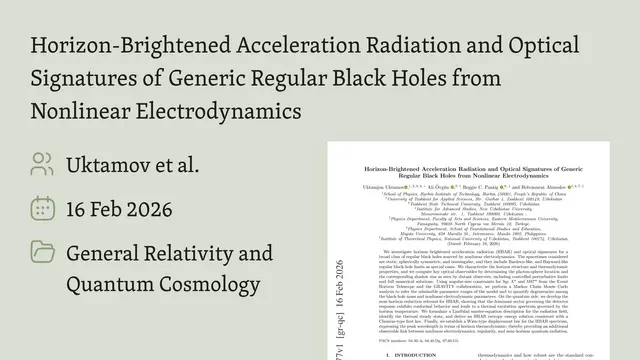
Acceleration Radiation of Freely Falling Atoms in Bardeen Regular Black Hole Spacetimes
This lightning talk explores how freely falling two-level atoms emit acceleration radiation near the horizons of Bardeen regular black holes. The authors combine quantum optics with conformal quantum mechanics to show that atoms falling toward these black holes experience a Planckian spectrum of radiation controlled by the Bardeen Hawking temperature. This work reveals how the regular core parameter modulates radiation properties and offers a quantum-optical diagnostic tool for probing black hole thermodynamics without singularities.Script
When atoms fall freely toward a black hole horizon, they don't just passively descend. They emit radiation, and the spectrum they produce reveals fundamental truths about quantum mechanics in curved spacetime.
The authors focus on Bardeen black holes, which replace the problematic singularity at the center with a smooth, regular core. This regular structure, controlled by a parameter called g, becomes a dial that modulates the radiation properties atoms experience as they fall.
How exactly do falling atoms produce this radiation?
The researchers track atoms falling along geodesics and treat them as two-level quantum systems that can absorb energy from the surrounding field. Using conformal quantum mechanics near the horizon, they compute the probability that an atom jumps to its excited state, which reveals the radiation spectrum.
The excitation probability follows a Planckian distribution, governed by the Bardeen Hawking temperature. The regular core parameter g directly influences both the strength and spectral shape of this radiation, offering a quantum-optical fingerprint of the black hole's interior structure.
This work transforms falling atoms into precision instruments for studying black hole thermodynamics. By avoiding singularities, Bardeen black holes provide a clean laboratory where quantum and gravitational effects intertwine, and the approach hints at future analog experiments that could test these predictions in controlled settings.
Acceleration radiation turns the journey toward a black hole into a quantum revelation, where every photon emitted carries information about spacetime itself. Visit EmergentMind.com to explore more cutting-edge research and create your own video presentations.