When Atoms Meet Modified Black Holes
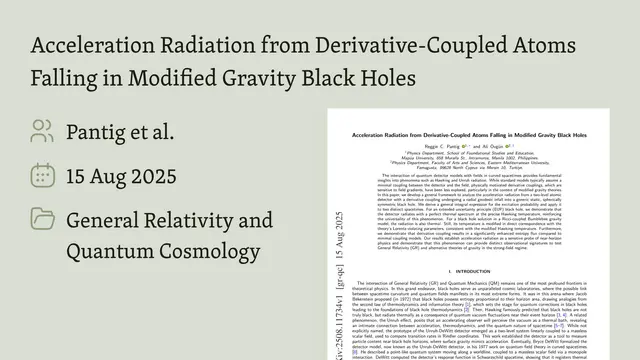
This presentation explores groundbreaking research on how atoms falling into black holes behave when quantum gravity effects are included. The authors investigate whether Einstein's equivalence principle still holds when the fabric of spacetime itself is modified by the Generalized Uncertainty Principle, and discover that black hole entropy remains remarkably universal even with these quantum corrections.Script
Black holes are among the universe's most extreme laboratories. But what happens when an atom falls toward one, and spacetime itself no longer obeys classical rules? This research reveals how quantum gravity corrections preserve one of physics' deepest principles.
The Generalized Uncertainty Principle emerges from quantum gravity theories, imposing a fundamental limit on how precisely we can measure distances. When applied to black holes, GUP modifies the event horizon itself. The authors ask whether an atom's experience falling toward this modified horizon remains consistent with Einstein's equivalence principle.
To answer this, they designed a quantum thought experiment.
The researchers compared two scenarios: an atom falling into a GUP-corrected black hole versus an atom accelerating uniformly near a moving mirror in flat spacetime. Using open quantum system techniques and the Lindblad master equation, they calculated excitation probabilities in both cases. Remarkably, the results matched exactly, confirming that the equivalence principle survives quantum corrections.
The centerpiece of their findings is HBAR entropy, which quantifies the thermal radiation an infalling atom detects. Even with GUP corrections modifying the black hole geometry, this entropy exactly recovers the Bekenstein-Hawking formula. Black hole thermodynamics proves robust, suggesting these fundamental relationships transcend the specific details of quantum gravity.
This work demonstrates that Einstein's equivalence principle withstands quantum modifications to spacetime structure, a crucial test for any theory of quantum gravity. It also establishes a theoretical framework that could guide future observations seeking signatures of minimum length scales in astrophysical systems.
When atoms meet the abyss, even quantum-corrected horizons speak the same thermal language. Visit EmergentMind.com to explore more cutting-edge research and create your own presentation videos.