Formation of Regular Black Holes from Baryonic Matter
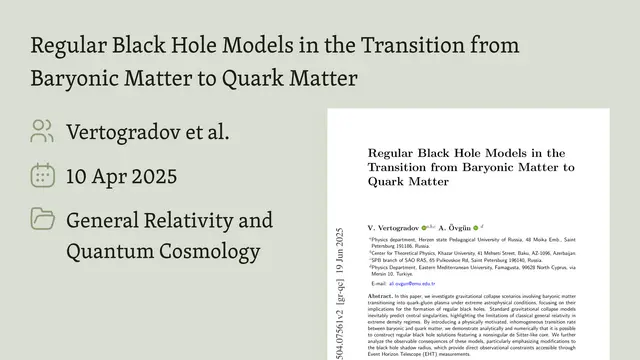
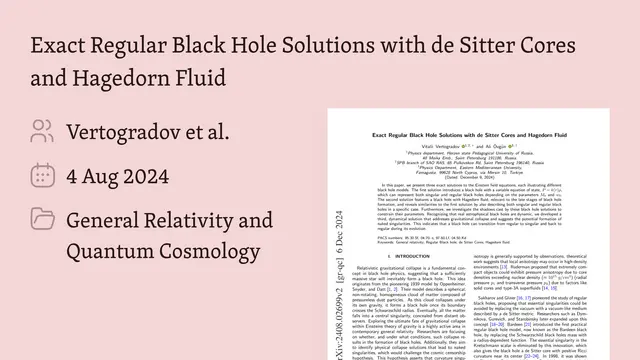
This presentation explores how collapsing baryonic matter can form black holes with nonsingular cores, avoiding the fundamental singularities predicted by general relativity. Through a dynamic equation of state and phase transition framework, the research demonstrates exact solutions that produce regular black hole centers resembling de Sitter space. The talk examines the theoretical mechanism, energy condition violations, and unique observational signatures—including distinctive shadow characteristics—that could distinguish regular black holes from their singular counterparts in astrophysical observations.Script
General relativity predicts that collapsing matter inevitably forms a singularity, a point where physics breaks down completely. But what if matter could transform during collapse, creating a black hole with a regular, nonsingular core instead?
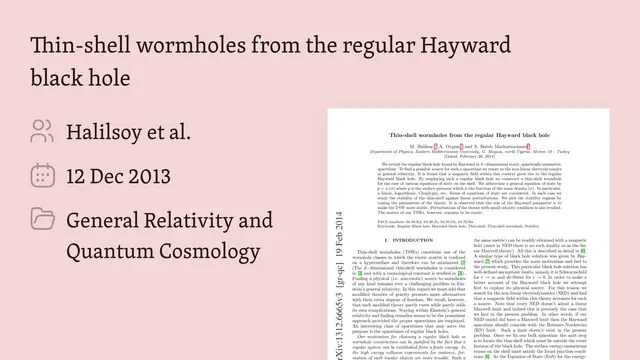
The authors tackle this fundamental problem by proposing that baryonic matter undergoes a phase transition during collapse. Instead of crushing to infinite density, the matter transforms into an exotic state that supports a regular center.
How does ordinary matter avoid forming a singularity?
The key innovation is a dynamic equation of state that changes as matter collapses. The authors derive exact solutions to Einstein's field equations showing that when the equation of state parameter varies appropriately, the collapsing matter transitions to a phase that prevents singularity formation. This requires violating the dominant energy condition, but produces a mathematically consistent, singularity-free spacetime.
Remarkably, these regular black holes leave observable fingerprints. The authors show that the shadow cast by a regular black hole changes systematically with the equation of state parameter. This means the phase transition that prevents the singularity would create distinct optical signatures detectable by instruments like the Event Horizon Telescope.
The work leaves important questions. What physical mechanism drives the phase transition in real collapsing stars? Can we observe the predicted shadow variations with current or near-future telescopes? The authors provide the mathematical framework, but connecting it to astrophysical reality remains an open challenge.
This research suggests that black holes might not harbor singularities after all—the very matter forming them could transform to prevent the breakdown of physics at their cores. Visit EmergentMind.com to explore more cutting-edge research and create your own video presentations.