- The paper presents cc-self-train, an adaptive and auto-updating curriculum that leverages staged persona progression to teach Claude Code effectively.
- It integrates instructional theories—Bloom’s Taxonomy, Gradual Release of Responsibility, cognitive load management, and constructionism—to structure a comprehensive learning experience.
- Empirical evaluations reveal significant self-efficacy improvements across skill levels, demonstrating effective cross-domain transfer and adaptive engagement.
Agentic Education for AI Coding Assistants: The cc-self-train System
Introduction
The proliferation of agentic AI coding tools such as Claude Code has revealed a significant shortfall in developer education. Existing learning resources are fragmented, rapidly outdated, and lack the pedagogical structure required for mastering complex, compositional toolchains. "Agentic Education: Using Claude Code to Teach Claude Code" (2604.17460) addresses this gap with cc-self-train, a modular, adaptive, and auto-updating curriculum for Claude Code. The framework integrates principles from modern instructional theory—including staged persona progression, adaptive engagement, step pacing, and cross-domain transfer—operationalized through programmatic hooks and structural invariants enforced by an extensive test suite.
Pedagogical Foundations
The curriculum architecture synthesizes four instructional frameworks:
- Bloom’s Revised Taxonomy: The module sequence follows the cognitive progression from knowledge recall to creation, aligning early modules with foundational tool usage and advanced modules with composition and system integration.
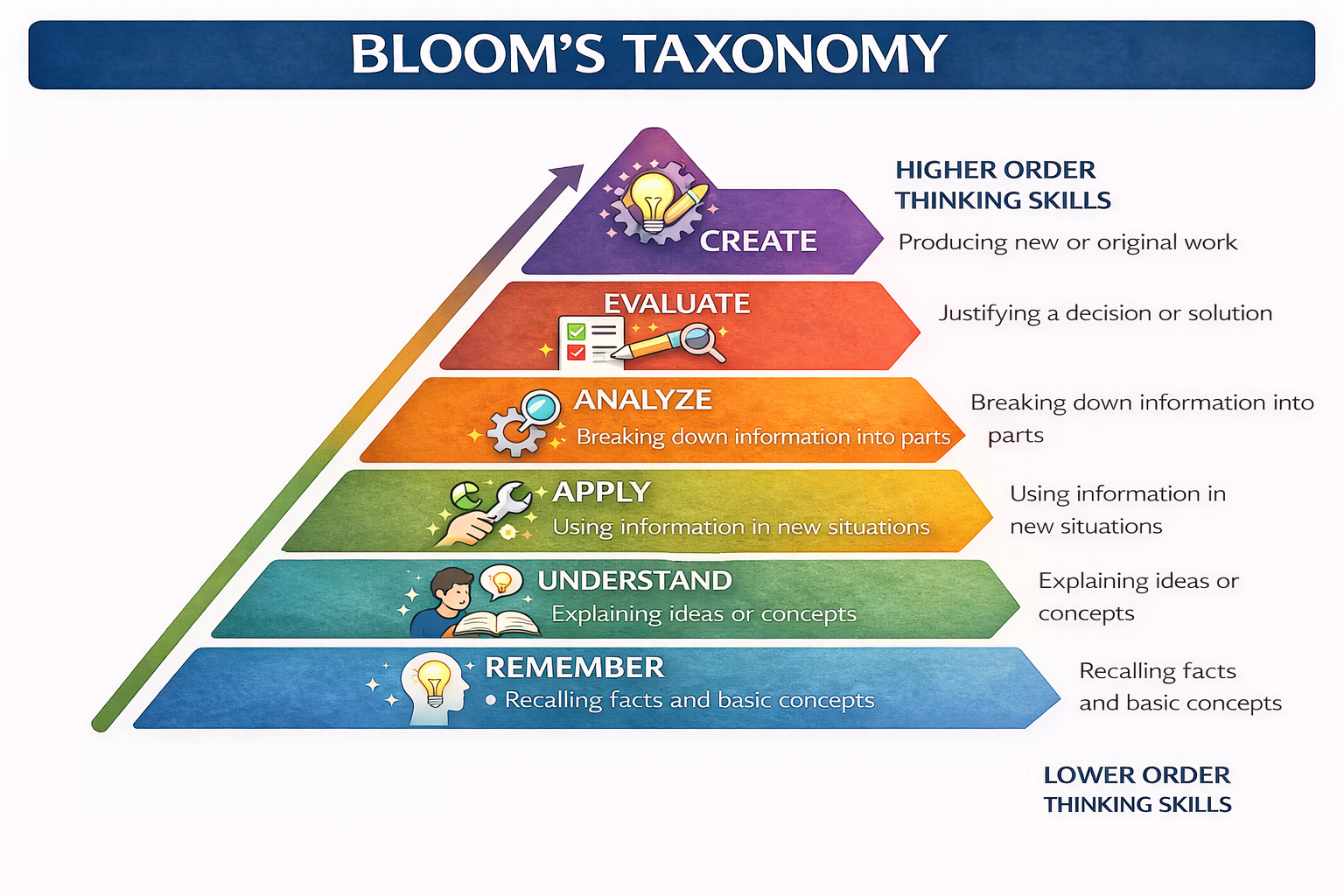
Figure 1: Bloom's revised taxonomy organizes the cognitive complexity of learning tasks, informing the curriculum's progressive module structure.
- Gradual Release of Responsibility (GRR): The curriculum’s staged persona model directly maps to GRR, transitioning the AI instructor’s role from Guide through Collaborator and Peer to Launcher as the learner demonstrates mastery.
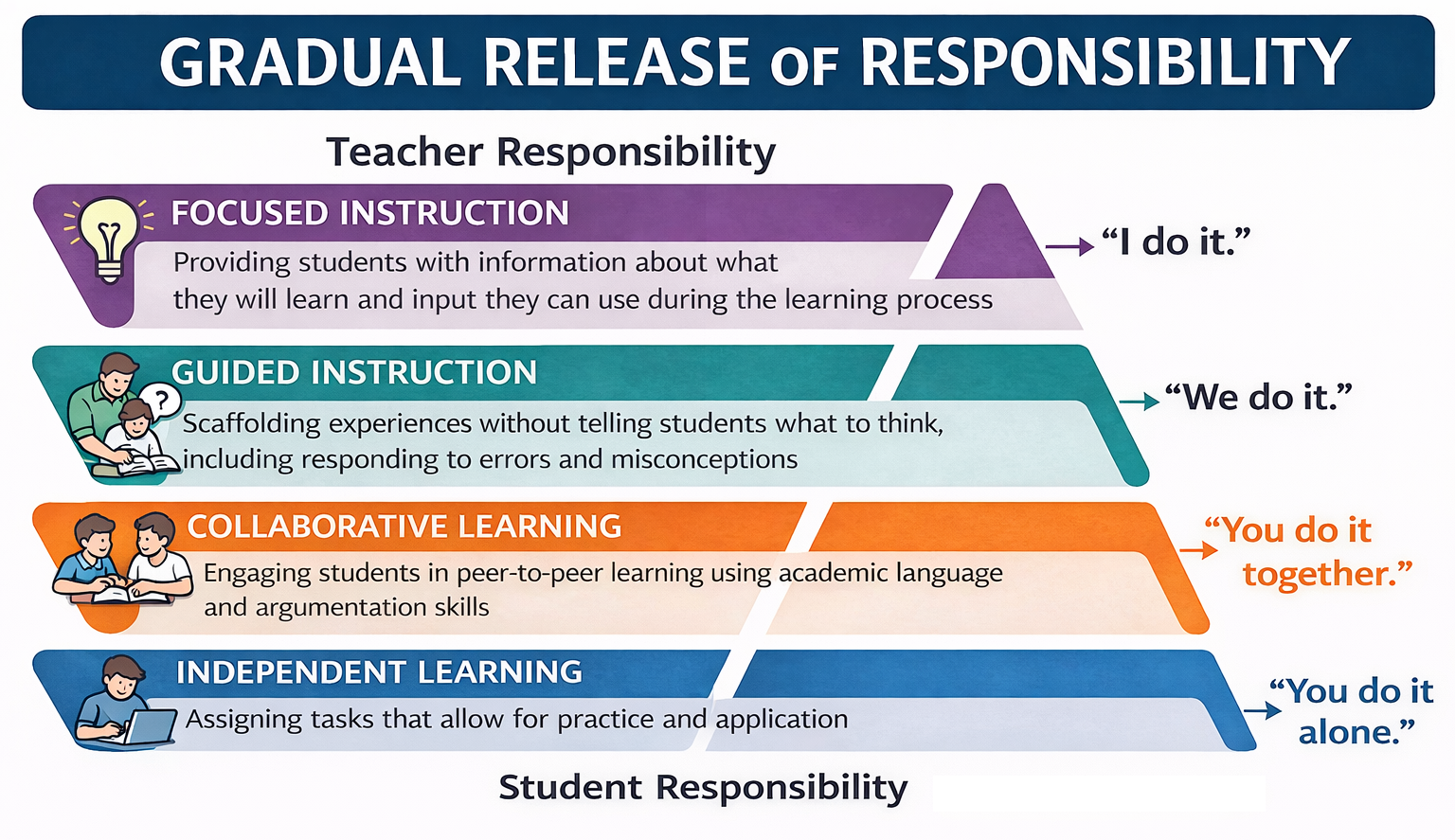
Figure 2: The Gradual Release of Responsibility framework visualizes the decreasing instructional control and increasing learner autonomy across four phases, adapted here for single-user AI-mediated coding education.
- Cognitive Load Theory: Step-pacing mechanisms with explicit STOP directives manage extraneous cognitive load, addressing the risk of information saturation endemic to AI-driven instruction in dense, terminal-based UX environments.
- Constructionism: Each project path produces a deployable artifact, not a disposable exercise, meeting the criterion that meaningful learning arises through artifact creation in authentic contexts.
System Architecture and Curriculum Design
The repository is organized into 5 parallel project paths (Canvas, Forge, Nexus, Sentinel, BYOP), each offering identical sequencing of 10 progressive modules. Every module teaches an incrementally complex Claude Code feature or capability, structuring not only what is taught but when, and governed by strict cross-project invariants on feature coverage and instructional persona.
Key structural aspects:
- Onboarding leverages a state machine for robust recovery, version-dependent curriculum updates, and adaptive experience-level detection.
- Module Files explicitly annotate instructional persona and CC features per module, enabling dynamic adaptation and testable coverage guarantees.
- Context Documents and session-specific metadata files underpin rapid context shifting and persistent state management, crucial for episode boundary-resilient teaching in autoregressive LLM environments.
Persona Progression Model
The core pedagogical innovation is dynamic persona scheduling. Four personas—Guide, Collaborator, Peer, Launcher—are encoded through minimalist prompt engineering and selected at onboarding based on learner-reported and observed proficiency. The persona assignment transitions at module boundaries, modulated by engagement metrics (effective-level adaptation) and intra-module streak detection (fast-timescale scaffolding injection). This approach resolves the canonical expert-novice instructional style compromise in fixed-persona LLM tutors and operationalizes GRR in an AI-mediated setting.
Automated tests enforce persona boundaries across all experience-level schedules, precluding regressions and ensuring all curriculum updates respect the progression.
Adaptive Engagement and Scaffolding
A three-layer architecture realizes runtime adaptation:
- Observation: Session hooks classify each utterance into one of six engagement states via keyword heuristics, maintaining productivity scores, moving averages, and short-term streaks. The design is informed by knowledge tracing literature highlighting the latent pedagogical importance of sequential non-mastery patterns.
- Context Injection: At session start, engagement trends guide invisible teaching notes, modifying AI behavior without surfacing meta-comments to the learner.
- Adaptation: End-of-module aggregate scores drive effective-level adjustments, recalibrating persona pacing. Fast-timescale streaks (e.g., three consecutive answer-seeking turns) override aggregate statistics for immediate increase in scaffolding.
The architecture leverages a deliberately lightweight implementation, with no per-turn LLM inference or external dependencies beyond the agent runtime.
Cross-Domain Curricular Invariance
Unified sequencing across five project domains enables direct transfer of Claude Code mastery. While project contexts differ (web, CLI, API, analysis, self-owned codebases), each feature is introduced in an isomorphic instructional position. Domain-specific exercises contextualize abstract features, while a test suite enforces cross-project staging and prohibits inconsistency.
The BYOP path acts as a transfer assessment: learners must instantiate new Claude Code capabilities within an arbitrary pre-existing codebase, with minimal instructor scaffolding, thus gauging genuine abstraction and adaptation skills.
Step-Pacing and Context Robustness
AI-instructed sessions risk exceeding learner cognitive limits due to non-interactive, blockwise information explosion. Step-pacing primitives (STOP blocks) enforce fine-grained atomicity, requiring explicit learner responses at checkpoints. Cross-session state files track progress outside of dialogue context, preserving instructional coherence across context compaction and session interruption, a critical adaptation for large-context LLM operational constraints.
Automated Quality Assurance
A parametrized test suite traverses the Cartesian product of projects and modules, enforcing completeness, persona mapping, cross-project feature coverage, and strict file structure. This forms a structural proxy for pedagogical consistency, particularly in the presence of automated curriculum updates.
Auto-Updating and Curriculum Currency
The auto-updating design treats curriculum content as mutable in lockstep with upstream tool releases. Onboarding triggers a sync pipeline: version checking, changelog triage, research-mapped content generation, and verification. Updates adhere to a safe-append rule, ensuring that existing learner module progress is never invalidated. The same pipeline enables maintainers to proactively bulk-update curricula in anticipation of major Claude Code architectural evolution. The approach directly addresses the “content decay” phenomenon affecting all existing agentic tool learning resources.
Empirical Evaluation
A pilot study (n=27, professionals, all prior experience levels) assessed pre/post self-efficacy on ten skill items. All items saw significant gains (p<0.001; Cohen’s d to 2.79), with the strongest effects in advanced features (hooks, custom skills). Gains were gradient by expertise: beginners (+1.18), intermediates (+0.94), advanced (+0.46), confirming ceiling effects but substantively improving compositional mastery in all groups. The data supports that staged persona adaptation and progressive, cross-domain scaffolding improve both foundational and advanced tool capabilities—especially in areas poorly addressed by existing doc- or video-based learning materials.
Practical and Theoretical Implications
This work demonstrates:
- The viability of staged-persona, prompt-driven instructor adaptation operationalizing GRR in agentic AI education for coding tools, without the need for complex downstream NLP pipelines or fine-tuned models.
- An auto-updating curriculum model maintaining structural and pedagogical invariants even as core tool capabilities churn on weekly cycles—a necessity for high-cadence agentic platforms.
- Cross-domain isomorphism as a guarantee of transferability, enabling more robust compositional competence than single-domain or ad hoc onboarding.
- Lightweight, local-only adaptive engagement as a viable alternative to heavyweight, telemetry-bound ITS for agentic tool education.
- A parametrized test-driven QA strategy replacing manual edu-content review in environments driven by LLM-generated curriculum deltas.
Future work should incorporate LLM-based engagement classifiers, expand to multi-tool and multi-language settings, and collect anonymized task-performance telemetries for richer learning analytics. The system's design patterns—staged-persona progression, safe-append updates, and modular cross-domain scaffolding—are broadly extensible to other agentic settings, from research automation to legal AI workflows.
Conclusion
cc-self-train presents a structurally rigorous, adaptable, and empirically supported pedagogical paradigm for teaching agentic AI coding tools. It operationalizes automated, staged instructional handoffs, robust engagement-based adaptation, and continuous curriculum currency—all verified by design-level test automation. As agentic AI becomes infrastructural across domains, such design patterns will underpin next-generation onboarding and upskilling toolchains, supporting scalable, individualized mastery well beyond software development.
References: See "Agentic Education: Using Claude Code to Teach Claude Code" (2604.17460) for complete implementation details, empirical data, and repository links.

