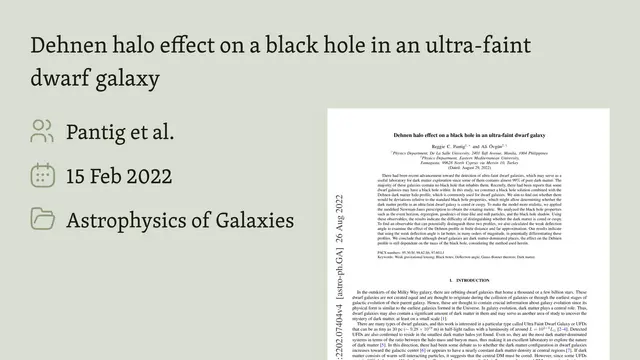
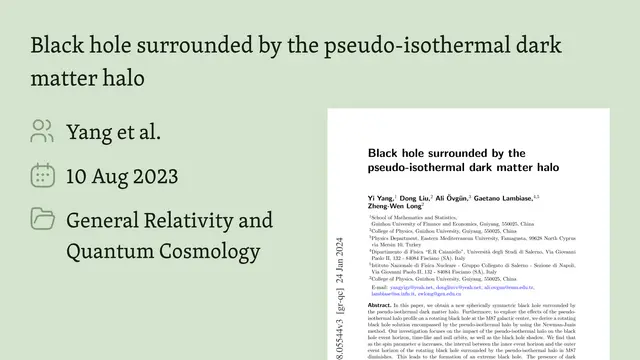
Black Hole Ringdown in a Dark Matter Halo
This presentation explores groundbreaking research on how black holes behave when embedded in Burkert dark matter halos. We examine how the surrounding dark matter environment alters the characteristic oscillation frequencies—called quasinormal modes—that black holes emit after being perturbed, revealing potential new signatures in gravitational wave observations that could help us probe the nature of dark matter itself.Script
When a black hole is disturbed, it rings like a bell, emitting gravitational waves at specific frequencies. But what happens when that black hole sits inside a halo of invisible dark matter that outweighs all the visible stars in a galaxy?
Dark matter dominates galactic dynamics, but its exact distribution remains debated. The Burkert profile describes a dark matter halo with a constant density core that gradually decreases with distance, matching what astronomers observe around real galaxies better than theoretical predictions.
The researchers embedded a black hole into this dark matter environment mathematically.
They constructed spacetime metrics that satisfy Einstein's equations while incorporating the Burkert halo, then studied how test fields oscillate in this modified geometry. Quasinormal modes characterize these oscillations, acting as fingerprints of the black hole's environment.
The dark matter halo fundamentally alters the ringdown. Both a larger core radius and higher central density shift the quasinormal mode frequencies upward and accelerate damping. The multipole index also boosts oscillation frequency, with the halo amplifying these effects across all perturbation types.
These findings matter because future gravitational wave detectors might distinguish between black holes in different dark matter environments. The work remains limited to non-rotating, spherically symmetric configurations, but it establishes crucial baselines for interpreting observations that could finally reveal what dark matter actually is.
Black holes don't ring in isolation—their environment writes itself into the gravitational waves they emit. Visit EmergentMind.com to explore more research and create your own presentations.