Dark Matter's Whisper: Black Holes in the Faintest Galaxies
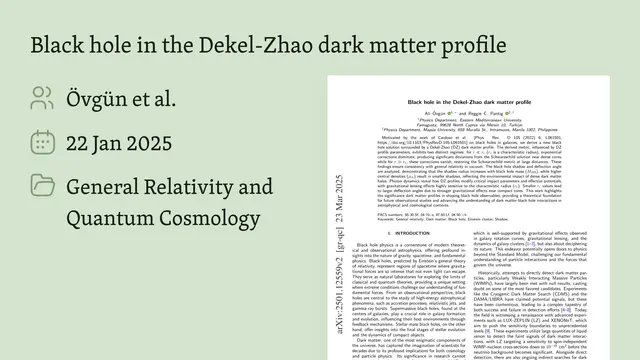
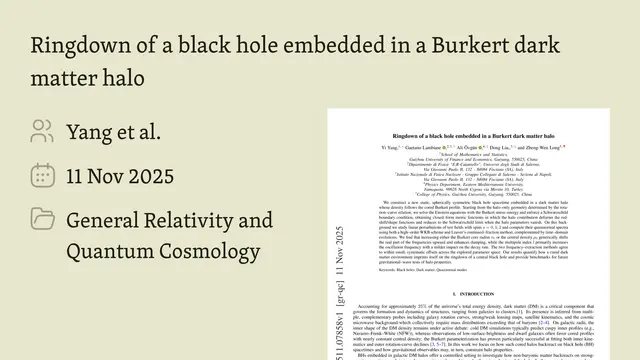
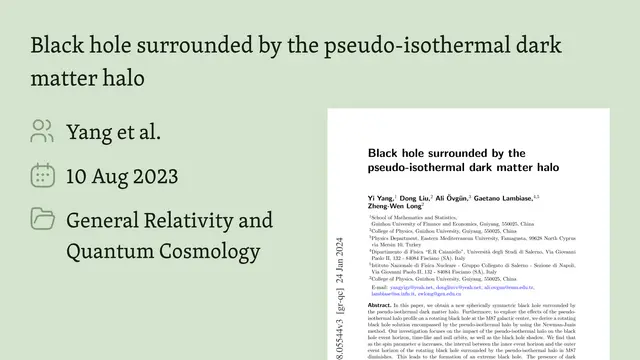
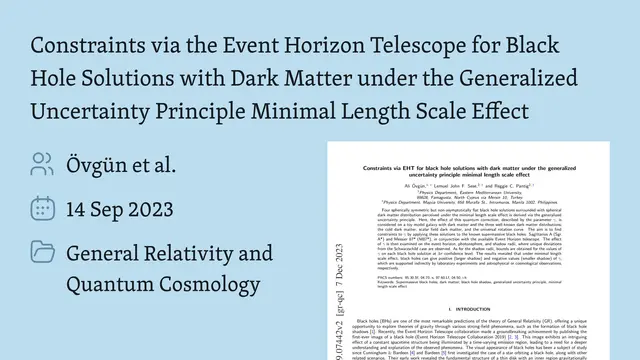
This presentation explores how dark matter shapes black holes in ultra-faint dwarf galaxies, where 99% of the mass is invisible. Using the Dehnen halo model, researchers investigated whether cored versus cuspy dark matter distributions measurably affect black hole properties like horizons, shadows, and orbits. Applied to Leo I, a nearby dwarf galaxy potentially hosting a black hole, the findings reveal that dark matter's influence is real but extraordinarily subtle, pushing the boundaries of what current technology can detect.Script
In the universe's faintest galaxies, 99% of the mass is invisible dark matter, and buried within some of them may be black holes. What happens when you place a black hole inside a galaxy made almost entirely of the stuff we cannot see?
Ultra-faint dwarf galaxies are essentially dark matter with a few stars sprinkled in. The Dehnen profile lets researchers model whether this dark matter concentrates sharply at the center, forming a cusp, or spreads more gently in a core. Each structure bends spacetime differently around any black hole that might live there.
So how do you calculate what dark matter does to a black hole?
The authors combine Einstein's field equations with the Dehnen halo, then use the Newman-Janis method to add black hole spin. This lets them compute horizons, shadows, and light deflection for black holes embedded in realistic dark matter distributions.
When applied to Leo I, a nearby dwarf galaxy potentially harboring a black hole, the model predicts that cored and cuspy halos shift black hole properties by less than 1%. The weak deflection of light passing near the black hole turns out to be the most sensitive probe, but even that signal is faint.
The deviations are real, but they whisper. Current instruments lack the resolution to see sub-percent shifts in black hole shadows or orbits at these scales. The research opens the door to future observations and refined models that might amplify dark matter's signature in these cosmic laboratories.
In the darkest galaxies, even black holes bow to invisible architecture, but detecting that influence will require us to listen more carefully than ever before. Visit EmergentMind.com to explore more research and create your own videos.