Published 3 Jun 2026 in hep-th, hep-ph, and quant-ph | (2606.05282v1)
Abstract: The symmetric double-well potential is one of the simplest quantum-mechanical systems in which perturbative and non-perturbative physics are deeply entangled. Its energy levels have non-analytic expansions in inverse powers of the inter-well separation, with factorially growing coefficients, while the parity splitting is exponentially small and invisible to perturbation theory. Resurgence ties the two features together, organizing the exact spectrum into a single tightly-constrained trans-series. This paper gives a self-contained account of this trans-series from two complementary approaches: exact WKB and the Euclidean path integral, developed in a common notation with explicit calculations through the four-instanton level and three-loop order. In exact WKB, Stokes phenomena encoded in the Delabaere--Dillinger--Pham relations control the analytic continuation of the wavefunction past turning points. The quantization condition expressed in terms of Voros symbols then determines the full trans-series. The DDP relations are local and do not require knowing the global topology of the energy surface, but that surface is an elliptic curve. In the path integral, elliptic curves enter differently: the classical saddle points are doubly-periodic elliptic functions of Euclidean time, and Stokes phenomena play out within the finite-dimensional manifold of quasi-zero modes rather than through analytic continuation of the wavefunction. A Lefschetz thimble decomposition determines which saddles contribute, and the resulting partition function trans-series is much simpler than the energy trans-series: at each instanton order the $T$-dependence is a polynomial fixed by the quasi-zero-mode thimble integrals. Together, the two approaches deploy a shared mathematical infrastructure in complementary ways, showing that the double well is an ideal setting to explore resurgence.
The paper establishes a unified framework that combines exact WKB and Euclidean path-integral methods to reveal resurgent trans-series in the quantum double-well potential.
It computes energy level splittings and confirms cancellation of Borel ambiguities via detailed multi-instanton, four-instanton, and three-loop order calculations.
The analysis employs elliptic curve geometry and Lefschetz thimble decompositions to map local and global non-perturbative features precisely.
Resurgence, Exact WKB, and Path Integrals in the Quantum Double Well
Introduction and Problem Statement
The symmetric quantum double-well potential is a paradigmatic example exhibiting the interplay between perturbative and non-perturbative phenomena in quantum mechanics. Its energy eigenvalues encode factorially divergent perturbative expansions and exponentially small splittings due to tunneling, phenomena unseen by perturbation theory at any finite order. Resurgence theory provides a formalism connecting these infractions of standard expansion, organizing the spectral data into a full trans-series. "The Double Well Done Doubly-Well" (2606.05282) presents a comprehensive, technical analysis of this problem, unifying the exact WKB method and the Euclidean path-integral approach. The paper further elucidates the geometric underpinnings of resurgence using elliptic curves and Lefschetz thimbles, and systematically pushes calculations to the four-instanton and three-loop regime.
Divergent Series and Trans-Series Structure
Perturbation theory near either well provides asymptotic expansions for the energies: EN(ℏ)=∑k=1∞ek(N)ℏk
with ek∼k! for large k. The factorial divergence reflects the presence of instanton saddles in the path integral, leading to additional exponentially suppressed contributions. The total non-perturbative structure is a trans-series: EN=k∑ekℏk+e−ℏSIk∑ek(1)ℏk+e−ℏ2SIk∑(ek(2)+ck(2)logℏ)ℏk+…
Here SI is the instanton action, and the coefficients across instanton sectors are algebraically related by resurgence.
The Borel transform constructs a resummation of the divergent perturbative series and reveals the analytic structure of the underlying physical function. Singularities in the Borel plane correspond directly to non-perturbative saddles in the semiclassical expansion. Resurgence theory, in the form developed by Écalle, enables the recursive determination of higher-instanton data from perturbative input via alien calculus.
Exact WKB Framework and Resurgent Constraints
The exact WKB method systematically regularizes the traditional WKB approximation by analytic continuation in the complex plane and Borel resummation, utilizing Voros symbols—exponentials of period integrals of the quantum momentum. Crucial is the treatment of analytic continuation across Stokes lines, formalized by Delabaere–Dillinger–Pham (DDP) relations, which relate discontinuities of Borel-resummed quantities to Stokes jumps associated with multi-instanton sectors.
The quantization condition for the spectrum involves both perturbative and instanton (non-perturbative) cycles: 1+VP(E)=±iVN(E)
where VP,N are exponential period integrals over the respective cycles in the complexified phase space.
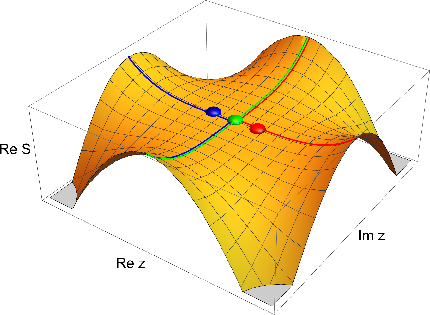
Figure 1: Complex z-plane with saddle points and associated Lefschetz thimbles illustrating the multi-saddle structure essential for resurgence.
The underlying geometry is that of an elliptic curve defined by the classical momentum, with the period integrals giving the actions of the relevant cycles. The period expansion enables computation to high order in ℏ for multi-instanton sectors, relying on Picard–Fuchs relations between higher k WKB integrals and the basic period data.
Resurgence is manifest in relations between the alien derivatives of Borel transforms (acting as 'bridges' between sectors). Explicit calculations verify the entanglement of the ek∼k!0-instanton and ek∼k!1-instanton sectors, and show that the reality of the energy spectrum emerges via intricate cancellation of imaginary parts at each instanton order, as quantified by the DDP and Écalle’s bridge equations.
Euclidean Path Integral and Lefschetz Thimbles
The path-integral approach decomposes the quantum partition function ek∼k!2 into sums over real and complex saddle points—determined by the finite-ek∼k!3 solutions to the Euclidean equations of motion, which are characterized by doubly-periodic Weierstrass elliptic functions. The actions are quantized according to their winding numbers around the fundamental cycles of the elliptic curve.
This saddle classification allows a Lefschetz thimble decomposition of the path integral: ek∼k!4
where ek∼k!5 are thimble contours and ek∼k!6 are intersection numbers—determined by the geometry of the complexified configuration space.
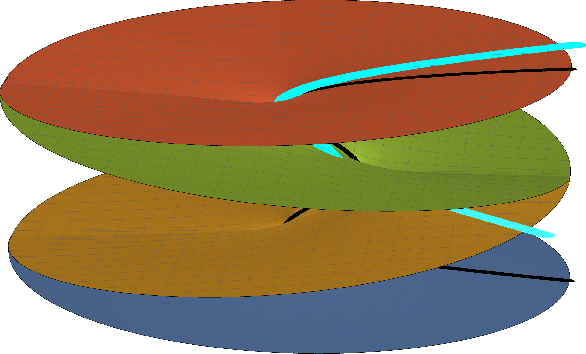
Figure 2: Four-sheeted Riemann surface associated with the 0D double-well model, revealing the multi-branched Borel structure reconstructed from the saddle analysis.
The functional determinant for quadratic fluctuations about each saddle is given in closed form in terms of period data. Collective coordinates (true zero modes) and quasi-zero modes (arising from nearly flat directions in multi-instanton configurations) are isolated and integrated over exactly, yielding precise ek∼k!7-dependence and demonstrating the polynomial structure of each sector in the large ek∼k!8 limit.
The path-integral framework provides a geometric realization of resurgence: the full spectrum emerges from the combined contributions of appropriately selected thimble integrals, with the properties of middle-dimensional integration cycles encoding the cancellation of Borel ambiguities.
Figure 3: Numerical computation of thimble structures for the Airy model, demonstrating analytic continuation around turning points and the geometry of Stokes phenomena relevant to the quantum double-well.
Numerical Results and Asymptotic Analysis
The analysis achieves explicit calculation of the spectrum up to four-instanton sectors and three-loop order in ek∼k!9, exposing the fine structure of the trans-series. The ground-state energy splitting and higher-level corrections are explicitly given and show exact agreement between the two methodological approaches.
Key numerical and analytical findings:
The level splitting is exponentially small in k0:
k1
All Borel ambiguities in perturbative and k2-instanton sectors cancel exactly against the contributions computed from lower sectors, as mandated by resurgence.
Odd-instanton sectors affect only the even/odd splitting (parity dependence); even-instanton sectors yield common energy shifts.
Implications and Theoretical Outlook
This work establishes the symmetric double-well as a model laboratory where resurgence manifests in its most transparent, algebraically tractable form. The explicit parallel analysis using exact WKB and path-integral/Lefschetz-thimble formulations highlights the complementary roles of local and global geometry (period integrals, Riemann surfaces, and saddle-point network) in the analytic structure of quantum observables.
The techniques developed, especially the concrete construction of multi-instanton sectors using algebraic period data and their geometric interpretation via thimble integration, provide a rigorous methodology generalizable to more complex quantum systems, including quantum field theory and SUSY gauge quantum mechanics, where resurgence structures govern non-perturbative phenomena.
In AI and symbolic computation, the methods for automatic generation and manipulation of high-order perturbative and trans-series expansions—as well as the algebraic manipulation of period integrals—could enable new computational algebra systems, potentially automating aspects of multi-instanton calculus and the symbolic analysis of divergent series for a wide class of quantum systems.
Conclusion
This paper delivers a unified, technically precise, and deeply interconnected view of resurgence in the archetypal double-well system. By harmonizing exact WKB and path integral methods through their common elliptic geometry and resurgent algebra, it both clarifies historical confusions and provides explicit computational protocols for multi-instanton physics. The analysis paves the way for systematic, algebraic understanding of non-perturbative phenomena in quantum and statistical field theories grounded in the geometry of complex saddle networks and their associated trans-series structures (2606.05282).
“Emergent Mind helps me see which AI papers have caught fire online.”
Philip
Creator, AI Explained on YouTube
Sign up for free to explore the frontiers of research
Discover trending papers, chat with arXiv, and track the latest research shaping the future of science and technology.Discover trending papers, chat with arXiv, and more.