- The paper introduces an exact finite-T path-integral method that replaces the dilute instanton gas approach with a rigorous resurgent framework based on exact saddle points.
- It employs Picard–Lefschetz theory to manage real and complex saddle contributions, achieving precise ambiguity cancellation between perturbative and non-perturbative sectors.
- The method recovers the full non-perturbative spectrum for both ground and excited states, providing insights applicable to quantum field theoretic problems.
Systematic Resurgence and Exact Saddle Contributions in the Quantum Double Well
Introduction
The study of non-perturbative effects in quantum mechanics, particularly in potentials with degenerate minima, has classically focused on the dilute instanton gas (DIG) approximation. While DIG, pioneered in the context of the double-well potential, elucidates ground-state splitting via well-separated instantons, its ad hoc analytic prescriptions and neglect of finite Euclidean time effects limit its reach. "Beyond the Dilute Instanton Gas: Resurgence with Exact Saddles in the Double Well" (2604.14279) addresses these deficiencies by employing a full finite-T path-integral approach. Through the computation and classification of exact periodic saddle points, the authors systematically develop a mathematically rigorous resurgent framework that cleanly resolves the contribution of instanton sectors, clarifies ambiguity cancellation, and recovers the full non-perturbative spectrum for all energy levels.
Limitations of the Dilute Instanton Gas
DIG approximates the partition function and energy spectrum using multi-instanton configurations constructed from well-separated, tanh-like kinks, focusing on the T→∞ limit. This approach, refined by the Bogomolny-Zinn-Justin (BZJ) prescription, introduces an analytic continuation in the coupling constant to cure divergences from quasi-zero mode integration, yielding the correct imaginary parts needed for Borel ambiguity cancellation. Notably, however, the DIG framework:
- Only accesses the ground-state splitting, as all excited states become degenerate in the T→∞ limit.
- Ignores instanton interactions beyond leading order, hence missing systematic subleading non-perturbative corrections.
- Adopts heuristic, not rigorous, prescriptions for the handling of quasi-zero modes and thimble structures.
Consequently, while DIG supports qualitative features of resurgence, it is intrinsically limited in quantitative, sector-resolved spectral extraction.
Exact Saddles, Periods, and Picard--Lefschetz Theory
The authors replace the dilute approximation by an exact analysis of finite-T Euclidean periodic solutions for the symmetric double well, V(x)=81(x2−1)2. These saddles are parameterized by Weierstrass elliptic functions, embedding the instanton and anti-instanton configurations within a finite time interval. The periodicity conditions are encapsulated by algebraic relations involving half-periods ωP,ωN and their conjugate actions SP0,SN0, satisfying Picard–Fuchs differential equations.
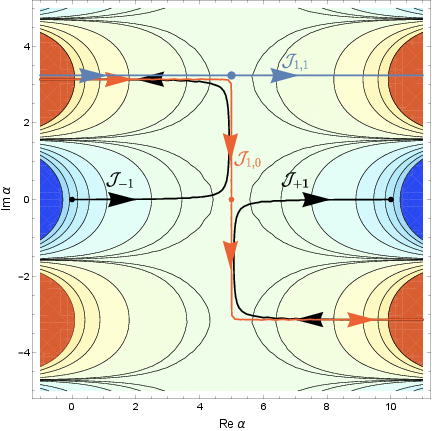
The path integral is decomposed using the Picard–Lefschetz approach, where the partition function Z receives contributions from thimbles Jk,k′ associated with distinct tanh0 saddles. In this formalism,
Resurgence via Quasi-Zero Mode Integration
A central technical innovation is the explicit computation of finite-dimensional thimble integrals over quasi-zero modes, fully characterizing the non-perturbative expansion beyond the DIG limit. For the tanh6 (instanton–anti-instanton) sector, the authors show that the relevant effective action for the separation coordinate tanh7 captures both real and complex saddle contributions, with geometric thimble integration yielding Borel resummation ambiguities in direct correspondence with perturbative non-Borel summability.
The full path-integral resurgence structure is realized as:
- The real line segment integral gives rise to asymptotic series and Borel singularities.
- Vertical and arm thimble integrals encode imaginary ambiguity contributions, summing precisely to cancel the corresponding Borel ambiguities as required for resurgence.
- The overall partition function, appropriately organized sector by sector, demonstrates exact cancellation and matching of ambiguities at every instanton order.
For higher-instanton sectors (tanh8 and above), a decomposition into separation and breathing collective coordinates allows the factorization of higher-dimensional thimble integrals, supporting a systematic, recursive structure for multi-instanton contributions and their affiliated ambiguity relations (as in the alien derivative framework).
Non-Perturbative Energy Splittings and Finite-tanh9 Corrections
The methodology enables extraction not only of the ground-state splitting but of the full non-perturbative energy spectrum, including excited-state splittings and their precise level dependence, by working at finite T→∞0 and employing the twisted partition function with parity projection. Finite-T→∞1 exact instantons (given in Jacobi elliptic form) yield actions and determinants capturing all corrections in powers of T→∞2, allowing direct matching to the spectral decomposition.
Key strong numerical results include:
- For all levels T→∞3, the energy splitting is given by
T→∞4
incorporating all T→∞5-dependent corrections;
- The uniformity of splitting predicted by DIG is shown incorrect for excited states, manifesting only in the leading ground-state term due to the neglect of finite-T→∞6 effects;
- All T→∞7 non-perturbative corrections are resolved via expansion of the exact finite-T→∞8 path integral.
These results agree with those from the Exact WKB method but arise here directly from the path integral, without recourse to algebraic resummation.
Ambiguity Cancellation and Consistency Checks
A notable achievement is the transparent realization of ambiguity cancellation among perturbative and non-perturbative sectors:
- The imaginary parts arising from thimble geometry are exactly canceled by those from the perturbative Borel resummation.
- Corrections at different loop orders (action, determinant, vacuum bubbles) are shown to combine in a three-way cancellation structure, notably illustrated by the precise matching of logarithmic corrections between instanton and vacuum sectors.
- Explicit checks are realized at two-loop order, confirming agreement of ambiguity cancellation with predictions from exact WKB calculations.
Implications and Prospects
The approach advanced in this work elevates the path-integral treatment of quantum mechanical tunneling problems, providing a rigorous, unambiguous, and fully resurgent expansion for the spectrum via exact finite-T→∞9 saddle configurations and their associated Picard–Lefschetz thimbles. Practically, this enables controlled, systematic calculation of non-perturbative effects for all energy levels, including all relevant subleading and ambiguity-canceling structures.
Theoretically, the results strongly suggest that similar methods can be extended to quantum field theoretic settings, notably to QCD, where the breakdown of the DIG is well known and analytic continuation approaches have not provided full satisfaction. The analogous role played by compactification and exact finite-volume saddles in QCD (calorons, etc.) hints that the resurgent path-integral framework could resolve outstanding issues in the treatment of non-perturbative gauge theory dynamics, instanton molecules, and possibly renormalon ambiguities.
Conclusion
By replacing the DIG with exact finite-T→∞0 instanton calculus and organizing the full path integral via Picard–Lefschetz theory, the paper achieves a principled, sector-resolved, and fully resurgent understanding of non-perturbative dynamics in the quantum double well. All saddle contributions, their spectral fingerprints, and the ambiguity cancellation structure are natural outputs of this framework. The methodology promises to be a blueprint for extending resurgence to higher-dimensional, less tractable quantum systems, where the reconciliation of perturbative and non-perturbative physics remains at the frontier of quantum theory.