- The paper shows that incorporating Einstein-Cartan torsion into holographic dark energy dynamically evolves the dark matter to dark energy density ratio, resolving the coincidence problem.
- It employs a Hubble radius IR cutoff and a torsion scalar scaling as a⁻³ to shift the dark energy equation of state, enabling cosmic acceleration without dark sector interaction.
- Observational constraints for the density ratio and the equation of state are satisfied within a narrow parameter range, highlighting the potential of torsion in addressing fundamental cosmological issues.
Dynamical Resolution of the Cosmic Coincidence Problem in Einstein-Cartan Holographic Dark Energy
Background and Motivation
The cosmic coincidence problem refers to the observation that the energy densities of dark matter and dark energy are comparable at the current cosmological epoch, despite their typically distinct scaling behaviors. Traditional ΛCDM frameworks typically address this with a cosmological constant, but the associated fine-tuning and coincidence issues motivate alternative models such as holographic dark energy (HDE).
HDE, based on the holographic principle, constrains dark energy density via an infrared (IR) cutoff. When the Hubble radius serves as this cutoff, non-interacting HDE models within standard GR yield a dust-like equation of state, unable to drive cosmic acceleration. Interacting HDE models introduce phenomenological couplings between dark matter and dark energy to overcome this, but such couplings lack fundamental motivation and observational evidence, and pose complications with concurrent resolutions of cosmological tensions.
Einstein-Cartan (EC) gravity, incorporating spacetime torsion, offers a geometric extension of GR where torsion is sourced by intrinsic spin. The model analyzed in this paper (2605.27973) exploits a torsion scalar Φ that self-consistently scales as a−3. The goal is to demonstrate that EC torsion enables non-interacting HDE models with the Hubble radius cutoff to both drive acceleration and yield a time-dependent density ratio, providing a dynamical mechanism for resolving the coincidence problem.
Theoretical Framework
The EC theory modifies cosmological dynamics through the torsion tensor Sμν ρ, which, under the cosmological principle, is characterized by a time-dependent scalar Φ(t). The Weyssenhoff spin fluid formalism links torsion to the spin of matter, yielding generalized Friedmann equations:
H2=3Mp21(ρ−3Mp2Φ2)
H˙+H2=−6Mp21(ρ+3p−12Mp2Φ2)
The model adopts the Hubble radius L=H−1 for the IR cutoff, leading to a holographic dark energy density ρX=3d2Mp2H2. The torsion scalar evolves via Φ˙+3HΦ=0, implying Φ0 without ad hoc assumptions.
Dynamical Density Ratio and Cosmic Acceleration
In standard non-interacting HDE (GR), the ratio Φ1 is constant, precluding any natural explanation for its current order-unity value. EC torsion modifies this fundamentally:
Φ2
Thus, Φ3 becomes explicitly time-dependent even without a dark sector interaction term (Φ4), allowing for dynamical evolution from large values in earlier epochs to the observed current value.
The torsion scalar also alters the equation of state for HDE:
Φ5
This enables Φ6 to be shifted toward negative values, facilitating cosmic acceleration in the absence of interaction. The model quantitatively demonstrates compatibility with observational constraints for the favored range Φ7 and current density ratio Φ8, yielding a restricted interval Φ9 for the holographic free parameter (Figure 1).
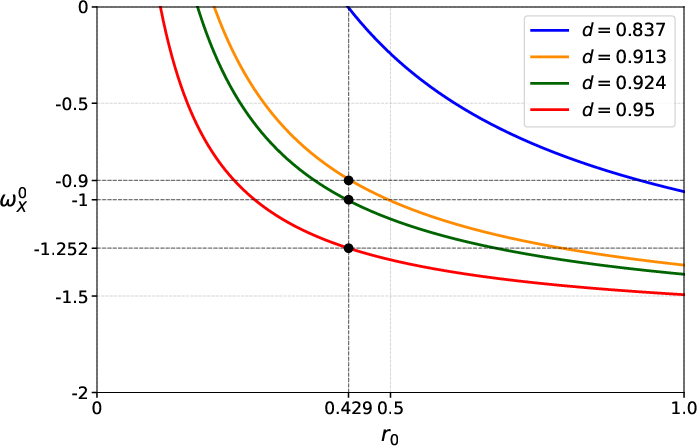
Figure 1: The allowed range a−30 satisfies both the observed density ratio a−31 and the favored equation of state for dark energy, a−32.
Dynamical Evolution and Order-Unity Density Ratio
The model tracks the evolution of a−33 via
a−34
For a−35, both in the matter-dominated era (a−36) and at the current epoch (a−37), a−38 decreases over time, supporting dynamical resolution of the coincidence problem. The observed order-unity value of a−39 is not a consequence of fine-tuning Sμν ρ0, but arises naturally from the weak torsion regime, Sμν ρ1 (Figure 2).
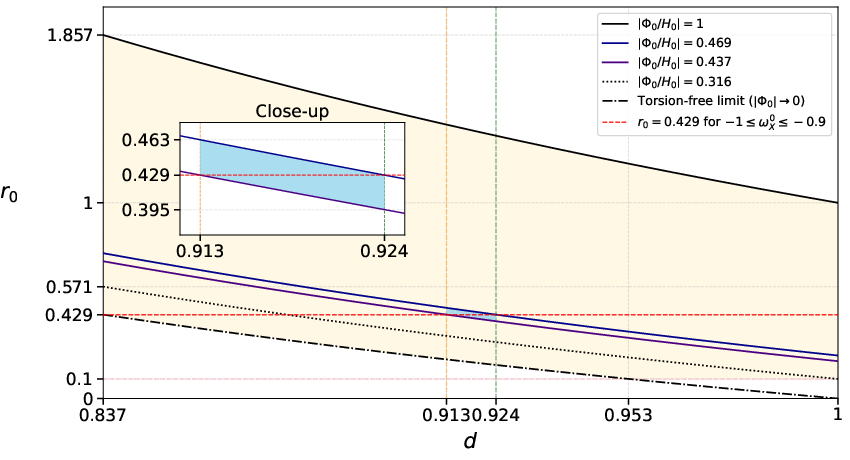
Figure 2: The yellow region indicates Sμν ρ2 for weak torsion Sμν ρ3, while intersections in the blue inset correspond to simultaneous satisfaction of Sμν ρ4 and Sμν ρ5 for Sμν ρ6.
Implications and Future Directions
This analysis demonstrates that EC torsion provides a geometric origin for the dynamical density ratio, obviating the need for phenomenological interaction terms. The results have the following implications:
- Resolution of the Coincidence Problem: The observed density ratio is dynamically achieved, not artificially fixed by parameter tuning.
- Cosmic Acceleration: The negative shift of Sμν ρ7 from torsion allows for acceleration in non-interacting HDE.
- Parameter Space: Observational constraints are satisfied within a well-defined free parameter range, subject to weak torsion.
- Dark Sector Models: EC gravity shapes cosmological dark energy phenomenology without explicit coupling, potentially avoiding issues with Sμν ρ8 and Sμν ρ9 tensions in interacting models.
Future work may involve:
- Constraining torsion effects through cosmological observations (e.g., CMB, large-scale structure).
- Exploring the interplay between torsion, early universe dynamics, and inflation.
- Investigating possible quantum gravity connections and phenomenological signatures of EC torsion in the dark sector.
Conclusion
Einstein-Cartan gravity, with a cosmologically consistent torsion scalar, enables non-interacting holographic dark energy models to dynamically resolve the cosmic coincidence problem and drive cosmic acceleration without phenomenological interaction terms. The current density ratio and equation of state requirements are met within a narrow yet natural parameter regime and weak torsion. Theoretical and observational implications indicate that geometric torsion offers a viable mechanism for addressing fundamental cosmological questions and motivates further exploration of spin-torsion effects in cosmic evolution.