- The paper demonstrates that incorporating torsion in Einstein-Cartan gravity shifts the dark energy equation of state, enabling cosmic acceleration.
- It derives Friedmann-like equations with explicit torsion terms and identifies critical thresholds for crossing the phantom divide in HDE models.
- The study details modifications in light propagation and cosmic distance duality, offering testable signatures in SNIa, BAO, and other observations.
Holographic Dark Energy with Hubble Radius as IR Cutoff in Einstein-Cartan Gravity
Theoretical Framework and Motivation
This paper systematically investigates non-interacting holographic dark energy (HDE) with the Hubble radius serving as the infrared (IR) cutoff under the Einstein-Cartan gravity framework. The motivation stems from the limitations of the cosmological constant model, particularly the vacuum energy fine-tuning and cosmic coincidence problems, alongside persistent cosmological tensions such as Hubble and S8 discrepancies. Einstein-Cartan gravity, as a natural classical stepping-stone toward quantum gravity, incorporates torsion linked to matter's spin degrees of freedom—a crucial aspect not addressed in standard general relativity.
The Einstein-Cartan equations are rigorously derived via an action-based approach, with a torsion scalar introduced. The torsion is modeled in terms of a Weyssenhoff spin fluid, grounded in the intrinsic macroscopic averaging of spin-1/2 fermions composing baryonic matter. This analysis avoids ad hoc ansätze prevalent in earlier torsion cosmology studies, resolving theoretical completeness issues by enforcing a self-consistent scaling Φ∼a−3 for the torsion scalar.

Figure 1: Transition from quantum gravity’s classical limit, passing through Einstein-Cartan theory prior to restoring general relativity.
Friedmann-Like Dynamics and Torsion Effects
By applying the cosmological principle, the resulting Friedmann-like equations contain explicit torsion-dependent terms. The torsion scalar, tied directly to spin density via the Cartan equations, behaves as non-propagating matter: its scaling mimics dust (Φ∼a−3). Consequentially, two notable modifications arise in cosmic dynamics:
- Equation of State Shift: In standard non-interacting HDE models with the Hubble radius cutoff and without torsion, the dark energy’s equation of state remains dust-like, inhibiting cosmic acceleration. Inclusion of torsion makes the equation of state increasingly negative, permitting acceleration. The model achieves ωX≃−1 and traverses the phantom divide even in the weak torsion regime ∣Φ/H∣<1.
- Dynamical Evolution: The equation of state evolves monotonically, with cosmic acceleration gradually declining—qualitatively aligned with recent DESI observations.
Numerically, the critical threshold for crossing the phantom divide is ∣Φ/H∣≃0.667 for d=0.837 and ∣Φ/H∣≃0.381 for d=0.95, reflecting sensitivity to model parameters.
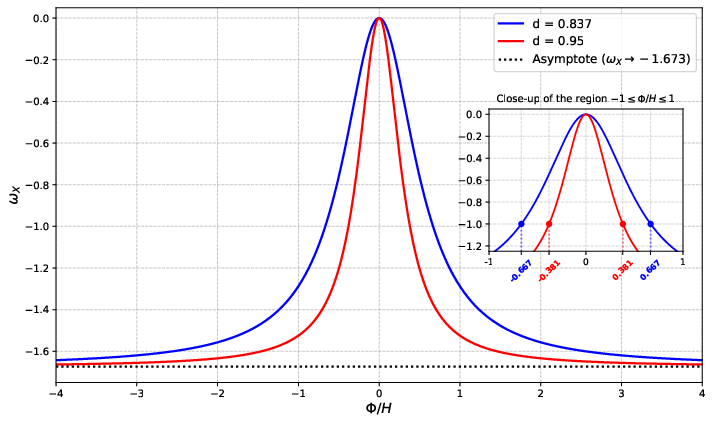
Figure 2: The equation of state for dark energy ωX as a function of Φ∼a−30 for distinct Φ∼a−31 values; torsion drives Φ∼a−32 negative, crossing the phantom barrier in the weak torsion regime.
Light Propagation, Cosmological Distances, and Torsion Signatures
The analysis extends to light propagation in torsion-rich spacetimes, elucidating how torsion alters standard cosmological observables. Null curves, distinguished from geodesics, autoparallels, and influenced by torsion, redefine the relation between luminosity distance (Φ∼a−33) and angular diameter distance (Φ∼a−34). While the redshift-scale factor duality is retained due to cancellation of torsion contributions—for the specific torsion scalar considered—the cosmic distance duality relation is modified:
Φ∼a−35
Here, Φ∼a−36 quantifies torsion-induced deviation and scales as Φ∼a−37, encapsulating torsion's matter-like dilution over cosmic expansion. This predicts observational signatures, particularly in SNIa and BAO measurements.
The reciprocity theorem, which connects observer and source area distances, is also generalized. While totally antisymmetric torsion preserves the canonical relation, more general torsion structures introduce modifications—these are parameterized and traced through the formalism.
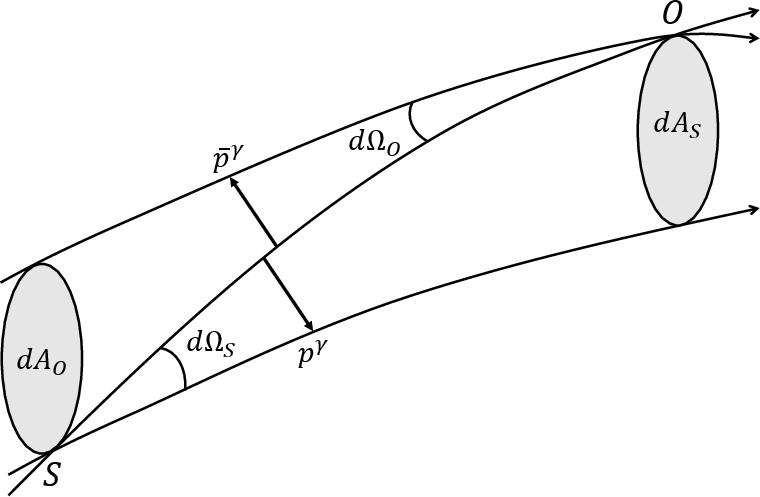
Figure 3: Null bundles from source (Φ∼a−38) to observer (Φ∼a−39), showing cross-sectional areas and connecting vectors relevant to reciprocity in the presence of torsion.
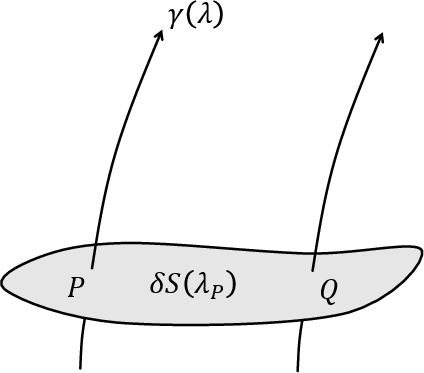
Figure 4: Two-dimensional cross-section representation of the null bundle, underpinning the calculation of area distances under Einstein-Cartan geometry.
Implications and Future Directions
The results establish the theoretical and phenomenological feasibility of non-interacting HDE with Hubble radius IR cutoff in Einstein-Cartan gravity:
- Cosmic Acceleration Without Interaction: Torsion-driven shift in the equation of state circumvents the causality and circular logic problems of the event horizon cutoff, permitting acceleration with non-interacting HDE.
- Consistency with Observational Data: The dynamical weakening of acceleration is compatible with DESI findings, and the small but nonzero torsion signature in distance measures offers a pathway for empirical discrimination between torsion-induced effects and dark sector models.
- Foundations for Likelihood Analysis: The explicit scaling laws and modified duality relations provide a rigorous foundation for statistical probes and parameter estimation in next-generation cosmological surveys.
Theoretically, this study advocates for more precise modeling of torsion’s quantum origin and evolution, integration with fermionic matter microphysics, and extensions to full quantum gravity scenarios. On the practical side, torsion-induced deviations in cosmological observables call for targeted analyses in BAO, SNIa, and CMB datasets.
Conclusion
This work systematically addresses the viability of holographic dark energy with the Hubble radius as IR cutoff within the Einstein-Cartan gravity framework. A self-consistent torsion scalar is shown to resolve theoretical inconsistencies, drive cosmic acceleration, and produce a dynamically weakening equation of state. Modifications in the cosmic distance duality relation, parameterized by Φ∼a−30, open the prospect for observational tests. The approach avoids previous issues inherent to event horizon-based HDE and strengthens the theoretical link between cosmic acceleration and quantum gravity-inspired torsion dynamics. For future developments in AI and cosmology, the explicit formalism and scaling behavior of torsion effects provide fertile ground for both likelihood-based analyses and deeper exploration of quantum-gravitational phenomenology.