- The paper introduces an analytical framework that isolates the intrinsic nonlinear spin current response dominated by the quantum metric term in non-Hermitian altermagnets.
- It employs a Schrieffer-Wolff transformation and biorthogonal state formalism to dissect contributions from quantum metric, Berry curvature, and Berry dipole.
- The study demonstrates that optical polarization enables reversible control of spin currents, paving the way for advanced spintronic device engineering.
Quantum Geometric Control of Nonlinear Spin Transport in Floquet Non-Hermitian Altermagnets
The paper develops an analytical framework for the nonlinear spin transport in line-gapped non-Hermitian altermagnets subjected to periodic optical driving. It extends the theory of intrinsic nonlinear spin current (INSC) response, which is fundamentally distinct from nonlinear electric transport due to its exclusive geometric origin in momentum space. The formalism delineates the response tensor into quantum metric, Berry curvature, and Berry connection dipole terms, leveraging biorthogonal states and the quantum geometric tensor (QGT) for non-Hermitian bands.
The physical realization involves engineering non-Hermiticity by coupling an altermagnetic layer to a ferromagnetic lead, introducing a complex self-energy into the effective Hamiltonian. The d-wave altermagnet, with nodal gapless structure, acquires a Floquet-induced line gap upon application of high-frequency elliptically polarized light. The nonlinear spin conductivity is then dominated by the geometric quantum metric term, with secondary contributions from Berry curvature and Berry dipole, as derived via Schrieffer-Wolff transformation up to second order in the applied electric field.
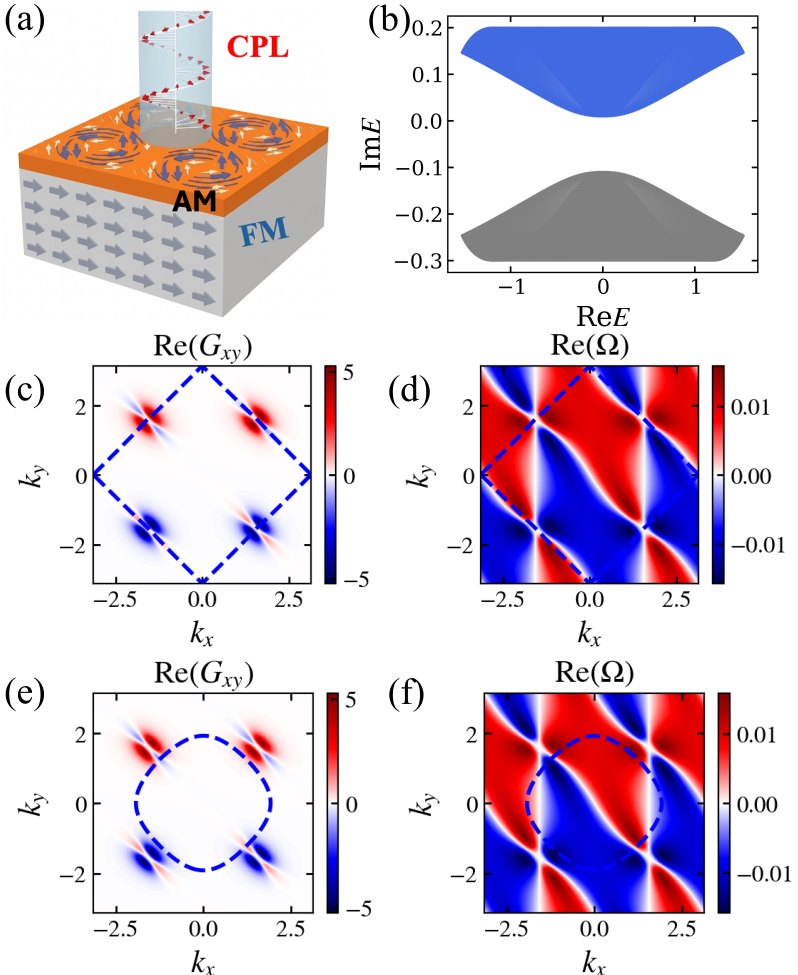
Figure 1: Schematic of the light-driven non-Hermitian altermagnet; the complex energy spectrum displays Floquet line gap formation, and the real part of the quantum metric gxy and Berry curvature Ω at varying chemical potentials elucidate geometric response localization.
Dominance of Quantum Metric in Nonlinear Spin Conductivity
Application of the derived formalism to the Floquet d-wave altermagnet reveals that the nonlinear spin conductivity tensor components (longitudinal and transverse) are overwhelmingly dictated by the quantum metric. Numerical evaluations show that variations in chemical potential μ effectively tune the overlap between Fermi-filled states and momentum-space regions of concentrated quantum metric, modulating both the magnitude and sign of the INSC. Near the nodal regime (μ∼0), polarization (Berry dipole-related) terms become non-negligible, but geometric quantum metric contributions still dominate.
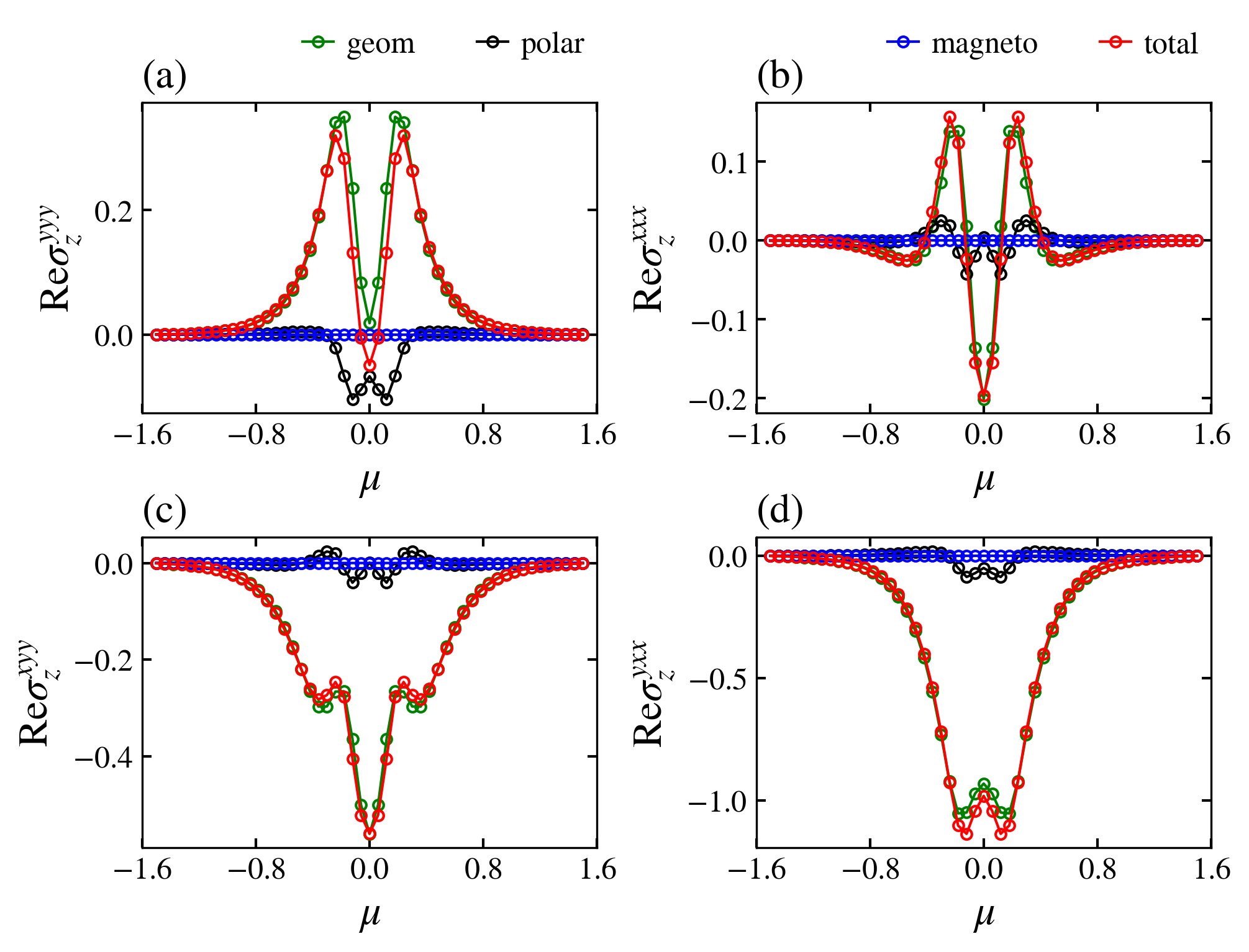
Figure 2: The real part of the nonlinear spin conductivity as a function of μ; geometric (quantum metric), polar (Berry dipole), and magneto (Berry curvature) components are individually resolved, demonstrating overwhelming dominance of the quantum metric except near μ=0.
Optical Polarization Control and Reversibility of Spin Currents
The Floquet-engineered band structure and quantum geometric tensor distribution are highly sensitive to the optical field's polarization, parameterized via the phase delay ϕ in the vector potential. This sensitivity enables active, reversible control over both longitudinal and transverse spin current directions, as confirmed by the strict sign reversal in the corresponding nonlinear conductivity tensor components upon sweeping ϕ. The total response tracks the geometric term exactly (for both gxy0, gxy1, gxy2, gxy3), while Berry curvature contributions are null for select tensor elements.
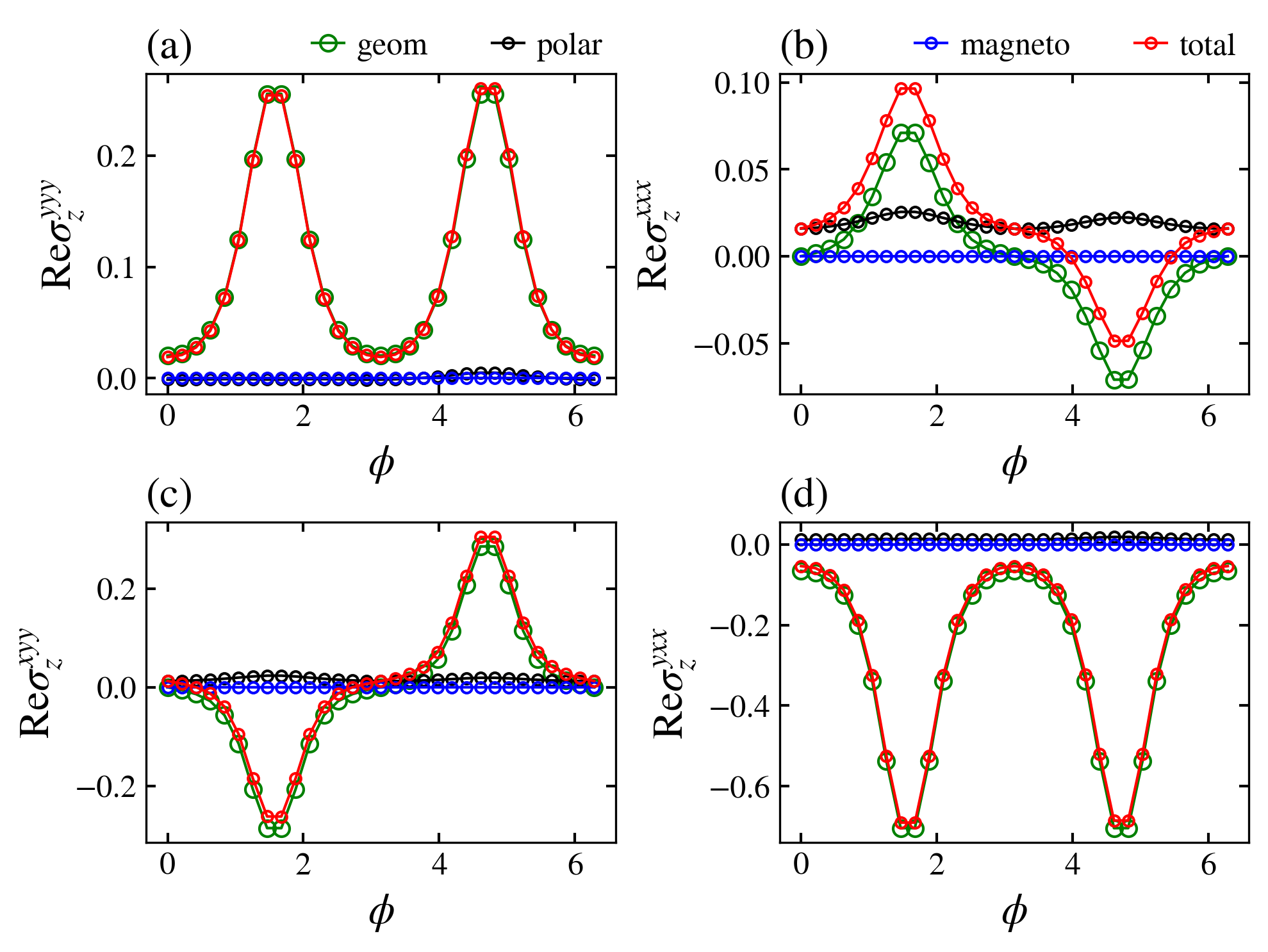
Figure 3: The real part of the nonlinear spin conductivity as a function of optical polarization gxy4; longitudinal and transverse INSCs exhibit perfect geometric tracking and strict sign reversal, confirming polarization-tunability and geometric selectivity.
Physical and Theoretical Implications
The work establishes a geometric paradigm for the design of optically controlled spintronic devices based on altermagnetic heterostructures. Experimentally, the predicted nonlinear spin transport can be realized in platforms such as RuOgxy5/Permalloy driven by femtosecond lasers, and detected via terahertz emission spectroscopy. Theoretical implications include the centrality of the quantum metric in dictating nonlinear spin transport in line-gapped non-Hermitian systems, supplementing the conventional Berry curvature viewpoint. The separation of INSC into distinct geometric, polar, and magneto terms provides a robust foundation for systematic exploration of quantum geometry in strongly driven and dissipative systems.
Future developments may involve leveraging non-Hermitian effects for dynamical control of spin currents, exploring topological transitions mediated by Floquet and geometric engineering, and integrating these mechanisms into ultrafast spin-based logic architectures. The quantum geometric framework could further be extended to yield new optical selection rules, enhancing functional control in magnonics, spin caloritronics, and valleytronics.
Conclusion
This paper introduces a general analytical framework for intrinsic nonlinear spin current response in periodically driven non-Hermitian altermagnets. It demonstrates that the quantum metric is the predominant driver of nonlinear spin conductivity, and that the optical polarization serves as a practical and robust knob for controlling the directionality of spin currents. The results lay a foundation for the geometric manipulation of spin transport in advanced magnetic materials, providing essential insights for future optically controlled quantum spintronic technologies.

