- The paper introduces a correlator-first approach that reveals an intrinsically simpler analytic structure for de Sitter correlators in conformal φ³ theory.
- It employs novel combinatorial dressing rules and time-integral representations to systematically derive recursion relations and energy singularity behavior.
- Integrated computations show a reduced symbol alphabet, highlighting a practical reduction of redundant graph-theoretic features in the analytic structure.
Simplicity in de Sitter Correlators: A Direct Analytic Approach
Motivation and Conceptual Roadmap
The paper rigorously investigates the intrinsic structure and analytic simplicity of equal-time correlators in de Sitter (dS) space for conformally coupled ϕ3 scalar field theory. The conventional approach treats cosmological correlators as secondary objects obtained from the wavefunction of the universe, which is often leveraged for analytic structure due to its compatibility with singularity analysis, flat-space limits, and bootstrap constraints. However, strong evidence is accumulating that correlators display their own simplicity, distinct from the wavefunction, and merit a direct, correlator-first treatment.
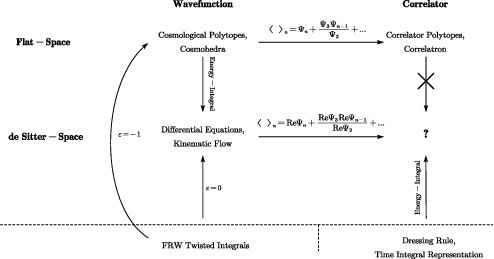
Figure 1: Relations between wavefunctions and correlators in flat space and de Sitter space.
The conceptual framework, as visualized in (Figure 1), delineates the distinction between wavefunction-based and correlator-based organizations, further stratified by the flat-space versus dS context. The paper locates itself in the lower-right quadrant: direct dS correlator organization, leveraging new combinatorial dressing rules and time-integral representations to make analytic structure, recursions, and singularities transparent at the integrand level and after integration.
Direct Representation and Dressing Rules
The paper systematically reviews and inverts momentum-space dressing rules for CC ϕ3 dS correlators, originally developed to relate dS correlators to flat-space Feynman diagrams dressed with auxiliary kernels. These kernels—"dashed" and "dotted" propagators—dictate the analytic structure:
- Dashed propagators correspond to kernels with logarithmic energy dependence, arising from time-dependent interactions.
- Dotted propagators correspond to constant kernels, linked to the real part of three-point wavefunction coefficients.
The prescription organizes the computation as a sum over all allowed dashed/dotted dressings (with parity constraints), integrating over internal and auxiliary energies. By inverting this, the authors develop a direct time-integral representation where correlator graphs are built from correlators with field and conjugate momentum insertions in flat space. White vertices correspond to field insertions, black vertices to conjugate momentum. The integrand structure is universally extendable, efficiently governing pertubative order and graph topology.
Analytic Simplicity and Recursion Structures
The time-integral formalism reveals multiple simplicity properties:
- Parity/Vanishing Sectors: Any graph with an odd number of conjugate momentum (black) vertices vanishes by symmetry, yielding a strict weight drop for odd-point correlators.
- Recursive Structures: Leaf recursions allow for stepwise reduction of tree graphs by integrating out single vertices. Fusion recursions enable gluing and collapsing of subgraphs, providing a rapid route to higher-point trees and loop integrands. Melonic diagrams universally collapse to lower-complexity exchanges via a simple combinatorial formula.
- Energy Singularities: The expansion about total- and partial-energy poles is manifest in the time-integral formalism, with residues reproducing flat-space amplitudes and universal factorization properties. The leading term is analytic; the subleading term vanishes universally for all black/white graphs, including loops.
All recursion relations and simplification operations—in time and momentum space—naturally close in the field/conjugate momentum basis.
Integrated Simplicity: Symbol Alphabets and Polylog Structure
The paper goes beyond the pre-integrand and undertakes explicit computation of integrated correlators for tree and loop graphs. Strong evidence is provided that the symbol alphabet of the correlator is strictly smaller than that of the wavefunction, especially for odd-point trees and polygons.
- Tree-level Even-Point Diagrams: Correspondence between correlator and wavefunction alphabets; no letters lost.
- Odd-Point Trees: Alphabets lose all letters corresponding to tubings (graph-theoretic features) that enclose all marked leaves; formalized as missing letters with graph-theoretic interpretation.
- Loop Integrands (Polygons): Odd- and even-point polygons show more subtle reductions, with missing letters organized by tubings spanning all marked points or partial tubings. The pattern is explicitly enumerated for triangles, boxes, and higher polygons, demonstrating that the correlator projection systematically restricts the symbol alphabet.
This reduction is nontrivial and not a post-cancellation artifact; the missing symbol letters admit a universal interpretation rooted in the combinatorics of leaf vertices, gray (dotted) sectors, and partial tubing data.
Theoretical and Practical Implications
The correlator-first approach sharply revises the analytic treatment of cosmological field theories:
- Structural Economy: The analytic structure—recursions, singularities, and symbol alphabets—are simpler and more economic than the corresponding wavefunction data. This basis is closed under the relevant graph operations necessary for recursion, fusion, and expansion.
- Integration-Level Simplicity: After energy integrations, the reduction in symbol letters persists and gains new geometric interpretation; the correlator naturally removes redundant tubings, reflecting its status as a more physical observable.
- Generality: The approach is robust, extendable to arbitrary topology, loops, and potentially spinning theories. The direct representation offers new avenues in positive geometry, algebraic simplification, and cluster algebra structure for cosmological correlators.
- Renormalization and Unitarity: Loop integrals, while simple at the integrand level, inherit regularization subtleties upon integration. The new representation may lead to renormalization schemes respecting correlator simplicity and new approaches to cosmological bootstrap.
Outlook and Future Directions
Several avenues for further development emerge:
- Formalization of the Symbol Alphabet Reduction: Developing a general rule or geometric understanding of which tubings/letters survive the correlator projection and how they assemble into a positive-geometric correlator description.
- Extension to Spinning Fields and Other Interactions: Generalizing the direct representation to higher spins, massive fields, and broader cosmological observables.
- Integration with Canonical Differential Equations and Cluster Structures: Exploring correlator-first bases in canonical differential equations, cluster adjacency, and cosmohedra, relating geometric correlator data to symbol alphabet and analytic structure.
- Renormalization, Unitarity, and Full Loop Control: Addressing regulator artifacts, UV-divergence, and unitarity constraints in the direct correlator representation, and developing renormalization prescriptions that preserve analytic simplicity.
Conclusion
This paper systematically demonstrates that equal-time de Sitter correlators, particularly in conformally coupled ϕ3 theory, admit an intrinsically simpler, direct analytic structure than is apparent from the wavefunction viewpoint. The time-integral representation, built from field and conjugate momentum correlators in flat space, closes all relevant operations and recursions. Integrated correlator symbols are universally simpler, with missing letters precisely determined by graph-theoretic features such as leaves and partial tubings. This structural economy is both practical and theoretical, potentially reshaping the analytic toolkit for cosmological QFT and revealing correlators as primary analytic objects with their own combinatorial and geometric language (2604.26421).

