- The paper introduces a universal differential equation system for massive correlators in de Sitter space by mapping Feynman integrals to twisted Euler-type integrals.
- It develops a combinatorial framework called 'kinematic flow' that encodes singularity evolution via graphical tubings, streamlining analytic computations.
- The study unifies light and heavy mass regimes, revealing polylogarithmic behavior and effective field theory structures crucial for analyzing cosmological correlators.
Differential Equations for Massive Correlators: Combinatorics and Analytic Structures in de Sitter Space
Introduction and Context
The computation of wavefunction coefficients for scalar fields of arbitrary mass in de Sitter space is a central challenge for analytic cosmological perturbation theory, particularly due to the time dependence of spacetime and particle interactions. These coefficients, which underpin the evaluation of cosmological correlators, are generally expressed in terms of Feynman integrals involving products of mode functions that reduce to Hankel functions for massive fields. This complexity renders direct calculation prohibitive except in special cases.
The paper presents a unifying combinatorial and analytic framework that recasts these integrals as twisted Euler-type integrals of rational functions, with the twist determined by the mass parameter. The core results show that all such integrals, for arbitrary graphs and mass assignments, can be described as members of a finite basis of master integrals satisfying a universal matrix-valued system of first-order differential equations. The system possesses an intrinsic graphical/combinatorial interpretation—termed “kinematic flow”—that naturally encodes the evolution and coupling of basis elements and singularities within a graphical tubing formalism.
Twisted Integral Representation and Master Basis
The rationalization of the massive mode function integrals proceeds via a contour integral representation of the Hankel functions, enabling the Feynman integrals to be expressed as
ψ=∫a∏xaxaξb∏tb(tb2−1)−ν−1/2Ψuniv(Xa+xa,tbY)
where Ψuniv is a universal rational function corresponding to a stripped Feynman graph, independent of the specific external state configuration. The twist parameters encode the deviation from the conformally coupled case. Singularities in this representation correspond to oriented hyperplane arrangements in the auxiliary variable space, as visualized in the x1–x2 and tL–tR planes:
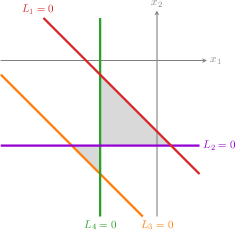
Figure 1: Visualization of the hyperplane arrangement defined by the singularities of the massive two-site integral in the x1-x2 plane.
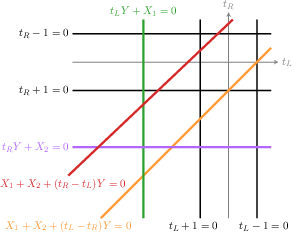
Figure 2: Visualization of the hyperplane arrangement defined by the singular lines of the massive two-site integral in the tL-tR plane; twist factors introduce additional singular lines at Ψuniv0 and Ψuniv1.
The set of twisted integrals generated in this representation forms a finite-dimensional vector space, yielding a systematic set of master integrals which can be chosen, for instance, by shifting twist exponents on specific factors. These satisfy a first-order Pfaffian system:
Ψuniv2
where the connection matrix Ψuniv3 is constructed entirely from the underlying singularity structure (the “letters”) and the combinatorics of the Feynman graph.
While the geometric–twisted approach secures the existence of first-order equations, explicit construction is most transparent in the time-integral language. There, a key technical advance is to decompose the mode functions into linear combinations of Ψuniv4, themselves combinations of Hankel functions and their derivatives, each of which obeys a first-order ODE. The basis of master integrals is thus dramatically extended: every internal (external) line doubles (quadruples) the number of basis elements. The advantage is closure of the system at first order, with all integration-by-parts and shift relations encoded.
A single-massive-exchange example is paradigmatic: four distinct basis functions (corresponding to different sign assignments on internal lines) and contact collapse contributions serve to span the relevant function space. The differential equations are of the form
Ψuniv5
The additional source terms arise from combinatorial sign flips (shrinking/growing tubes) and contact term collapses in the diagram.
Kinematic Flow and Graph Tubings
The structure of the first-order connection is encoded entirely in graphical/combinatorial “tubings” on a marked or truncated version of the Feynman diagram. Each basis function corresponds to a unique tubing, and letters (singularities) are in bijection with activated tubes.
The evolution of the system under differentiation follows three universal rules:
- Activation: Each tube can be “activated" by Ψuniv6(letter) with weight given by the sum of exponents at enclosed vertices.
- Merger (Collapse): Adjacent tubes can merge to form a larger tube, encoding propagation of singularities under collapse (integration-by-parts).
- Mixing (Growth/Shrinkage): Tubes pierced by massive lines can grow/shrink, corresponding to sign mutations in the basis and introducing source functions with modified twists.
These rules generalize straightforwardly to multiple vertices, arbitrary graphs, and loop integrands, with no added structural complication compared to tree-level cases.
Results in Mass Limits and Polylogarithmic Structure
The formalism both unifies and vastly simplifies parametric expansions, as demonstrated for the four-point function with a single massive internal line:
- Light mass expansion (Ψuniv7): The leading term is polylogarithmic, with explicit realization in terms of classical dilogarithms. Subleading terms are higher-weight polylogarithms, whose symbols are directly related to the pattern of letters governing the system. The cancellation of unphysical (folded) singularities and the matching to conformal Ward identities is manifest via the structure of the connection matrix.
- Heavy mass expansion (Ψuniv8): The differential system collapses to a recurrence, implementing the effective field theory expansion. The series is formally asymptotic and summable to an inverse differential operator, providing a closed-form resummation of the EFT corrections.
Boundary conditions (e.g. regularity at kinematic thresholds and vanishing on the null cone) are efficiently implemented via the combinatorics of the tubing formalism, making the extraction of physical solutions transparent.
Implications and Perspectives
The identification of a combinatorial and geometric structure behind all differential equations for massive correlators in de Sitter space has both practical and conceptual implications:
- Algorithmic evaluation: The method provides an efficient and generalizable algorithm to generate matrix-valued differential equations for arbitrary graphs and mass assignments, unifying tree and loop computations under a common formalism. This greatly reduces the technical obstruction for analytic computation in cosmological collider and bootstrap contexts.
- Symbolic and transcendental structure: By reducing solutions to polylogarithmic space and making the symbol/algebraic structure manifest, the approach enables the systematic study and classification of the analytic structure (e.g. location of singularities, transcendental weight) of cosmological correlators—crucial for matching to conformal bootstrap and geometry (e.g. cosmological polytopes [Arkani-Hamed:2017fdk, Benincasa:2024leu]).
- Uniformization of mass dependence: All masses appear only in twist factors and associated combinatorics, with no essential difference between conformally coupled and generic mass cases. This enables uniform treatment across phenomenologically relevant scenarios (e.g. quasisingl—field inflation, signals of heavy new physics).
Possible future directions include: (1) extension to spinning propagators, (2) further geometric interpretation in terms of “massive cosmological polytopes,” (3) exploration of non-perturbative mass corrections (e.g. cosmological particle production, resurgence structure), and (4) systematic application to bootstrap equations for inflationary correlators.
Conclusion
This work reveals that Feynman integrals for massive correlators in de Sitter, despite their initial analytic intractability, are governed by a surprisingly tractable combinatorial framework. The reduction to finite-dimensional twisted cohomology with a universal first-order connection, explicit graphical rules (“kinematic flow”), and the encoding of all analytic complexity into combinatorial data, places the problem in a form that is both formally rigorous and practically potent. This shared structure with the conformally coupled case and its geometric manifestation suggests that even in the presence of intricate analytic structure, cosmological correlators in de Sitter share a universality governed by positive geometry and hyperplane arrangements.
Figure 1: Visualization of the hyperplane arrangement defined by the singularities of the massive two-site integral in the Ψuniv9-x10 plane.
Figure 2: Visualization of the hyperplane arrangement defined by the singular lines of the massive two-site integral in the x11-x12 plane; twist factors introduce additional singular lines at x13 and x14.

