- The paper demonstrates that Hilbert space fragmentation results in an exponential number of disconnected Krylov sectors, where emergent local gauge symmetries arise despite the full Hamiltonian lacking gauge invariance.
- The study employs the S=1 dipole conserving spin chain as a concrete example to reveal non-thermal dynamics and persistent oscillations within fragmented sectors.
- The findings suggest that by targeting specific Krylov sectors, researchers can engineer effective gauge-invariant dynamics, offering new strategies for quantum simulation of gauge theories and probing ergodicity breaking.
Hilbert Space Fragmentation and Emergent Gauge Symmetry
Introduction
This paper addresses the interplay between Hilbert space fragmentation and gauge symmetry in quantum many-body systems, particularly in the context of lattice models relevant for quantum simulation of gauge theories. The authors offer a rigorous investigation of how fragmentation can yield an exponential proliferation of dynamically disconnected sectors, and critically, demonstrate that emergent gauge symmetries can arise within a subset of those sectors—even when the Hamiltonian itself lacks gauge invariance. This work situates Hilbert space fragmentation as a key mechanism for both ergodicity breaking and for realizing gauge theories on quantum simulators, revealing new theoretical structures underpinning quantum non-ergodic dynamics.
Hilbert Space Fragmentation: Mechanisms and Scenarios
Hilbert space fragmentation occurs when the Hamiltonian's dynamics restrict the time evolution of initial product states to exponentially small subspaces, known as Krylov sectors. Strong fragmentation is realized when the largest sector's dimension grows subextensively with system size, and this phenomenon cannot be attributed to canonical symmetries alone, which typically produce only polynomially many symmetry sectors. Instead, fragmentation relies on more intricate constraints, such as those enforced by generalized or non-invertible symmetries. The authors systematically categorize these fragmentation mechanisms and relate them to emergent conservation laws and non-invertible symmetry operators.
Key claim: Fragmentation may be underpinned by emergent partial isometries, representing non-invertible symmetries only realized on restricted subspaces. This goes beyond global symmetry groups, connecting to projective or higher-form symmetry structures, and is argued to be a likely explanation for many unexplained fragmentation phenomena in the literature (2604.15820).
The S=1 Dipole Conserving Spin Chain: Concrete Realization
The S=1 dipole conserving spin chain is analyzed as a paradigmatic example. Its Hamiltonian
H=n∑Sn+(Sn+1−)2Sn+2++h.c.
exhibits extensive fragmentation, as evidenced by the confinement of dynamics to small Krylov sectors and the persistence of non-thermal, non-translation-invariant oscillations for specific initial product states.
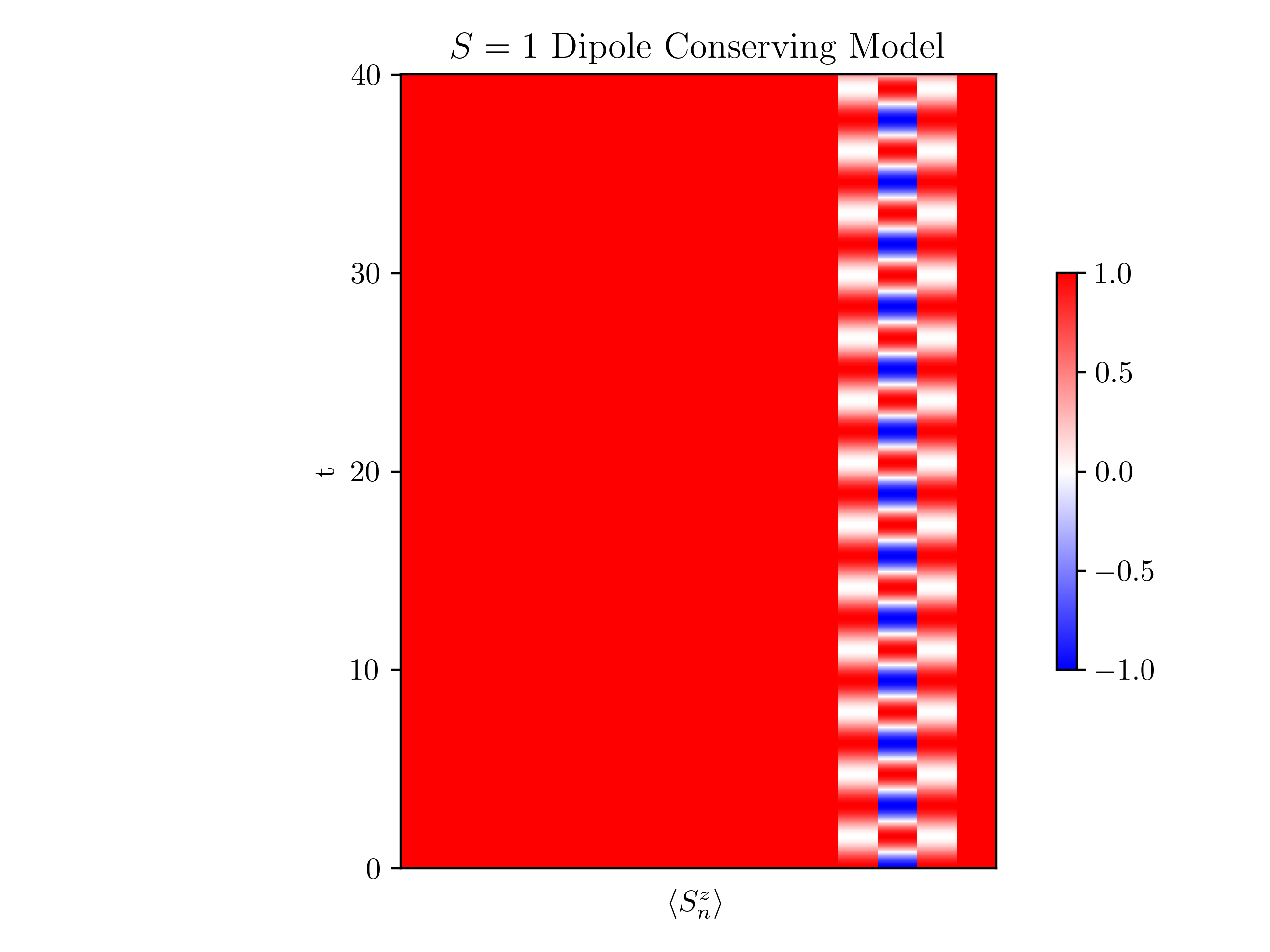
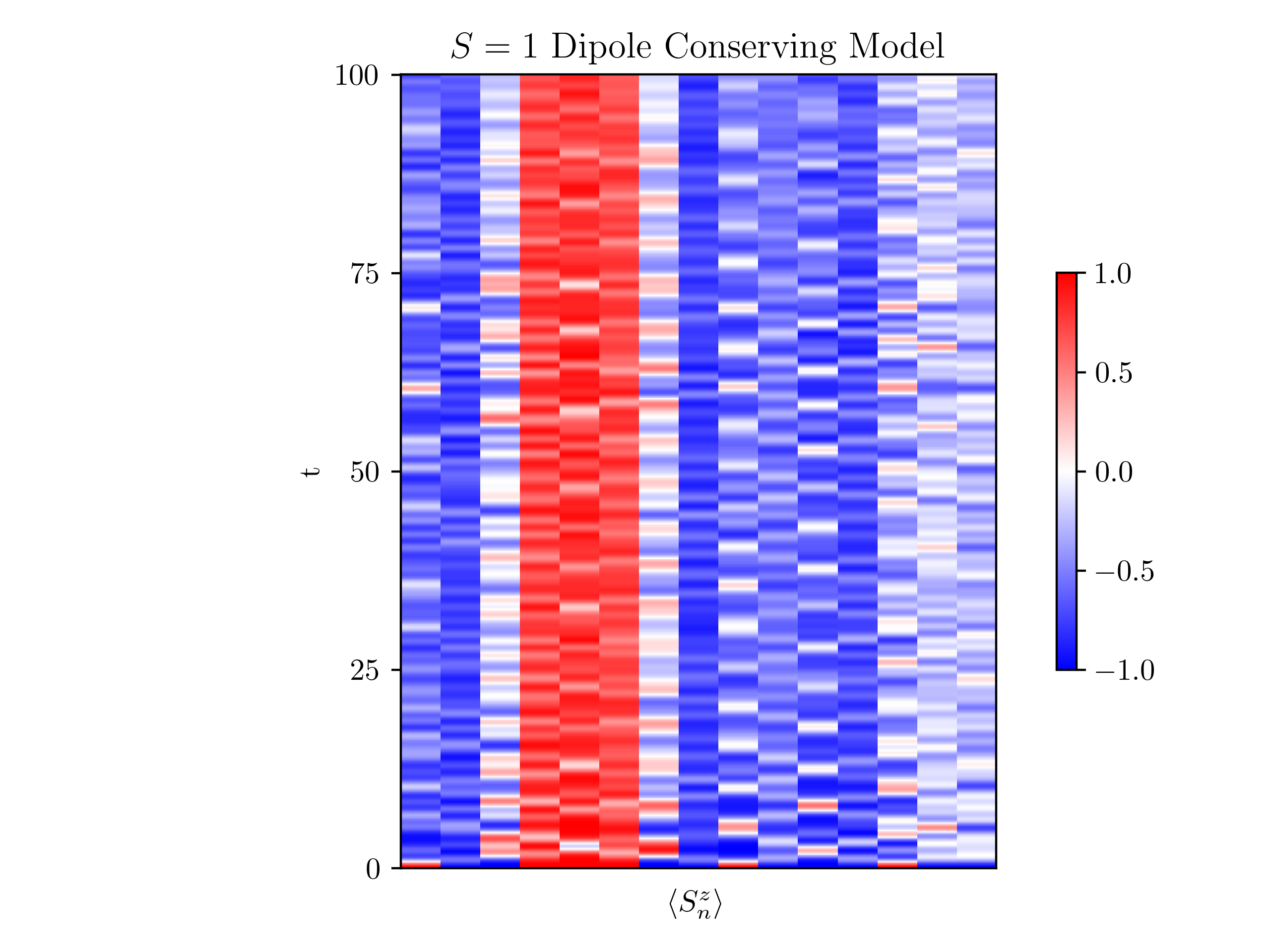
Figure 1: The real-time dynamics of two product initial states. The Krylov sectors are very small, such that significant oscillations persist even after a long time. Additionally, the system is not evolving into a translation-invariant ensemble, even though the Hamiltonian is translation invariant.
The model includes global conservation of magnetization and dipole moment; however, these are insufficient to uniquely label the exponential number of fragments. The Hamiltonian's structure achieves a block-diagonal form with many small blocks, labeled in part by nonlocal conserved quantities but not fully accounted for by standard symmetry algebra.

Figure 2: Left: A sketch of the structure of the S=1/2 dipole conserving spin chain Hamiltonian in the product basis. The blue squares represent the global symmetry sectors. These sectors are split into many more fragments represented in black. Some sectors conserve the identified quantities eq.~(3).
Emergent Local Gauge Symmetries in Specific Fragments
A central technical advance of the paper is the identification of local operators—Gn=∣0⟩⟨0∣n and G~n=Snz+2Sn+1z+Sn+2z—which, although not symmetries of the full Hamiltonian, are strictly conserved within certain large families of Krylov sectors. In these sectors, the Hamiltonian reduces to an effective form that commutes with these operators, realizing a local U(1) gauge symmetry on the restricted Hilbert space.
The emergent symmetry here is non-invertible in the sense that it is only realized when projected onto sectors defined by the spectrum of these local quantities. The associated partial isometries commute with the Hamiltonian in these sectors, and thus the dynamics can simulate gauge theories despite the full system not being gauge-invariant. This approach complements recent discussions on non-invertible and higher-form symmetries in quantum many-body systems (Bartsch et al., 6 Feb 2026, Ortiz et al., 29 Sep 2025).
The analysis also establishes that while these emergent local quantities account for an exponential subset of fragments, a full classification likely requires additional structure, possibly associated with higher-locality constraints or more intricate projectors.
Implications for Quantum Simulation of Gauge Theories
A significant implication of this work is the realization that quantum simulations of gauge theories need not require a gauge-invariant Hamiltonian on the full Hilbert space. Instead, if the initial state is prepared within a Krylov sector where the appropriate local gauge symmetry is realized, exact quantum simulation of the target gauge theory can be performed.
The paper extends this idea to show that several widely studied lattice gauge models, such as quantum link models and the PXP model, are natural instances where fragmentation leads to robust gauge sectors suitable for quantum simulation [Surace_2020, Banerjee2012]. As a corollary, Hilbert space fragmentation provides a novel Hamiltonian engineering strategy: by identifying fragmented models with desired sectoral symmetries, one can simulate a variety of gauge theory dynamics, including dynamics of physical and non-physical sectors. This approach has potential for high-fidelity digital quantum simulation platforms and for exploring ergodicity breaking in gauge theories.
Broader Theoretical and Practical Impacts
The connection between fragmentation and emergent gauge symmetry prompts several theoretical questions:
- Classification: Is there a universal scheme to enumerate all possible emergent gauge sectors in strongly fragmented systems, possibly extending the operator-algebraic approach of commutant algebras [Moudgalya_2022]?
- Thermalization Breakdown: Fragmentation induces robust violations of ergodicity, leading to localization and nonthermal dynamics even in disorder-free models [Sala_2020, Jeyaretnam_2025].
- Non-invertible Symmetries: This work strengthens the paradigm that Hilbert space fragmentation is tightly linked to non-invertible symmetry operators, offering new directions for their characterization and classification [Seiberg:2024gek].
On the practical side, these results inform the design of quantum devices for simulating gauge theories—by selectively initializing states in specific fragmented sectors, experimentalists can realize effective gauge invariance and explore the real-time dynamics of lattice gauge theories, including phenomena otherwise inaccessible in translation-invariant or non-fragmented systems.
Conclusion
This paper demonstrates that Hilbert space fragmentation can induce emergent, sector-local gauge symmetries in quantum many-body spin chains. These emergent symmetries arise via non-invertible, local conservation laws that are not symmetries of the full model, but become exact within particular sectors. Consequently, quantum simulation of gauge theories does not necessitate global gauge invariance; targeting appropriate fragmented sectors suffices. The paper also identifies open problems regarding the complete labeling of fragments and the full scope of emergent symmetry mechanisms. This provides a robust framework for both theoretical analysis of ergodicity breaking and the engineering of gauge-invariant dynamics on quantum simulators, positioning Hilbert space fragmentation as a central concept at the intersection of statistical mechanics and lattice gauge theory.

