- The paper introduces a Floquet-engineering protocol that creates emergent hierarchical symmetries, ensuring robust quantum simulation of lattice gauge theories.
- It maps defect dynamics to a quantum marble model, revealing precise sector-dependent kinetic constraints and suppression of defect mobility.
- Simulations validate that sector-specific protection scales with drive frequency, offering potential for error-corrected quantum simulations in high-energy physics.
Engineered Emergent Hierarchical Symmetries for Robust Quantum Simulation of Lattice Gauge Theories
Motivation and Framework
This work introduces a Floquet-engineering framework to protect quantum simulations of many-body lattice gauge theories (LGTs) with constrained Hilbert spaces, specifically focusing on abelian U(1) LGT implementations. Realistic quantum simulators typically experience unavoidable violations of local gauge constraints due to imperfect multi-body gate realizations and symmetry-breaking perturbations. These violations couple otherwise disjoint gauge sectors, destabilizing the target dynamics and undermining the fidelity of quantum simulation. The authors address this challenge by proposing a symmetry-controlled dynamical protection scheme that restructures symmetry-breaking perturbations so as to induce a hierarchy of emergent local symmetries, each prevailing for parametrically long times. This yields sector-dependent robustness through a set of approximate dynamical selection rules, effectively acting as passive error correction.
Symmetry Hierarchies and Dynamical Selection Rules
The Floquet protocol dynamically establishes a hierarchical symmetry structure,
U(1)local→Z2local×U(1)global→E,
where E denotes the trivial group. The emergent Z2local×U(1)global symmetry leads to suppression of both defect creation and their transport between sectors. These dynamical selection rules are independent of microscopic model details and induce pronounced kinetic constraints. The local charges gj (eigenvalues of the gauge generator) are partitioned such that, depending on the sector and perturbation structure, defects can be entirely frozen or become mobile only via intra-sector dynamics involving auxiliary excitations ("kinks"). Sector robustness is thus not uniform, but exhibits a symmetry-controlled hierarchy.
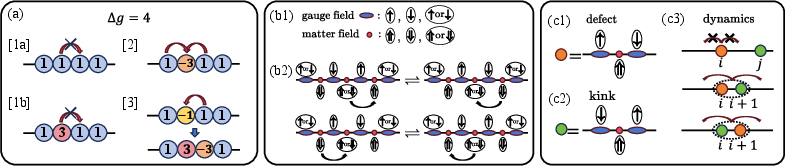
Figure 1: Defect configurations and their constrained dynamics, highlighting the Z2local symmetry-induced stability and the role of Floquet engineering in suppressing undesirable processes.
Floquet Engineering and Quantum Marble Model
Under the Floquet protocol consisting of single-bond pulses and tailored periods, the effective Hamiltonian admits an expansion where higher-order terms break residual symmetries only weakly. At leading order, the defect dynamics are rigorously described by an effective few-body quantum marble model (QMM). In this mapping, defects are mobile only when colliding with kinks, with QMM revealing exponential Hilbert space reduction and direct microscopic insight into kinetic constraints and sector-dependent stability. The QMM applies broadly, including multi-defect scenarios, and enables accurate large-scale numerical simulation.
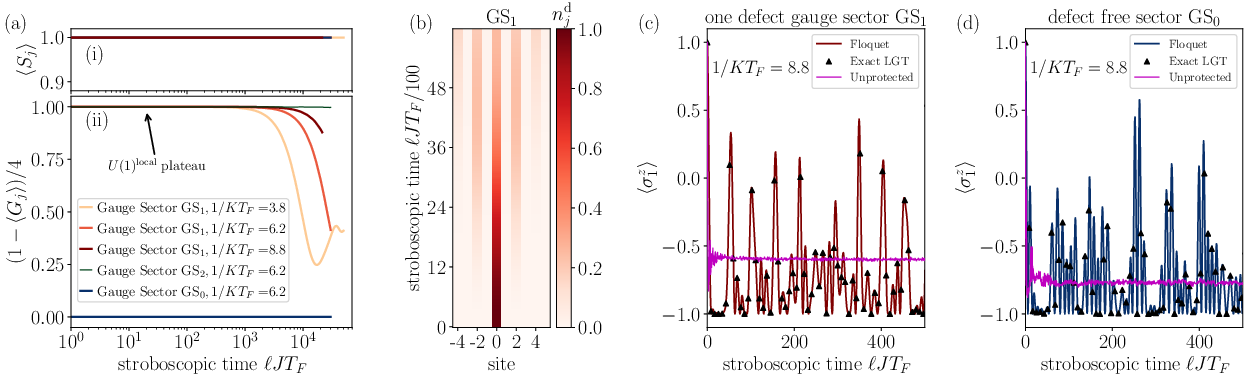
Figure 2: Dynamics of the charge and defect density for various initial sectors, illustrating enhanced stability and tunable prethermal plateaus achieved via the Floquet protocol.
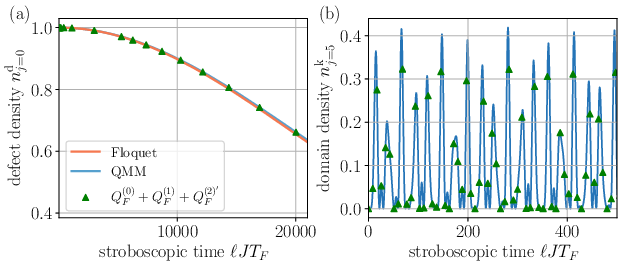
Figure 3: Comparison of QMM and full lattice gauge dynamics, showing agreement in defect and kink evolution within extended time windows.
Numerical Results: Sector-Dependent Robustness
Extensive simulations validate the dynamical protection scheme. For defect-free sectors, Z2local-preserving perturbations leave the dynamics virtually undisturbed. In sectors harboring defects, the Floquet engineering controls the defect spreading rate via drive frequency; the prethermal plateau lifetime scales inversely as the square of the period (τ∼TF−2). Numerical agreement with perturbative scaling confirms both the microscopic QMM description and sector-dependent suppression of symmetry violation.
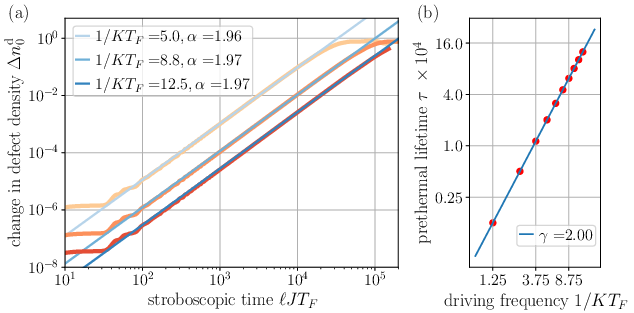
Figure 4: Scaling of defect density dynamics and prethermal lifetime versus drive frequency in QMM, showing the algebraic dependence and sector-selective protection.
Strong numerical results highlight sharp contrasts in symmetry violation rates between sectors, with some exhibiting order-of-magnitude longer prethermal plateaus.
Degeneracy Structure and Perturbative Analysis
The authors demonstrate that defect spreading is tightly bound to the spectral degeneracy of the effective Hamiltonian. Degenerate perturbation theory reveals that when accidental degeneracy is lifted (as in multi-defect or large-system scenarios), inter-sector coupling is further suppressed. Defect motion is exponentially rare unless resonance conditions are met, bolstering robustness in complex sectors.
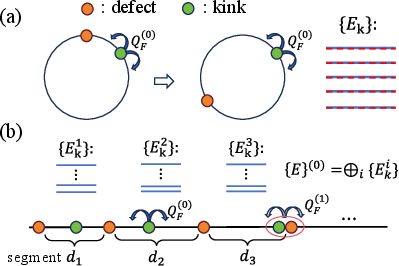
Figure 5: Schematic showing how defects and kinks partition the system and determine the degeneracy structure, impacting defect mobility and lifetime scaling.
Generalization and Implications
The protection mechanism is robust to general symmetry-breaking perturbations, and explicit protocol modifications accommodate higher-order effects. The framework generalizes naturally to higher spins, higher-dimensional models, and non-Abelian SU(N) LGTs. Theoretical implications span:
- Emergent kinetically constrained dynamics for composite degrees of freedom.
- Sector-dependent transport properties, potentially accessible via semiclassical and tensor network simulations in larger systems.
- Substantially improved simulation fidelity for physical sectors relevant to high-energy physics (e.g., Gauss's law-abiding states).
- Insights into disorder-free localization, ergodicity breaking, and sector-selective restoration.
- Applicability to quantum error correction schemes leveraging passive dynamical protection via hierarchical symmetry engineering.
Future developments may explore more elaborate symmetry hierarchies, non-Abelian scenario selection rules, hydrodynamic limits, and extended prethermal regimes.
Conclusion
The proposed Floquet-engineered hierarchical symmetry protection of lattice gauge theory simulations establishes a symmetry-controlled sector hierarchy, yielding robust and tunable dynamical stability against unavoidable symmetry-violating perturbations. The quantum marble model provides a rigorous, scalable microscopic theory of sector-dependent kinetic constraints. Theoretical and practical implications extend widely across quantum simulation, condensed matter, and quantum information, setting the stage for systematic studies of emergent constrained dynamics and sector-selective quantum error correction.

