- The paper extends the quantum regression theorem by incorporating inhomogeneous corrections to address system–bath correlations and non-equilibrium initial states.
- It employs a variational polaron transformation that mitigates infrared divergences, enabling accurate modeling of ohmic, super-ohmic, and sub-ohmic regimes.
- Benchmarking against tensor-network simulations validates the method’s quantitative accuracy for population dynamics, coherences, and linear-response spectra.
Beyond the Quantum Regression Theorem in Variational Polaron Master Equations with Low-Dimensional Baths
Introduction and Context
The paper "Beyond the Quantum Regression Theorem in Variational Polaron Master Equations with Low-Dimensional Baths" (2604.13541) presents a rigorous extension of the quantum regression theorem (QRT) for variational polaron master equations, targeting open quantum systems with low-dimensional (especially 1D and 2D) environments. The standard QRT presumes system–bath separability and a bath in equilibrium, assumptions invalidated in the presence of strong dynamical correlations and non-equilibrium initial states. Employing time-convolutionless projection operator methodology, the authors derive a non-Markovian master equation with inhomogeneous (correlation-induced) terms, systematically quantifying their impact via comparison with tensor-network simulations. The primary model is the spin–boson system with spectral densities parameterized by exponent s, encompassing ohmic, super-ohmic, and sub-ohmic regimes relevant for quantum emitters in reduced dimensionalities.
Conventional QRT assumes system–environment separability, yielding inaccurate predictions in strong-coupling/non-Markovian settings. The authors show that initial system–environment entanglement or non-equilibrium (illustrated in panel b of (Figure 1)) generates a nontrivial irrelevant component Qχ(t0) in the density matrix, requiring inhomogeneous correction terms in both one- and two-time observables.
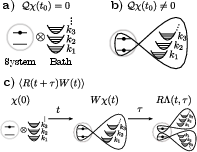
Figure 1: Illustration of system–bath separability, correlated initial conditions, and accumulation of dynamical correlations neglected by standard QRT.
The new master equation incorporates a memory kernel and inhomogeneous term, both nonlocal in time and explicitly dependent on the initial bath correlations. Importantly, even when the initial state is thermal, variational polaron transforms induce implicit bath displacement, encoding correlations at t0. As a result, the projected evolution and the calculation of multi-time correlators must include both P and Q contributions.
For the spin–boson Hamiltonian with J(ω)∝ωs, the standard polaron transformation, valid at weak coupling or s>2, fails for s≤2 due to infrared divergences in the Franck–Condon factor. The variational polaron transformation, parameterized by frequency-dependent displacement fk, circumvents this by excluding slow modes from the transformation, yielding a numerically tractable and physically meaningful basis for strong-coupling regimes.
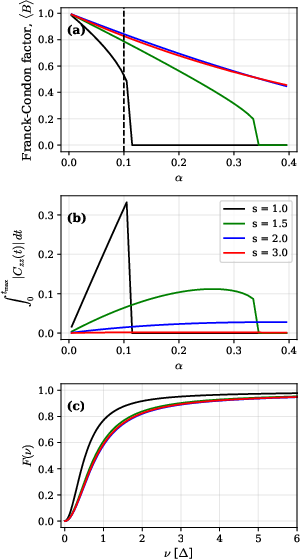
Figure 2: Franck–Condon factor ⟨B⟩ as a function of coupling Qχ(t0)0 for different Qχ(t0)1, showing localization transitions for ohmic and near-ohmic baths; panel (c) illustrates that only high-frequency modes are strongly displaced.
The analysis reveals sharp localization transitions (Qχ(t0)2) for Qχ(t0)3 (ohmic) and Qχ(t0)4 at critical coupling, alongside substantial contributions from untransformed slow modes in Qχ(t0)5. Importantly, variational theory accurately models the system for Qχ(t0)6 and moderate Qχ(t0)7, while the standard theory fails.
Benchmarking: Dynamics and Steady-State Observables
The authors meticulously benchmark the variational master equation and its corrections against tensor-network simulations, focusing on single-time populations and coherences.
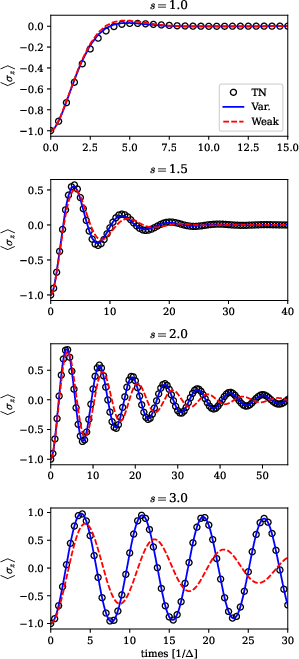
Figure 3: Population dynamics Qχ(t0)8 for various Qχ(t0)9, showing quantitative agreement between variational theory and tensor networks except for weak-coupling regimes, where the standard master equation suffices.
Populations (t00) require no correction as they commute with the polaron transformation, yielding robust agreement across regimes. However, coherences (t01) are highly sensitive to both initial bath state and environmental dressing corrections.
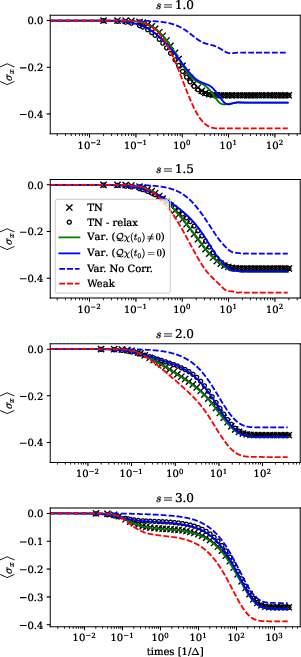
Figure 4: Coherence dynamics t02 for different t03, demonstrating the necessity of environmental dressing and inhomogeneous corrections for agreement with exact dynamics, especially in super-ohmic and intermediate regimes.
When inhomogeneous terms are included, the variational theory accurately reflects the exact tensor-network results for both uncoupled and displaced initial baths. Omitting such corrections—standard practice in the literature—results in incorrect short-time loss of coherence and steady-state values, particularly for t04. For strictly ohmic baths at strong coupling, both variational and tensor-network predictions diverge, attributed to breakdown of the second-order expansion for the untransformed slow modes; reducing t05 restores agreement.
Multi-Time Observables: Linear Response and Spectra
Calculation of the linear-response spectrum t06 relies on the extended QRT, propagating the post-excitation operator on the correlated steady-state. Standard factorized calculations (Eq.~\eqref{eq:seperating}) omit critical dynamical corrections. The variational formalism implemented herein requires explicit inclusion of both relevant and irrelevant terms, including three- and four-time bath correlations.
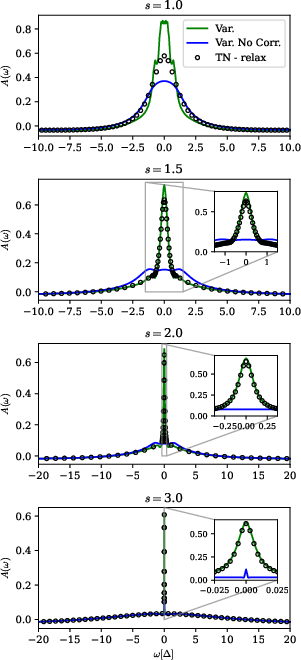
Figure 5: Linear response spectrum t07 for multiple t08, with variational theory (including corrections) accurately reproducing both central peak and phonon sidebands from exact tensor networks; standard (uncorrected) approaches fail.
Quantitative agreement is achieved for super-ohmic and moderately coupled ohmic environments when all corrections are included, strengthening confidence in the variational approach and its extension to two-time observables. Omitting dynamical corrections—typical in prior applications—results in erroneous spectral features and incorrect central peak amplitudes.
Implications, Limitations, and Outlook
This study fundamentally advances polaron-based master equation methodologies for low-dimensional quantum environments, enabling full inclusion of non-equilibrium bath states and system–environment correlations. The rigorous benchmarking against tensor-network calculations confirms the necessity and validity of the extended QRT framework.
Key mathematical and numerical findings include:
- Demonstration that environmental-dressing corrections and inhomogeneous terms are strictly required for quantitative accuracy in coherence and spectrum predictions except in weak-coupling/Markovian limits.
- Identification of critical localization transitions and the limitations of variational theory for slow-mode-dominated baths at high coupling, delineating parameter regimes for perturbative validity.
- Ability to treat realistic scenarios such as quantum dots in nanophotonic wires, emitters in 2D materials, and excitons in carbon nanotubes, where dimensionality controls spectral density and correlation dynamics.
The methodological framework can be applied beyond the spin–boson model, including reaction-coordinate master equations, photosynthetic complexes, and phonon-dressed quantum optics scenarios. Extension to arbitrary delay times and higher-order photon correlations is feasible, as outlined in the appendices.
Conclusion
The paper derives and implements a systematic extension of the quantum regression theorem within the variational polaron master equation formalism, rigorously including non-equilibrium bath states and correlation-induced inhomogeneous dynamics. Benchmarking against numerically exact tensor-network calculations validates the approach, particularly for population dynamics, coherences, and linear-response spectra in physically relevant low-dimensional environments. The results delineate parameter regimes where variational theory succeeds or fails, provide clear physical understanding of environmental dressing, and set a foundation for future explorations of non-Markovian multi-time correlations and quantum phase transitions in open systems.