- The paper introduces a novel PT-CCQME that accurately simulates open quantum systems in strong and intermediate coupling regimes.
- It combines a non-perturbative polaron transformation with a canonically consistent master equation to ensure fourth-order expansion and thermodynamic accuracy.
- The method preserves positivity and reproduces correct dynamics and thermalization across various coupling and temperature regimes, validated against numerically exact benchmarks.
Introduction
The challenge of accurately simulating open quantum system (OQS) dynamics in the strong system-bath coupling regime persists as a central problem in quantum statistical mechanics and quantum information science. Standard approaches such as Redfield or Lindblad-type master equations rely fundamentally on the Born-Markov and weak-coupling approximations, rendering them inadequate for many physically relevant systems that exhibit pronounced non-Markovian effects and memory-dependent evolution. The present paper introduces the Polaron-Transformed Canonically Consistent Quantum Master Equation (PT-CCQME) (2604.02731), which strategically integrates the polaron transformation and the recently developed Canonically Consistent Quantum Master Equation (CCQME) framework. This construction effectively extends the regime of applicability to systems with strong or intermediate system-bath coupling, while ensuring thermodynamical and mathematical consistency up to fourth-order in the residual coupling.
Theoretical Framework
The PT-CCQME is derived by first applying the polaron transformation to the total Hamiltonian, dressing the system with bath modes in a non-perturbative, system-independent manner. In the polaron frame, the system-bath interaction is strongly renormalized and the effective Hamiltonian decomposes into a renormalized system Hamiltonian, a free bath, and a residual (and typically much weaker) interaction. Crucially, the form of this residual interaction remains amenable to perturbative treatments, and for the models considered is always quadratic or higher order in the original coupling.
The CCQME is then formulated within this transformed frame. In contrast to Redfield or Lindblad equations, the CCQME is anchored on the steady-state mean-force Gibbs (MFG) state of the Hamiltonian of mean force, extending to fourth-order in the system-bath interaction and guaranteeing correct relaxation behavior, even in the deep strong-coupling regime. The PT-CCQME thus inherits both the non-perturbative power of the polaron transformation and the thermodynamic consistency of the CCQME.
The final equation takes a time-local Redfield form, augmented with statistical corrections extracted from the equilibrium MFG state. This approach regularizes the divergences that plague higher-order expansions by bypassing secular divergence through equilibrium statistical corrections, thus ensuring stable propagation.
Benchmarking and Positivity Preservation
The PT-CCQME is systematically benchmarked on the paradigmatic spin-boson model, a two-level system coupled to a bosonic environment via linear position coordinate coupling. The super-Ohmic spectral density is used as a testbed for the dynamics, with couplings ranging from the weak to ultra-strong coupling limits.
Key technical focus is dedicated to analyzing positivity preservation, a persistent deficiency of standard Redfield-type approaches. The PT-CCQME demonstrates significant improvement in retaining complete positivity over a vast parameter range, especially at intermediate coupling strengths and low temperatures. The only residual breakdown is observed at extremely strong coupling and low temperatures, regimes where any finite-order perturbative approach is expected to fail by construction.
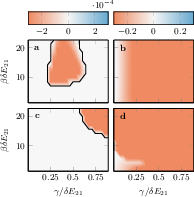
Figure 1: Minimum eigenvalue of the reduced density matrix over an extended interval as a function of coupling strength γ and inverse temperature β, quantifying the regime of positivity violation for various master equation strategies.
Comparison with Exact Dynamics
The PT-CCQME and PT-Redfield equations are numerically compared to the time-evolving matrix product operator (TEMPO) method, which provides numerically exact non-Markovian dynamics for the spin-boson model. The analysis spans weak, intermediate, and strong coupling, as well as quantum and classical temperature regimes.
The original-frame Redfield and CCQME approaches grossly deviate from TEMPO except in the strict weak-coupling, high-temperature limit, often yielding unphysical population dynamics (∣⟨σz⟩∣>1) due to severe positivity violations. In contrast, both PT-CCQME and PT-Redfield correctly capture the relaxation dynamics and equilibrium states in the weak- and ultra-strong-coupling limits, converging to either the standard or projected Gibbs state, respectively.
The PT-CCQME especially outperforms at intermediate coupling and moderate-to-low temperature—regimes of significant practical relevance—where PT-Redfield breaks down but PT-CCQME reproduces the exact dynamics with high quantitative accuracy.
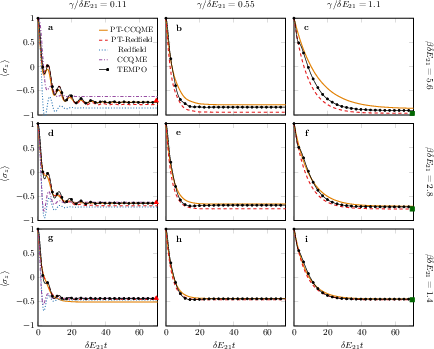
Figure 2: Population dynamics ⟨σz⟩ calculated via different master equation approaches and compared to exact TEMPO results across coupling and temperature regimes, highlighting superiority of PT-CCQME in intermediate-coupling/low-temperature regime.
Steady-State and Thermalization Properties
By construction, the PT-CCQME guarantees relaxation to the correct steady-state: the polaron-transformed mean-force Gibbs state. Analytical expansions confirm that this state interpolates smoothly between the canonical Gibbs state (weak coupling), the projected diagonal Gibbs state (ultra-strong coupling), and the maximally mixed state (high temperature), thus unifying disparate regimes within a single dynamical framework.
The Liouvillian spectral gap, computed for both PT-CCQME and PT-Redfield, provides further insight into relaxation timescales. Both approaches predict a non-monotonic dependence of the thermalization rate on system-bath coupling: initial increases in coupling speed up relaxation, but at strong coupling, relaxation is substantially impeded, and the gap shrinks, manifesting as metastable long-lived modes. This initial-condition-independent Zeno-type slowing is inaccessible to original-frame weak-coupling master equations.
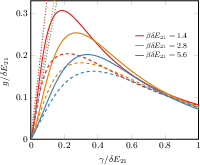
Figure 3: Liouvillian gap as a function of coupling, demonstrating the initial enhancement and subsequent suppression of relaxation rate at strong coupling in both PT-CCQME and PT-Redfield.
Practical and Theoretical Implications
The PT-CCQME achieves fourth-order expansion in the residual coupling while remaining numerically efficient and scalable, requiring only standard quadrature of correlation functions and rate kernel evaluation, with no multidimensional superoperator expressions. This positions PT-CCQME as a method capable of treating large, multilevel quantum systems and complex networks under realistic (strong) dissipation and decoherence.
On the theoretical side, the combination of polaron frame and canonical consistency ensures that both steady-state and dynamical features are physically meaningful across all but the most extreme strong-coupling/low-temperature regimes. The framework is inherently extendable: a non-Markovian generalization based on the time-nonlocal kernel or further resummation would allow for first-principles treatment of structured environments with long correlation times.
Potential applications include quantum thermodynamics, quantum biology (photosynthetic complexes with strong system-environment coupling), solid-state qubits, and large-scale quantum transport. The preservation of thermodynamic consistency and positivity is particularly crucial for the interpretation of dissipative quantum control and the study of emergent quantum phenomena in mesoscopic regimes.
Conclusion
The polaron-transformed CCQME comprehensively addresses critical failures of conventional quantum master equations in the strong-coupling regime. By embedding equilibrium statistical corrections into a fourth-order, Markovian time-local framework, it ensures accurate dynamics, correct thermalization to the mean-force Gibbs state, and robust positivity, as evidenced by close correspondence with numerically exact TEMPO benchmarks. The PT-CCQME thus provides both theoretical clarity and practical computability for quantum dissipative systems with non-negligible system-environment coupling, and sets the stage for further development toward non-Markovian and many-body quantum simulation methods.

