- The paper demonstrates that combining constraint-aware initialization with a hybrid XY-X mixer improves optimal-state probability (e.g., 0.6176 in statevector simulation) for vehicle routing problems.
- The study evaluates performance across ideal, finite-shot, and noisy regimes, highlighting the tradeoff between preserving constraint structures and handling hardware errors.
- The proposed framework directs quantum amplitude to feasible subspaces, reducing energy gaps and enhancing sampling efficiency in complex combinatorial settings.
Improving Feasibility in QAOA for Vehicle Routing: Constraint-Aware Initialization and Hybrid XY-X Mixing
Motivation and Background
Quantum Approximate Optimization Algorithm (QAOA) has established itself as a central approach for leveraging quantum resources to address combinatorial optimization. In applications such as the Vehicle Routing Problem (VRP)—a fundamental logistics problem with severe combinatorial complexity—the practical deployment of QAOA confronts distinct feasibility bottlenecks. Specifically, feasible solution sets for VRP typically constitute a minuscule fraction of the overall 2n Hilbert space, and the canonical QAOA recipe (uniform-superposition initialization with Pauli-X mixer) not only wastes computational amplitude on infeasible subspaces but actively disrupts partial constraint structures during the circuit evolution. This paper proposes a QAOA variant that explicitly prioritizes feasibility by combining constraint-aware initialization with a hybrid mixer, aiming for improved solution quality under both ideal and hardware-relevant regimes.
Quantum Preliminaries
Quantum states for n-qubit systems are represented in the exponentially large Hilbert space, with basis states ∣x⟩, x∈{0,1}n, and physical gates manipulating these states via unitary operations. The Bloch sphere offers a geometric description of single-qubit states, facilitating understanding of quantum mixing/rotation protocols.
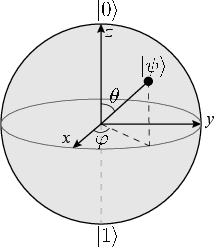
Figure 1: Bloch sphere representation of a qubit, visualizing the geometric structure underlying quantum superposition and measurement.
QAOA: Standard Procedure vs. Constrained Routing
The QAOA workflow begins with encoding VRP as a QUBO (or equivalently, an Ising Hamiltonian), integrating all constraints via penalty terms. Standard circuits prepare the initial state as ∣+⟩⊗n (uniform superposition), whose measurement probabilities are distributed equally across 2n states. Pauli-X mixers introduce independent bit flips, permitting exploration but destroying local structures relevant to VRP constraints.
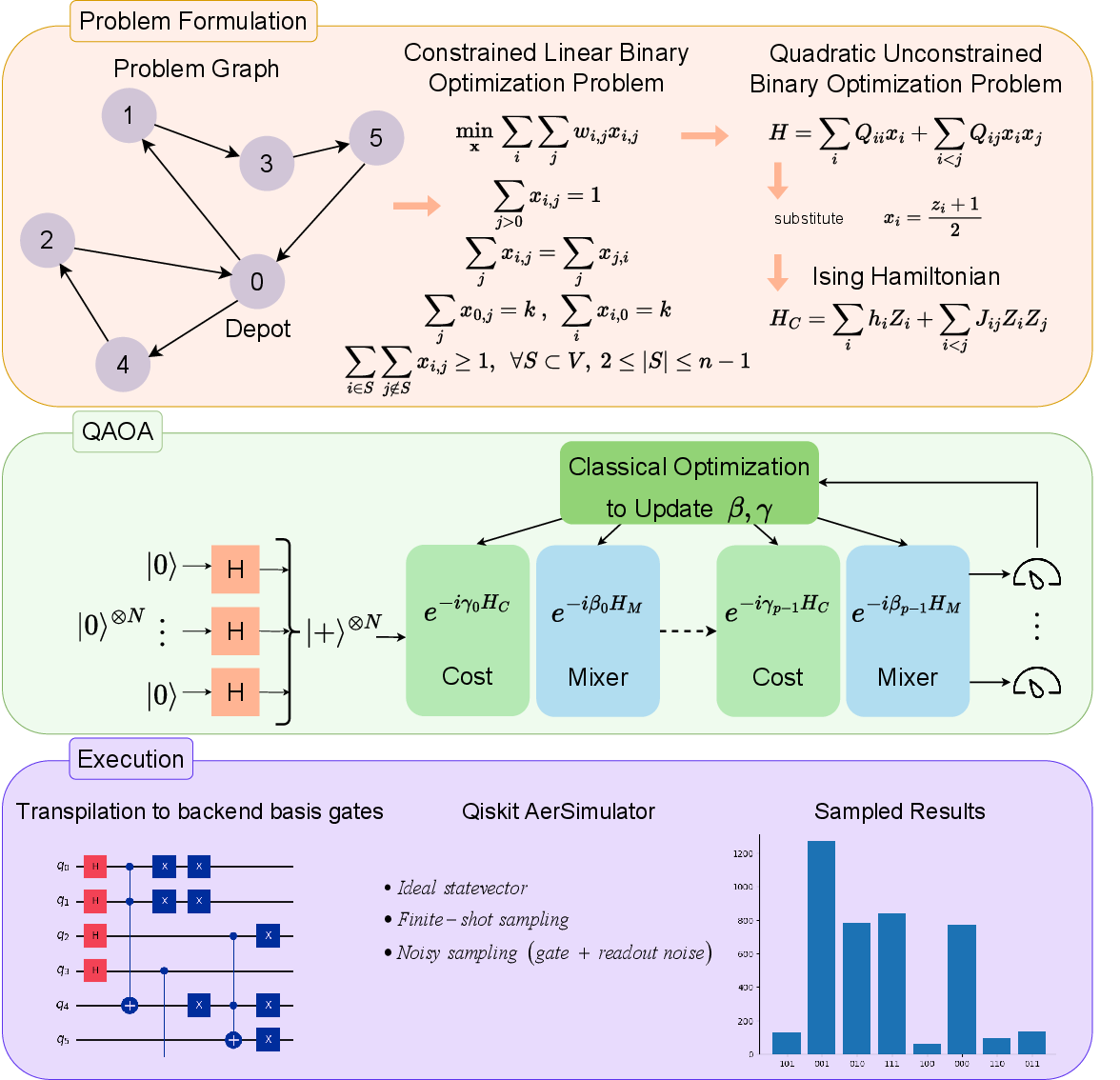
Figure 2: QAOA pipeline for combinatorial optimization encoded as QUBO/Ising, with alternating cost and mixing unitaries and classical parameter updates.
To illustrate, a 3-node, 2-vehicle VRP encodes as a 6-qubit system, but only a single bitstring is feasible—so uniform initialization yields a feasible fraction <2%.
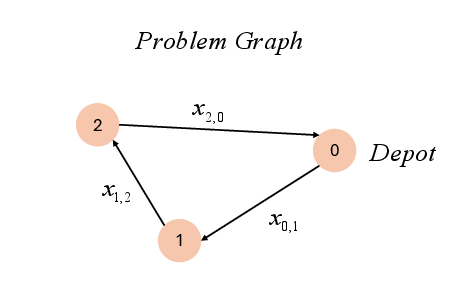
Figure 3: Toy VRP instance with nodes and links, illustrating the sparsity of feasible solutions in quantum encoding.
Constraint-Aware Initialization
The proposed framework leverages local one-hot and degree constraints to restrict the initial superposition to a structured subspace. For example, enforcing xi,0+xi,2=1 reduces the local Hilbert space from X0 to X1 states for a pair of qubits. By targeting such easily implementable constraints across variable blocks, the initialization concentrates probability mass in regions with higher feasible density, bypassing costly Grover-style initialization routines.
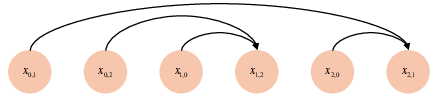
Figure 4: Relations of constraints in VRP encoding, with each link denoting a local one-hot (degree) constraint.
Hybrid XY-X Mixer Design
A pure XY mixer maintains Hamming weight and preserves local constraint structure but prevents transitions between weight sectors, locking amplitude out of feasible regions in many practical encodings. The hybrid XY-X mixer supplements XY blocks with Pauli-X2 mixing on unconstrained qubits, weighted by a parameter X3. This maintains constraint structure where informative and enables broader exploration where required.
Experimental Regimes and Evaluation
Experiments utilize three regimes: (I) ideal statevector simulation (exact expectation), (II) finite-shot sampling (measurement-based estimation), (III) noisy finite-shot sampling (gate/readout errors matching best laboratory fidelities). Performance is quantified by (a) optimal-state probability, (b) expected energy gap, (c) sampling rank (prominence of optimal solution).
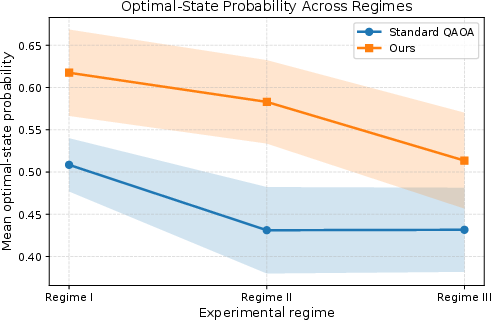
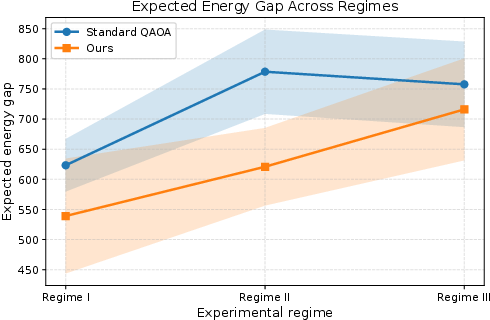
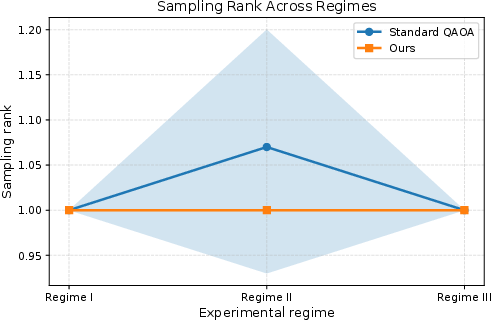
Figure 5: Probability mass on optimal solution, expected energy gap, and sampling rank across ideal, sampling, and noisy regimes.
The optimal-state probability achieved by the proposed method is consistently higher than standard QAOA (Regime I: 0.6176 vs. 0.5086, Regime II: 0.5831 vs. 0.4312, Regime III: 0.5136 vs. 0.4317), with best performance at intermediate X4–X5. Expected energy gap is also reduced (Regime I: 539.14 vs. 623.37, Regime II: 611.55 vs. 746.35, Regime III: 716.13 vs. 757.68). Excessive X6 attenuates structural preservation and degrades rank stability.
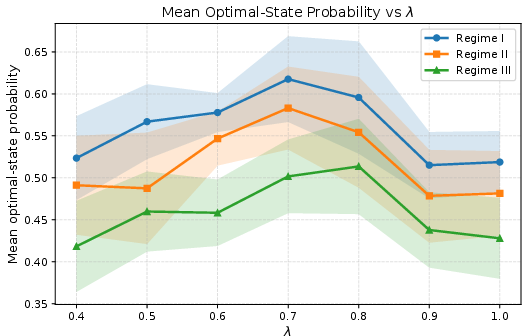
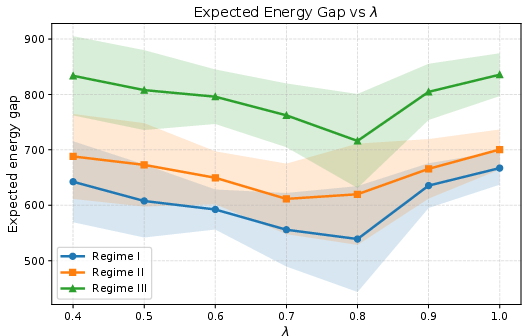
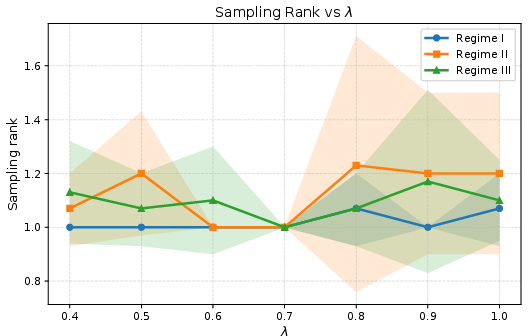
Figure 6: Sensitivity of optimal-state probability, energy gap, and rank to the mixing parameter X7 in each regime.
Circuit Visualization
Circuit diagrams reveal the structural evolution in both standard and constraint-aware QAOA variants at initial and optimized stages, highlighting the impact of initialization and mixing choices.
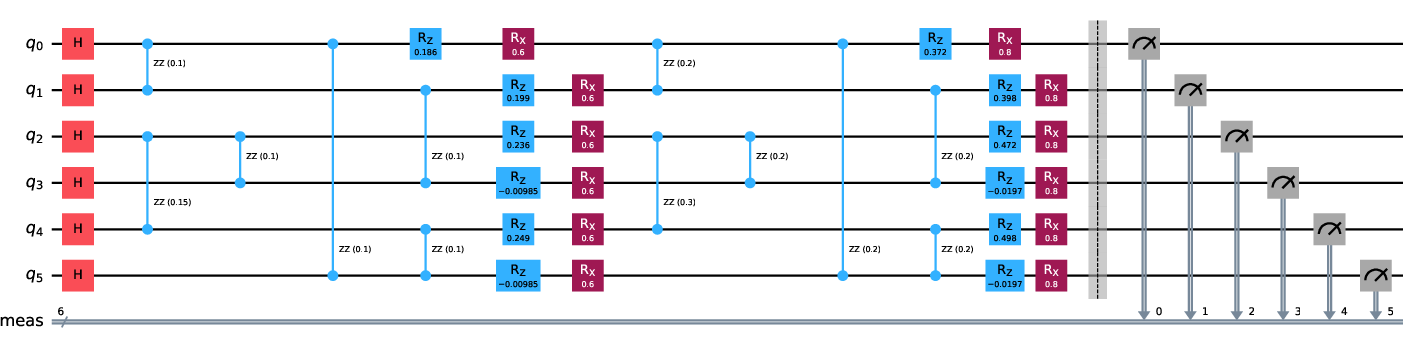
Figure 7: Standard QAOA circuit (Initial), showing uniform preparation and X-mixing.
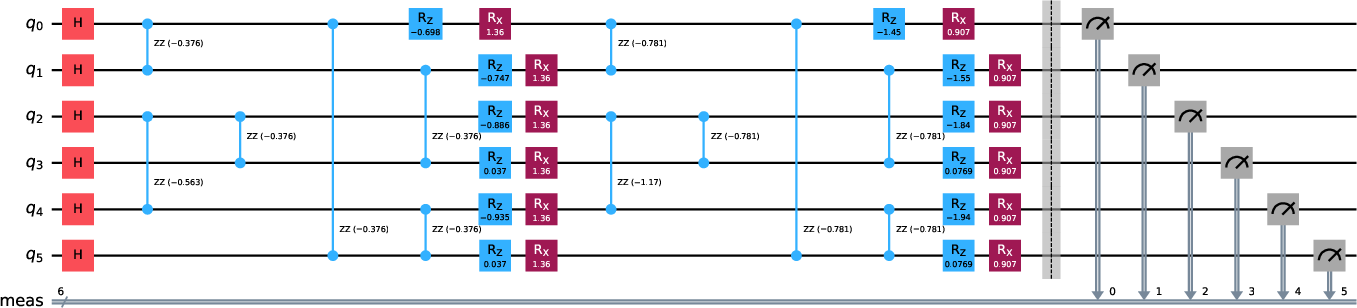
Figure 8: Standard QAOA circuit (Optimized), after classical tuning.

Figure 9: Proposed QAOA circuit (Initial), with constraint-aware initialization and hybrid mixing.

Figure 10: Proposed QAOA circuit (Optimized), incorporating variational updates.
Practical and Theoretical Implications
Numerical results demonstrate that the constraint-aware approach reliably enhances feasibility and sampling efficiency across algorithmic and hardware-relevant regimes. The hybrid mixing strategy achieves a substantial improvement in solution quality and concentration on optimal feasible states, especially when initialization incorporates easy-to-encode constraints. Theoretical advantages attenuate in presence of realistic noise, underscoring the fundamental hardware-algorithm tradeoff: increased circuit structure induces vulnerability to gate/readout errors.
Practically, the approach provides a scalable framework for encoding feasibility in QAOA, pushing towards larger VRP instances as quantum device fidelity improves. Theoretically, it motivates further investigation into selective constraint encoding, circuit compilation, and dynamic mixer scheduling for more complex combinatorial problems.
Conclusion
The paper proposes a QAOA framework for VRP that directly addresses feasibility through constraint-aware initialization and hybrid XY-X mixing. This approach yields marked gains in optimal-state probability and expected solution quality compared to standard QAOA, under both ideal algorithms and realistic quantum hardware models. The results clarify the critical role of initialization and mixing strategies in quantum optimization for practical constrained problems. Further extensions to richer constraint structures, deeper analysis of circuit complexity/noise tradeoffs, and integration with warm-start or decomposition approaches offer avenues for improved scalability and robustness. The ultimate applicability of this approach depends on concurrent advances in quantum algorithm design and hardware fidelity.
Code and resources: https://github.com/EdisonYLei/Improving-Feasibility-in-QAOA-for-VRP
Reference: "Improving Feasibility in Quantum Approximate Optimization Algorithm for Vehicle Routing via Constraint-Aware Initialization and Hybrid XY-X Mixing" (2604.07218)

