- The paper introduces a colored-permutation encoding that reduces qubit count and optimizes solutions for capacitated vehicle routing via CE-QAOA.
- It eliminates the need for explicit capacity registers by incorporating constraints directly into the decision register, improving resource efficiency.
- Numerical results demonstrate enhanced scalability on challenging benchmarks, with a hybrid quantum–classical pipeline ensuring solution feasibility.
Optimal, Qubit-Efficient Quantum Vehicle Routing via Colored-Permutations: A Technical Essay
Introduction
The paper "Optimal, Qubit-Efficient Quantum Vehicle Routing via Colored-Permutations" (2604.04570) advances quantum algorithm design for capacitated vehicle routing problems (CVRP) by introducing a colored-permutation encoding that enables both optimality and qubit efficiency. The authors specifically target primary quantum resource bottlenecks in encoding vehicle assignments and enforcing capacity constraints—critical challenges for practical gate-model quantum approaches to combinatorial optimization. The work situates itself within the Constraint-Enhanced QAOA (CE-QAOA) program, optimizing the mapping between the combinatorial structure of CVRP and the capabilities of shallow ansatzes to outperform classical heuristics under the regime of stringent hardware constraints.
The formulation defines the routing state space as K color layers over a common n×n permutation structure: each vehicle k∈[K] is assigned a disjoint partial permutation X(k) over customers and timeline positions, and the sum of these layers yields a complete permutation P ensuring the coverage and ordering requirements of CVRP.
The assignment is encoded using n2K binary decision variables, significantly reducing the qubit count compared to previous schemes, especially where vehicle and capacity representations contribute substantial logical overhead. Explicitly, for each customer-position pair (i,j), the assignment xi,j,k indicates the placement of customer i at position j by vehicle n×n0. The per-block one-hot and global uniqueness conditions guarantee the correctness of the mapping to feasible CVRP tours, encoding the admissible solution space as colored permutations whose partial layers are naturally interpretable as the vehicle routes.
Importantly, the authors prove that every feasible bitstring respecting these constraints corresponds bijectively to a colored decomposition of a permutation matrix: the supports of the n×n1 color layers are disjoint and their union covers the support of n×n2. This mapping underpins both the qubit-efficiency and the ease of diagonal constraint imposition on quantum hardware.
Qubit Efficiency and Scaling
A central claim is the elimination of explicit capacity/load registers, which dominate the resource profile in prior quantum CVRP encodings. Both hard (item-once, one-hot) and soft (capacity) constraints are enforced within the decision register itself—a direct result of the colored-permutation formalism, which recasts capacity as a diagonal function of assignment variables. This yields immediate ancilla-free enforcement, in contrast to approaches with n×n3 (unary) or n×n4 (binary) load-register qubits.
The binary-coded colored-permutation encoding further compresses the logical qubit count from n×n5 (in vehicle-separated schemes) to n×n6. This improvement transitions a range of benchmark and small industrial CVRP instances into a regime addressable by near-term devices, as shown in Figure 1.
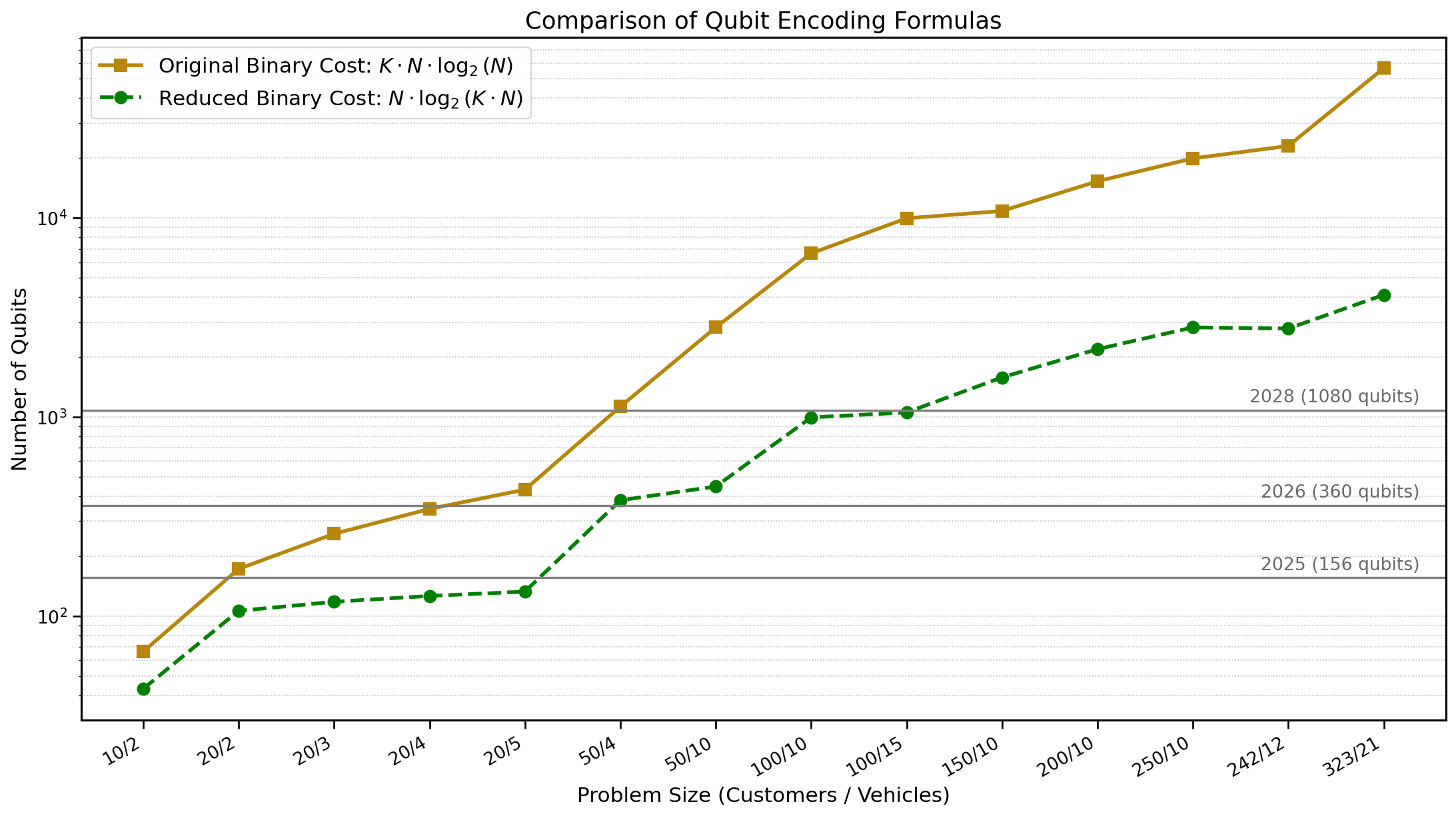
Figure 1: Qubit count comparison showing colored-permutation scaling achieves orders of magnitude reduction over separated encodings, enabling quantum evaluation of much larger routing instances within hardware budget.
CE-QAOA Integration and Algorithmic Guarantees
Constraint-Enhanced QAOA (CE-QAOA) is leveraged as the quantum kernel: the quantum circuit alternates block-local XY mixers (preserving the block one-hot, colored-permutation encoded manifold) and diagonal cost/constraint phase operations (objective, assignment, capacity penalties). The state initialization is a tensor product of block-wise n×n7-states (uniform superpositions across the per-block alphabet), and the mixer acts invariantly within the feasible subspace—empowering efficient exploration of admissible colored-permutation solutions.
The authors draw upon analytical guarantees from the kernelized CE-QAOA regime, leveraging encoded anticoncentration and the Fejér-trigonometric filtering framework. As established in prior work, the application of CE-QAOA yields a dimension-free lower bound on optimal-solution sampling: For any instance with positive envelope weight on the optimal set and nonzero phase gap separation, the probability of sampling an optimal solution at finite depth is lower-bounded independently of the size of the encoded manifold, provided by explicit estimates based on block-XY envelope overlaps and spectral gaps.
Numerical experiments (referenced in the main text) confirm empirical recovery of independently verified optima on challenging QCVRP benchmarks, with hybrid classical-quantum post-processing (including a deterministic polynomial-time feasibility filter) ensuring only admissible colored-permutation solutions are retained and scored.
Implementation: Hybrid Pipeline and Feasibility Certification
Because the per-vehicle route contiguity constraint is not strictly enforced by quantum evolution, the practical algorithm operates in a hybrid quantum–classical mode. The quantum circuit generates candidate bitstrings in the colored-permutation space, and a classical feasibility oracle certifies one-hotness, customer uniqueness, vehicle load compliance, and (optionally) contiguous route formation. The feasibility oracle, presented in detail, is a reusable polynomial-time routine, scalable to large instance sizes and applicable independently of the quantum sampling source.
This hybrid framework (PHQC) decouples quantum circuit design and classical verification, which is crucial when the quantum subroutine samples only a fraction of the feasible colored-permutation sector containing optimal solutions. It enables the deterministic certification of optimality for any sampled bitstring.
Industrial Scalability and Future Directions
The most significant bottleneck for near-term quantum routing is the quadratic n×n8 cost in one-hot representations of the colored-permutation formalism. The authors outline a path to compress this via binary-coded symbol registers while preserving the essential properties of the encoded manifold necessary for CE-QAOA's performance guarantees.
The development of suitable low-depth, symbol-respecting mixers for the binary-coded colored-permutation representation stands as the next technical milestone—these must enforce the one-hot-encoded submanifold structure and enable efficient exploration of valid solution space without leakage. This step is essential to push quantum CVRP optimization into the field of operationally meaningful industrial problem sizes (n×n9, k∈[K]0, k∈[K]1–k∈[K]2).
The paper articulates that quantum utility for routing will likely first arise in the closure of open optimality gaps for benchmark CVRP instances considered difficult at the classical boundary, such as real-world logistics datasets with unresolved optima.
Conclusion
The colored-permutation encoding introduced provides a formal, qubit-efficient foundation for quantum CVRP solvers, fully leveraging the encoded-manifold and constraint-preserving properties of CE-QAOA. By integrating capacity as a native diagonal term and exploiting the algebraic structure of color layers, the approach achieves optimal scaling and enables practical hybrid quantum–classical pipelines for routing optimization. Theoretical guarantees for optimal solution recovery are preserved under realistic circuit and sampling budgets, and practical experiments support feasibility for instances at the threshold of classical hardness.
The transition to wide adoption and genuine quantum advantage in routing will entail construction of robust binary-coded mixers and further integration of physical device capabilities. The colored-permutation formalism provides a mathematically precise, empirically supported, and operationally scalable route to realizing these goals.

