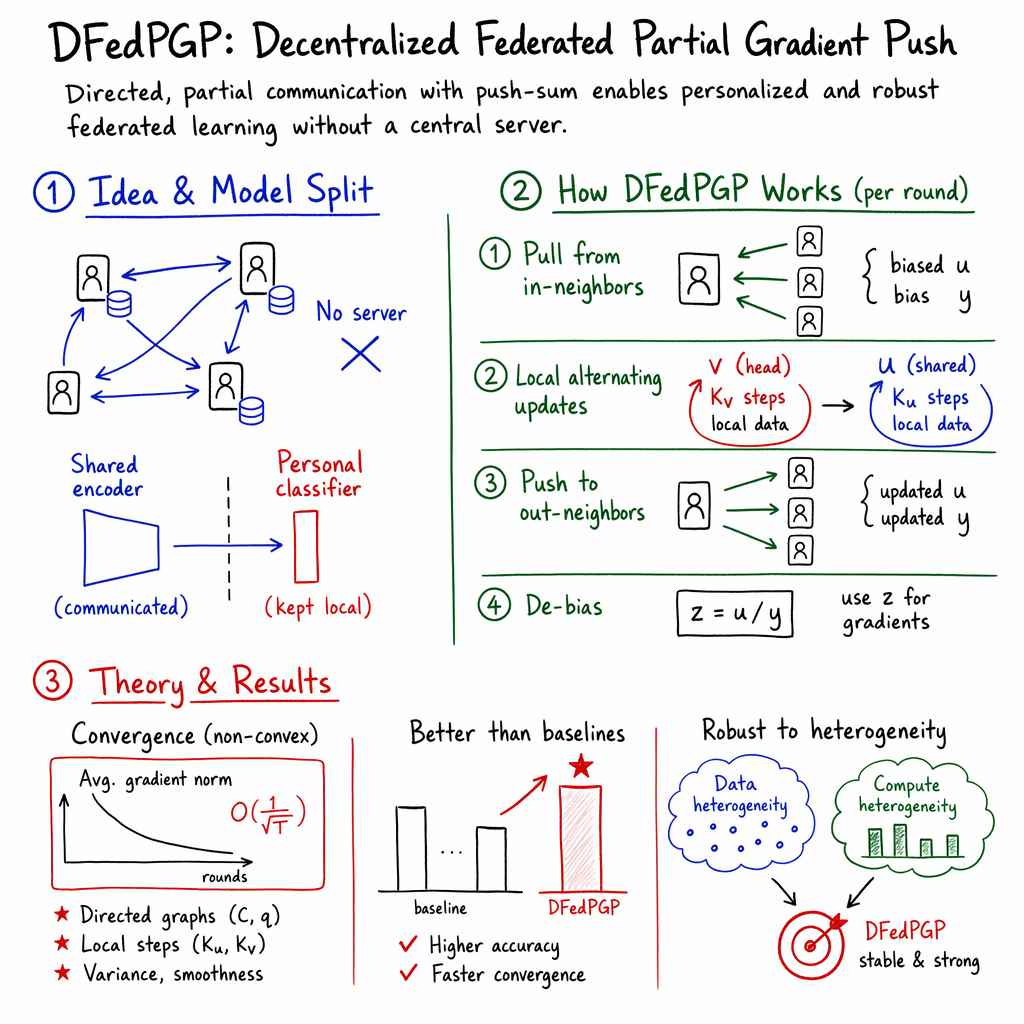
- The paper introduces DFedPGP, a decentralized framework that uses directed collaboration for partial model personalization and efficient gradient exchanges.
- It achieves accelerated convergence with a theoretical rate of O(T^-1/2) and demonstrates robust performance on CIFAR-10, CIFAR-100, and Tiny-ImageNet datasets.
- The framework adeptly handles heterogeneous client conditions in data, computation, and communication, making it practical for real-world edge and mobile applications.
Decentralized Directed Collaboration for Personalized Federated Learning
Introduction
The paper "Decentralized Directed Collaboration for Personalized Federated Learning" (2405.17876) addresses the problem of heterogeneity in Personalized Federated Learning (PFL), emphasizing the limitation of server-based FL frameworks that suffer from central failure and communication bottleneck issues. The authors propose Decentralized Directed Collaboration for Personalized Federated Learning (DFedPGP), a framework leveraging directed collaboration to enhance decentralized learning efficiency by addressing the impact of data, computation, and communication resource heterogeneity. This paper offers a comprehensive analysis and empirical assessment demonstrating DFedPGP's potential to deliver state-of-the-art accuracy in heterogeneity scenarios.
Methodology
Framework Design
DFedPGP incorporates partial model personalization and stochastic gradient push, both strategically designed to enhance convergence and minimize communication costs. The methodology involves decoupling the model into shared and private parts, enabling agile communication with directed neighbors. Key steps include sharing partial gradients and maintaining flexibility in neighbor selection to optimize resource consumption and convergence rates. The approach is distinctly advantageous in computation-constrained and communication-constrained settings, benefiting from directed collaboration topology.
Theoretical Convergence Analysis
The paper provides a rigorous convergence analysis for DFedPGP, showcasing a convergence rate of O(T−1/2) under general non-convex settings. This rate highlights the accelerated convergence achieved through tighter connectivity and partial gradient agreements. Notably, the algorithm illustrates superiority in resource efficiency and client adaptability compared to state-of-the-art baselines.
Experimental Results
Empirical Validation
Experiments on CIFAR-10, CIFAR-100, and Tiny-ImageNet datasets with non-IID data emphasize DFedPGP's superior accuracy and stability compared to existing PFL methods. The results demonstrate consistent improvement over baselines, confirming DFedPGP’s robustness in various data distribution scenarios, such as Dirichlet and Pathological distributions.
The paper reveals DFedPGP's capacity to maintain optimal performance amidst varying computational and communication resource conditions. It underscores the modular personalization that facilitates efficient model adjustments, significantly mitigating adverse effects from resource variance.
Implications and Future Directions
Practical Implications
DFedPGP represents significant advancements in decentralized learning, especially critical for scenarios involving extensive heterogeneity across clients. The innovative use of directed collaboratory networks circumvents centralized shortcomings and promotes adaptability for real-world applications in edge computing and mobile services where resource constraints are prevalent.
Theoretical Contributions
DFedPGP's convergence assurances and empirical results contribute to the broader PFL landscape by demonstrating the tangible benefits of incorporating directed graphs in distributed optimization. The study fosters further exploration into fully decentralized models, adaptive neighbor selection, and enhanced local optimization techniques.
Future Research
The authors suggest future exploration in refining client selection methods, examining additional model decoupling techniques, and expanding directed communication strategies to optimize federated learning's adaptability to dynamic and resource-intensive environments.
Conclusion
The DFedPGP framework marks a pivotal step in personalized federated learning by tailoring models to heterogeneous client needs while ensuring efficient training and communication protocols through directed collaboration. The paper’s convergence guarantees and empirical validations firmly establish the framework as a robust, scalable solution within decentralized learning domains, fostering future technological advancements.