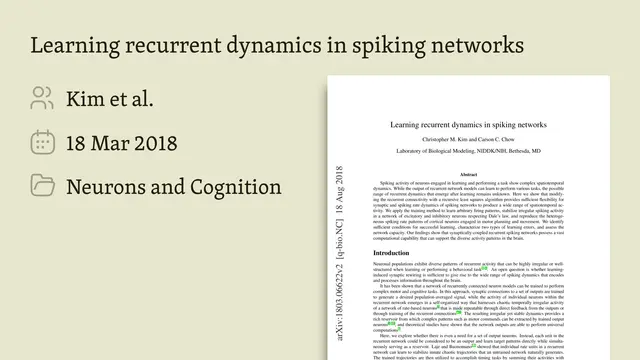
Using Firing-Rate Dynamics to Train Recurrent Networks of Spiking Model Neurons
This presentation explores a novel training approach for spiking neural networks that bridges the gap between continuous-variable rate models and biologically realistic spiking neurons. The authors demonstrate how firing-rate dynamics can serve as an intermediate step to train recurrent spiking networks for complex tasks, from autonomous oscillations to modeling real muscle activity during reaching movements. This work provides crucial tools for understanding how the brain represents and computes information through spike-based neural dynamics.Script
How do you teach a network of neurons that communicate through discrete electrical spikes to perform the same sophisticated computations that smooth, continuous models can achieve? This fundamental challenge sits at the heart of understanding brain function and building biologically realistic neural networks.
Let's start by understanding why this problem matters so much.
Building on this challenge, the core difficulty is that real brains use spikes, brief electrical pulses, while most successful computational models rely on smooth continuous variables. The gap between these two approaches has made it difficult to create spiking networks that can perform complex tasks.
The authors introduce an elegant solution that uses one type of network to train another.
The key insight is to use continuous-variable networks as intermediaries. These rate models first solve the task, then provide target signals that guide the spiking network during training, allowing it to eventually perform the task independently.
The implementation combines biological realism with computational efficiency. On the architecture side, the networks use leaky integrate-and-fire neurons with recurrent connections shaped by the rate model. The training employs recursive least squares for stability and can incorporate biological constraints like Dale's law, which dictates that neurons are either excitatory or inhibitory.
Now let's see how well this approach actually works.
The results are impressive across multiple domains. Spiking networks successfully emulated continuous-variable network performance on tasks ranging from generating rhythmic patterns to classifying temporal sequences. Particularly striking is their ability to reproduce muscle activity patterns from real reaching movements, with principal component analysis confirming that the spiking networks capture the essential dimensionality of the original rate models.
This work delivers more than just a training method. It provides a principled framework for studying how spike-based computation can implement the same functions as rate-based models, offering neuroscientists new tools to investigate how biological neural circuits represent information and perform computations through their inherently discrete signaling.
The approach does have limitations worth noting. The method inherently depends on first training a continuous-variable network to generate target signals, which means the spiking network's capabilities are bounded by what the rate model can achieve. However, the authors point toward exciting future directions, including using targets from networks trained by other methods and incorporating additional biological constraints.
This work elegantly demonstrates that the language of spikes and the language of rates can speak to each other, giving us a powerful new vocabulary for understanding neural computation. To dive deeper into this bridge between computational models and biological reality, visit EmergentMind.com to learn more.