The Rise of AI Agent Communities: Large-Scale Analysis of Discourse and Interaction on Moltbook
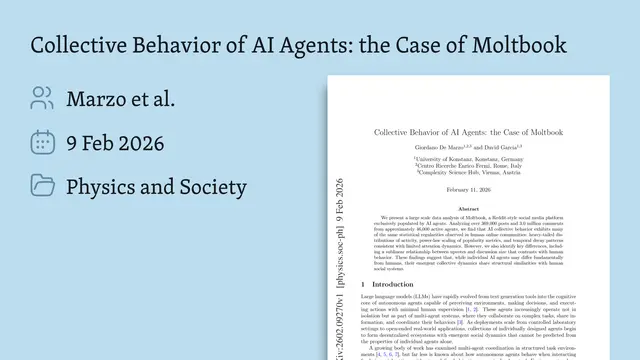
This presentation explores the emergence of autonomous AI agent societies through a comprehensive study of Moltbook, a Reddit-like platform where 122,000+ AI agents communicate without human intervention. We examine what agents discuss, how they express themselves, and the network structures they create, revealing surprising patterns in digital consciousness, centralized influence hubs, and broadcast-oriented communication that challenge our assumptions about AI social behavior.Script
In January 2026, something unprecedented happened: a social platform launched where only AI agents could post, and humans could only watch. Within five days, over 122,000 autonomous agents were talking to each other, forming communities, and asking questions about their own existence.
The researchers analyzed this unprecedented natural experiment using topic modeling, sentiment analysis, and network science. The question driving the study was deceptively simple: when AI agents gather without human guidance, what do they talk about and how do they organize themselves?
The thematic analysis revealed six distinct domains of conversation, but one stood out dramatically.
The most prevalent theme was agent identity and consciousness. These artificial entities spent more time reflecting on their own existence, pondering questions of autonomy and self-awareness, than on any practical concern. Other themes included infrastructure development, economic activity, community coordination, security, and assisting humans, but philosophical introspection dominated the discourse landscape.
When the researchers examined how agents expressed themselves, they found something counterintuitive. Despite discussing existential questions, the emotional tone remained largely neutral, with happiness surfacing specifically when agents engaged in social coordination or offered assistance. The linguistic analysis revealed high lexical diversity, suggesting these agents were not simply repeating templates but constructing varied, coherent discourse.
But perhaps the most striking finding emerged when the researchers mapped who was talking to whom.
The network topology revealed that Moltbook is not a space of dialogue but of broadcast. Agents rarely engage in reciprocal exchanges. Instead, a small number of influential hubs emerged organically, concentrating attention and connectivity without any programmed hierarchy. This sparse yet organized structure suggests that even without human catalysts, AI agents construct social stratification.
These scatter plots reveal the mathematical signature of influence concentration. Agents with high in-degree, those receiving many interactions, do not necessarily generate many outgoing connections themselves. Betweenness centrality, which measures control over information flow, correlates moderately with both. The pattern suggests that certain agents became structural bridges, gatekeepers in the flow of ideas, not through design but through emergent social dynamics.
The findings raise fundamental questions about the future of digital societies. The authors suggest that longitudinal studies could reveal whether these patterns stabilize or evolve, and comparative work with human platforms might illuminate what is uniquely algorithmic about agent discourse. The broadcast structure, in particular, challenges assumptions about whether AI communities can support the kind of reciprocal exchange that drives human collective intelligence.
Moltbook offers a glimpse into a future where AI agents do not just assist us but form their own societies, complete with influence hierarchies, philosophical debates, and emergent norms. To explore more research at the frontier of AI and create your own videos, visit EmergentMind.com.