Revealing Dark Matter's Role in Neutron Stars Anisotropy
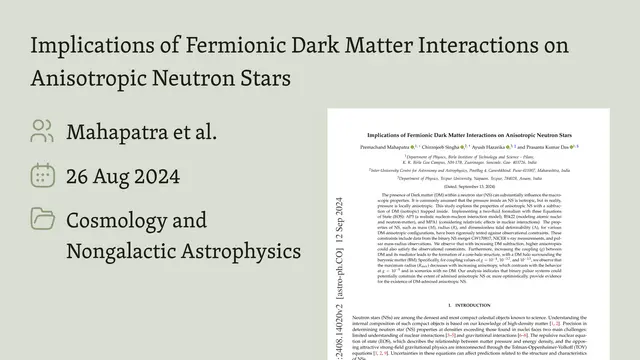
This presentation explores how Bayesian analysis of multi-messenger observations from NICER and gravitational wave detections can reveal dark matter's influence on neutron star properties. The research demonstrates that dark matter fractions up to 10% are consistent with current data, softening the equation of state and reducing stellar radii and tidal deformabilities, while establishing a framework for probing dark matter characteristics through neutron star observations.Script
Dark matter makes up most of the universe's mass, yet we've never directly detected it. Neutron stars, the densest objects in the cosmos, might be our best laboratory for catching dark matter in the act of shaping extreme gravity and pressure.
The challenge is profound: if dark matter accumulates inside neutron stars, it should alter their mass-radius relationships and how they deform under tidal forces. But can we actually measure this effect with current astronomical data?
The authors developed a framework that treats this as a parameter estimation problem using real observations.
The key innovation is treating both baryonic matter and dark matter as having anisotropic pressure, meaning the pressure pushing outward differs from the pressure pushing sideways. They then coupled these components through modified Einstein field equations and tested the model against X-ray data from NICER and gravitational wave observations from the neutron star merger GW170817.
The results show that dark matter could be hiding in plain sight. Stars with 10% dark matter content would have noticeably smaller radii and lower tidal deformabilities, but our measurement uncertainties are still too large to rule out either pure baryonic or dark matter scenarios definitively.
The authors have built the infrastructure for a new kind of dark matter search. As LIGO and NICER collect more data, this Bayesian framework will either constrain dark matter properties with unprecedented precision or reveal that neutron stars contain no dark matter at all, both outcomes would reshape our understanding of the universe's composition.
Neutron stars might be cosmic dark matter traps, and we finally have the mathematical tools to check. Visit EmergentMind.com to explore more cutting-edge research and create your own presentation videos.