Religion and AI as Distributed Meaning Systems
This presentation explores a formal analogy between religion and artificial intelligence, examining how both function as distributed meaning systems that emerge from socially extended cognitive architectures. Drawing on distributed cognition, cultural evolution, and philosophy of mind, the talk reveals structural parallels in how these systems scaffold meaning, authority, and coordination through external symbolic ecologies, while carefully distinguishing their fundamental differences in agency, normativity, and temporal emergence.Script
Religion coordinates billions of people through texts and rituals. AI coordinates decisions through algorithms and data. What if both are emergent meaning systems, neither fully designed nor fully understood by any single mind?
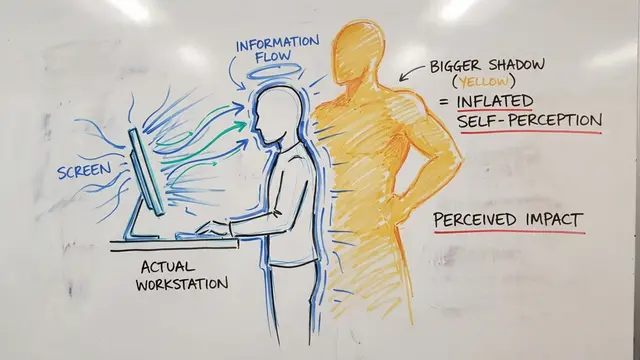
The authors propose that religion and AI are both distributed cognitive architectures. No priest holds the entirety of Catholic theology in their head, and no GPU contains the full logic of a language model. Meaning arises from the coordinated dynamics of many components, texts, rituals, optimization loops, not from any single source.
Their framework analyzes both systems across five dimensions: evolutionary development through selection and optimization, cognitive distribution across agents and components, intersubjective realities that shape interpretation, technological scaffolding through texts or data pipelines, and anthropological narratives that mediate cultural expectation. Each dimension reveals structural parallels, from emergent authority to unpredictable behavior.
But the analogy has clear boundaries. Religious authority is normatively thick, historically embedded, and explicitly intentional. AI authority is normatively thin, statistically derived, and institutionally conferred without intrinsic intentionality. Religion evolves over centuries, AI emerges in computational cycles. The parallel is structural, not substantive.
As AI systems scale and integrate into everyday cognition, they increasingly function as meaning authorities, sometimes rivaling traditional religious structures in shaping coordination and interpretation. This rise creates intersections and potential conflicts that demand anticipatory governance, ethical deliberation, and system-level analysis rather than anthropomorphic attribution.
Both religion and AI compress complexity into shared frameworks, reducing cognitive load and stabilizing interpretation across communities. Understanding them as distributed meaning systems, not agents or doctrines, clarifies how authority and coordination emerge without design. Explore more conceptual models and create your own videos at EmergentMind.com.