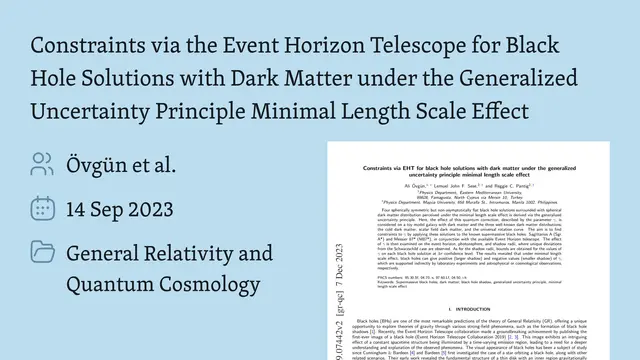
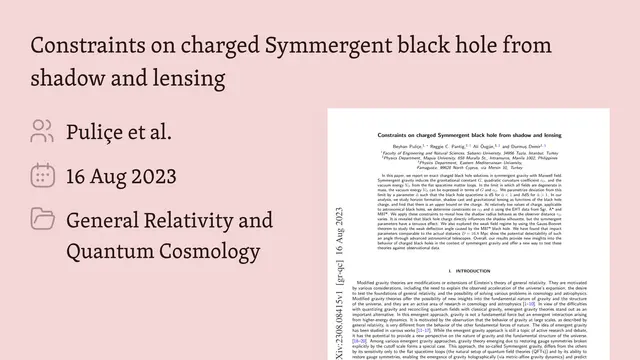
Exotic Forces Hidden in Black Hole Shadows
This presentation explores how quantum field theory predicts long-range forces that subtly alter black hole geometry. Using two distinct theoretical potentials—the repulsive Feinberg-Sucher potential from massless neutrinos and the attractive Ferrer-Nowakowski potential from boson-mediated interactions—the research demonstrates measurable changes to photon spheres and shadow radii. These corrections offer a pathway to test physics beyond the Standard Model through Event Horizon Telescope observations and gravitational wave signatures.Script
The Event Horizon Telescope gave us the first direct images of black hole shadows, but what if those shadows are whispering secrets about forces we've never detected? This research reveals how exotic quantum corrections—forces predicted by field theory but never observed—could leave measurable fingerprints on black hole geometry itself.
The authors examine two specific potentials that emerge from quantum field theory. The Feinberg-Sucher potential produces a repulsive correction—imagine neutrinos pushing outward on spacetime—while the Ferrer-Nowakowski potential creates an attractive pull through thermally excited bosons. These forces are extraordinarily weak, yet their mathematical structure suggests they should warp the Schwarzschild metric in opposite ways.
How do you find a whisper in the roar of a black hole's gravity?
They treat these quantum forces as small perturbations to the Schwarzschild solution, solving Einstein's equations with the potential's Laplacian acting as a correction term. The photon sphere—where light orbits the black hole—becomes a diagnostic tool, because its radius encodes how spacetime curvature has shifted.
The results split cleanly. Repulsive forces shrink the photon sphere and shadow, as if the black hole is pushing light inward. Attractive forces do the opposite, expanding the shadow radius. Crucially, these effects also alter quasinormal mode frequencies—the gravitational wave tones a black hole rings with after a disturbance—giving us two independent observational channels.
The authors position this work at the intersection of observation and speculation. Current Event Horizon Telescope data and gravitational wave catalogs are approaching the sensitivity needed to detect these deviations. If future measurements show shadows consistently larger or smaller than Schwarzschild predicts, we might be seeing the first evidence of quantum forces reshaping spacetime at macroscopic scales.
Black holes might be the universe's most sensitive scales, weighing forces so faint that only their shadows give them away. Visit EmergentMind.com to explore more cutting-edge research and create your own explainer videos.