Scalable Neural Decoders for Practical Fault-Tolerant Quantum Computation
This presentation explores a breakthrough in quantum error correction: Cascade, a structure-aware neural network decoder that achieves near-optimal accuracy while meeting the strict latency requirements of practical quantum computers. By exploiting the geometric regularity of quantum error correcting codes, Cascade outperforms conventional decoders by up to 4000× in error suppression and delivers throughput improvements of 3,000–100,000× through hardware acceleration. The talk reveals how decoder sophistication—not just code distance—fundamentally determines error suppression, reshaping resource estimates for fault-tolerant quantum computation.Script
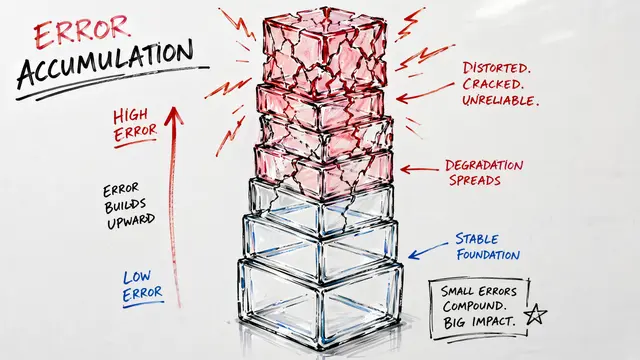
Quantum computers promise revolutionary capabilities, but there's a catch: quantum bits are fragile, and errors destroy computation within microseconds. Error correction requires classical decoders fast enough to keep pace with quantum hardware, accurate enough to suppress errors below critical thresholds, and scalable enough for thousands of qubits. Until now, no decoder has delivered all three.
The researchers identified a fundamental gap: belief propagation gets stuck in local error patterns called trapping sets, while slower methods that avoid these traps take milliseconds when quantum hardware needs answers in microseconds. Advanced quantum codes like bivariate bicycle codes offered better efficiency, but no decoder could exploit their full potential at practical speeds.
The authors designed Cascade to bridge this gap by learning directly from code geometry.
Cascade treats quantum codes as geometric objects. It uses three-dimensional convolutions for surface codes and specialized toroidal convolutions for bivariate bicycle codes, with direction-sensitive layers that mirror how errors propagate through stabilizer structures. This architectural choice transforms local syndrome patterns into global logical predictions through successive refinement stages.
The performance numbers rewrite expectations. On the 144-qubit Gross code, Cascade reaches error rates 4 orders of magnitude lower than competing methods, with a scaling exponent of 11—meaning every 10% reduction in physical errors yields a thousand-fold improvement in logical performance. This waterfall regime exists because higher-weight failure modes dominate at moderate noise levels, and Cascade resolves them where conventional decoders cannot.
Cascade's feed-forward architecture maps naturally onto specialized hardware. Batched GPU inference already meets latency requirements for trapped-ion and neutral-atom systems, while roofline projections show FPGA implementations will satisfy even superconducting qubit timing constraints. The decoder's calibrated uncertainty estimates unlock practical post-selection protocols, slashing the time overhead for producing high-fidelity magic states.
This work reveals that decoder sophistication, not just code distance, determines practical quantum error suppression—reshaping how we estimate resources for fault-tolerant quantum computers. Structure-aware neural decoding transforms quantum error correction from a theoretical framework into an engineerable reality. Visit EmergentMind.com to explore more cutting-edge research and create your own videos.