Motion 3-to-4: 3D Motion Reconstruction for 4D Synthesis
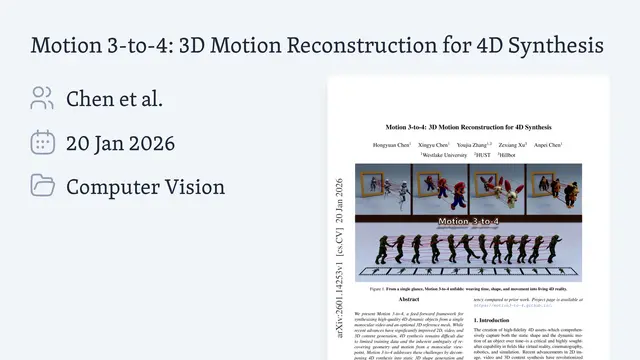
This lightning talk presents "Motion 3-to-4," a novel approach for reconstructing dynamic 4D assets from single monocular videos. The paper addresses the challenges of high-fidelity 4D generation by decomposing the problem into static 3D shape generation and efficient motion reconstruction, leveraging a feed-forward framework to overcome limitations of previous optimization-based and feed-forward methods.Script
Imagine animating a static 3D object into a lifelike, moving entity from just a single video. That's the challenge Motion 3-to-4 tackles, unlocking new possibilities in 4D synthesis.
The core problem stems from the extreme difficulty of creating high-fidelity 4D assets, which are objects possessing both 3D structure and dynamic motion over time. This challenge is further compounded by a critical lack of high-quality 4D training data, making it hard for models to learn consistent movements. Current methods are either too slow, requiring extensive optimization for each video, or they produce geometries and motions that are inconsistent.
To address these limitations, the authors propose a clever decomposition strategy: rather than generating a full 4D object from scratch, they tackle two simpler tasks. First, a static 3D mesh is created using an existing 3D generator. Then, the method focuses entirely on efficiently reconstructing the motion of that mesh over time, driven by a feed-forward process. This approach is more robust because it's easier to align an existing surface to video pixels than to hallucinate new geometry for every frame.
The paper demonstrates in-the-wild video-to-4D synthesis, which means the method can process real-world videos and directly transform them into dynamic 4D assets. This ability to generalize to diverse, unconstrained inputs, including both real footage and animated clips, highlights the model's significant practical utility. The key to this robustness is the formulation of motion reconstruction as a surface-to-pixel alignment problem, allowing for effective local correspondence reasoning across a wide array of shapes and motion complexities.
A particularly exciting capability showcased is motion transfer, where the motion from one video can be applied to a completely different static 3D mesh. This example, which might involve transferring the dynamic movement of a dragon to an entirely different object like a chicken, underscores the power of disentangling 4D synthesis into distinct shape and motion components. Such disentanglement allows for creative applications, opening up new avenues for animators and content creators by separating the appearance from the action.
Motion 3-to-4 demonstrates that by cleverly decomposing 4D synthesis, we can achieve high-quality, temporally coherent dynamic objects from single videos, paving the way for more efficient and versatile asset creation. To delve deeper into this innovative work, visit EmergentMind.com.