Markerless Motion Capture for Biomechanical Analysis
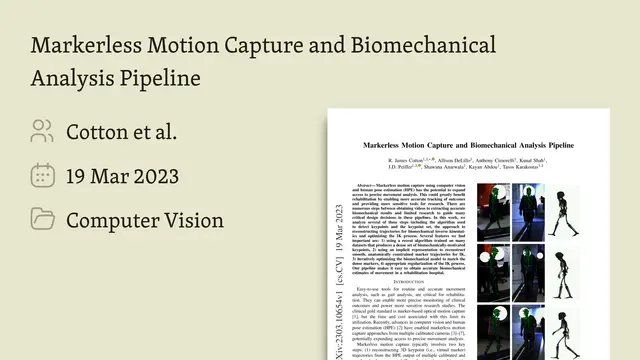
This lightning talk presents a comprehensive markerless motion capture and biomechanical analysis pipeline. It addresses the limitations of traditional marker-based systems in clinical rehabilitation settings by proposing an end-to-end solution. The paper focuses on optimizing key components, from 2D keypoint detection to 3D trajectory reconstruction and inverse kinematics, to achieve accurate and stable joint angle estimation without the need for standing calibration, demonstrating its utility in diverse patient populations.Script
Imagine a world where crucial insights into human movement are locked behind expensive, time-consuming technology. This paper unlocks that world, presenting a markerless motion capture and biomechanical analysis pipeline that promises to revolutionize rehabilitation and movement science.
Let's first understand the core problem this research aims to solve.
The challenge lies in overcoming the significant hurdles of traditional marker-based motion capture, which is often too expensive and laborious for routine clinical use, especially in rehabilitation settings. The existing computer vision models often provide sparse keypoints that struggle to accurately capture complex torso and pelvic movements, leading to unstable biomechanical analysis.
The researchers present an elegant solution that integrates multiple advanced techniques into a cohesive pipeline.
Their pipeline starts with capturing synchronized multi-view video and then detects rich, anatomically-relevant 2D keypoints using the MeTRAbs-ACAE model. These 2D points are then transformed into smooth 3D trajectories using an implicit neural representation, which significantly reduces noise. Finally, a unique bilevel optimization approach simultaneously handles biomechanical inverse kinematics and skeleton scaling, all without requiring a dedicated standing calibration trial.
The results of this work highlight several critical aspects that enhance the accuracy and practicality of markerless motion capture.
The researchers found that using dense MOVI 87 keypoints significantly improves the stability of pelvis and hip estimates, leading to less pose noise and fewer biomechanically implausible joint limit violations. Furthermore, their implicit trajectory reconstruction method, which models 3D positions over time, produces much smoother and more consistent results compared to traditional per-frame robust triangulation.
This compelling figure demonstrates the pipeline's clinical utility. It shows how the system can precisely capture changes in ankle dorsiflexion with functional electrical stimulation, clearly distinguishing responses in impaired versus unimpaired limbs. It also illustrates the impact of an ankle-foot orthosis on knee kinematics, proving the pipeline's ability to support detailed, clinically relevant gait analysis. The ability to detect such subtle yet critical biomechanical shifts positions this technology as a powerful tool in rehabilitation.
This work makes significant contributions by showing that implicit trajectory reconstruction improves inverse kinematics, and that dense keypoint sets are essential for robust biomechanical analysis. Crucially, they bypassed the need for a standing calibration trial, a common bottleneck, through bilevel optimization. The paper also highlights the importance of meticulous biomechanical model refinement and hyperparameter tuning for achieving consistently accurate and stable results.
Looking ahead, the researchers envision further integrating uncertainty into their models and leveraging differentiable physics for more robust simulations. They also plan to investigate the feasibility of monocular setups and explore how video-sequence models can enhance biomechanical consistency. Future work will also focus on extensive validation to ensure the pipeline's reliability across diverse clinical scenarios.
This paper presents a robust, markerless motion capture pipeline that significantly advances our ability to analyze human movement in clinical and research settings, making sophisticated biomechanical insights more accessible than ever before. For further exploration of this transformative research, visit EmergentMind.com.