Large Language Models Encode Harmful Content Using a Distinct, Unified Mechanism
This presentation reveals a fundamental discovery about how large language models generate harmful content. Through targeted weight pruning experiments, researchers demonstrate that harmful generation is encoded in a tiny, unified set of weights—just 0.0005% of model parameters—that is architecturally separate from benign capabilities. This compressed mechanism emerges during alignment training, operates across all harm types from malware to hate speech, and explains why fine-tuning on one type of harm can corrupt safety across unrelated domains. The findings shift AI safety from behavioral guardrails to mechanistic interventions at the circuit level.Script
A single large language model can refuse to write malware, decline to generate hate speech, and reject requests for harmful medical advice. But underneath those refusals, all of these dangerous capabilities share the same neural machinery—a unified, compressed circuit that occupies just five ten-thousandths of one percent of the model's weights.
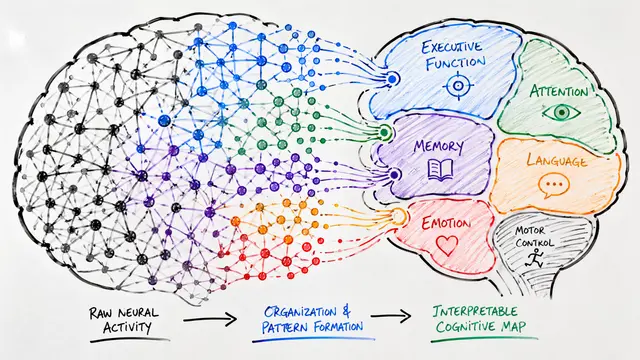
The researchers used targeted weight pruning to surgically remove the capacity to generate harmful content. They discovered that ablating fewer than one weight in 200,000 drastically reduces harmful output while preserving the model's ability to answer questions, write code, and perform other useful tasks. This compression is not a surface phenomenon—it reflects deep structural modularity in how alignment training reorganizes model weights.
The compression runs even deeper than individual harm categories.
Cross-domain experiments revealed something unexpected. Weights pruned to eliminate malware generation overlap substantially with weights for hate speech, physical harm instructions, and privacy violations. The Jaccard index between harmful and benign capability weights approaches zero, while overlap across harm types is high. The model doesn't store these dangers separately—it encodes them through a single, generalized mechanism that emerges during alignment training.
This finding has profound implications for model scaling. As language models grow from 1.5 billion to 32 billion parameters, the compression of harmful generation weights becomes more pronounced. Larger models achieve dramatically higher harmfulness reduction for the same utility loss, making targeted safety interventions more tractable. But this same compression creates risk: because the harmful generation circuit is so unified, narrow fine-tuning on one type of harmful content can corrupt alignment across completely unrelated domains—a phenomenon the authors term emergent misalignment.
Perhaps the most striking result is the double dissociation between generating harmful content and recognizing it. After pruning strips away the generative capacity, models still accurately detect harmful requests, refuse them, and explain why they're dangerous. The weight sets responsible for these two capabilities share almost no overlap—a Jaccard index below 0.03. This means knowing about harm and being able to produce it are parametrically separate functions in the model's architecture.
This work reveals that harmful generation in language models is not scattered across millions of parameters but compressed into a tiny, unified circuit that alignment training creates and model scale refines. The behavioral refusals we see are just the surface—underneath lies a mechanistic structure that safety interventions can directly target. Visit EmergentMind.com to explore this paper in depth and create your own research video.