Black Holes Beyond Einstein: Kalb-Ramond Gravity's Observable Signatures
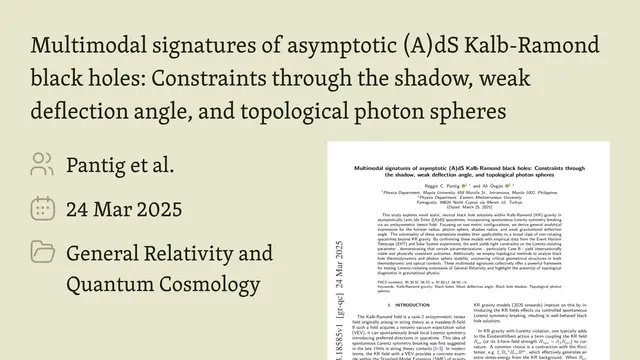
This lightning talk explores how electrically charged black holes behave when Lorentz symmetry breaks through the Kalb-Ramond field from string theory. We examine four key observables—light deflection angles, shadow characteristics, oscillation modes, and neutrino annihilation—that could reveal deviations from General Relativity in the strong gravity regime, with constraints already emerging from Event Horizon Telescope observations of supermassive black holes.Script
General Relativity has passed every test we've thrown at it for a century, but it breaks down where quantum gravity takes over. This paper investigates what happens when a field from string theory, the Kalb-Ramond tensor, breaks Lorentz symmetry around charged black holes, leaving observable fingerprints in their shadows and the paths of light.
The Kalb-Ramond field emerges naturally from string theory as an antisymmetric tensor that can create a preferred direction in spacetime. When this field couples to gravity and electromagnetism, it modifies the Einstein equations themselves, producing black hole solutions fundamentally different from those in General Relativity through a parameter the authors call ℓ.
These mathematical modifications translate into four measurable phenomena.
Light bending near these black holes deviates from Einstein's predictions in two regimes. Far from the black hole, deflection angles pick up corrections from the Lorentz-violating parameter. Closer in, at the photon sphere where light can orbit, the shadow cast by the black hole changes size in ways the Event Horizon Telescope can actually measure for objects like Sagittarius A star and M87 star.
Beyond photons, the research examines how black holes ring like bells after disturbances, producing quasinormal modes, and how neutrino pairs annihilate near the event horizon. Both phenomena encode the Lorentz violation signature, offering future tests through gravitational wave observatories.
The Event Horizon Telescope's images of supermassive black hole shadows already place meaningful constraints on how much Lorentz symmetry can be broken in this framework. The parameter ℓ is bounded by real observations, transforming this from pure theory into testable physics, with gravitational wave detections poised to narrow the allowed range even more.
String theory's fingerprints might already be hiding in the shadows of the universe's darkest objects, waiting for our instruments to resolve them. Visit EmergentMind.com to explore more cutting-edge research and create your own video presentations.