- The paper introduces the Mixture of Frames Policy which denoises multi-frame actions, adaptively fuses predictions, and preserves trajectory consistency.
- It employs a novel column-vector SE(3) representation to ensure accurate noise transformation across frames, enabling specialized frame experts.
- MoF outperforms fixed-frame baselines with up to 16 percentage points improvement in success rates across both simulation and real-world tasks.
Mixture of Frames Policy: Multi-Frame Action Denoising for Bimanual Mobile Manipulation
Introduction and Motivation
Robotic bimanual mobile manipulation tasks inherently involve a multiplicity of reference frames: base, end-effectors, and object-centric frames each present distinct action distribution characteristics. The complexity or compactness of these distributions varies widely across tasks and task phases. Prevailing diffusion-based visuomotor policies commit to a single action frame, inevitably inheriting the limitations imposed by that frame's bias or non-invariance. This work introduces the Mixture of Frames Policy (MoF), which departs from this convention by synchronously denoising actions in parallel across multiple task-relevant coordinate frames, then adaptively fusing the predictions. The result is a policy capable of exploiting the representational advantages of each frame without sacrificing consistency in trajectory optimization.
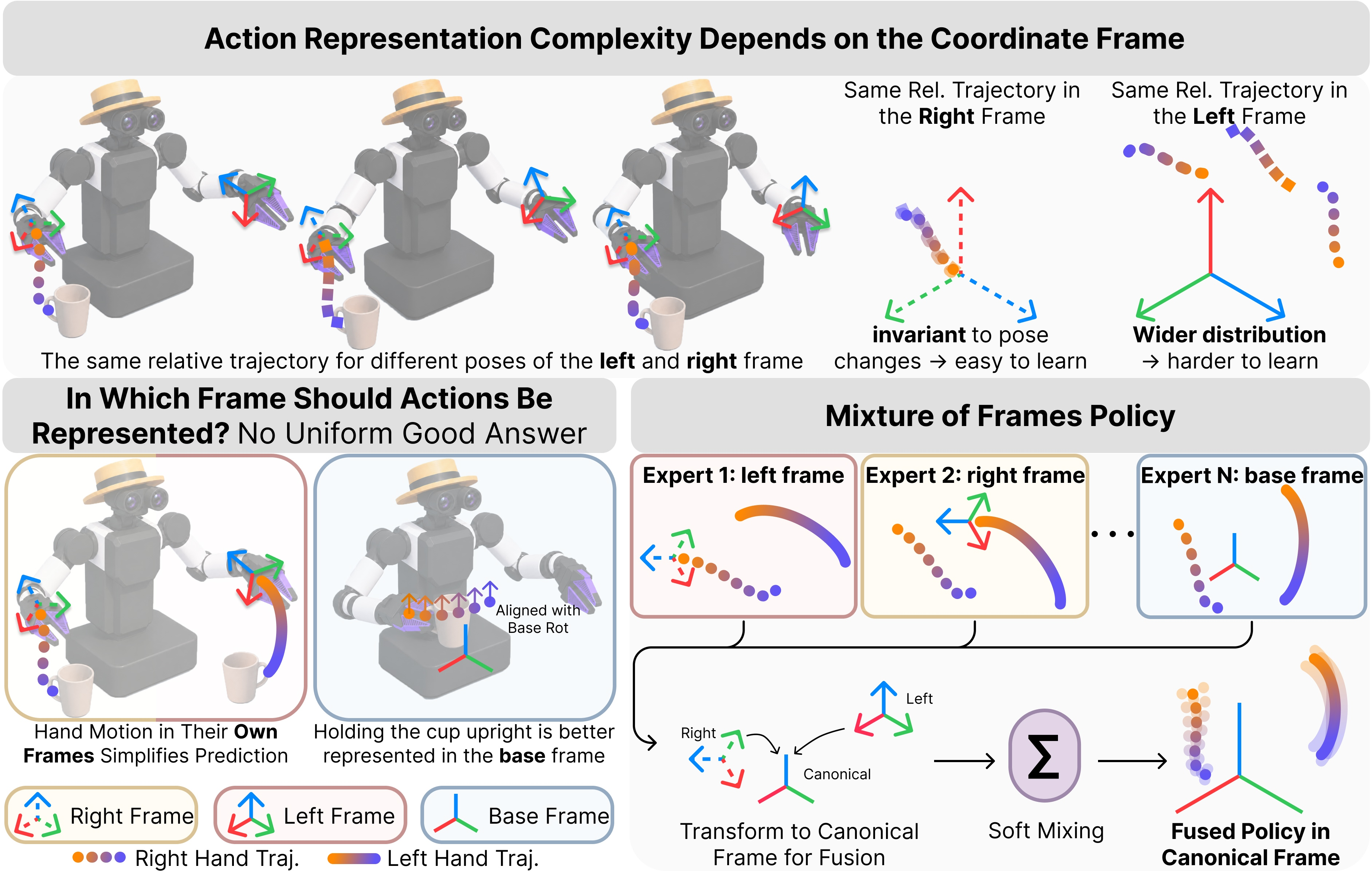
Figure 1: The Mixture of Frames (MoF) concept: each expert denoises in its own action frame, with predictions transformed and fused in a canonical frame.
Methodology
Multi-Frame Synchronized Action Denoising
MoF maintains a single canonical action trajectory as the diffusion process state. At each denoising step, this state is projected into each expert's frame, each frame-specific denoiser outputs a noise estimate, and all estimates are rigidly transformed back to the canonical frame for fusion—either by learned router weights or uniform averaging. This procedure requires differentiable, exact transformations not only for noise-free actions but also for noisy intermediate states. To this end, the paper introduces a column-vector action representation for SE(3), guaranteeing that arbitrary noisy vectors can be mapped across frames without projection onto SO(3), thus preserving the Markovian structure of the diffusion trajectory.
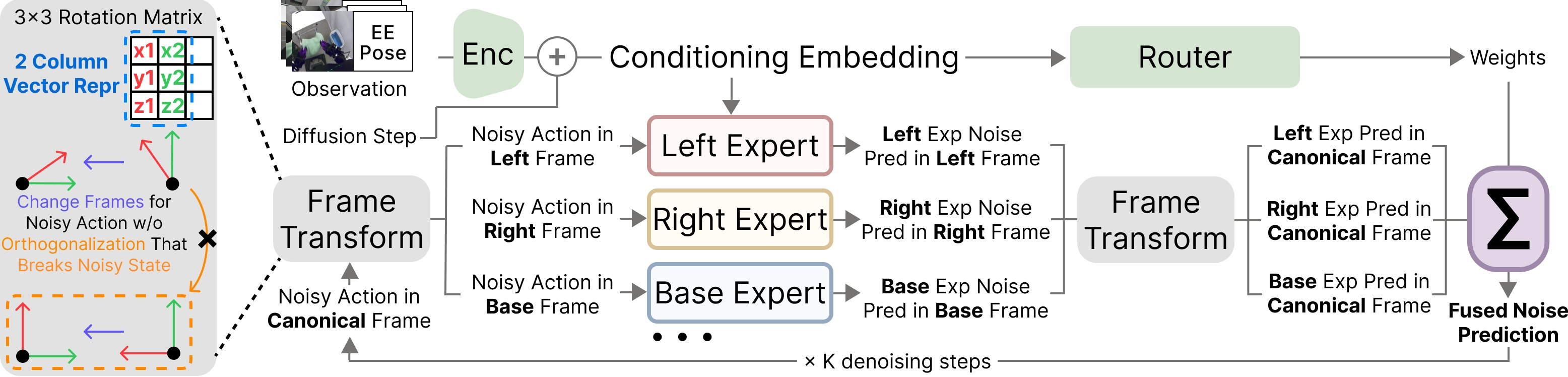
Figure 2: The MoF diffusion policy architecture: synchronized diffusion sampling, exact frame transformation using column-vector SE(3) representation, and router-driven fusion mechanisms.
Frame-Expert Set and Canonical Representation
MoF instantiates experts for left end-effector, right end-effector, base-relative, and per-arm relative-trajectory frames. This diverse expert set is shown empirically to cover the compact action representations required at various task phases: local manipulations, coordinated transports, and pose-invariant behaviors. The canonical frame is arbitrary—the framework is robust to its selection—but all diffusion takes place as a single sample path, ensuring convergence to a consistent action proposal.
Comparison with Conditioning/MoE Baselines
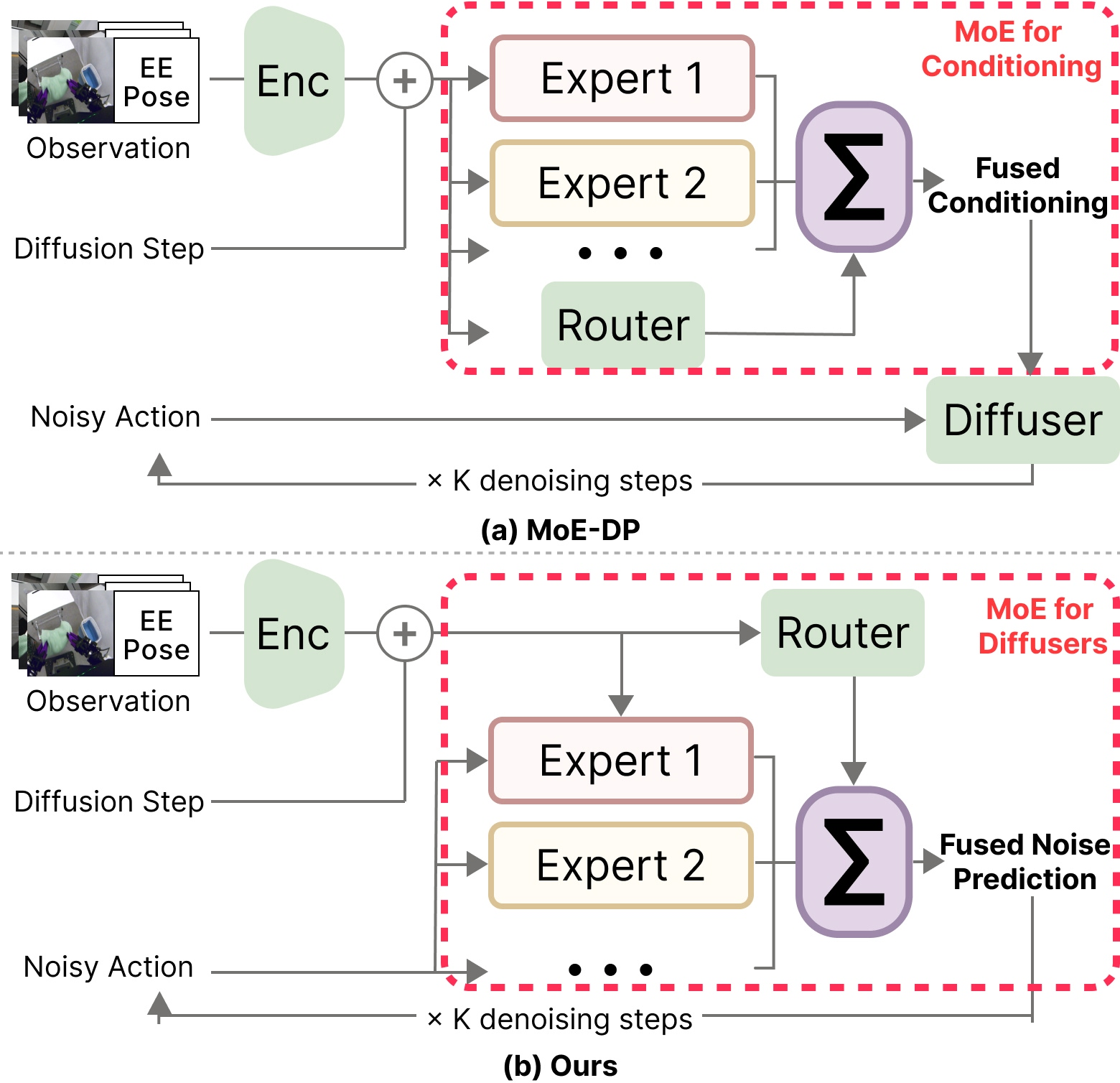
Figure 4: Structural distinction between conventional MoE-DP (left: MoE in observation encoder path only) and MoF (right: mixture over action-frames during denoising).
Crucially, MoF differs from standard mixture-of-experts approaches (e.g., MoE-DP), which allocate expert structure at the conditioning/feature level, but retain a single-frame action denoising process. By contrast, MoF places the mixture structure directly over action frames, enabling dynamic specialization to task-dependent action manifolds.
Simulation Results
Task and Baseline Evaluation
Nine diverse tasks from BiGym and DexMimicGen provide a comprehensive testbed for the impact of frame choice. Single-frame policies with fixed action frames show that no action frame universally optimizes the success rate across all tasks—task-dependent variance between the best (Oracle Frame) and worst frame averages 15 percentage points. The selection of the base frame, for instance, is advantageous for whole-body navigation, but suboptimal for local manipulations.
Multi-Frame Fusion Gains
MoF variants (w/ router: MoF-MoE, and uniform: MoF-Ensemble) consistently outperform Oracle Frame and established DP/MoE-DP baselines, with gains of up to 16 percentage points in mean success rate across tasks. Notably, MoF achieves strong improvement on tasks with marked phase decompositions—e.g., in Threading, router weights smoothly transition dominance between experts as the robot shifts from independent reaching to coordinated bimanual insertion. These intra-episode modulations are beyond reach for any single-frame or frame-agnostic ensemble approach.
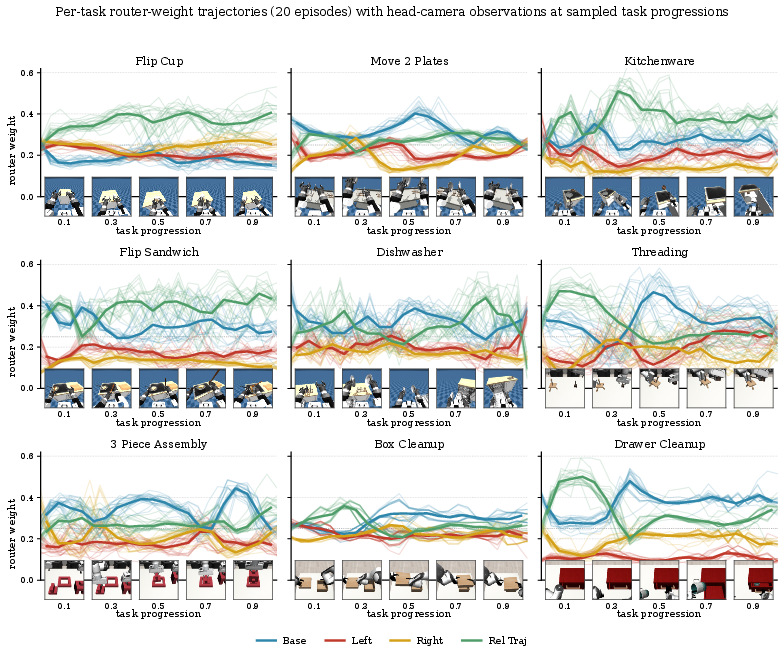
Figure 6: Router weight trajectories demonstrate phase-aligned modulation: rel-traj expert dominates during reach, switching to base-frame expert for coordinated phases.
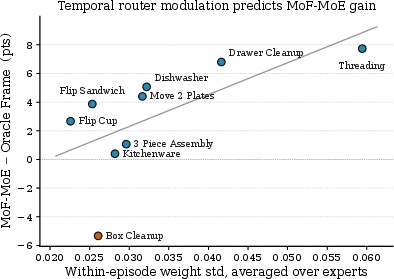
Figure 8: Quantitative correlation between router weight modulation amplitude and MoF-MoE advantage over Oracle Frame validates the alignment between dynamic frame-use and performance gain.
Ablations
The performance of the policy is robust to the choice of canonical frame; ablations removing the highest-performing expert or introducing incorrect frame transforms (with forced SO(3) projections) result in severe performance degradation, confirming the necessity of each MoF design element. Removing the per-expert auxiliary denoising loss also proves detrimental, emphasizing the value of direct supervision to maintain expert competence.
Real-World Experimental Validation
The approach is further validated on real-world bimanual mobile manipulation: pouring and serving tasks requiring fluid transitions between local and global reasoning, coordination, and manipulation. Here, MoF-MoE achieves 85% success on pouring and 70% on serving, outstripping all single-frame policy baselines by significant margins and demonstrating robust generalization to unseen object color and placement configurations.
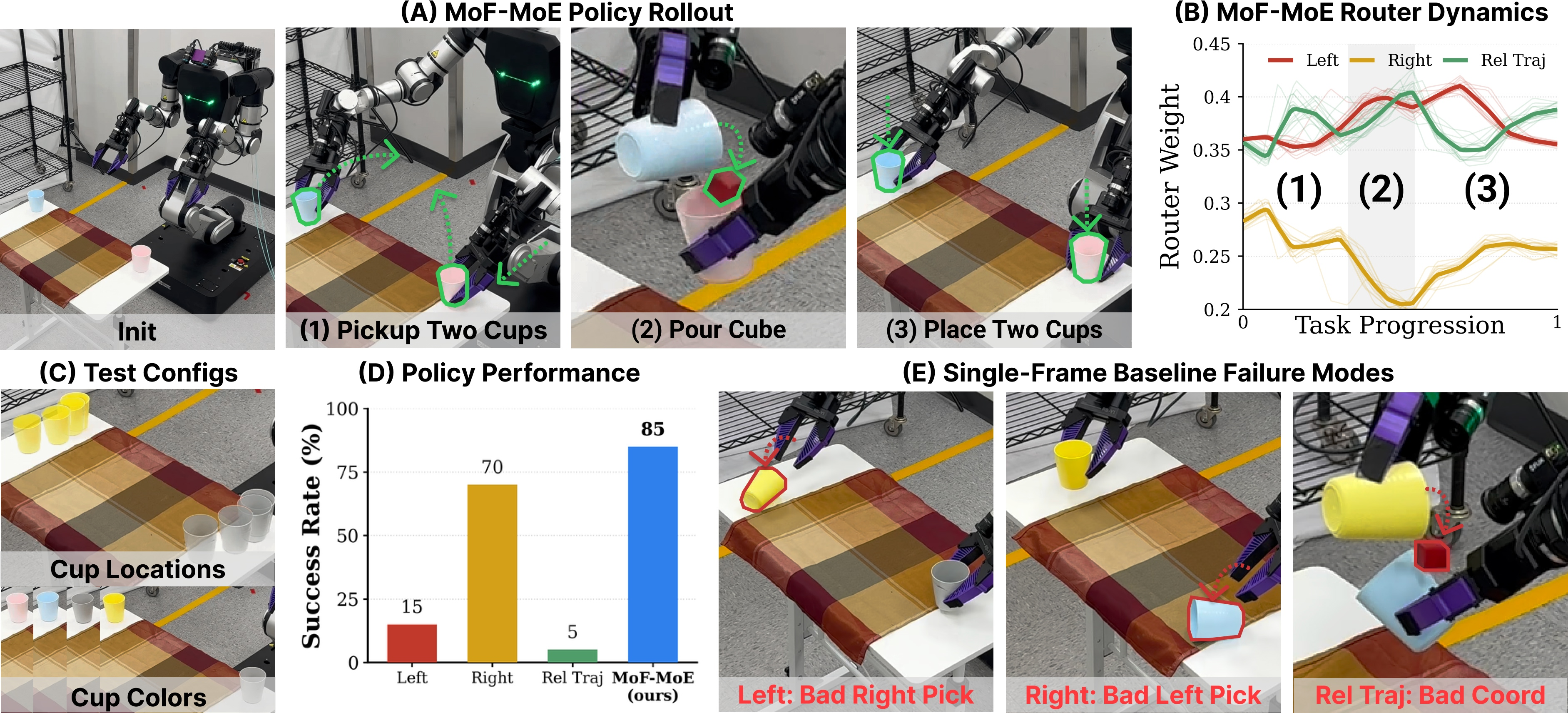
Figure 3: Pouring task: MoF rollout sequence, router weight evolution, generalization testbed, and phase-targeted failure cases in single-frame baselines.
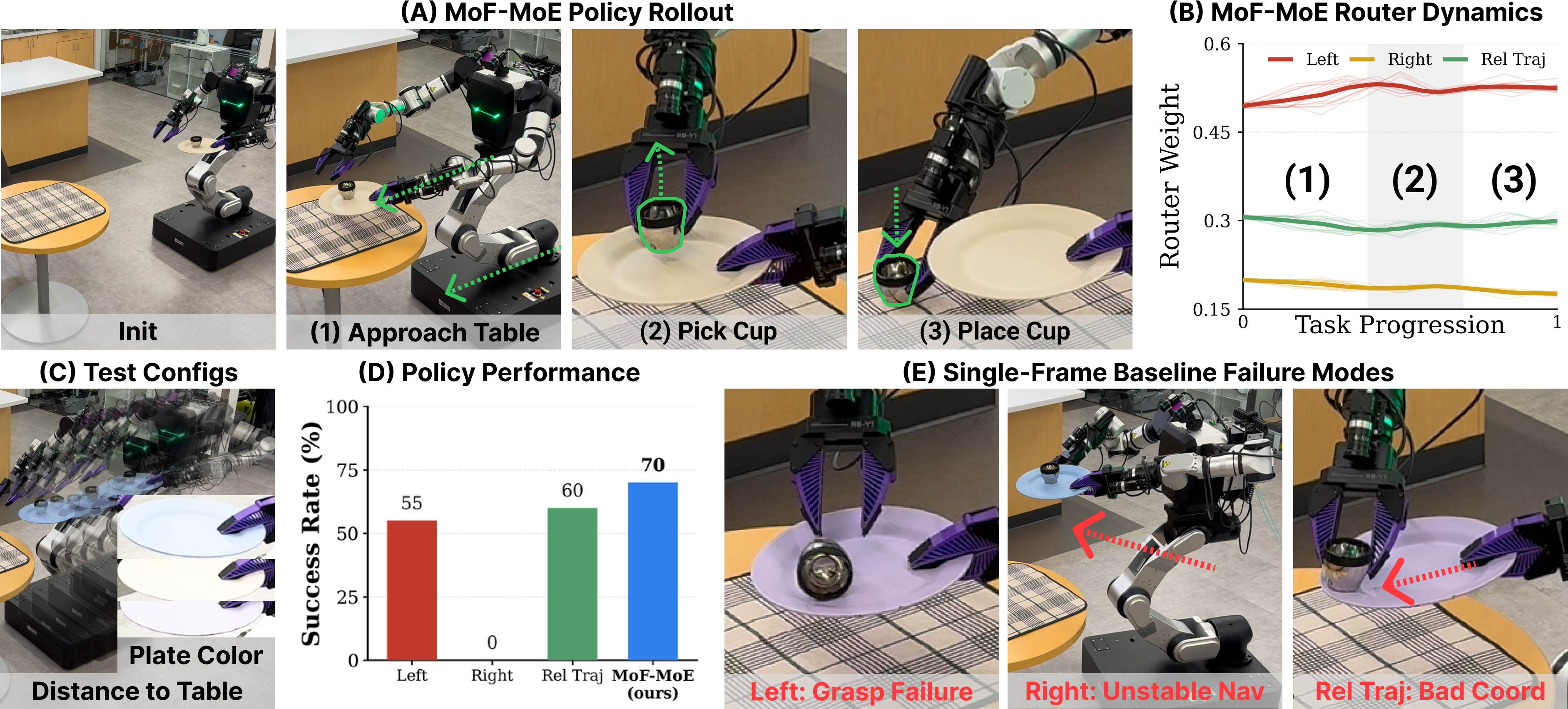
Figure 5: Serving task: analysis as for pouring, highlighting frame-dependent failures in baselines.
Routers learned by MoF adaptively shift weight between experts according to task phase, e.g., prioritizing relative trajectory or left end-effector in picking, switching to base or coordinated frames for transport, and emphasizing local stability frames for precision placement. Single-frame policies consistently fail in those subphases not aligned with their fixed frame.
Theoretical and Practical Implications
MoF empirically and analytically demonstrates that reasoning over multiple action frames is essential for high-fidelity visuomotor imitation learning in bimanual mobile manipulation. The introduction of synchronized, frame-specialized denoisers eliminates the need for hand-designed, task-specific frame selection, and provides a direct mechanism for context-dependent frame adaptation on the fly. This capability is essential for tasks with significant heterogeneity in local vs. global structure or sequential subgoal composition, such as cooperative transport, assembly, or serving.
Theoretical implications include:
- A general mechanism for modular action-space specialization that preserves the temporal and geometric consistency of the diffusion process.
- Foundations for extending MoF to compositional, hierarchical, or runtime-discovered frame expert sets.
Practical consequences are stark for real-world policy deployment: MoF's increased generalization and robustness are key for unstructured environments where hand-coded frame partitioning is infeasible.
Limitations and Future Directions
MoF depends presently on a designer-specified set of candidate frames and requires access to accurate proprioceptive transformations. Automatic discovery of optimal frame sets, adaptation to frame uncertainty, and integration with large-scale VLA architectures are identified as critical next steps. Furthermore, end-to-end behavior-aware objectives for router optimization may further align frame switching with ultimate task rewards and stability metrics.
Conclusion
Mixture of Frames Policy (MoF) establishes a robust, principled, and empirically superior paradigm for multi-frame action denoising in complex bimanual mobile manipulation. By unifying expert frame denoising via synchronized diffusion and adaptive fusion, MoF systematically transcends the limitations of single-frame and frame-agnostic mixture-of-experts approaches. This work repositions coordinate frame selection from a brittle design choice to a learned, context-sensitive, and performance-critical component of state-of-the-art visuomotor policy learning.
(2607.11884)