Video Generation Models are General-Purpose Vision Learners
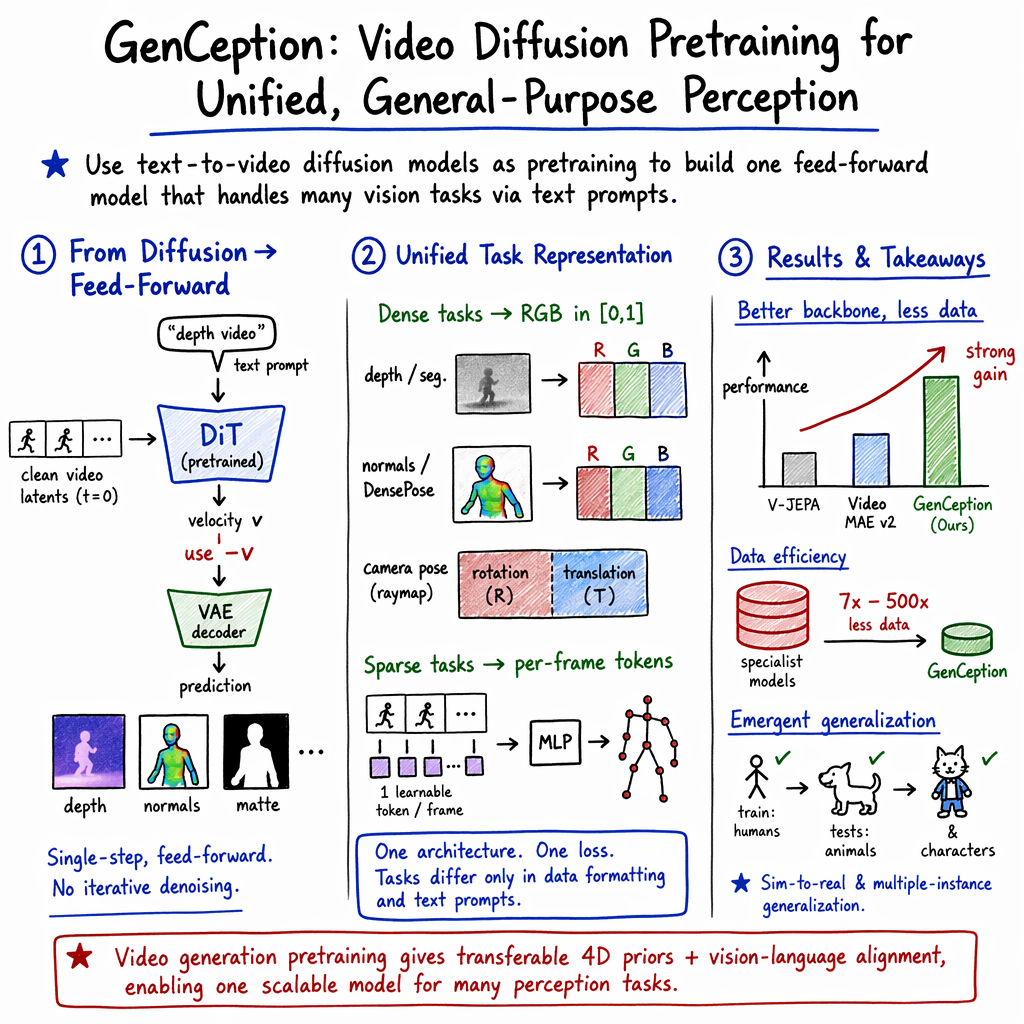
Abstract: Driven by next-token prediction, NLP shifted from task-specific models into powerful generalist foundation models. What, then, is the equivalent catalyst needed to achieve a general-purpose model in computer vision? In this paper, we contend that large-scale text-to-video generation serves as a strong pre-training paradigm for computer vision, providing the necessary spatiotemporal priors, vision-language alignment, and scalability required for general visual intelligence. We introduce GenCeption, which leverages a pre-trained video generative diffusion backbone to define a feed-forward perception model, capable of performing various vision tasks steered by text instructions. Empirical results demonstrate that GenCeption achieves state-of-the-art performance across a diverse suite of tasks, including depth, surface normal, and camera pose estimation, expression-referring segmentation, and 3D keypoint prediction, often matching or surpassing specialized models (e.g. DepthAnything3, SAM3, D4RT, VGGT-Omega, Sapiens, David, Genmo, and Lotus-2). Furthermore, the video generative pretrained backbone outperforms alternative pretraining paradigms (e.g., V-JEPA, and Video MAE) under comparable settings. Importantly, GenCeption exhibits preliminary data and model scaling properties along with exceptional data efficiency, where it achieves comparable performance with leading models like D4RT and VGGT-Omega with 7 to 500 less training data. Finally, GenCeption also exhibits intriguing emergent behaviors: a model trained exclusively on synthetic human videos generalizes to real-world footage and out-of-distribution object categories (e.g., animals and robots). These findings suggest that video generation is not merely a synthesis tool, but a foundational path toward generalist vision intelligence for the physical world. Project page: https://genception.github.io
Paper Prompts
Sign up for free to create and run prompts on this paper using GPT-5.
Top Community Prompts
Explain it Like I'm 14
What is this paper about?
This paper asks a big question: how can we build one “all‑in‑one” computer vision model that can understand many kinds of visuals (videos and images) the way LLMs (like chatbots) understand many kinds of text? The authors argue that training a model to create videos from text (text‑to‑video generation) is the key first step. They then show how to turn that video‑making model into a fast, general tool that can solve many vision tasks. They call their system GenCeption.
What questions are the researchers trying to answer?
The paper focuses on three simple questions:
- What kind of training helps a vision model learn about the real world best?
- Can one unified model, guided by plain‑language instructions, handle many different vision tasks without changing its architecture each time?
- Will this approach work well with limited training data and generalize to new, real‑world situations?
How did they do it? (Methods in everyday language)
Think of learning vision like learning physics from movies:
- When a model learns to generate realistic videos from text, it must “understand” how the world looks and moves over time—how objects persist, how 3D shapes work, and how actions unfold. That’s like learning basic “world rules.”
Here’s their approach, step by step:
- Start with a video generator: They take a powerful text‑to‑video “diffusion” model. Diffusion models usually create images by starting with static and then removing noise step by step, like cleaning a blurry photo until it’s clear. For videos, it’s like cleaning every frame so a believable clip appears.
- Turn the generator into a perceiver: Instead of slowly generating a new video, they feed a real input video into the model and reformulate it to make a one‑step prediction. In plain terms, they repurpose the video‑maker into a video‑understander that gives answers in a single, fast pass.
- Use text instructions to steer tasks: You can tell the model what to do using simple prompts like “Depth,” “Surface normals,” or “Segment the person wearing a yellow sweater.” The same model switches tasks based on the prompt—no extra model needed.
- Unified outputs: For “dense” tasks that need an answer for every pixel (like depth or segmentation), they put answers into a standard 3‑channel image format (RGB), which keeps everything consistent and simple. For “sparse” tasks (like predicting a person’s 3D joint positions), they add tiny additional inputs (“tokens”) and decode them into coordinates.
- Train mostly on synthetic data: They create a lot of high‑quality, computer‑generated human videos with ground‑truth labels (true depth, true surface directions, true masks, etc.). This is far cheaper than collecting and labeling real videos. For one language‑heavy task (referring segmentation), they also include real datasets.
- Keep training simple: They use a single, standard measure of error for all tasks, instead of juggling many different specialized loss functions. Task differences are handled by how the data is formatted, not by changing the model.
Analogy: They took a talented movie director (a video generator that “knows” how the world looks and moves), and turned them into a great movie critic (a perceiver) who can quickly answer different questions about any video—just tell them what to look for.
What did they find, and why is it important?
Main results:
- Strong, wide‑ranging performance: The single GenCeption model matches or beats specialized, task‑specific models on many benchmarks, including:
- Depth (how far things are)
- Surface normals (which way a surface is facing)
- Camera pose (where the camera is and where it points)
- Foreground and language‑guided segmentation (find the object described by a sentence)
- 2D/3D human keypoints (where body joints are)
- Better pretraining matters: Using a video‑generation backbone (trained to make videos from text) consistently outperforms other popular pretraining methods for video (like VideoMAE and V‑JEPA) under similar settings.
- Data efficiency and scaling: It reaches performance similar to top models while using about 7× to 500× less fine‑tuning data. It also improves as you give it more data and make it larger, a good sign for future scaling.
- Emergent generalization:
- Sim‑to‑real: Even though it was trained mostly on synthetic (computer‑made) human videos, it works well on real videos.
- Unseen categories: It also handles objects it never trained on (like animals or robots) and videos with multiple objects, even though training videos often had just one.
Why it matters:
- A single, instruction‑following model for many vision tasks is simpler and more flexible than maintaining dozens of specialized systems. It’s closer to how LLMs work: one backbone, many capabilities.
- Learning from video generation gives the model a natural feel for space and time (the “physics” of the world) and connects visuals to language, which helps it follow instructions.
- Using mostly synthetic data lowers costs and speeds up research and development.
What could this change in the real world?
If one general vision model can be steered by plain language and trained mostly on cheap synthetic data, many applications become easier to build and maintain:
- Robotics and drones: Understand scenes, estimate distances, and track movement with a single model.
- Self‑driving and AR/VR: Perceive depth, motion, and objects in real time from videos.
- Video editing and content creation: Quickly segment people or objects and track them across frames using natural language prompts.
- Research and education: Lower the barrier to testing new vision tasks—add a task by designing data, not by redesigning the model.
Big picture: This work suggests that video generation isn’t just for making cool clips—it can be the foundation for general visual intelligence, much like next‑token prediction became the foundation for language intelligence.
Knowledge Gaps
Unresolved limitations, knowledge gaps, and open questions
Below is a focused list of what remains missing, uncertain, or unexplored in the paper, phrased to guide concrete follow-up research:
- Data scope and diversity: Training relies predominantly on 7,500 synthetic, human-centric videos plus a few synthetic datasets; it remains unknown how performance scales and generalizes when pretraining/fine-tuning on diverse real-world, multi-category, multi-scene video corpora.
- Quantitative OOD generalization: Multi-instance and non-human generalization are shown only qualitatively; robust, quantitative evaluations on established OOD and multi-object video benchmarks are absent.
- Temporal extent and long-horizon behavior: The model is trained/evaluated on 81-frame clips at 24 FPS; generalization to long-form videos, higher frame rates, streaming inputs, and tasks requiring long temporal context (e.g., tracking, long-range camera odometry) is not assessed.
- Temporal consistency metrics: There is no quantitative evaluation of frame-to-frame consistency (e.g., flicker or warping-based metrics) for dense predictions across videos.
- Inference efficiency and deployability: The 14B model runs at ~8 FPS on a v6e TPU with ~43 GB of VRAM at 480×832; performance on commodity GPUs, latency under batching/streaming, and practical deployment strategies (e.g., distillation, pruning, quantization) are not explored.
- Variable length and resolution handling: The approach is tuned to a fixed clip length and resolution; robustness to arbitrary-length videos, variable resolutions/aspect ratios, and multi-scale inference is not evaluated.
- Dependence on a single backbone: Results are tied to WAN 2.1 and Rectified Flow; generality across other video generative backbones (e.g., EDM/score-based, autoregressive) and non-Rectified Flow objectives is untested.
- Unified 3-channel representation limits: Compressing high-dimensional outputs (e.g., 6-channel raymaps) into 3 RGB channels may be lossy; the fidelity and limits of this compression are not ablated against native representations.
- Absolute depth scale: Per-video median normalization and an L2 loss avoid task-specific objectives, but it is unclear how well the model recovers absolute depth scale and how evaluation aligns predictions to ground truth (scale-invariant vs. absolute).
- Single loss vs. task-specific objectives: The choice to use only an L2 loss is not compared to task-tailored losses (e.g., cosine loss for normals, BCE/Dice for segmentation), leaving unknown whether performance is capped by the unified loss.
- Sparse-output degradation in joint training: Joint multitask training harms 3D keypoint performance; alternatives (e.g., pretraining query tokens, adapters, MoE, auxiliary regularizers) are not investigated.
- Query token design for sparse tasks: The added learnable tokens (with 3D RoPE and temporal interpolation) are introduced without a systematic study of positional encoding choices, token counts, temporal scaling, or pretraining strategies to stabilize training.
- Vision-language alignment robustness: While text prompts steer tasks, robustness to prompt phrasing, compositional queries, negation, ambiguous instructions, long instructions, and multilingual inputs is not evaluated.
- Language understanding benchmarks: No quantitative assessment of language comprehension beyond two referring segmentation datasets; broader multimodal benchmarks (e.g., compositional reasoning) are missing to support claims about vision-language alignment.
- Task breadth and coverage: Several common video perception tasks (e.g., optical flow, scene flow, multi-object tracking with IDs, instance segmentation, open-vocabulary detection, 3D reconstruction/NeRFs) are not evaluated within the unified framework.
- Camera pose evaluation breadth: Camera pose is tested only on Sintel; performance on real-world odometry datasets (e.g., KITTI Odometry, TUM RGB-D, EuRoC) and under challenging conditions (motion blur, low light) remains unknown.
- Robustness and stress testing: Sensitivity to common corruptions (noise, blur, compression), adverse weather/lighting, camera distortions, and challenging materials (transparency/reflectivity) is not studied.
- Uncertainty and calibration: The model produces point estimates; uncertainty quantification, calibration, and confidence-aware evaluation for safety-critical applications are not addressed.
- Multitask interference vs. synergy: Beyond anecdotal degradation in some tasks, there is no systematic analysis of negative transfer, per-task gradients, data-mix scheduling, or strategies to mitigate interference.
- Data mixture policy: The method claims data-centric harmonization but does not disclose or analyze task/data mixing schedules, sampling ratios, or curriculum strategies that could materially affect multitask performance.
- Scaling laws and compute: Only preliminary scaling is shown; rigorous scaling curves with controlled compute/data, and characterization of diminishing returns and regime changes, are lacking.
- Fairness of pretraining comparisons: Comparisons to V-JEPA and VideoMAE may not be compute- or data-matched; controlled experiments equalizing compute budgets, training durations, and data are needed to isolate objective vs. scale effects.
- VAE bottleneck effects: The impact of the VAE compression on fine-grained dense predictions (e.g., thin structures, high-frequency details) and whether higher-capacity VAEs improve performance is not analyzed.
- Streaming/online inference: It is unclear whether the feed-forward DiT can operate in a causal/online manner for real-time applications without accessing the full clip.
- Failure mode analysis: The paper lacks a systematic error analysis (e.g., where depth fails, segmentation leakage on boundaries, articulated motion failure cases), hindering targeted improvements.
- Bias and ethics: Biases arising from the (unspecified) text-to-video pretraining corpus and the synthetic fine-tuning data (e.g., demographics, attire, body shapes) and their downstream effects are not evaluated.
- Data and reproducibility: The synthetic data generation pipeline (assets, motions, scenes) is described but its release status is unclear; reproducibility is further hindered by missing hyperparameters (e.g., exact gradient clipping/dropping thresholds).
- Licensing and compliance: The legal/ethical status and licensing constraints of the WAN 2.1 pretraining data and weights for various use cases (e.g., commercial) are not discussed.
- Generalization to new tasks via prompting: The model’s ability to handle entirely new modalities specified only via prompt (without retraining) is untested; the extent of “instruction-following” beyond the enumerated tasks is unclear.
- Multimodal extensions: Integration with audio or other sensory streams is not explored, despite claims toward generalist perception.
- Distillation and model compression: No study of compressing the 14B model into smaller deployable models while preserving performance (e.g., knowledge distillation, low-rank adaptation).
- Cross-backbone modularity: How interchangeable the VAE, text encoder, and DiT components are (and their individual contributions) is not ablated, limiting architectural generalization.
- Evaluation breadth for segmentation: For foreground and referring segmentation, reliance on MSE or J&F leaves open whether the approach achieves competitive boundary quality, instance separation, and stability across video; broader metrics and datasets are needed.
- Training stability mechanisms: Gradient dropping/clipping are critical but under-specified; a study of stability regions and alternatives (e.g., optimizers, schedulers, norm scaling) is missing.
Practical Applications
Immediate Applications
Below are actionable, sector-linked use cases that can be deployed now, using the paper’s feed-forward, text-prompted, unified perception model and its demonstrated performance on depth, normals, camera pose, segmentation, expression-referring segmentation, and 3D keypoints.
- Media/Creative (video editing, VFX, UGC platforms)
- What: Text-prompted segmentation/matting (“segment the person with a red jacket”), soft foreground extraction, and camera tracking from raw footage for roto, relighting, and compositing.
- Tools/products/workflows: NLE/DAW plugins (e.g., Premiere/Resolve/Final Cut), After Effects nodes; batch “prompt-to-mask” pipelines for asset libraries; on-device or cloud “smart green screen.”
- Assumptions/dependencies: GPU/TPU or high-end CPU for inference; licensing/weights availability of pre-trained video diffusion backbone; guardrails for ambiguous prompts; human-in-the-loop QC.
- Social platforms and Trust & Safety
- What: Prompt-based detection/segmentation of policy-relevant objects or actions (e.g., “segment knives,” “highlight vehicles moving against traffic”) to triage content for review.
- Tools/products/workflows: Moderation triage queues with prompt templates; compliance dashboards that surface explainable masks and clips.
- Assumptions/dependencies: Human review in the loop; bias audits; clear policy mappings; privacy-by-design data handling.
- Robotics (drones, warehouse, mobile bases)
- What: Drop-in unified perception module for depth, surface normals, and camera pose to improve navigation, obstacle avoidance, 3D mapping, and grasp planning.
- Tools/products/workflows: ROS2 nodes exposing a “prompt-to-perception” API; SLAM front ends using raymap outputs; plug-ins for Isaac/ROS/Unity.
- Assumptions/dependencies: Real-time constraints (8–14 FPS figures shown; may need distillation/pruning for edge SoCs); robustness checks in multi-object, cluttered scenes; safety validation.
- AR/VR and Mobile Cameras
- What: Real-time occlusion, background matting, portrait relighting, and room scanning from monocular video for more realistic AR compositing.
- Tools/products/workflows: Unity/Unreal SDKs that accept text prompts for target layers; smartphone camera enhancement apps.
- Assumptions/dependencies: On-device acceleration (NNAPI/Core ML/Vulkan); power/thermal budget; tuning for indoor/outdoor domain shifts.
- Sports, Fitness, and Biomechanics
- What: 3D keypoint estimation from broadcast or training video for coaching, injury prevention, and performance analytics.
- Tools/products/workflows: Web/mobile coaching dashboards; gym kiosks that analyze recorded sets.
- Assumptions/dependencies: Multi-person scenes and occlusions require validation; the paper notes joint training can degrade 3D keypoints—prefer specialist fine-tuning or task-specific post-training for immediate deployment; camera viewpoint constraints may apply.
- AEC/Construction and Film Set Workflows
- What: Fast camera trajectory and depth estimation from walkthrough video for on-site previsualization, quick scene scale-ups, and match-moving.
- Tools/products/workflows: “Video-to-3D” site capture utilities; VFX camera-tracking assistants; BIM viewers ingesting raymaps/depth.
- Assumptions/dependencies: Depth is normalized in training; absolute scale recovery needs fiducials/known baselines or multi-view fusion; quality degrades in low-texture or reflective scenes without domain adaptation.
- E-commerce and Retail
- What: Product/person segmentation and background cleanup for catalog videos; AR try-on occlusion handling using depth and matting.
- Tools/products/workflows: Seller onboarding tools with prompt-driven cutouts; retail media pipelines for UGC hygiene.
- Assumptions/dependencies: Edge deployment optimization; privacy and consent handling for user uploads; fair performance across demographics.
- Wildlife/Ecology and Field Research
- What: Tracking and segmentation of non-human subjects (animals, robots) in unconstrained footage, leveraging shown OOD generalization.
- Tools/products/workflows: Conservation dashboards for population monitoring; automated highlight reels for behavioral studies.
- Assumptions/dependencies: Validate across species and habitats; limited training data on non-human categories may require light adaptation.
- Remote Work and Telepresence
- What: High-quality background matting and depth-aware bokeh for conferencing without green screens.
- Tools/products/workflows: SDKs for conferencing platforms; GPU-accelerated desktop and mobile apps.
- Assumptions/dependencies: Mobile inference constraints; latency targets for real-time conversational settings.
- Academic R&D and Education
- What: A unified, task-agnostic pretraining and post-training recipe for multi-task video perception; scalable synthetic data generation workflow for labels across depth/normals/segmentation/pose.
- Tools/products/workflows: Course labs and workshops (“build a generalist vision model”); synthetic data pipelines (Blender-based) for new tasks.
- Assumptions/dependencies: Access to compute; availability of open-weight backbones; careful data mixture design for multi-task stability.
- Industrial Safety Audits (PPE, hazard zones)
- What: Prompt “segment hardhats” or “highlight people in restricted zones” on recorded or edge-captured video for compliance checks.
- Tools/products/workflows: Post-hoc audit tools; real-time alerts in monitored zones using on-prem GPUs.
- Assumptions/dependencies: Ethical and legal review; high-recall requirements and calibrated false-positive thresholds; worker privacy safeguards.
Long-Term Applications
Below are forward-looking uses that require more research, scaling, and productization—e.g., higher FPS on edge, broader domain pretraining, stronger multi-object reasoning, or regulatory certification.
- Autonomous Driving and ADAS
- What: Consolidated perception stack (depth, normals, ego pose, instance segmentation) with text-driven task configuration across weather and geography.
- Tools/products/workflows: Unified perception backbone for self-driving; validation suites built around synthetic + real-world curricula.
- Assumptions/dependencies: Functional safety certification; large-scale real-world and sim datasets; edge inference at 30–60 FPS; robust multi-object tracking.
- Household and Service Robotics
- What: Generalist, instruction-following perceiver for multi-task manipulation and navigation (“find the red mug,” “avoid wet floor,” “track the person”).
- Tools/products/workflows: Vision module integrated with policy learning and VLMs; home-environment synthetic pretraining + continual on-device learning.
- Assumptions/dependencies: Tight LLM–vision alignment; open-world generalization; reliability in cluttered, dynamic homes; safety and privacy governance.
- Surgical and Clinical Video AI
- What: Depth and tool/tissue segmentation for minimally invasive surgery, and post-op rehab assessment via 3D keypoints.
- Tools/products/workflows: OR-integrated perception assistants; clinical analytics dashboards.
- Assumptions/dependencies: Regulatory approval (FDA/CE); domain-specific training with medical data; robust performance guarantees and explainability.
- City-Scale Digital Twins and Infrastructure Inspection
- What: Multi-camera video-to-3D pipelines for persistent mapping, change detection, and asset monitoring (bridges, lines, solar farms).
- Tools/products/workflows: “Perception as a Service” that fuses raymaps/depth across fleets; maintenance prioritization dashboards.
- Assumptions/dependencies: Privacy-preserving data collection; synchronization and scale calibration; long-horizon temporal consistency; compute and storage budgets.
- Agentic Perception-Language Systems
- What: A general-purpose vision backbone tightly coupled with LLMs for multi-step, instruction-conditioned reasoning over video (e.g., “track the person who picked up the blue bag, then measure gait”).
- Tools/products/workflows: Multi-modal agent frameworks with memory and planning; dataset recipes for chain-of-thought in video.
- Assumptions/dependencies: Training for cross-modal reasoning; safe deployment to avoid over-interpretation; latency control.
- Professional Sports Officiating and Broadcast Enhancements
- What: Automated line calls, offsides detection, and pose-based event analytics; AR overlays synchronized to live camera pose.
- Tools/products/workflows: League-certified review tools; live broadcast pipelines.
- Assumptions/dependencies: Multiview calibration; fairness and transparency; strict accuracy thresholds before on-field use.
- Education and Skills Training
- What: Automated lab/video tutors that provide feedback on procedures via segmentation and pose (“you held the pipette at 45°”).
- Tools/products/workflows: Classroom kits and LMS integrations; creator tools for instructors to prompt custom assessments.
- Assumptions/dependencies: Domain adaptation per discipline; robust handling of low-resource school hardware.
- XR “World-Understanding” Services
- What: OS-level service for real-time scene understanding (occlusions, collisions, surface normals) enabling more realistic physics and interaction.
- Tools/products/workflows: APIs in AR operating systems; headset-optimized generative pretraining.
- Assumptions/dependencies: 60–120 FPS pipelines with low latency; power constraints; on-device privacy.
- Energy and Sustainability
- What: Drone-based inspection and monitoring (wind blades, solar panels, pipelines) with depth/pose and segmentation to locate defects and estimate severity.
- Tools/products/workflows: Field-to-cloud inspection workflows; proactive maintenance planners.
- Assumptions/dependencies: Domain-specific fine-tuning; all-weather robustness; safety of flight operations.
- Insurance and Claims
- What: Rapid, explainable video assessments for property/auto claims with depth- and pose-aware measurements and object-level segmentation.
- Tools/products/workflows: Adjuster apps with overlays; triage queues with confidence scoring.
- Assumptions/dependencies: Privacy and consent; anti-fraud safeguards; calibration for accurate scale recovery.
- Standards, Benchmarks, and Policy
- What: Guidelines for synthetic-to-real evaluation, data mixture design for multi-task training, and pretraining disclosures for foundation vision models.
- Tools/products/workflows: Industry benchmark suites (multi-object, multi-domain); certification paths for generalist perception.
- Assumptions/dependencies: Cross-stakeholder alignment; evolving regulations on surveillance and generative training data.
Cross-Cutting Assumptions and Dependencies
- Availability and licensing of large text-to-video backbones (e.g., WAN 2.1) and weights for adaptation.
- Compute and latency targets: paper shows 8–14 FPS at 480×832×81 frames on high-end TPUs; many applications require model distillation, pruning, or hardware acceleration for edge.
- Data strategy: synthetic data pipelines help with diversity and labeling cost; some domains (medical, AV) still require real data and rigorous validation.
- Task balance and stability: joint training can regress some tasks (e.g., 3D keypoints); consider specialist heads or curriculum/mix tuning.
- Scale calibration: monocular depth is normalized; absolute scale needs additional cues (fiducials, multi-view, known baselines).
- Safety, ethics, and privacy: human oversight for moderation/surveillance; consent and secure handling of video; bias and fairness audits; regulatory approvals in sensitive sectors.
- Integration with language: instruction-following hinges on strong vision-language alignment and robust prompt design.
Glossary
- AbsRel: Mean absolute relative error used to evaluate depth estimation models. "the mean absolute value of the relative depth (AbsRel)"
- Average Translation Error (ATE): Metric measuring average error in estimated camera translation. "average translation error (ATE)"
- CLIP: A vision-LLM trained with contrastive learning to align images and text. "such as CLIP [51] or DINO [48]"
- Contrastive learning: Self-supervised approach that pulls semantically similar samples together and pushes dissimilar ones apart. "Another prominent paradigm, contrastive learning, aims to align semantically similar samples while separating dissimilar ones."
- DensePose: Task/representation mapping image pixels to 3D human body surface coordinates. "DensePose estimation"
- Denoising steps: Iterative diffusion process steps that progressively transform noise into a signal. "conducts a number of denoising steps"
- DiT (Diffusion Transformer): Transformer architecture used as the core neural network in latent diffusion models. "diffusion transformer (DiT)"
- DINO: A self-distillation framework for visual representation learning. "such as CLIP [51] or DINO [48]"
- Emergent behaviors: Unplanned capabilities that arise at scale or with certain training paradigms. "this paradigm triggers emergent behaviors, including seamless sim-to-real transfer"
- Feed-forward perception model: Reformulated single-step inference model derived from an iterative diffusion backbone. "single-step, feed-forward perception model"
- Few-shot LoRA: Parameter-efficient fine-tuning method (LoRA) applied with very few task examples. "few-shot LoRA adaptation"
- HDRI: High Dynamic Range Imaging environments used as photorealistic lighting/backdrops in rendering. "HDRI backdrops"
- Inverse rendering: Estimating scene properties (e.g., geometry, materials, lighting) from images or video. "tackle the dual problems of inverse rendering and forward rendering."
- J&F score: Metric for video object segmentation combining region similarity (J) and boundary accuracy (F). "J&F scores 50"
- Latent space: Compressed representation space where diffusion models operate and losses can be applied. "applied directly in the latent space"
- Latent tokens: Tokenized latent representations of video frames processed by the diffusion transformer. "transforming it into latent tokens"
- Learnable tokens: Additional trainable tokens appended to the model input to predict structured outputs. "We append T learnable tokens"
- Masked autoencoders (MAE): Self-supervised models that reconstruct masked parts of images to learn representations. "masked autoencoders 23, 49, inspired by masked language modeling [8, 14], learn to reconstruct missing image regions"
- Mean Per Joint Position Error (MPJPE): Average Euclidean error between predicted and ground-truth 3D joint positions. "mean per joint position error (MPJPE)"
- Monocular depth estimator: Model predicting scene depth from a single RGB image or video frame. "to act as a monocular depth estimator."
- Open-vocabulary classification: Recognizing categories beyond a fixed label set by leveraging text supervision. "open-vocabulary classification and segmentation."
- Out-of-distribution (OOD) generalization: Model’s ability to perform on categories or data distributions not seen during training. "out-of-distribution generalization to unseen object categories"
- Pixel-space raymap: Dense per-pixel encoding of camera rays (origins and directions) as images. "pixel-space raymap [28, 83, 85]"
- Rectified Flow: Diffusion-style training objective predicting a velocity field between noise and data for efficient generation. "the 'Rectified Flow' variant [16, 44, 45]"
- Relative Pose Error (RPE-R): Rotation component of relative pose error for camera pose estimation. "relative pose error - rotation (RPE-R)"
- Relative Pose Error (RPE-T): Translation component of relative pose error for camera pose estimation. "relative pose error - translation (RPE-T)"
- RoPE (Rotary Positional Embeddings): Technique for encoding positional information in transformer attention using rotations. "we apply its native 3D RoPE to the additional tokens."
- Self-distillation: Training a student model to match a teacher’s feature distributions to improve representations. "leverages feature-level self-distillation"
- Sim-to-real transfer: Generalization from models trained on synthetic data to real-world data. "seamless sim-to-real transfer"
- Spatiotemporal priors: Learned assumptions about 3D structure and temporal dynamics in video. "providing the necessary spatiotemporal priors"
- Text-to-video diffusion model: Generative model that synthesizes video conditioned on text prompts via diffusion. "text-to-video diffusion model"
- VAE (Variational Autoencoder): Probabilistic encoder-decoder used to map images/videos to and from a latent space. "a VAE encoder-decoder pair"
- VideoMAE: Extension of masked autoencoders to video for self-supervised representation learning. "Later works like VideoMAE [61] and RVM [87] have extended this to the video domain."
- Vision-language alignment: Associating visual features with linguistic semantics for instruction following and multimodal tasks. "vision-language alignment"
- V-JEPA: A video extension of JEPA (Joint-Embedding Predictive Architecture) for self-supervised video representation learning. "We use the largest available variants of V-JEPA [4] and VideoMae V2 [61]"
- Zero-shot generalization: Performing a task without task-specific training examples by leveraging prior knowledge. "generalizes in zero-shot to real videos with multiple objects."
Collections
Sign up for free to add this paper to one or more collections.