Creativity from Friction: Human-AI Interaction for Exploratory Structural Design
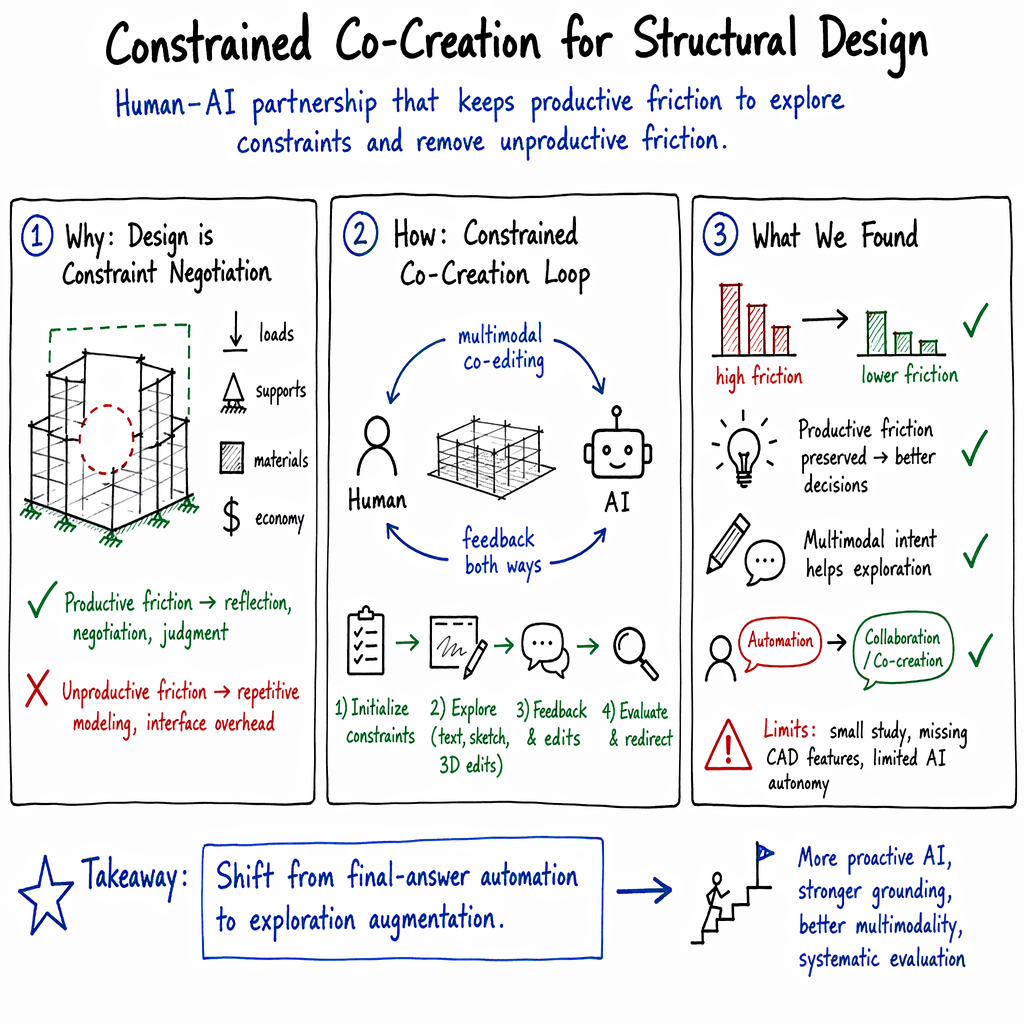
Abstract: AI agents that generate final answers based on user input often do not meet the needs of creative fields. Fields such as structural design and architecture need interactive systems that help users externalise and develop ideas, explore alternatives, and refine partial solutions. The final product of such designs needs to comply with many constraints concerning, e.g., spatial configuration, mechanical behaviour, material quantities, and costs. These constraints create friction in the design process, which can stimulate novel and creative solutions. In this paper, we discuss the misalignment between current generative AI goals to remove friction and provide final solutions and the needs of creators, such as structural designers, who develop ideas through iterative work. We present the design dimensions of systems allowing for constrained human-AI co-creation that rely on vision-LLMs making structural exploration conversational, multimodal, and responsive to evolving human intent in ways that follow and augment the discipline's creative process. Through a pilot design interface based on these principles and a study with experts in the field, this paper shows how structural designers perceive interactive AI systems and how such systems can support design space exploration by reducing repetitive modelling friction while preserving reflective design friction.

Paper Prompts
Sign up for free to create and run prompts on this paper using GPT-5.
Top Community Prompts
Explain it Like I'm 14
What is this paper about?
This paper looks at how people and AI can work together to design building structures (the “skeletons” that hold buildings up). Instead of asking AI to spit out a finished design, the authors argue that AI should be an interactive partner that helps humans explore ideas, compare options, and improve early, rough concepts—while still respecting real-world rules like safety, materials, and cost.
They call this approach “creativity from friction,” meaning some “good” difficulty (like real constraints and trade‑offs) actually sparks better ideas, while “bad” difficulty (like boring, repetitive modeling) should be reduced by AI.
What questions does the paper try to answer?
The paper focuses on simple, practical questions:
- How can AI help designers explore many structural ideas, not just jump to one final answer?
- What features should an AI tool have so it respects engineering rules and keeps the human in control?
- Can a prototype tool (that understands both sketches and text) make designing faster and more creative without losing safety and quality?
How did the researchers study this?
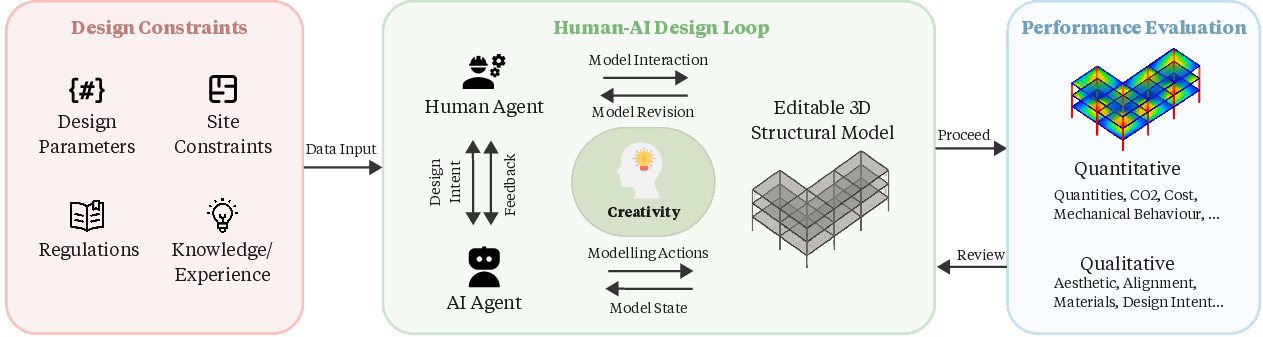
The authors propose a “constrained co-creation” workflow and build a pilot design tool. Think of it like this: the human and the AI take turns editing a shared 3D model of a building. The human can type instructions or sketch on the screen; the AI “understands” both words and drawings and makes changes to the model. The AI they used is a vision-and-LLM (it can look and read), so it can respond to both sketches and text.
They also define four features they believe any good human–AI structural design tool should have. Here they are in plain language:
- Model grounding: The AI must know basic structural rules (what keeps buildings safe and standing).
- Shared representation: The model should be easy for people to see and edit, and also easy for AI to read and modify.
- State awareness: The AI should remember what has been changed and what the current design looks like.
- Multimodal intent: The tool should accept different ways of communicating—text, sketches, and direct edits—because designers don’t just use words.
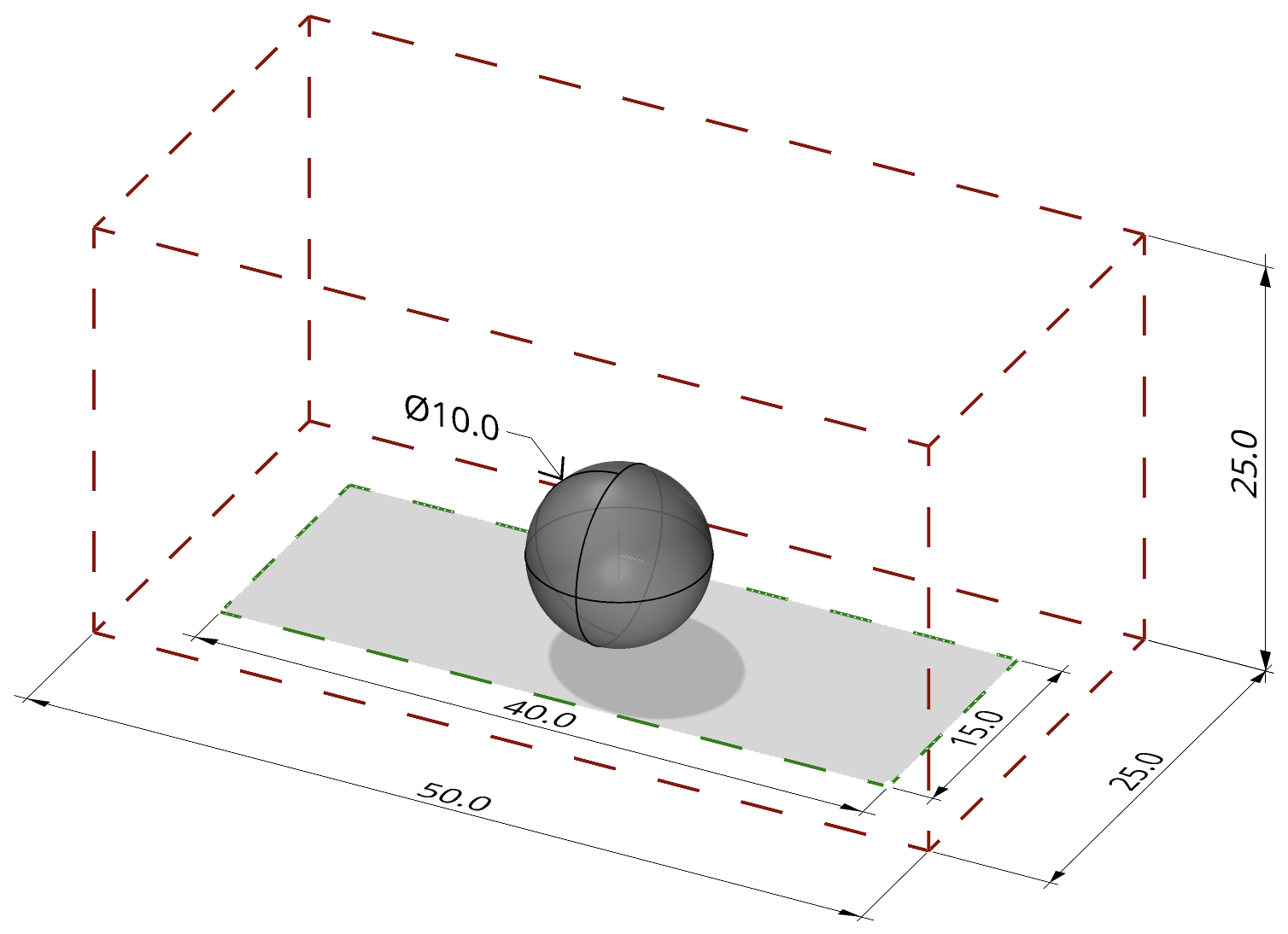
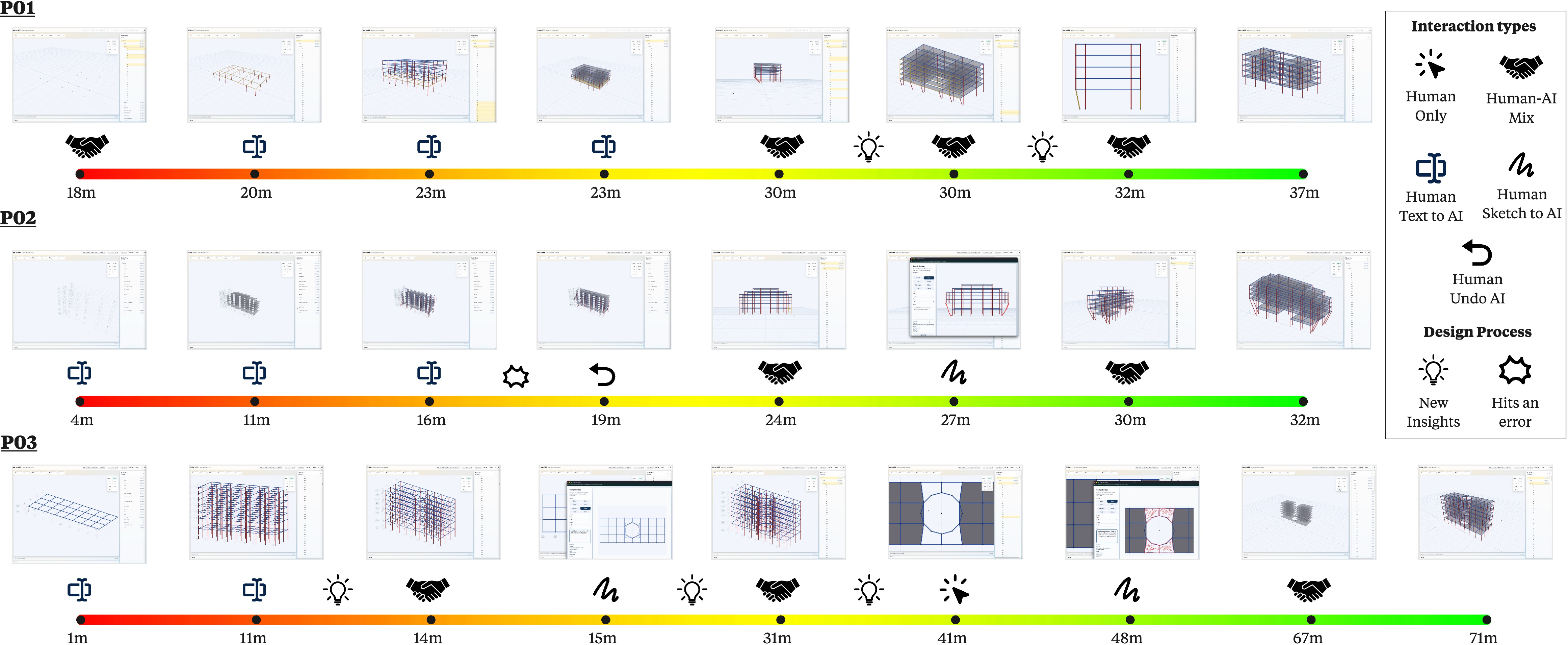
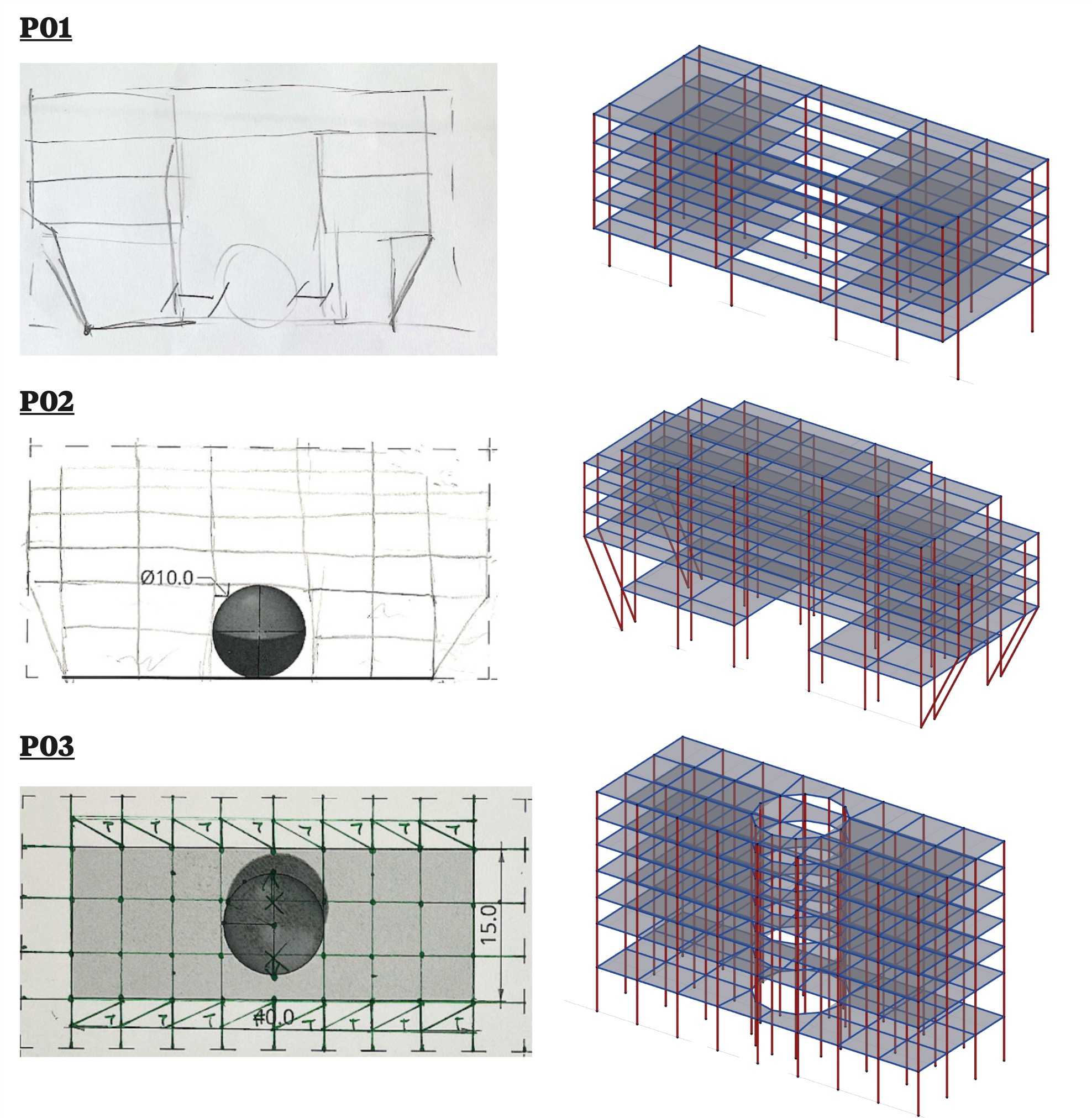
Then they ran a small, hands-on study with 3 experienced users (architects/engineers). The task: design a multi‑storey building inside a size limit, place supports only in a certain area, and keep an open plaza in the middle (imagine there’s an invisible sphere you must not touch). Each person sketched their idea first, then used the tool to build and refine a 3D structural model by mixing manual edits, text prompts, and on-screen sketches. The researchers observed what helped, what slowed them down, and how their ideas changed.
What did they find, and why does it matter?
Here are the main takeaways and why they’re important:
- Exploration beats one-shot answers: All three designers changed their initial ideas as they worked. The tool helped them explore alternatives, which is how creative design really happens. This supports the idea that AI should help the journey, not jump straight to the destination.
- Keep the “good friction,” remove the “bad friction”:
- Good friction: Engaging with constraints (like column lengths, spacing, and open areas) made designers rethink and improve their ideas. This reflective effort led to smarter designs.
- Bad friction: Repetitive tasks (like copying grids, placing many similar beams/columns) were time-consuming. The AI handled these well, saving time and attention for creative choices.
- Multimodal input is powerful—but not perfect:
- Sketches helped express messy, early ideas that are hard to put into words.
- Text prompts were great for clear, repetitive commands (like “copy this floor up 5 times”).
- Sometimes the AI misunderstood sketches or complex instructions, which slowed things down.
- Human control matters:
- Participants saw the tool mostly as an assistant. Some called it “automation,” some “collaboration.”
- They wanted the AI to respect constraints, help spot problems, and do repetitive work—but they still wanted to make the key decisions.
- Limitations:
- This was a small, early study (3 participants).
- The prototype is still developing; some CAD-like features were missing.
- The AI didn’t proactively suggest big design changes; designers initiated most pivots themselves.
- The study wasn’t designed to prove that AI alone makes designs “more creative,” but to observe how interaction patterns can help.
These findings matter because real-world structural design is full of rules and trade-offs. A tool that reduces dull tasks and supports thinking—without breaking safety rules—can speed up learning, spark new ideas, and keep people in charge.
What’s the big impact?
The paper argues for a shift in how we build AI for creative work like structural engineering:
- Don’t build “answer machines.” Build interactive partners that help people explore, compare, and refine ideas under real constraints.
- Design tools that:
- Understand structural basics,
- Share a clear, editable model with the user,
- Remember the design’s history and current state,
- Accept both words and sketches.
- Keep designers’ creativity and judgment at the center. Let AI do the repetitive modeling and help check constraints, so humans can focus on making smart, safe, and elegant structures.
If future tools follow this approach, engineers and architects could work faster and smarter—coming up with safer, more efficient, and more imaginative structures—because the AI supports the creative process instead of trying to replace it.
Knowledge Gaps
Unresolved knowledge gaps, limitations, and open questions
Below is a single, concrete list of what remains missing, uncertain, or unexplored in the paper, formulated to guide actionable future research:
- Lack of quantitative evaluation: No objective metrics were used to assess creativity, exploration breadth, design quality, or time savings versus traditional CAD/parametric workflows.
- No structural performance validation: Generated designs were not verified with analysis (e.g., FE checks, load paths, serviceability, safety factors) or compared to code-compliant benchmarks.
- Absence of baseline/comparison conditions: No controlled comparison against manual CAD, parametric tools, or alternative AI systems to isolate the added value of the proposed interface.
- Very small and homogeneous sample: Only three expert participants worked on one task; generalizability across user expertise levels, team sizes, and domains is unknown.
- Single design scenario: Findings may not transfer to different typologies (e.g., shells, tension structures, bridges), scales, materials, or multi-objective constraint regimes.
- Unoperationalized “productive friction”: The concept is not formalized or instrumented; no method to measure, tune, or balance productive vs unproductive friction in practice.
- Unclear grounding mechanism: How discipline-specific knowledge is represented, integrated, and updated in the VLM remains unspecified (e.g., rules, graphs, domain adapters, fine-tuning).
- No uncertainty handling: The system does not expose model confidence, ambiguity in sketch interpretation, or reliability of AI-generated edits to help users calibrate trust.
- Missing safety guardrails: There is no mechanism to prevent or flag unsafe/structurally invalid edits in real time, nor thresholds for mandatory human verification.
- Limited multimodal disambiguation: When sketches are ambiguous or incomplete, the system lacks iterative clarification dialogs or interactive disambiguation strategies.
- Sketch-to-geometry robustness: Failure cases (e.g., inconsistent grid propagation, irregular slab generation) are not systematically characterized or mitigated.
- Data representation gap: The “human- and AI-readable” structural model schema is not concretely defined (e.g., IFC/structural graph schema, constraints/units, edit API).
- State awareness/traceability not operationalized: Versioning, provenance, and attributions of actions (human vs AI) are not specified or evaluated for auditability and liability.
- Lack of proactive constraint management: The AI did not autonomously maintain or enforce constraints, detect conflicts, or propose constraint-informed alternatives.
- No autonomy/agency tuning framework: How to calibrate AI initiative (e.g., suggest, warn, act) to user preference, task phase, or risk level is left unexplored.
- Trust and user experience not measured: Trust calibration, mental workload, satisfaction, and learnability were not assessed with validated instruments or longitudinally.
- Error taxonomy and recovery: The types, causes, and frequencies of AI errors (e.g., hallucinated members, broken load paths) and effective recovery workflows are not cataloged.
- Latency and scalability: Real-time responsiveness with larger models, complex constraints, or multi-user sessions is untested; performance budgets and UI strategies are unspecified.
- Integration with industry tools: Interoperability with BIM, analysis software, and downstream documentation/manufacturing workflows is not addressed.
- Constraint lifecycle management: How constraints are created, prioritized, relaxed, or superseded over time—and how the system reconciles conflicting constraints—remains undefined.
- Evaluation of creativity causality: The study does not establish whether AI interaction causally increases creativity or exploration versus users’ own iterative practices.
- Responsibility and compliance: Processes for code compliance checks, sign-off workflows, and assignment of liability in human–AI co-creation are not proposed.
- Dataset and model transparency: Training data provenance, domain coverage, and biases of the underlying VLM are not disclosed; domain adaptation strategies are not discussed.
- Security and IP concerns: Handling of proprietary design data, privacy controls, and on-prem vs cloud deployment implications are not explored.
- Accessibility and onboarding: How novices, students, or multidisciplinary teams adopt the interface and how training materials or scaffolding should be designed are open questions.
- Multi-user collaboration: The approach is single-user; coordination, conflict resolution, and shared state awareness in synchronous/asynchronous co-design are untested.
- Feedback modalities: Beyond visual checks, the system lacks structural feedback channels (e.g., real-time indicators for load paths, utilization, material quantities, cost estimates).
- Robust constraint checking for sketches: Automated detection of sketch-induced violations (e.g., supports removed, disconnected members) and immediate corrective suggestions are missing.
- Benchmark tasks and datasets: There is no standardized suite of tasks, datasets, or metrics to compare co-creative structural design systems fairly across studies.
- Release of artifacts: The prototype, schemas, and interaction logs are not made available for replication, benchmarking, or community-driven improvement.
Practical Applications
Immediate Applications
Based on the paper’s prototype and study findings, the following use cases can be deployed now with reasonable engineering effort, primarily in AEC (architecture, engineering, construction), education, and software/HCI.
- AI-augmented early-stage structural modeling in CAD/BIM
- Sector: AEC software; Architecture/Structural Engineering practice
- Use case: Speed up schematic design by delegating repetitive geometry operations (e.g., generating grids, populating beams/columns/slabs, cloning floors, removing bays) via text or sketch prompts while designers retain control over feasibility and aesthetics.
- Potential tools/products/workflows:
- Rhino/Grasshopper, Revit, or SketchUp plugins offering “conversational + sketch-to-edit” commands tied to the model graph (e.g., “replicate beams to Levels 2–5,” “remove the largest slab,” “move selected joints by 4 m”).
- A “Constraint Console” UI for setting and checking explicit constraints (e.g., footprint, open-space volumes, minimum area).
- A “State & History Panel” that records edit history for traceability and undo.
- Assumptions/dependencies:
- Vision-LLM (VLM/LLM) can robustly interpret simple sketches and text for bounded structural edits.
- Underlying model representation exposes elements, relationships, and tags to both human and AI (e.g., scene graph/IFC-like semantics).
- Designers accept that structural correctness is not automatically guaranteed; basic checks and human judgement remain essential.
- Design-review facilitation with conversational edits in workshops
- Sector: AEC practice; Design management
- Use case: Live design-review sessions where the AI executes batched, explicit changes on a shared 3D model in response to verbal/text instructions, accelerating iteration while stakeholders evaluate alternatives.
- Potential tools/products/workflows:
- “Co-creation Replay” that replays the session timeline for post-hoc review.
- Shared whiteboard/sketch overlay to mark intended changes and constraints.
- Assumptions/dependencies:
- Stable multi-user session management and permissions.
- Reliable versioning and an audit log of AI- vs human-issued changes.
- Studio teaching and training for design space exploration
- Sector: Education (architecture, structural engineering)
- Use case: Help students externalize ideas, iterate alternatives, and learn constraint negotiation (e.g., load paths, typical spans) through multimodal interaction that preserves “productive friction.”
- Potential tools/products/workflows:
- Class-ready “Sketch-to-Structure” modules for concept development.
- Guided tutorials that visualize why certain edits (e.g., removing a support) break the load path.
- Assumptions/dependencies:
- Lightweight model grounding with basic structural heuristics (not full FEM).
- Instructor supervision to contextualize AI output and ensure learning outcomes.
- Rapid pre-feasibility and massing-plus-structure studies
- Sector: Real estate development; Early-phase consulting
- Use case: Generate and compare multiple structural-massing options under simple constraints (envelopes, open-space cutouts, support zones, floor area) to inform go/no-go decisions faster.
- Potential tools/products/workflows:
- Templates that combine footprint constraints with quick structural layouts and area counting.
- Assumptions/dependencies:
- Limited to coarse-grained feasibility; not a substitute for detailed analysis.
- Clear disclaimers on the indicative nature of results.
- Interaction logging for accountability in human-in-the-loop AI design
- Sector: AEC management; Risk and QA
- Use case: Maintain a “responsibility trail” of who/what edited what and when, aiding internal QA and client transparency during concept development.
- Potential tools/products/workflows:
- “Interaction Ledger” attached to the BIM/CAD file with role-tagged change records.
- Assumptions/dependencies:
- Firm policies on data retention and privacy.
- Buy-in that early-stage traceability adds value without slowing teams.
- Research testbeds for co-creative interfaces beyond structural design
- Sector: Academia; HCI/software R&D
- Use case: Apply the paper’s four design dimensions (grounding, shared data structures, state awareness, multimodality) to other constrained creative domains (e.g., mechanical assemblies, product design) to study agency and friction.
- Potential tools/products/workflows:
- Open-source reference implementations for mixed-initiative editing on graph-based models.
- Assumptions/dependencies:
- Domain-specific grounding must be adapted per discipline.
- Access to or creation of suitable benchmark tasks and datasets.
Long-Term Applications
The following applications require further research, scaling, stronger domain grounding, and/or regulatory acceptance before widespread deployment.
- Proactive co-creative structural assistant with domain-grounded reasoning
- Sector: AEC software; Structural engineering
- Use case: An AI that not only executes edits but also anticipates constraint violations, highlights unstable load paths, and proposes structurally meaningful alternatives (e.g., “edge arches,” “inclined columns shortened to viable lengths”) while preserving designer agency.
- Potential tools/products/workflows:
- Tight integration of VLMs with analysis engines (FEM/graphic statics/autodiff equilibrium) and code heuristics.
- “Exploration Navigator” that flags promising directions and explains trade-offs among efficiency, economy, and elegance.
- Assumptions/dependencies:
- Robust, verifiable physics coupling and code-aware checks (Eurocode, ACI).
- Calibrated AI autonomy with user-tunable agency and explainability.
- Multimodal sketch-to-structural-model translation with high reliability
- Sector: AEC software; Digital design tools
- Use case: Production-grade interpretation of ambiguous sketches into parametric, analyzable structural models with transparent semantics.
- Potential tools/products/workflows:
- Standardized “sketch intent” schemas; improved training datasets (sketch–model pairs).
- Assumptions/dependencies:
- Advances in sketch understanding for engineering geometry.
- Human-in-the-loop verification to manage ambiguity and risk.
- End-to-end BIM integration: co-creation across architecture–structure–MEP with audit-ready records
- Sector: AEC; Integrated project delivery
- Use case: Cross-disciplinary agents that coordinate constraints and propose revisions across trades, maintaining a synchronized, explainable design history acceptable for procurement and QA.
- Potential tools/products/workflows:
- IFC/IDS extensions for AI-readability; shared graph APIs across authoring tools.
- Role-based “agent marketplaces” (e.g., structure, façade, MEP) with standardized handoffs.
- Assumptions/dependencies:
- Interoperability standards and vendor cooperation.
- Governance for edit rights, conflict resolution, and data security.
- Regulatory and procurement frameworks for AI-assisted concept design
- Sector: Policy/regulation; Public sector clients
- Use case: Update guidelines to recognize human-in-the-loop AI workflows that preserve accountability (e.g., requiring state-aware histories, explicit constraints logs, human sign-off), without mandating fully automated design.
- Potential tools/products/workflows:
- “AI-in-Design” compliance checklists; audit tooling for early stages.
- Assumptions/dependencies:
- Engagement with professional bodies and insurers.
- Evidence that traceable co-creation improves quality and does not obscure liability.
- Education at scale with AI co-instructors
- Sector: Education
- Use case: Curriculum that embeds AI co-creation to teach constraint negotiation, structural reasoning, and reflective practice; adaptive feedback tailored to student proficiency.
- Potential tools/products/workflows:
- Classroom dashboards that visualize student exploration paths and “productive friction” points.
- Assumptions/dependencies:
- Demonstrated learning gains; safeguards against over-reliance on AI.
- Institutional policies on academic integrity and data use.
- Multi-objective, sustainability-aware exploration (cost, material, carbon)
- Sector: AEC; Sustainability consulting
- Use case: Co-creative agents that surface alternatives balancing material efficiency, embodied carbon, constructability, and cost while maintaining structural feasibility.
- Potential tools/products/workflows:
- Real-time links to LCA databases and quantity takeoff; “carbon/quantity overlays” during edits.
- Assumptions/dependencies:
- Reliable material/assembly datasets; fast approximate analyses.
- Clear uncertainty communication for early-stage decisions.
- Formal verification and certification of AI–human edit pipelines
- Sector: AEC risk/QA; Standards bodies
- Use case: Auditable, certifiable pipelines where AI suggestions and human approvals are versioned and verifiable, enabling eventual acceptance of AI-assisted concept work in regulated environments.
- Potential tools/products/workflows:
- Cryptographic signing of edits; provenance graphs; tamper-evident logs.
- Assumptions/dependencies:
- Standards development and third-party certification ecosystems.
- Toolchain maturity across vendors.
- Urban- and systems-scale co-creation for complex constraints
- Sector: Urban planning; Large developments; Infrastructure
- Use case: Extend the co-creative paradigm to campus or district scales, coordinating structural, spatial, and public-field constraints (e.g., plazas, passages) with stakeholder-in-the-loop sessions.
- Potential tools/products/workflows:
- Scenario planners that orchestrate multiple agents and stakeholders; scalable constraint solvers.
- Assumptions/dependencies:
- Performance at larger model scales; robust multi-user collaboration and governance.
- Clear role definitions to avoid over-automation in public-interest decisions.
These applications operationalize the paper’s core contributions—co-creative, multimodal, state-aware, and domain-grounded interfaces that reduce unproductive modeling friction while preserving reflective, constraint-driven “productive friction.” Implementations should prioritize human agency, transparent data structures, and traceable interactions to maintain trust and safety in creative, safety-critical design.
Glossary
- Agency (Human–AI): The capacity and control distributed between human and AI partners in a collaborative workflow. "distribution of agency"
- Agentic interfaces: Interactive systems designed to endow AI agents with initiative and capabilities within user-facing analytics tools. "for agentic interfaces in visual analytics"
- Automatic differentiation: A computational technique to efficiently and accurately compute derivatives used in optimization and physics-based models. "introducing auto-differentiation algorithms for equilibrium"
- Bay (structural): A repeated spatial module in a frame or grid, typically defined by adjacent columns or beams. "remove unwanted bays"
- Boundary conditions: Constraints that define how structural elements are supported or connected to their environment. "boundary condition definition"
- Catenary: The curve assumed by a perfectly flexible, uniform cable under its own weight; often used for efficient tensile structures. "follows the geometry of a catenary"
- Combinatorial approach (equilibrium modeling): A method that explores structural forms by combining discrete elements and relationships to find configurations in equilibrium. "propose a combinatorial approach that allows exploration and form-finding of spatial configurations in equilibrium for 3D systems"
- Constructability: The practicality and feasibility of building a design given methods, materials, and constraints. "constructability, economy, safety"
- Cross-section: The shape and dimensions of a structural member’s cut perpendicular to its length, determining strength and stiffness. "cross-sections"
- Design space exploration: The process of systematically generating and evaluating many alternative designs within defined constraints. "design space exploration by reducing repetitive modelling friction"
- Divergent thinking: A creative reasoning process that generates multiple, varied ideas and analogies for novel solutions. "highlight the importance of divergent thinking"
- Equilibrium (structural): A state where all forces and moments balance so the structure is stable and not accelerating. "spatial configurations in equilibrium"
- Finite Element Method (FEM): A numerical technique for approximating solutions to complex structural and physical problems by dividing a system into discrete elements. "Structural analysis or FEM tools, such as RFEM, SAP2000, ETABS, Karamba, or Abaqus"
- Form-finding: The process of discovering efficient structural shapes that naturally satisfy equilibrium under applied loads. "form-finding of spatial configurations in equilibrium"
- Graphic statics: A visual, geometry-based method for analyzing and designing structures in equilibrium. "graphic-statics-based algorithms"
- Graph transformers: Transformer-based neural architectures operating on graph-structured data to model relationships between components. "using graph transformers to generate structures from text descriptions"
- Lateral wind loads: Horizontal forces exerted by wind on structures, critical for stability and design of tall or slender systems. "resist the effects of lateral wind loads"
- Load-bearing arch: An arch structure that carries and transfers loads, often used to span openings or redistribute forces. "embeds a load-bearing arch"
- Load path: The route by which forces travel through a structure from where they are applied to the supports. "structural load paths"
- Member hierarchy: The relative importance and roles of structural elements within a system (e.g., primary vs. secondary members). "member hierarchy"
- Mixed-initiative: A collaboration paradigm where both human and AI can proactively contribute actions or suggestions. "co-creative and mixed-initiative frameworks"
- Multimodal (interaction): Using multiple input or communication modalities (e.g., text, sketches, models) to express and interpret intent. "multimodal expression of design intent"
- Orthographic views: 2D projections (e.g., plan, elevation, section) used to depict 3D objects without perspective distortion. "orthographic views of the building"
- Parametric modelling: A design approach where geometry and behavior are driven by adjustable parameters and rules. "experience in the fields of architecture, structural engineering, and parametric modelling"
- Pair analytics: A study method where a facilitator collaborates with a participant to capture reasoning during visual analytics tasks. "following the pair-analytics design approach"
- Projection-based design exploration: An approach that guides search within complex design spaces using projections or lower-dimensional representations. "allowing for projection-based design exploration"
- Reflection-in-action: A professional practice of iteratively thinking and adjusting while doing, central to creative design processes. "``reflection-in-action''"
- Shape grammars: Formal rule systems that generate families of shapes through sequential application of transformation rules. "Shape grammars are often used to encode design transformations"
- Slab (structural): A flat, plate-like structural element (often concrete) forming floors or roofs. "remove the ``largest'' slab"
- State awareness: An AI system’s capability to track, understand, and reason over the current model state and interaction history. "State awareness and interaction history"
- Storey: A level or floor in a multilevel building. "at least 5 storeys"
- Structural art: A design philosophy emphasizing efficiency, economy, and elegance in structures as an integrated creative goal. "structural ``art''"
- Tacit knowledge: Unwritten, experience-based know-how that practitioners use but may not explicitly formalize. "encode tacit knowledge"
- Typology (architectural/structural): A class of design characterized by shared structural or spatial features and conventions. "predetermined typologies"
- Vision–LLMs (VLMs): AI models that jointly process visual and textual inputs to reason about and generate multimodal content. "vision-LLMs"
Collections
Sign up for free to add this paper to one or more collections.