RoboDojo: A Unified Sim-and-Real Benchmark for Comprehensive Evaluation of Generalist Robot Manipulation Policies
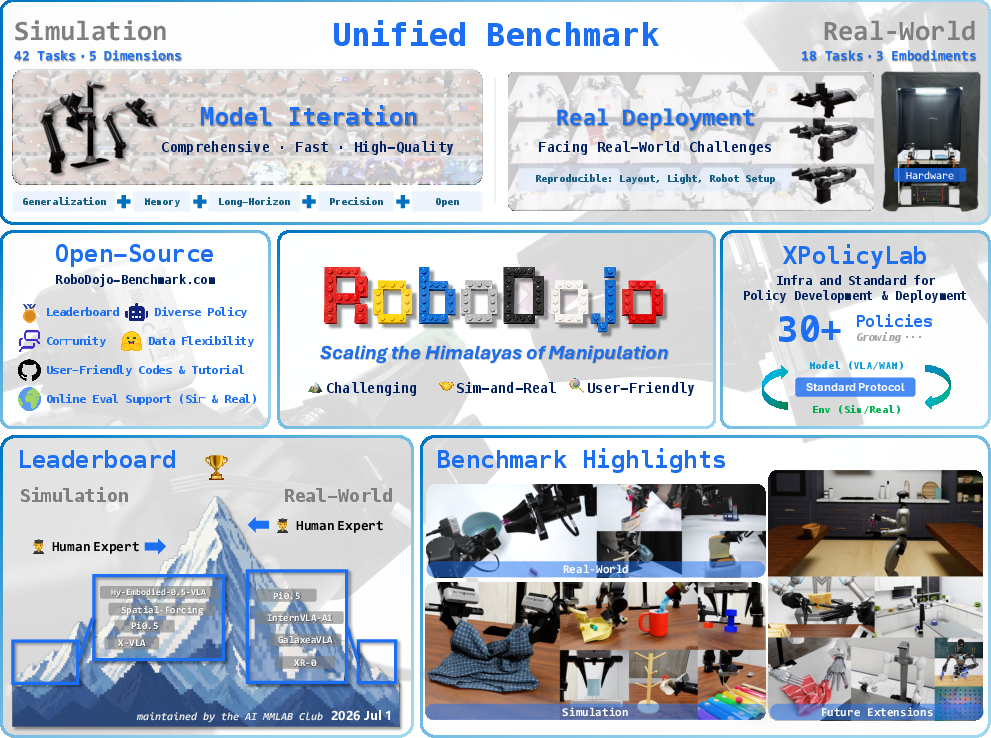
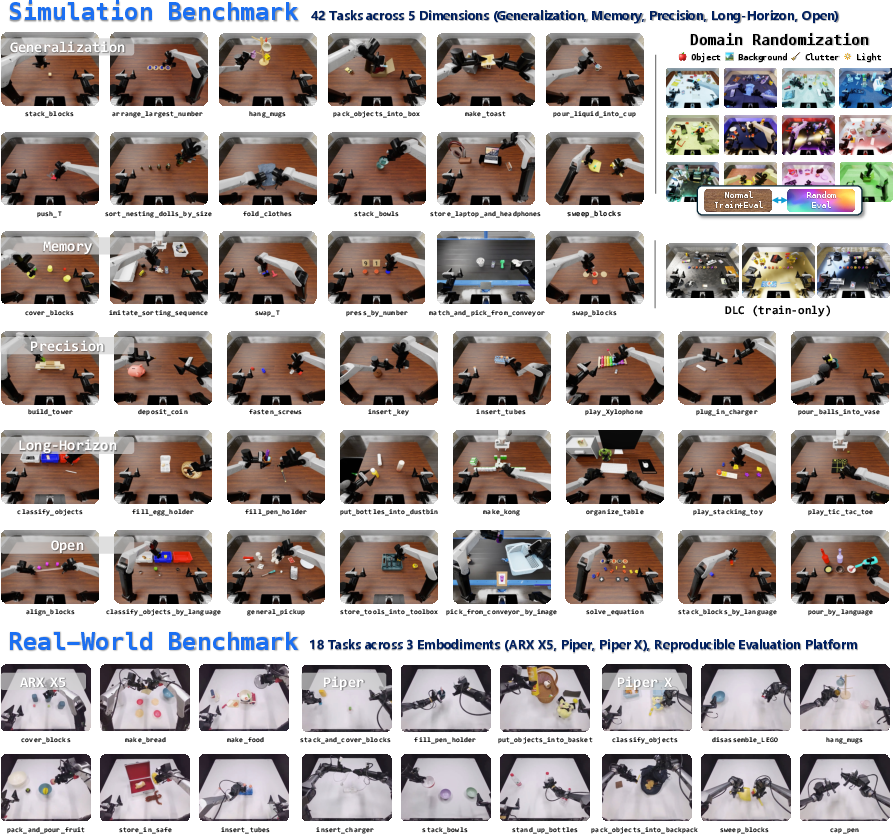
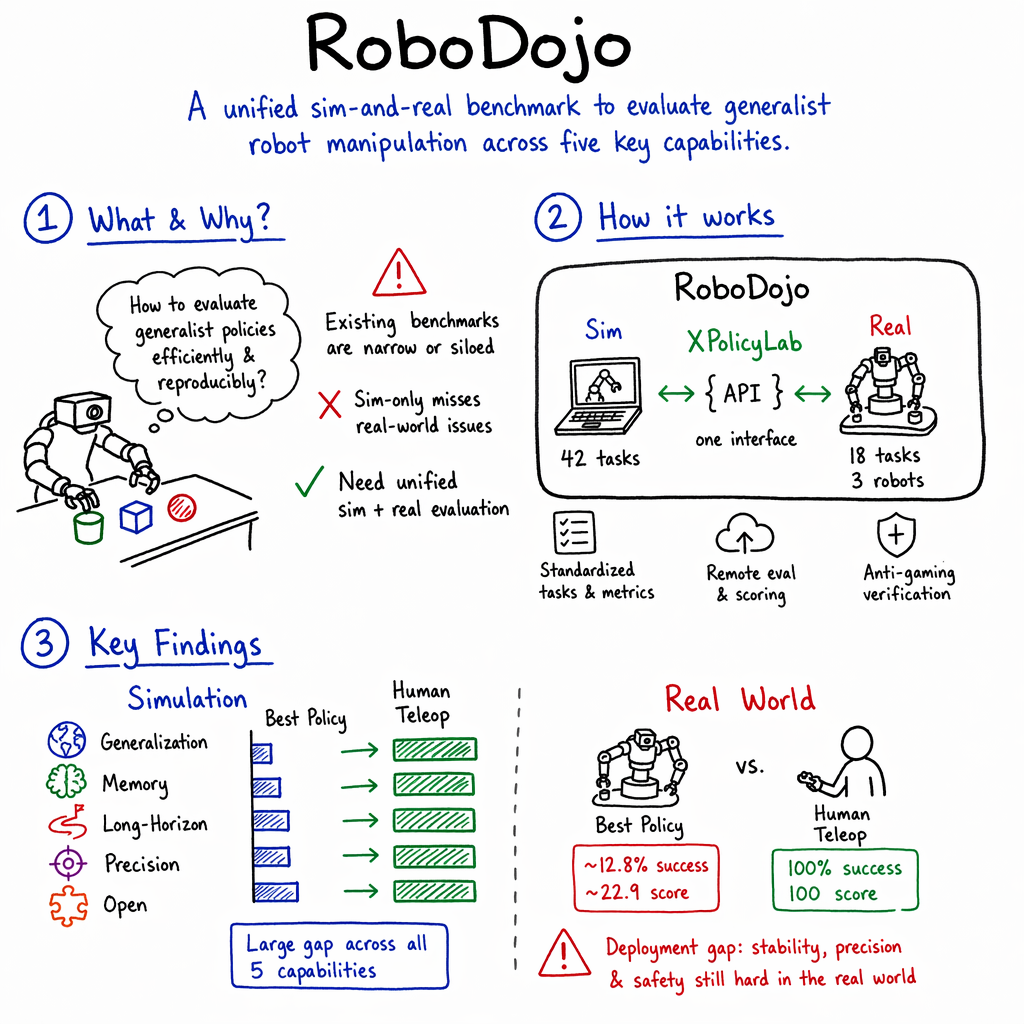
Abstract: Generalist robot manipulation policies have advanced rapidly, yet existing benchmarks remain limited in systematically evaluating their capabilities. Many rely on simple, short-horizon, or skill-narrow tasks with limited capability coverage, and are often conducted only in simulation or only in the real world. Simulation enables scalable feedback but misses physical deployment challenges, while real-world evaluation is costly, time-consuming, and difficult to reproduce. We introduce RoboDojo, a unified sim-and-real benchmark for comprehensive evaluation of generalist robot manipulation policies. RoboDojo includes 42 simulation tasks and 18 real-world tasks covering diverse and complementary manipulation capabilities. The simulation benchmark evaluates five dimensions: generalization, memory, precision, long-horizon execution, and open-vocabulary instruction following, while the real-world benchmark exposes policies to challenging physical-world deployment conditions. RoboDojo supports scalable evaluation through heterogeneous parallel simulation in Isaac Sim and provides RoboDojo-RealEval, a reproducible real-world evaluation system with remote cloud access, standardized hardware, scene reset, evaluation protocol, and deployment interface. Together with XPolicyLab, policies can be integrated once and evaluated across simulation and real-world settings with minimal adaptation. We integrate 30 policies into XPolicyLab and evaluate them on RoboDojo, establishing a public leaderboard and systematic analysis of current policy performance. The website is available at http://robodojo-benchmark.com/.
First 10 authors:




Paper Prompts
Sign up for free to create and run prompts on this paper using GPT-5.
Top Community Prompts
Explain it Like I'm 14
What is this paper about?
This paper introduces RoboDojo, a big “obstacle course” for robot arms. It lets researchers test and compare how well different robot-control programs (called policies) can use their arms and hands to do real-world tasks. Uniquely, RoboDojo tests robots both in computer simulation (like a realistic video game) and in the real world (with actual robots), using the same rules and a fair scoreboard.
What questions are the researchers trying to answer?
The team built RoboDojo to make it easier to answer simple but important questions:
- Can a single robot policy handle many different tasks, not just one or two?
- Does a policy that works in simulation also work on real robots under real-life messiness, like noisy cameras or slippery objects?
- Where do today’s robot policies most often struggle: remembering earlier information, doing long multi-step tasks, being precise, or generalizing to new situations?
- How can we test many different policies fairly, quickly, and in a way others can reproduce?
How did they study this?
They created a unified benchmark and tools that cover both simulation and real-world testing.
The simulation benchmark (the “video game practice arena”)
- 42 tasks organized into five skill areas:
- Generalization: Do the same task in new scenes with different backgrounds, lighting, or clutter.
- Memory: Remember earlier information to act correctly later (like watching a demo and then copying the order).
- Long-Horizon: Finish multi-step goals without losing track (like sorting many items in sequence).
- Precision: Be very accurate (like inserting a tube into a narrow hole).
- Open: Follow new instructions by recombining skills learned before (new goals, familiar skills).
- Diverse scenes at once: They run many different task setups in parallel, like opening many different game levels side-by-side. This speeds up testing and gives wider coverage.
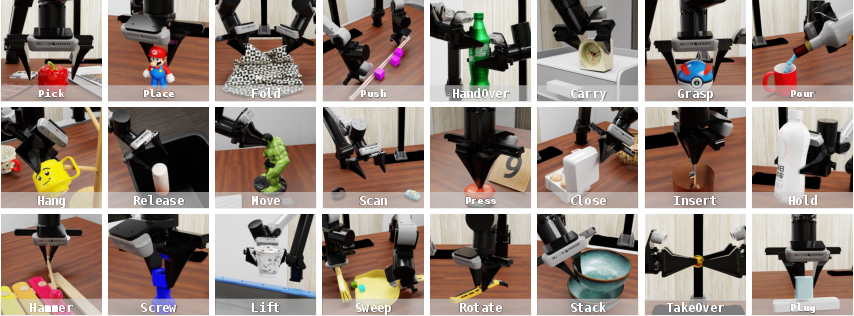
- Rich digital objects: A big library of realistic 3D items (rigid, articulated, even deformable like cloth) so contact and motion feel lifelike in the simulator.
- Training data: About 3,500 practice demonstrations for simulation training (collected by VR teleoperation or automatic script-based skills), plus extra visually varied data so policies don’t overfit to one look.
- Evaluation: Each of the 42 tasks is tried 50 times (2,100 total episodes). They record simple “success” and a “score” for partial progress.
The real-world benchmark (the “gym test with actual robots”)
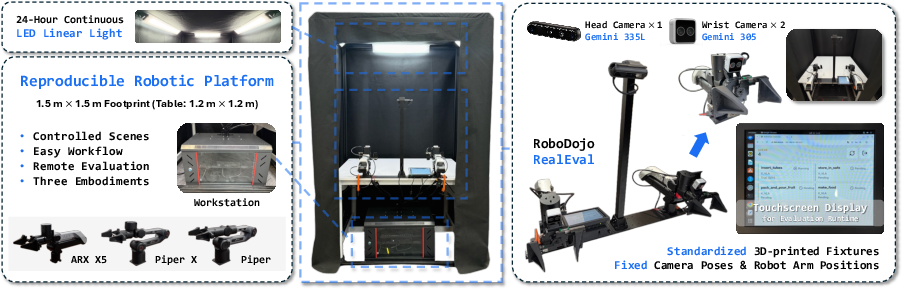
- 18 physical tasks on three bimanual robot setups (ARX X5, Piper, and Piper X). This checks whether a policy works across different robot bodies and camera positions.
- RoboDojo-RealEval: A standardized hardware station that fixes robot mounts, camera angles, lighting, and reset steps. Think of it like identical exam rooms, so results are fair and repeatable.
- Remote evaluation: You can submit your policy to be tested on the official robots, like sending your solution to a trusted referee.
- Careful scoring: 10 trials per task. Three independent judges score each trial, and videos are shared for transparency.
XPolicyLab (the “universal plug” for robot policies)
- A common interface and toolkit that lets many different robot policies plug into the same system without rewriting everything.
- They integrated 30 existing policies so they can be trained, deployed, and compared under the same rules in both sim and real tests.
Fair leaderboard and anti-gaming rules
- Public tasks and layouts make comparisons transparent.
- Hidden verification layouts act like surprise quizzes to prevent overfitting.
- To appear on the official leaderboard, teams must use the standard evaluation process, report multiple random seeds, test on all real robot bodies, and share code/checkpoints so others can reproduce the results.
What did they find?
The paper’s main contribution is building the complete testing system and running broad evaluations, not announcing one “winner.” Early results (with many popular robot policies) show:
- A clear, apples-to-apples comparison across five skill areas in simulation and across three real robot setups.
- A consistent gap between simulation success and real-world reliability, which the standardized real tests help reveal.
- Diagnostic patterns that highlight where current policies still struggle, especially with long sequences, memory of earlier observations, precise insertions, and handling visual/physical changes.
Because the benchmark is public and continuously updated, everyone can see where policies improve over time.
Why is this important?
- Faster progress: Researchers can iterate quickly in simulation, then check if improvements actually work on real robots using the same interface.
- Fairness and trust: Standardized hardware and public videos make results easier to compare and believe.
- Clear goals: The five skill areas show exactly where to focus (generalization, memory, long-horizon planning, precision, and open-ended understanding).
- Broad impact: Better, more reliable robot manipulation helps in homes, factories, labs, and hospitals—anywhere robots need to handle messy, varied, real-world tasks.
In short, RoboDojo gives the robot community a shared “dojo” to train, test, and honestly measure progress toward general-purpose, trustworthy robot hands.
Knowledge Gaps
Below is a concise, actionable list of the paper’s unresolved gaps, limitations, and open questions to guide future work:
- Sim-to-real predictivity: No quantitative analysis of how simulation performance correlates with real-world outcomes, especially because there are no aligned sim–real task pairs. Open need: construct minimally matched task subsets or meta-metrics to measure and model sim→real transferability.
- Physics fidelity and calibration: The “physically grounded” asset library lacks empirical calibration against real-world counterparts (e.g., friction, compliance, contact damping). Open need: publish parameter identification procedures and validation experiments that link sim parameters to real measurements.
- Task domain coverage: Benchmark focuses on tabletop, bimanual manipulation. Missing domains include single-arm platforms, mobile manipulation (navigation+manipulation), dynamic/non-prehensile skills (throwing, catching), deformable-object manipulation in real, tool use with dynamic contact, and human–robot collaboration.
- Embodiment diversity: Real-world evaluation covers only three collaborative bimanual embodiments with likely similar parallel-jaw grippers. Open need: extend to varied end-effectors (suction, soft grippers, anthropomorphic hands), industrial arms, and different kinematics to study embodiment-sensitive ranking shifts.
- Sensor modality limitations: Real-world data uses RGB and robot states; no depth, force/torque, or tactile sensing. Open need: add sensor-variant tracks and tasks where tactile/force feedback is necessary (e.g., blind insertions) to assess multimodal policy robustness.
- Lighting and perception robustness: RealEval standardizes lighting and camera poses, reducing ecological variability. Open need: systematically stress-test robustness to lighting changes, camera calibration drift, motion blur, lens flare, occlusions, and moving distractors.
- Memory evaluation scope: Memory tasks emphasize short- to mid-range dependencies (key-frame memory, short sequences). Open need: longer-term memory tasks (minutes/hours), cross-episode persistence, and tests of memory under distraction and partial observability with delayed consequences.
- Long-horizon structure: Long-horizon tasks do not explicitly probe branching plans, partial-order constraints, failure recovery, or replanning under unexpected disturbances. Open need: introduce perturbation events, reversible subgoals, and recovery requirements.
- Precision under contact: Precision tasks target visual grounding and smooth motion but do not isolate the role of force control or compliance in contact-rich operations. Open need: tasks that require force-regulation and contact-implicit planning, plus metrics for contact quality.
- Language and open semantics: “Open” tasks evaluate skill recombination with unseen specifications but do not assess robustness to linguistic variability (paraphrases, synonyms), ambiguous instructions, or multilingual input. Open need: standardized multi-lingual/multi-style instruction sets and ambiguity resolution tests.
- Training/eval data leakage controls: The Open dimension assumes unseen task specifications but policies may be pretrained on broad corpora. Open need: clearer provenance checks and tracks that separate “from-scratch on RoboDojo data” vs “foundation pretraining” to interpret leaderboard results.
- Metric completeness: Simulation reports success rate and average score; real-world uses human-scored partial credit. Missing metrics include time-to-completion, trajectory smoothness, energy/effort, peak contact forces, safety incidents, and reset efficiency. Open need: adopt standardized, sensor-driven objective metrics and publish scoring code/rubrics.
- Statistical power and reliability: 50 sim episodes and 10 real trials per task may miss rare failures. Inter-rater reliability for manual scoring (e.g., Cohen’s kappa) is not reported. Open need: power analyses, confidence intervals for real-world scores, and inter-rater agreement statistics.
- Anti-gaming robustness: Hidden layouts are only an auxiliary check; public layouts remain primary. Open need: larger, rotating hidden sets, periodic refresh, and audit trails to mitigate overfitting and hand-tuning to public layouts.
- Compute/data fairness: Leaderboard aggregates models with vastly different pretraining data and compute budgets. Open need: resource-normalized tracks (performance per demonstration, per GPU-hour), and sample efficiency benchmarks.
- Remote evaluation confounds: Impact of network latency/jitter on control performance is unspecified for remote real evaluation. Open need: latency-controlled protocols and reporting of end-to-end delays, plus offline “batch action” modes to equalize conditions.
- Heterogeneous parallelism determinism: While heterogeneous parallel simulation aids diversity, reproducibility across hardware/GPU stacks and seeds is not quantified. Open need: determinism audits, cross-machine reproducibility studies, and throughput benchmarks.
- Reset accuracy and drift: RealEval uses overlay-guided manual resets, but the sensitivity of outcomes to reset errors is not measured. Open need: quantify reset tolerance, release reset QA metrics, and study performance vs. controlled perturbations in initial states.
- Cross-site reproducibility: Standardization is demonstrated within the authors’ setup; generalizability across independent sites with manufacturing/assembly tolerances is not tested. Open need: multi-lab replication studies and site-to-site variance reporting.
- Skill-level diagnostics: Capability dimensions are defined, but there is no canonical per-skill attribution (e.g., grasping vs. insertion vs. handover) to localize failure modes. Open need: standardized skill tags, per-skill metrics, and skill-wise confusion analyses.
- Action space/control frequency effects: Policies may use heterogeneous action parameterizations and control rates, but the benchmark does not control or analyze their impact. Open need: action-space-agnostic tracks or controlled comparisons across action representations and frequencies.
- Demonstration biases: Sim and real demos are collected via synthesis or 4 teleoperators, which may impose stylistic biases. Open need: cross-operator analysis, diversity augmentation, and ablations comparing auto-planned vs. teleop demos on downstream performance.
- Simulator exclusivity: Implementation depends on NVIDIA Isaac Sim/Isaac Lab, potentially limiting accessibility and cross-simulator validation. Open need: cross-backend support (e.g., MuJoCo, PyBullet, Gazebo) to evaluate simulator dependence of rankings.
- Deformable-object realism gap: Deformables are present in sim assets, but the real-world suite does not yet emphasize deformable manipulation. Open need: add real deformable tasks (cloth, cables) to measure sim–real gaps for deformables.
- Safety evaluation: Beyond emergency stop procedures, there is no explicit safety metric (collision counts, near-miss distances, force thresholds exceeded). Open need: safety logging and standardized safety scorecards per trial.
- Lifecycle/continual learning: The benchmark evaluates static policies; there is no protocol for continual learning, catastrophic forgetting, or on-robot adaptation under safety constraints. Open need: sequential task tracks and safe adaptation evaluations.
Practical Applications
Practical Applications of RoboDojo
Below are actionable, real-world applications derived from RoboDojo’s benchmark, system design, and tooling (RoboDojo-RealEval, XPolicyLab, heterogeneous parallel simulation, digital asset library, and anti-gaming/leaderboard governance). Each item notes the sector, potential tools/workflows/products, and feasibility dependencies.
Immediate Applications
Robotics, Manufacturing, and Logistics
- Standardized pre-deployment evaluation and regression testing of manipulation policies (Robotics, Manufacturing, Logistics)
- What: Use the 42-task simulation suite and 18-task real-world suite to gate software releases, compare suppliers, and monitor regressions across Generalization, Memory, Long-Horizon, Precision, and Open capability axes.
- Tools/workflows: CI-style evaluation harness using heterogeneous parallel Isaac Sim runs; RoboDojo-RealEval trials on standardized bimanual setups; scorecards per capability dimension for release gates.
- Dependencies/assumptions: Access to NVIDIA Isaac Sim/Lab and GPU resources; correlation between benchmark tasks and company-specific tasks; mapping capability scores to operational KPIs.
- Vendor-agnostic procurement benchmarking for integrators and end users (Robotics, Manufacturing)
- What: Create objective RFP criteria using RoboDojo scores; require suppliers to submit verified leaderboard results and videos.
- Tools/workflows: Public leaderboard plus hidden-layout verification; standardized scoring and double-blind evaluation videos.
- Dependencies/assumptions: Willingness of vendors to publish checkpoints/configurations (or use private-but-verified flow); acceptance of benchmark as a proxy for target workflows.
- Rapid iteration loops for policy improvement with sim-to-real validation (Robotics)
- What: Diagnose failure modes in simulation along capability axes; validate fixes on RoboDojo-RealEval to confirm physical-world gains under noise, contact, and actuation errors.
- Tools/workflows: XPolicyLab unified policy interface for “integrate once, evaluate everywhere”; heterogeneous parallel sim for fast turnaround; remote RealEval sessions for physical validation.
- Dependencies/assumptions: Internal policies adapted to XPolicyLab interface; stable internet for remote evaluation; hardware availability/queue time for RealEval.
- Digital-twin-like scenario stress tests using the asset library and randomization (Robotics, Logistics)
- What: Stress-test generalization to clutter, lighting, and background shifts that mirror changing workcells or seasonal product mixes.
- Tools/workflows: Asset library with semantic/affordance annotations; task YAML specifications; deterministic seed-based randomization for reproducible stress suites.
- Dependencies/assumptions: Need to extend assets to company-specific SKUs and fixtures; simulator fidelity to relevant contact dynamics.
- Internal QA for motion-planning and control stacks in contact-rich tasks (Robotics)
- What: Use Precision and contact-heavy tasks (e.g., insertion) to benchmark motion-planning updates for smoothness and stability.
- Tools/workflows: cuRobo v2 integration in data synthesis; precision-score thresholds in QA pipelines.
- Dependencies/assumptions: Simulator-to-robot calibration; representative contact parameters; safe testing on RealEval.
Software and MLOps for Robotics/AI
- Continuous integration/continuous evaluation (CI/CE) for manipulation models (Software, AI/ML)
- What: Automate per-PR model checks across 2,100 simulation episodes/task suite; fail builds on capability regressions.
- Tools/workflows: Headless Isaac Sim farms; XPolicyLab runners; standardized metrics and seed control; result dashboards.
- Dependencies/assumptions: Compute budget; test flakiness management (seeded episodes, variance thresholds).
- Unified SDK for multi-policy comparison and A/B testing (Software)
- What: Swap in any of 30 integrated policies via XPolicyLab to compare inference latency, stability, and success by dimension.
- Tools/workflows: Policy-server interface; batched policy queries; deployment templates and data converters.
- Dependencies/assumptions: Containerization and versioning discipline; consistent preprocessing and action scaling.
- High-quality demo collection pipelines (Software, Robotics)
- What: Bootstrap or expand datasets using VR teleoperation and automated skill synthesis for imitation learning.
- Tools/workflows: Teleop interface, asset affordances, modular skill library (grasp/place/handover/insert), trajectory synthesis with motion planner.
- Dependencies/assumptions: Operator training; coverage of edge cases; alignment with downstream policy’s observation/action spaces.
Academia and Education
- Reproducible evaluation for papers, courses, and competitions (Academia, Education)
- What: Course labs and challenges that measure capability dimensions; reproducible baselines; double-blind scoring.
- Tools/workflows: Open tasks, datasets, and RealEval hardware spec; public docs and scoring scripts; remote evaluation access for classrooms.
- Dependencies/assumptions: Access to GPU clusters; scheduling RealEval slots; institutional support for hardware builds.
- Meta-analysis of policy capabilities and ablations (Academia)
- What: Diagnose which architectural/algorithmic changes impact temporal reasoning vs precision vs generalization.
- Tools/workflows: Multi-seed evaluations, variance reporting; capability-wise leaderboards; hidden-layout checks against overfitting.
- Dependencies/assumptions: Compliance with governance (seed reporting, artifact release) for verified entries.
Policy, Standards, and Governance
- Practical template for certification-style conformance tests (Policy, Standards)
- What: Use standardized protocols, hidden-layout checks, and independent scoring as a blueprint for pre-certification tests of manipulation systems.
- Tools/workflows: RoboDojo governance rules; dataset/task disclosures; video-based audit trails; appeal mechanisms.
- Dependencies/assumptions: Alignment with regulators; coverage sufficiency for sector-specific safety cases.
Daily Life and Consumer Robotics
- Independent product comparisons for household robot manipulators (Consumer)
- What: Media/reviewers use capability scores and videos to compare home-assistant robots on precision and long-horizon tasks.
- Tools/workflows: Adapted RealEval layouts approximating household scenes; public scorecards and video evidence.
- Dependencies/assumptions: Transferability of benchmark tasks to household use; access to consumer platforms and safe test spaces.
Long-Term Applications
Cross-Sector Deployment and Ecosystems
- Sector-specific benchmark “profiles” and certification (Healthcare, Manufacturing, Logistics, Retail)
- What: Derive regulated, domain-tailored test suites (e.g., sterile handling in hospitals, SKU-specific picks in retail) built atop RoboDojo methodology.
- Tools/workflows: New task packs, assets, and scoring rubrics; accredited third-party RealEval sites; insurer/standards-body acceptance.
- Dependencies/assumptions: Expanded asset libraries (medical tools, packaging, fragile items); validated sim-to-real correlation for safety-critical tasks.
- Policy marketplaces with verified capability cards (Robotics, Software)
- What: Distribute manipulation policies with standardized capability profiles; match policies to customer workflows based on RoboDojo scores and videos.
- Tools/workflows: Model registry integrated with XPolicyLab API; reproducible eval badges; automated compatibility checks by embodiment.
- Dependencies/assumptions: IP/licensing norms; willingness to disclose evaluation artifacts; standardized deployment interfaces.
- Facility-level digital twins for continuous learning and monitoring (Manufacturing, Logistics)
- What: Use heterogeneous parallel sim plus site-specific assets to create always-on “shadow tests” for proposed policy updates and data collection.
- Tools/workflows: Asset ingestion pipelines; synthetic data generation; closed-loop retraining triggered by failure signatures.
- Dependencies/assumptions: Accurate modeling of contact dynamics; automatic domain randomization calibrated to site variance; data governance.
Advanced Research and Foundation Models
- Benchmark-driven training curricula for generalist embodied models (Academia, AI/ML, Robotics)
- What: Use the capability axes as a curriculum to steadily improve temporal reasoning, fine manipulation, and open-ended grounding.
- Tools/workflows: Curriculum schedulers; auto-generated tasks with increasing difficulty; cross-embodiment transfer evaluations.
- Dependencies/assumptions: Sufficient diverse data; scalable training compute; robust policy interfaces across embodiments.
- Automated failure mode discovery and targeted data synthesis (AI/ML, Robotics)
- What: Mine per-dimension failures to auto-synthesize new sim scenes and teleop quotas that specifically close gaps.
- Tools/workflows: Analytics that link failure types to asset/scene parameters; programmatic task generation; active data collection.
- Dependencies/assumptions: Reliable failure categorization; controllable scene generators; alignment between synthetic and real failure distributions.
Standards, Safety, and Public Policy
- Third-party accredited labs using RealEval-like platforms (Policy, Standards)
- What: Network of audited facilities offering certified manipulation tests with shared protocols and transparent scoring.
- Tools/workflows: Hardware standard kits; layout replay and logging; chain-of-custody for artifacts and videos; hidden-layout rotations.
- Dependencies/assumptions: Institutional funding; governance to avoid gaming; periodic refresh to prevent overfitting.
- Insurance and compliance frameworks tied to capability thresholds (Policy, Finance)
- What: Premiums and coverage terms that reference benchmark performance for specific deployment conditions (e.g., precision thresholds for contact tasks).
- Tools/workflows: Capability KPIs mapped to risk models; standardized reporting; periodic re-certification runs.
- Dependencies/assumptions: Empirical linkage between scores and incident rates; acceptance by underwriters.
Consumer and Service Robotics
- Home and service-robot readiness indices (Consumer, Services)
- What: Curate household/service task suites (folding, placing, opening/closing) to rate robots for home, hotels, eldercare support.
- Tools/workflows: Adapted assets and scenes; open-vocabulary “Open” tasks to test instruction following; public video libraries for transparency.
- Dependencies/assumptions: Broader embodiment coverage beyond ARX/Piper families; safety and human-robot interaction constraints.
Notes on feasibility and adoption
- Compute and tooling: Immediate simulation workflows need GPUs and Isaac Sim/Lab; teams may need to containerize XPolicyLab and standardize preprocessing/action spaces.
- Hardware availability: RealEval benefits from standardized bimanual platforms (ARX X5, Piper, Piper X); broader uptake may require additional embodiments and cost-reduced kits.
- Task-to-product transfer: Capability scores are strongest as comparative diagnostics; organizations should pilot calibration studies to map scores to field KPIs before making high-stakes decisions.
- Governance and IP: Verified leaderboard entries require releasing checkpoints/configurations; private-but-unverified evaluation remains an option for proprietary settings.
Glossary
- Actuation errors: Discrepancies between commanded and actual motor outputs that cause physical motions to deviate from planned trajectories. Example: "actuation errors"
- Affordance (manipulation): Properties of an object that specify possible actions a robot can take on it, used to ground skills like grasping or placing. Example: "manipulation affordances"
- Articulation states: The configuration of joints or movable parts of an articulated object (e.g., door angles, drawer positions) used in simulation and control. Example: "articulation states"
- Bimanual: Involving coordinated control of two robot arms to perform manipulation tasks. Example: "collaborative bimanual robot platforms"
- Contact-rich dynamics: Physical interactions dominated by frequent contacts, friction, and impacts that are hard to model and simulate accurately. Example: "contact-rich dynamics"
- Cross-embodiment transfer: The ability of a policy to generalize skills across robots with different bodies and kinematics. Example: "cross-embodiment transfer"
- cuRobo v2: A GPU-accelerated motion planning system used to generate collision-free, dynamics-aware robot trajectories. Example: "cuRobo v2 motion planner"
- Deformable objects: Objects whose shape changes under force, requiring specialized simulation and control strategies. Example: "deformable objects"
- Digital twin: A high-fidelity digital replica of physical assets and environments to support simulation and evaluation. Example: "digital-twin asset generation"
- Distributional robustness: The resilience of a policy to shifts in data distributions (e.g., backgrounds, lighting, clutter) between training and evaluation. Example: "distributional robustness"
- Domain randomization: A sim-to-real technique that randomizes visual and physical parameters during training to improve generalization. Example: "domain randomization"
- Double-blind protocol: An evaluation method where both the evaluators and subjects are blinded to reduce bias in scoring. Example: "double-blind protocol"
- Embodied foundation models: Large, general-purpose models for agents that perceive and act in the physical world, integrating vision, language, and action. Example: "embodied foundation models"
- Embodiment: The physical form and morphology of a robot that determine its kinematics, sensors, and action space. Example: "robot embodiments"
- Generalist robot policies: Policies designed to handle a broad range of manipulation tasks instead of specializing in a single task. Example: "generalist robot policies"
- Handover behaviors: Coordinated actions where an object is passed between robot hands/arms to extend reach or facilitate task completion. Example: "handover behaviors"
- Heterogeneous parallel simulation: Concurrent simulation of diverse scenes and tasks under a shared vectorized interface to speed evaluation. Example: "heterogeneous parallel simulation"
- Kinematics: The geometric relationships between robot joints and end-effector poses, independent of forces. Example: "robot kinematics"
- Language-conditioned transfer: Reusing learned skills to satisfy new goals specified in natural language. Example: "language-conditioned transfer"
- Leader-follower teleoperation: A setup where an operator controls a leader device whose motions are mirrored by a follower robot. Example: "leader-follower teleoperation"
- Long-horizon execution: Tasks requiring extended sequences of dependent steps with progress maintenance and error accumulation management. Example: "language-conditioned long-horizon execution"
- Non-Markovian decision making: Decision processes that depend on history beyond the current observation, requiring memory. Example: "non-Markovian decision making"
- Observation-action interface: A standardized API through which an evaluation system provides observations and receives policy actions. Example: "observation-action interface"
- Open-semantic grounding: Mapping free-form, previously unseen language semantics to actionable goals and behaviors. Example: "open-semantic grounding"
- Open-vocabulary instruction following: Following instructions that contain novel words or categories not seen during training. Example: "open-vocabulary instruction following"
- Partial observability: When current sensor inputs do not fully reveal the underlying state, necessitating memory or inference. Example: "partially observable"
- Sim-to-real transfer: Transferring policies trained in simulation to real-world robots without extensive re-training. Example: "sim-to-real transfer"
- Skill recombination: Composing previously learned primitive skills to solve new tasks in different contexts. Example: "skill recombination"
- Vectorized execution interface: A simulator mechanism that steps many environments in lockstep for efficient parallel evaluation. Example: "vectorized execution interface"
- Visuomotor manipulation: Using visual inputs to directly guide motor actions for manipulation tasks. Example: "visuomotor manipulation performance"
- World-model-based control: Control approaches that use learned predictive models of environment dynamics to plan or act. Example: "world-model-based control"
- YAML specifications: Human-readable configuration files used to define task assets, layouts, randomization, and success conditions. Example: "YAML specifications"
Collections
Sign up for free to add this paper to one or more collections.

