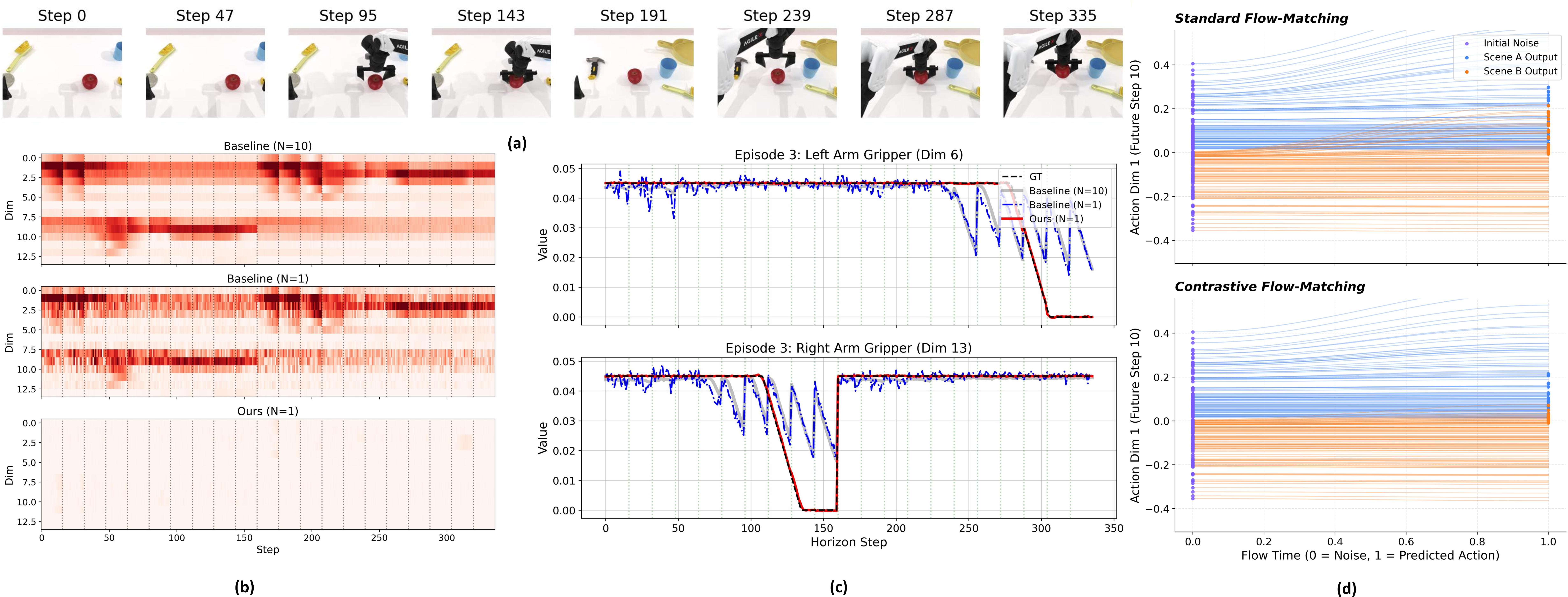
- The paper introduces a one-step generative visuomotor policy that integrates recursive correction, frequency consistency, and contrastive flow matching to reduce approximation gaps in single-step control.
- It leverages a multimodal Diffusion Transformer and adaptive techniques to achieve higher success rates and reduced inference latency compared to multi-step baselines.
- Empirical analyses demonstrate improved spatial precision, spectral fidelity, and multimodal decoupling across simulations and real-world robotic benchmarks.
High-Fidelity One-Step Generative Visuomotor Policy via Recursive Correction, Frequency Consistency, and Contrastive Flow Matching
Overview and Motivation
Modern robotic visuomotor policy learning using generative models—especially diffusion and flow matching techniques—has drastically improved the modeling of complex, temporally-coherent, multimodal action distributions. However, conventional diffusion and flow-matching policies require iterative multi-step sampling or ODE integration to produce trajectory-consistent actions, resulting in significant inference latency. This severely impedes deployment in high-frequency, closed-loop robotic control applications.
Single-step acceleration approaches partially address this problem, but often incur a non-trivial fidelity gap: the "approximation gap" when compressing a curved, iterative generation trajectory into a single-step prediction. This gap manifests as three major failure modes: spatial deviation due to neglect of local flow geometry, frequency distortion via over-smoothed outputs that suppress critical high-frequency control details, and mode averaging resulting from entangled multimodal flows leading to ambiguous or suboptimal actions.
The authors of "High-Fidelity One-Step Generative Visuomotor Policy via Recursive Correction, Frequency Consistency, and Contrastive Flow Matching" (2607.03865) introduce a principled one-step generative control framework that targets these three coupled deficiencies through three complementary mechanisms: Recursive Consistent Action Flow (RCAF) for spatial residual correction, Dual-Timestep Frequency Consistency (DTFC) for adaptive spectral fidelity, and Contrastive Flow Matching (CFM) for multimodal flow separation.
Framework Design
Architecture and Policy Network
The core policy backbone is a multimodal Diffusion Transformer (DiT), which takes multimodal observation (2D visual or 3D point cloud, proprioception) and outputs continuous action velocities conditioned on the current state and a diffusion timestep. Condition fusion is mediated by adaptive normalization (adaLN). This DiT-based backbone enables both image- and point-cloud-driven policy architectures, facilitating evaluation across diverse robotic platforms.
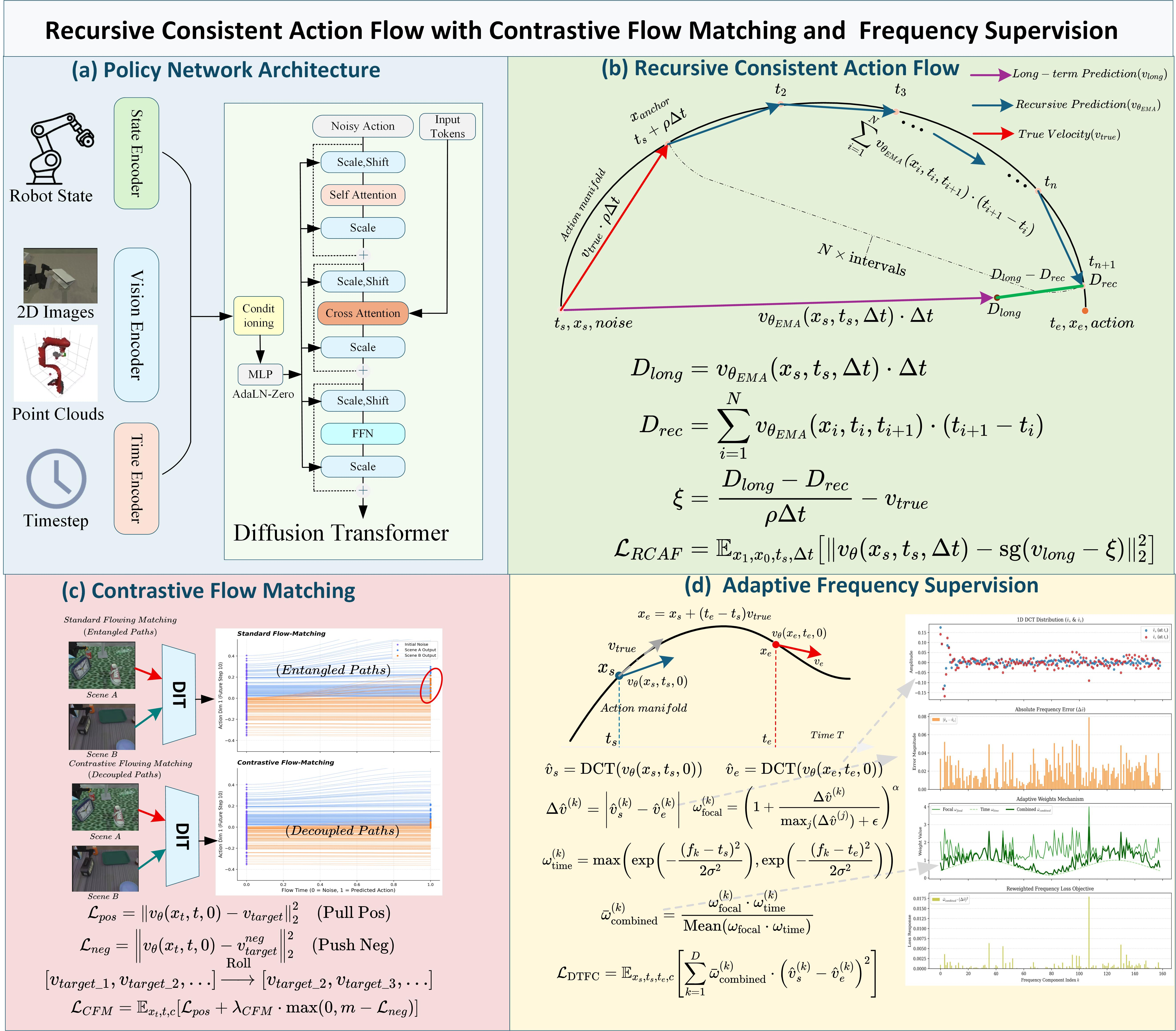
Figure 1: The framework integrates a multimodal DiT backbone with explicit RCAF, CFM, and DTFC correction modules targeting fidelity, spectral detail, and mode separation, respectively.
Recursive Consistent Action Flow (RCAF)
RCAF explicitly compensates for spatial truncation errors inherent in one-step policies by recursively distilling the curvature of multi-step teacher trajectories into a single-step corrective residual. Using an adaptive multi-timestep sampling strategy, RCAF computes an anchor velocity via the optimal transport path and recursively estimates the "tail" of the trajectory using an EMA teacher. The student is trained to close the residual between the single-step leap and the high-order recursive trajectory, enforcing an implicit high-gain spatial feedback correction.
This results in the student one-step policy aligning with the multi-step ground-truth ODE trajectory, significantly improving action fidelity for manipulation tasks requiring geometric precision.
Dual-Timestep Frequency Consistency (DTFC)
One-step policies are prone to frequency distortion: the suppression of high-frequency action details crucial for fine-grained, contact-rich manipulation. DTFC counteracts this by enforcing spectral consistency across action velocities predicted at two randomly sampled flow timesteps. The frequency-domain loss is adaptively reweighted: a dynamic focal weight prioritizes frequency bands with greatest error, combined with a dual-timestep Gaussian mask that biases early timesteps toward low frequency (global trajectory structure) and late timesteps toward high frequency (fine details). A linear warmup increases the frequency penalty gradually as training proceeds, improving convergence stability.
Contrastive Flow Matching (CFM)
Traditional flow matching can entangle multimodal action flows when observations admit multiple valid solutions, inducing mode averaging. CFM introduces a batch-wise contrastive objective that penalizes action velocity predictions when they are close to negative samples (actions for other scenes/tasks) beyond a static margin in the velocity space. This repulsive force decouples action modes in the latent space, sharply reducing mode averaging and trajectory ambiguity.
Empirical Analysis
Qualitative and Error Analysis
Qualitative visualizations highlight key behavioral improvements over standard one-step and multi-step baselines. The proposed framework yields trajectories that demonstrate:
Simulation and Real-World Benchmarks
Evaluation covers 33 tasks across DexArt, Adroit, RoboTwin 1.0/2.0, and physical deployment on SO101 and UR7E platforms. Image- and point-cloud-based observations are both supported. Despite requiring only a single function evaluation (NFE=1), the proposed method either matches or surpasses state-of-the-art 10-step generative baselines (e.g., ManiFlow, Diffusion Policy), attaining:
- In the 2D/3D settings: Average success rates of 65.3% (2D) and 74.2% (3D) versus the strongest baselines at 56.5% and 66.5% respectively.
- Cross-domain generalization: Gains from 28.8% (ManiFlow) to 34.5% (proposed) on RoboTwin 2.0.
- Real-world deployment: Higher success rates across low-cost and industrial platforms (e.g., SO101 and UR7E) with pronounced benefits in challenging low-data generalization settings.
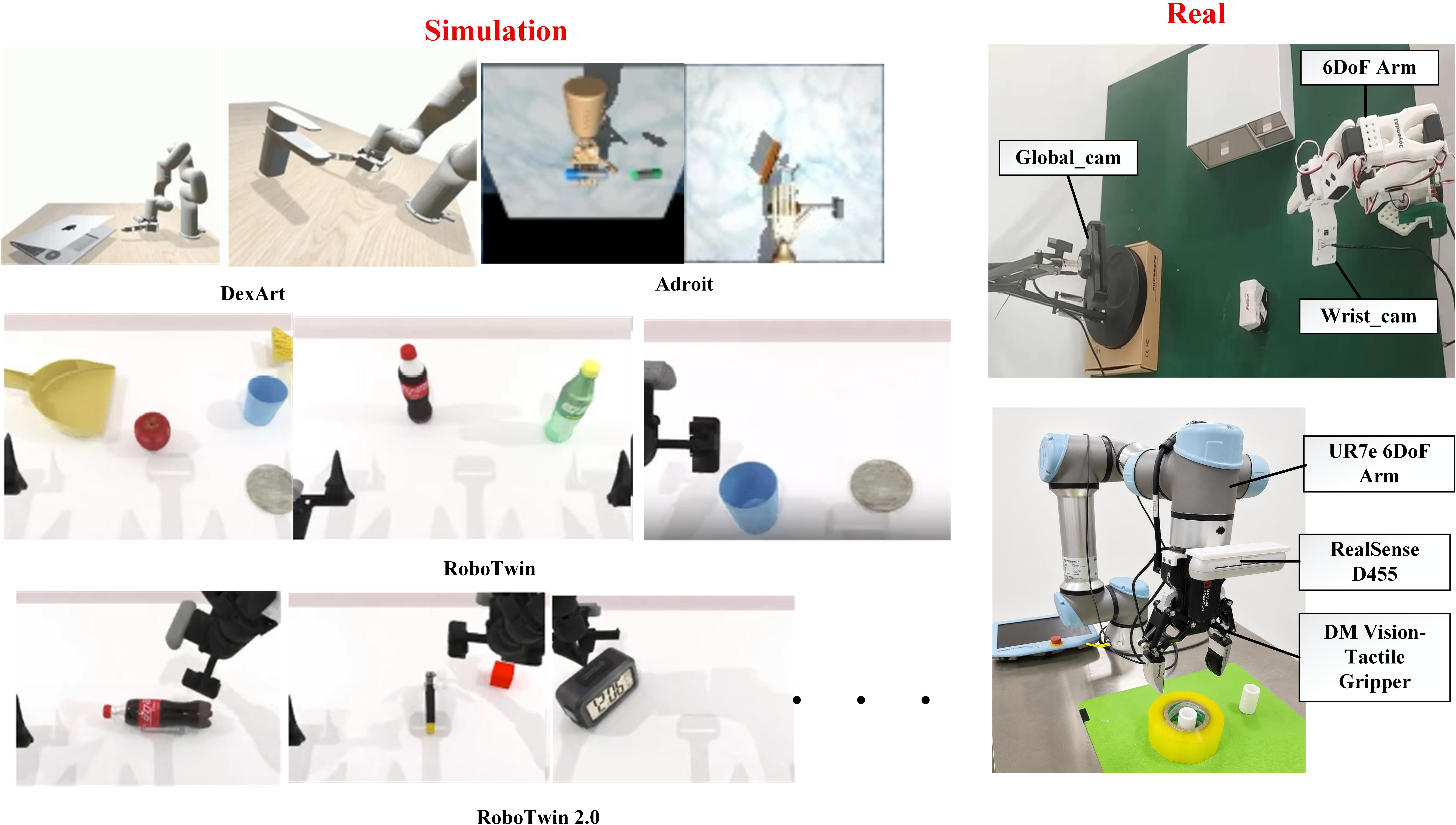
Figure 3: Evaluation spans bimanual, dexterous, and cross-domain tasks in both simulation and diverse real-world robots.
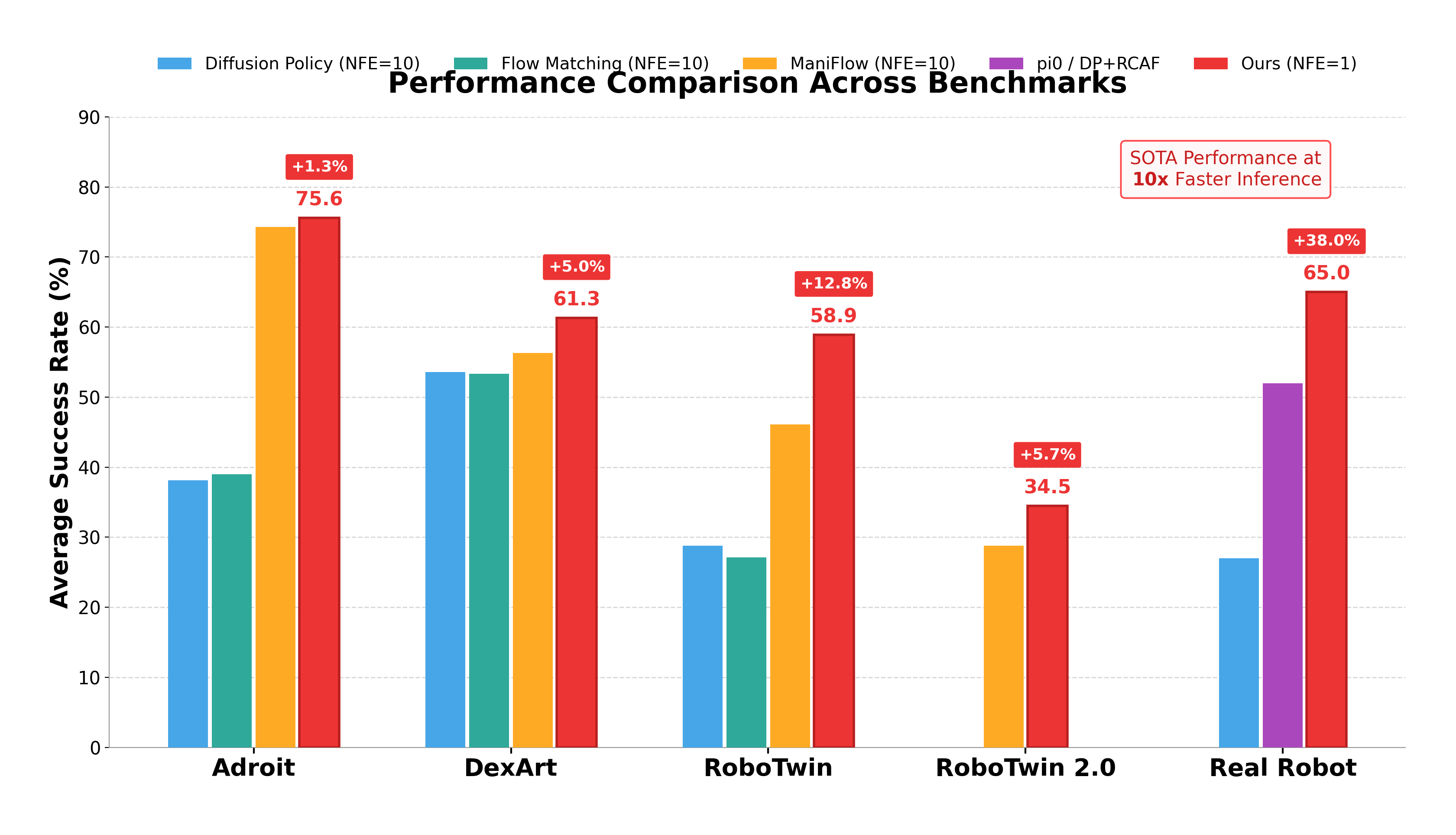
Figure 4: The single-step framework maintains or exceeds the performance of multi-step baselines while reducing inference cost by an order of magnitude.
Ablation and Module-Level Analysis
Systematic ablation demonstrates that:
- RCAF alone provides substantial performance uplift over single-step mean-flow methods (~5% absolute), confirming its importance for spatial compensation.
- DTFC further boosts spectral fidelity and performance, especially when combined with a linear curriculum.
- CFM (static margin) is most effective in decoupling modes; dynamic margins introduce instability.
- The full model outperforms all single-step mean-flow derivatives (e.g., MeanFlow, IMF, SplitMeanFlow).
- The theoretical analysis justifies RCAF's success: it acts as a high-gain proportional controller, enforcing strict feedback alignment with the multi-step manifold.
Implications and Outlook
Theoretical Impact
This work closes a critical gap in high-frequency robot control by demonstrating, both theoretically and empirically, that spatial, spectral, and multimodal constraints jointly suffice for one-step generative policy fidelity. The recursive correction perspective may inspire generalized feedback-aligned policy regularization in other ODE-based generative models.
Practical Impact
The reduction of inference to a single forward pass without compromising manipulation fidelity directly enables deployment in latency-sensitive settings (e.g., high-speed, high-DOF bimanual control), and also reduces energy consumption and computational cost—key for embedded and edge robotic systems.
Extensions and Future Directions
Scaling to larger foundation models, incorporating tactile feedback for richer contact dynamics, and systematic study of hyperparameter robustness across manipulation domains are cited as natural next steps. The framework's modularity also encourages its integration into ever-larger multimodal and multi-task robotic learning systems.
Conclusion
The presented framework demonstrates a principled approach to high-fidelity, one-step generative visuomotor policy learning. The joint design of recursive correction, adaptive frequency consistency, and contrastive flow separation overcomes core limitations of prior single-step generative controllers, yielding superior performance on diverse spatially and temporally complex manipulation challenges. This contribution establishes both an empirical and conceptual foundation for accelerated, robust, and generalizable closed-loop robot control via one-step generative modeling.