A Mathematical Introduction to Diffusion Models
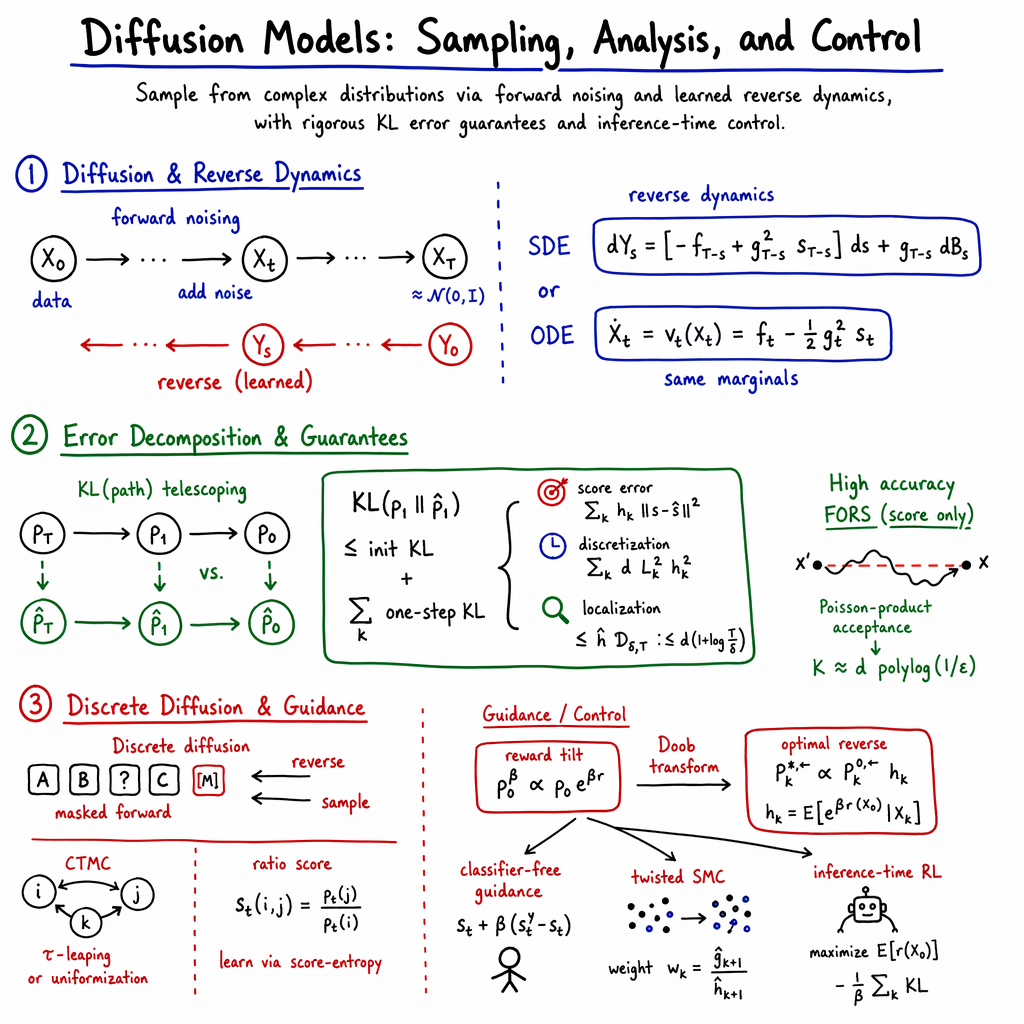
Abstract: These notes give a proof-oriented introduction to diffusion models from the viewpoint of sampling, tracing a single arc from classical sampling dynamics to modern diffusion samplers, their error analysis, and inference-time control. Throughout, the material is layered into core definitions and identities proved in full, representative estimates proved under simplifying assumptions, and research-level theorems stated with a proof roadmap. The intended audience is beginning graduate students with a background in probability but no prior exposure to stochastic differential equations, stochastic numerics, or diffusion models.
Paper Prompts
Sign up for free to create and run prompts on this paper using GPT-5.
Top Community Prompts
Explain it Like I'm 14
What this paper is about
This paper is a friendly, proof-focused guide to how diffusion models work, written for math-minded beginners. Diffusion models are a popular way to make new images, sounds, or text by learning how to turn random noise into realistic data. The notes connect classic ideas from probability (like random walks and Markov chains) to modern diffusion samplers, explain why these samplers work, how accurate they are, and how to steer them at generation time.
What questions the paper answers
In simple terms, the notes tackle questions like:
- How can we generate new, realistic samples when we only have data, not a neat formula for the data’s shape?
- How do we measure “how close” our generated samples are to the real thing?
- How do we turn a continuous process (like a smooth movie) into a step-by-step algorithm (like a flipbook) without making too many mistakes?
- How do “scores” (arrows pointing toward more likely data) help us denoise and sample?
- Can we guide or control a trained diffusion model to follow instructions or rewards at generation time?
How the methods work (in everyday language)
Think of the problem this way: you want to pull a marble from a jar, but you don’t know the jar’s contents exactly—you only have examples. The paper builds tools to “walk” around the space of possibilities and settle into places that look like the real data.
Here are the main ideas, with everyday analogies:
Measuring closeness
To check if your fake marbles look like real ones, you need a way to measure closeness between two “shapes” of distributions:
- Total variation: do the two worlds agree on the chance of every event? (Very strict.)
- Wasserstein distance: how much effort would it take to move mass from one shape to the other? (A transport view.)
- KL divergence: how surprised would you be if you used one world to encode the other? (An information view.)
The notes mostly track KL divergence because it is mathematically convenient and ties into how diffusion models learn.
Walking with push and wiggle (Langevin dynamics)
Imagine a ball rolling down a landscape (the “push” from gradients) but constantly jiggled by random bumps (noise). This is overdamped Langevin dynamics. Over time, the swarm of balls matches the target distribution (the shape of the landscape). The paper proves:
- The distribution evolves by a differential equation (the Fokker–Planck equation).
- A kind of “energy” (KL divergence) decreases over time (entropy dissipation), which shows convergence under some regularity assumptions.
From continuous to step-by-step (ULA and MALA)
Computers work in steps. Two ways to discretize the smooth walk:
- ULA (Unadjusted Langevin Algorithm): take a small gradient step and add noise. Simple and fast, but slightly biased—like walking with a tiny compass error each step.
- MALA (Metropolis-Adjusted Langevin Algorithm): propose the same step as ULA, but add an accept/reject check that fixes the bias. It needs evaluating how likely points are under the true target, which isn’t always available.
The notes give clean, quantitative bounds: how step size, smoothness, and dimension affect error and runtime.
Noising and denoising (the heart of diffusion models)
Diffusion models don’t start from a known formula. Instead, they:
- Add noise to real data over time (like gradually fogging a photo).
- Learn how to reverse the fogging.
In continuous time, the corrupted variable looks like
- , where is clean data and is Gaussian noise.
The “score” at time , , is a vector pointing toward more likely regions of the blurred density . A key identity (Tweedie’s identity) says the score equals “how to correct” a noisy observation back toward its clean source. That’s why training a score model is the same as training a denoiser.
Running time backward (reverse SDE and probability flow)
If the forward process adds noise, the reverse process removes it. The notes show two equivalent ways to run backward through the fog:
- A reverse-time SDE (random but correct on average).
- A “probability flow” ODE (deterministic paths that match the same snapshots in time).
Both are guided by the learned score field. If the score is perfect, reversing gets you back to data.
Turning flows into algorithms (DDPMs and error analysis)
To implement on a computer, we take discrete steps (like frames in a flipbook). The paper derives:
- Exact and Gaussian approximations of the backward transition (“reverse kernels”).
- The denoising–score equivalence in discrete time (used in DDPMs).
- An error breakdown for sampling that separates: early stopping error, step-discretization error, and score-learning error.
It also presents improved samplers:
- Euler–Maruyama steps (basic),
- Hessian-aware controls (smoother steps when curvature is known),
- First-Order Rejection Sampling (FORS), a practical “propose-and-correct” method that needs only scores.
Discrete diffusion on finite state spaces
Not everything lives in continuous space. The notes also cover diffusion where states are discrete (like text tokens), replacing SDEs with continuous-time Markov chains, and rebuilding the reverse process and error bounds in this finite setting.
Steering at generation time
Once trained, how do you nudge a diffusion model to follow a prompt or preference?
- Guidance: tilt the sampling toward a desired attribute (like “more cat-like”).
- Reward tilting and path-space control: change probabilities using a reward signal.
- Inference-time reinforcement learning: adjust the sampler’s path to maximize a given score, without retraining the entire model.
Main results and why they matter
Here are the key takeaways, stated simply:
- Diffusion as principled sampling: The forward “add noise” and reverse “remove noise” processes can be written precisely, and reversing is guided by the score (the denoising direction).
- Denoising equals score estimation: Tweedie’s identity ties the learned score directly to the best denoiser. This explains the standard diffusion training objective.
- Convergence guarantees:
- For Langevin diffusion (the continuous process), KL divergence to the target shrinks exponentially under standard conditions—so the method is sound.
- For ULA (the step-by-step version), there’s small but unavoidable bias, and the notes quantify it and its dependence on step size, dimension, and smoothness.
- MALA removes that bias exactly when density ratios are available and can mix quickly from a warm start in nice cases.
- Practical reverse sampling: The notes derive exact and approximate reverse transitions for DDPMs and show when discrete samplers are accurate, splitting errors into understandable pieces (discretization, early stopping, score error).
- Control at inference time: With guidance, reward tilting, and path-space methods, you can push a trained model toward desired outcomes without retraining from scratch.
These results matter because they turn “it works” into “here’s why it works and how to make it reliable,” giving engineers and researchers levers to trade speed for accuracy and to safely steer models.
Why this is useful and what it could change
- Reliability: By proving how and when errors shrink, the notes help you choose step sizes, noise schedules, and corrections that make sampling stable and accurate.
- Data-only settings: When you don’t have a neat formula for your data, the diffusion framework shows how to learn the right directions to denoise and sample.
- Controllability: Guidance and reward tilting allow you to shape outputs at generation time—crucial for creative tools, safety filters, or task-specific goals.
- Bridges to new methods: The same math underlies newer one-step or few-step methods (like flow matching or rectified flows), making it easier to understand and compare them.
In short, the paper gives a clear, math-grounded path from classical random walks to modern diffusion models, showing how to build them, analyze their errors, and steer them—turning noise into signal with confidence.
Knowledge Gaps
Knowledge gaps, limitations, and open questions
The paper lays out a rigorous, proof-oriented pathway from classical Langevin sampling to diffusion-model samplers, but it deliberately narrows scope and makes simplifying assumptions in several places. Below is a single, consolidated list of concrete gaps and open problems that remain unresolved and are natural targets for future research:
- Assumptions for continuous-time guarantees:
- Convergence and entropy-dissipation proofs rely on log-Sobolev (LSI) or transport inequalities for the target. How to obtain comparable guarantees for targets that are multimodal, heavy-tailed, non-smooth, or do not satisfy LSI/spectral gap assumptions?
- ULA beyond LSI and smoothness:
- The KL analysis of ULA assumes -Lipschitz gradients and LSI for . Can we derive nonasymptotic KL/Wasserstein guarantees for ULA under weaker conditions (e.g., Poincaré only, bounded moments, dissipativity without global smoothness)?
- Tightness and lower bounds for ULA:
- Are the dimension and accuracy dependences in the KL bound (e.g., ) optimal? Establish matching lower bounds or improved algorithms with better -dependence using only gradient oracles.
- Bias-removal without density evaluations:
- MALA removes discretization bias using acceptance ratios that require . Is there a principled correction mechanism for diffusion/Langevin proposals when only scores (not densities) are available, with provable stationary-law guarantees?
- Warm-start requirements for MALA:
- The best-known MALA mixing bounds assume warm starts and strong log-concavity/smoothness. How to construct warm starts for general (non-log-concave, multimodal) targets, and can we prove fast mixing from cold starts in these settings?
- Beyond Gaussian forward noising:
- The theory centers on linear Gaussian forward processes. What are the implications and reverse-time constructions for non-Gaussian or state-dependent diffusions (e.g., Lévy noise, multiplicative noise, nonlinear drifts), and can we obtain analogous Tweedie identities and error controls?
- Singular and discrete data:
- Many real datasets live on low-dimensional manifolds or are discrete/singular. How to define and estimate scores and develop reverse dynamics when fails to be everywhere smooth/absolutely continuous (and KL may be ill-defined)?
- Boundary/regularity justifications:
- Several derivations assume vanishing boundary terms and smooth decays. Specify minimal analytic conditions (tail behavior, integrability) that rigorously justify integration by parts, Girsanov, and interchange of limits for realistic data distributions.
- Optimal design of forward schedules:
- Given a budget of function evaluations and a score-error profile over , how to choose (or discrete ) to minimize final sampling error? Provide principled, data-dependent schedule synthesis.
- Score learning theory (statistical, not treated here):
- The notes explicitly treat learned-score error as an input and omit sample-complexity/generalization. Establish finite-sample guarantees linking dataset size, network class, and noise schedule to and to end-to-end sampling error in TV/W2/KL.
- Error propagation under score misspecification:
- Quantify how time-dependent score errors (varying with and spatially with ) accumulate across reverse steps for SDE/ODE samplers, beyond Gaussian or strongly convex settings, and derive stability regions for large but structured errors.
- Probability flow ODE vs reverse SDE:
- Provide comparative, nonasymptotic error bounds and stability analyses for probability-flow ODE discretizations versus reverse SDE samplers, including step-size restrictions that prevent blow-up under imperfect scores.
- High-accuracy first-order rejection sampling (FORS):
- The notes state the result and intuition. A remaining need is a fully explicit, practically checkable acceptance-rate analysis in high dimensions, including dependence on score error, curvature, and dimension, and a comparison to MALA with/without density access.
- Dimension dependence and preconditioning:
- Current bounds often have linear (or worse) dimension dependence. Can we obtain dimension-free or intrinsic-dimension guarantees via adaptive preconditioning, local covariance estimation, or Riemannian metrics, with provable gains for anisotropic data?
- Adaptive discretization and stopping:
- Formalize adaptive step-size and early-stopping policies that jointly balance discretization error and score error, with guarantees that translate to endpoint TV/W2/KL bounds under computational budgets.
- Reverse kernels for discrete diffusion at scale:
- The finite-state analysis (announced later in the notes) invites scalable constructions for large combinatorial state spaces (e.g., text, code). How to learn and control reverse kernels with provable error and mixing behavior when the state space is exponentially large?
- Robustness of inference-time guidance/control:
- Provide rigorous bounds on distributional shift, KL blow-up, or mode imbalance induced by classifier-free guidance, reward-tilting, or path-space control. Characterize ranges of guidance strengths that guarantee stability and bounded divergence from .
- Normalization and feasibility under reward tilting:
- Reward tilting introduces new normalizing constants along the path. Develop computational schemes with error bounds for estimating/controlling these constants and guaranteeing well-posedness of the tilted dynamics.
- Combining exact MCMC with learned scores:
- Explore hybrid samplers where learned scores produce proposals corrected by exact or approximate acceptance tests relative to a tractable surrogate. Can we bound bias and variance without access to the true target density?
- Beyond Euclidean settings:
- Extend the framework to manifolds and constrained domains (e.g., images on spheres, diffusion on meshes), providing well-posed reverse processes, discretizations, and score-learning strategies that respect geometry and constraints.
- Metrics beyond KL/TV/W2:
- The analysis centers on KL with translations to TV/W2 under additional assumptions. Develop guarantees in weak topologies or task-aligned metrics (e.g., bounded-Lipschitz, FID-like proxies) that better reflect generative quality when densities are ill-posed.
- Calibration of constants and practical regimes:
- Many results hide constants in O(·) or invoke small-step conditions (e.g., ). Provide sharpened constants, practical ranges, and empirically validated regimes where the theory predicts observed behavior.
- Lower bounds and impossibility:
- Establish computational/statistical lower bounds for diffusion-based samplers under oracle models (gradient-only, score-only, partial density), clarifying what improvements are fundamentally out of reach without stronger assumptions or additional information.
Practical Applications
Immediate Applications
The items below translate the paper’s key results—Langevin/Metropolis samplers, continuous/discrete diffusion mechanics, Tweedie’s identity, reverse-time SDE/ODE samplers, KL-based error accounting, first-order rejection sampling (FORS), and inference-time control (guidance, reward tilting, path-space control, inference-time RL)—into deployable use cases. Each bullet notes target sectors, potential tools/workflows, and feasibility constraints.
- Strong-baseline, convergence-aware MCMC for Bayesian inference
- What: Use ULA/MALA with log-Sobolev-based step-size tuning and warm-start prep to sample posteriors reliably.
- Sectors: healthcare (Bayesian survival/drug-response models), finance (risk/posterior predictive scenarios), energy (calibration/uncertainty in grid or reservoir models), software (probabilistic programming backends).
- Tools/workflows: MALA kernels with auto step-size schedulers; underdamped Langevin warm-start; diagnostics from entropy dissipation (KL decay) and Talagrand bounds for W2 proxies.
- Assumptions/dependencies: Access to density ratios for MALA; smoothness (L-Lipschitz gradients) and, for strongest guarantees, strong log-concavity/log-Sobolev; warm starts in high-d; preconditioning for ill-conditioned posteriors.
- High-accuracy diffusion sampling via first-order rejection sampling (FORS)
- What: Plug-in score-only Gaussian-tilt corrections to reduce discretization bias at inference without retraining.
- Sectors: media generation (higher-fidelity images/audio), molecular design (conditional property tilts), scientific synthesis (denoising with precision constraints).
- Tools/workflows: A “FORS” module between DDPM/DDIM steps; acceptance-probability monitors; score-calibration tests.
- Assumptions/dependencies: Approximate Gaussian tilt structure per step; sufficiently accurate learned scores; moderate compute overhead from rejection checks.
- Inference-time guidance and reward tilting for safe/preference-aligned generation
- What: Use the guidance and reward-tilting identities to steer a trained model toward user constraints or safety policies at inference time.
- Sectors: software/media (content filters, personalization), policy (harm-minimizing generation), healthcare (soft toxicity/structure constraints in generative chemistry).
- Tools/workflows: Plug-and-play guidance schedules; reward-model APIs; knob settings for tilting strength vs distributional drift.
- Assumptions/dependencies: Availability and calibration of reward/classifier models; trade-offs between sample quality/diversity vs constraint strength; monitoring drift from the training distribution.
- Path-space control for conditional generation with physics or design constraints
- What: Impose trajectory-level controls to meet conservation laws or feasibility constraints while sampling.
- Sectors: engineering/science (physics-informed surrogate simulators), robotics (trajectory proposals compatible with dynamics), geoscience (mass-/energy-consistent downscaling).
- Tools/workflows: Controllers integrated in reverse SDE/ODE; constraint penalties/rewards; feasibility diagnostics on generated paths.
- Assumptions/dependencies: Reasonably accurate time-indexed scores; well-posed and computable path constraints; runtime budget.
- Discrete diffusion for categorical/tabular data
- What: Apply finite-state reverse kernels and the paper’s discrete error analysis to generate categorical/tabular synthetic data with tunable error.
- Sectors: finance (tabular credit/fraud), healthcare (EHR synthesis), marketing (segmentation data).
- Tools/workflows: Discrete diffusion pipelines with exact/approximate backward kernels; step-size schedules informed by finite-state bounds; category-mismatch and mode-coverage diagnostics.
- Assumptions/dependencies: State-space design (category graph, smoothing); robust estimation of discrete scores/denoisers; privacy utility trade-offs.
- Training/inference diagnostics using KL telescoping and entropy-dissipation identities
- What: Separate error sources—early stopping, discretization, score error—when evaluating samplers; pick steps and schedules systematically.
- Sectors: model governance (auditability), enterprise ML (reproducible deployment), academia (benchmarking).
- Tools/workflows: KL telescoping estimators; Fisher-information proxies; stopping rules minimizing total KL; data-processing bounds to map path-level guarantees to output distributions.
- Assumptions/dependencies: Estimation of KL/score error from samples; reliability of surrogate metrics in high dimension; computational budgets.
- Tweedie-based denoising and posterior-mean estimators
- What: Use the continuous-time Tweedie identity to convert scores into Bayes-optimal denoisers for Gaussian channels.
- Sectors: imaging (MRI, microscopy, photography), communication (Gaussian channels), remote sensing (denoise/deblur).
- Tools/workflows: Denoiser heads derived from s_t via D_t(x)=a_t{-1}(x+σ_t2 s_t(x)); schedule-aware denoising intensity; uncertainty estimates from posterior residuals.
- Assumptions/dependencies: Known/noise-calibrated a_t, σ_t; sufficiently accurate scores at target t; mismatch if noise deviates from Gaussian assumptions.
- Schedule and step-size design with Hessian/Lipschitz control
- What: Use smoothness/Hessian bounds to set discretization steps for Langevin/diffusion (EM) and reduce bias or instability.
- Sectors: all diffusion deployments; foundation-model inference services.
- Tools/workflows: Adaptive step controllers; per-layer/latent preconditioning; variance-preserving vs exploding schedule selection from derived trade-offs.
- Assumptions/dependencies: Estimable local Lipschitz/Hessian scales; robust in nonconvex/multimodal regimes only as heuristics.
- Education and upskilling on SDEs and diffusion models
- What: Adopt the notes’ proof-oriented structure and appendices (Itô/Girsanov, Gaussian toolbox) for courses and internal trainings.
- Sectors: academia, industry training programs.
- Tools/workflows: Modular lecture/practicum sequences; code labs replicating section results (e.g., ULA bias for Gaussians, reverse-SDE samplers).
- Assumptions/dependencies: Standard probability/linear algebra background; access to basic SDE simulation stacks (PyTorch/JAX).
Long-Term Applications
These items extrapolate the paper’s techniques toward larger-scale, regulated, or more complex deployments that require additional research, scaling, or validation.
- Certified safety-critical generative systems via path-space control and KL/TV guarantees
- What: Combine reward tilting, guidance, and KL-based error accounting to deliver formal divergence/safety bounds for outputs in regulated contexts.
- Sectors: healthcare (molecule/sequence design), finance (scenario generation), autonomy (trajectory proposals).
- Tools/workflows: Certification dashboards computing output-level KL/TV via data-processing inequalities; risk thresholds tied to regulator-defined tolerances.
- Assumptions/dependencies: Verified score accuracy bounds, functional-inequality surrogates for complex data (beyond strong log-concavity), robust uncertainty quantification.
- Energy-efficient, on-device generation via probability-flow ODE with error-controlled solvers
- What: Use the probability-flow ODE and step-control informed by discretization analysis to reduce steps and FLOPs in edge deployments.
- Sectors: mobile media, AR/VR, embedded robotics.
- Tools/workflows: Adaptive ODE solvers with embedded error estimates; partial-stochastic DDIM hybrids; distillation into few-step samplers with provable residual error.
- Assumptions/dependencies: High-quality continuous-time scores; solver stability under stiff regions; hardware-friendly implementations.
- Unified discrete–continuous diffusion for planning and inference-time RL
- What: Combine discrete diffusion (for symbol/action choices) with continuous reverse SDE/ODE (for states/trajectories) using inference-time reinforcement learning.
- Sectors: robotics (task-and-motion), logistics (routing), operations research (combinatorial design).
- Tools/workflows: Joint state–action samplers; path-space rewards for task completion/safety; rollout–rejection hybrids akin to FORS for mixed spaces.
- Assumptions/dependencies: Stable reward shaping; exploration vs exploitation balance; controllable compounding model and reward biases.
- New training paradigms via stochastic localization and Polchinski flows
- What: Recast training as learning flows with improved stability/conditioning over standard score matching, potentially reducing variance and steps.
- Sectors: foundation models (robust and fast training), scientific ML (stable physics-aware flows).
- Tools/workflows: Alternative forward processes and matching objectives; variance-reduction schemes; preconditioning informed by flow geometry.
- Assumptions/dependencies: Algorithmic maturity; empirical validation across modalities; theory for non-Gaussian/noisy channels.
- Warm-start pipelines enabling exact Metropolis-corrected samplers in complex posteriors
- What: Combine underdamped Langevin warm starts with MALA to deliver bias-free sampling for high-dimensional Bayesian deep learning.
- Sectors: healthcare (calibrated diagnostics), finance (stress testing with exact posterior draws).
- Tools/workflows: Automated warm-start generators; trust-region step-size tuning; accept–reject analytics.
- Assumptions/dependencies: Access to log-density and gradients (often hard for implicit models); good preconditioners; scalable acceptance rates in high-d.
- Standards and audits grounded in transport/entropy functionals
- What: Institutionalize Wasserstein/KL/TV-based evaluation across generative models, leveraging data-processing inequalities to relate internal path controls to output guarantees.
- Sectors: policy/regulation, enterprise governance.
- Tools/workflows: Reference test suites; reporting templates for divergence trajectories, Fisher information, and telescoped KL decompositions.
- Assumptions/dependencies: Reliable divergence estimation; sector-specific thresholds; acceptance that guarantees may rely on surrogate assumptions.
- Physics- and law-preserving scientific simulators via reward tilting
- What: Enforce conservation laws or PDE constraints during sampling for climate downscaling, fluid surrogates, or inverse problems.
- Sectors: energy, climate science, aerospace.
- Tools/workflows: Constraint reward models; domain-aware guidance schedules; posterior consistency checks.
- Assumptions/dependencies: Accurate constraint detectors/rewards; quantified trade-off between fidelity and constraint adherence; compute overhead for control.
- Privacy-preserving synthetic data with provable distributional controls
- What: Use discrete diffusion with error bounds and KL-based drift limits to release synthetic tabular/categorical datasets under privacy and fairness constraints.
- Sectors: healthcare (EHR sharing), finance (open datasets), public policy (census-like microdata).
- Tools/workflows: Divergence budgets; fairness-aware reward tilts; disclosure-risk monitors.
- Assumptions/dependencies: Calibrated divergence-to-reidentification mappings; fairness metric availability; regulator acceptance of formalizations.
Glossary
- accept-reject step: A mechanism that accepts or rejects proposed moves to enforce the correct target distribution. "The Metropolis-adjusted Langevin algorithm (MALA) corrects the ULA proposal with an accept-reject step."
- Bakry--Emery criterion: A condition linking curvature (convexity) of a potential to functional inequalities like log-Sobolev, yielding exponential convergence rates. "by the Bakry--\nEmery\ncriterion~\cite{bakry2014analysis} the target satisfies the log-Sobolev\ninequality with $C_{\mathsf{LSI}\leq 1/m$"
- Brownian motion: A continuous-time stochastic process with independent Gaussian increments used to model random diffusion. "Brownian motion driving the forward noising SDE."
- conductance: A measure of bottlenecks in Markov chains that controls mixing rates via isoperimetric properties. "Quantitative sampling bounds then add still more structure: spectral\ngaps, conductance, contraction, or functional inequalities."
- couplings: Joint distributions with given marginals, used to compare probability laws and define Wasserstein distance. "Here is the set of couplings of and "
- data processing: The principle that applying the same measurable map to two distributions cannot increase certain divergences like KL. "Another recurring rule is data processing: applying the same observation map to two random objects cannot increase KL."
- denoising-score equivalence: The identity that links the score of a noised distribution to the optimal denoiser of the clean signal. "the denoising-score equivalence"
- detailed balance identity: A symmetry condition on a Markov kernel that implies reversibility and invariance of a target distribution. "It is reversible for if the detailed balance identity"
- DDIM: Denoising diffusion implicit model; a (deterministic or partially stochastic) sampler compatible with DDPM, related to probability-flow discretization. "DDIM & denoising diffusion implicit model, a deterministic or partially\nstochastic DDPM-compatible sampler closely related to probability-flow\ndiscretization."
- DDPM: Denoising diffusion probabilistic model; a discrete-time Gaussian noising and learned reverse-sampling framework. "DDPM & denoising diffusion probabilistic model, the discrete Gaussian noising\nand learned reverse-sampling framework."
- entropy dissipation: The decrease of KL divergence over time along certain Markov evolutions, often quantified via Fisher information. "entropy dissipation"
- Euler--Maruyama: A time-discretization scheme for SDEs that replaces continuous dynamics with discrete updates. "EM & Euler--Maruyama, the basic time-discretization rule for SDEs."
- first-order rejection sampling: A correction technique that uses score information to refine Gaussian proposals without density ratios. "FORS & first-order rejection sampling, a score-only correction mechanism\nfor Gaussian tilts."
- Fokker--Planck equation: A PDE describing the time evolution of the probability density of a diffusion process. "the Fokker--Planck equation and\nentropy dissipation"
- Girsanov change-of-measure formula: A theorem that relates probability laws of diffusions with different drifts via a Radon–Nikodym derivative. "the Girsanov change-of-measure formula in Appendix~\ref{app:ito-girsanov}"
- Gr\"onwall's inequality: An integral inequality used to bound solutions of differential inequalities, providing exponential-type estimates. "By Gr\"onwall's inequality,"
- Harris recurrence: A condition ensuring that a Markov chain visits sets frequently enough to guarantee ergodicity in general state spaces. "the\nappropriate Harris recurrence and minorization conditions in general state\nspaces."
- infinitesimal generator: The operator describing the instantaneous action of a Markov process on test functions. "is called the infinitesimal generator of the Langevin diffusion."
- isoperimetry: Geometric inequalities controlling measure expansion, used to derive mixing bounds for Markov chains. "extend this warm-start MALA picture under\nsmoothness and isoperimetry"
- It^o calculus: The mathematical framework for integrating with respect to stochastic processes like Brownian motion. "It^o calculus and\nthe Girsanov change-of-measure formula"
- kinetic Langevin (underdamped Langevin): A second-order (in time) Langevin dynamics with momentum that often mixes faster than overdamped versions. "kinetic Langevin, also called\nunderdamped Langevin,"
- KL divergence: A measure of discrepancy between probability distributions defined via relative entropy. "KL divergence asks whether can be encoded efficiently using \nas a reference:"
- log-Sobolev inequality: A functional inequality that relates KL divergence and Fisher information, yielding exponential convergence of diffusions. "log-Sobolev inequality"
- Markov chain Monte Carlo (MCMC): A class of algorithms that sample from a target distribution by simulating a Markov chain with that invariant law. "Markov chain Monte Carlo (MCMC) turns sampling into the problem of running a\nMarkov chain."
- Markov kernel: A mapping from states to probability distributions specifying the transition mechanism of a Markov process. "A Markov kernel maps a current state to a distribution ."
- Metropolis-adjusted Langevin algorithm (MALA): A Metropolis–Hastings correction of ULA that uses density ratios to ensure exact invariance. "The Metropolis-adjusted Langevin algorithm (MALA) corrects the ULA proposal with\nan accept-reject step."
- Metropolis ratio: The acceptance ratio in Metropolis–Hastings algorithms ensuring detailed balance and stationarity. "The Metropolis ratio\n\eqref{eq:mala-acceptance} enforces detailed balance:"
- minorization condition: A probabilistic lower bound on transition probabilities used to establish ergodicity of Markov chains. "Harris recurrence and minorization conditions in general state\nspaces."
- optimal transport: The study of transporting probability mass optimally, underpinning Wasserstein distances and gradient flows. "In optimal-transport language, overdamped Langevin is the -gradient flow"
- Ornstein--Uhlenbeck process: A Gaussian Markov process describing mean-reverting diffusion, often arising as linear Langevin dynamics. "Example}[Ornstein--Uhlenbeck process]"
- path-space: The space of entire trajectories of a stochastic process, used for comparing laws beyond single-time marginals. "we use this principle\nrepeatedly to pass from path-space comparisons to endpoint laws;"
- Polchinski flow: A continuous-time flow related to renormalization ideas, used here as an alternative perspective on Gaussian channels. "Polchinski flow."
- probability flow ODE: A deterministic ODE whose solution curves share the same time marginals as a given stochastic diffusion. "the probability flow ODE"
- Radon--Nikodym derivative: The density of one measure with respect to another, used to define distances like total variation and KL divergence. "The notation denotes the\nRadon--Nikodym derivative"
- relative Fisher information: A measure of the “sharpness” of a distribution relative to a reference, governing entropy dissipation. "where $\FI(q\|\pi)$ is the relative Fisher information."
- reverse-time SDE: The stochastic differential equation that, run backward in time, has prescribed marginals matching a forward noising process. "the reverse-time SDE"
- spectral gaps: Eigenvalue gaps of Markov operators controlling the rate of convergence to equilibrium. "spectral\ngaps, conductance, contraction, or functional inequalities."
- stochastic differential equation (SDE): A differential equation driven by stochastic noise (e.g., Brownian motion) modeling random dynamics. "For an SDE, all formal differentiations can be justified"
- stochastic localization: A stochastic process technique that progressively localizes measures, connected here to Gaussian channels. "stochastic localization"
- Talagrand transport-entropy inequality: An inequality bounding Wasserstein-2 distance by KL divergence relative to a reference law. "A\nprobability law satisfies a Talagrand transport-entropy inequality"
- total variation distance: A metric measuring the maximal difference in probabilities assigned to events by two distributions. "Total variation asks whether every event has nearly the right\nprobability:"
- Tweedie's identity: A relation connecting the score of a corrupted distribution to the posterior mean (denoiser) under Gaussian noise. "Tweedie's\nidentity"
- unadjusted Langevin algorithm (ULA): The Euler–Maruyama discretization of overdamped Langevin dynamics, generally biased without correction. "ULA & unadjusted Langevin algorithm, the Euler--Maruyama discretization of\noverdamped Langevin diffusion."
- underdamped Langevin: See kinetic Langevin; second-order Langevin dynamics with momentum that can accelerate mixing. "also called\nunderdamped Langevin,"
- variance-exploding heat flow: A forward noising process where variance increases over time via additive Gaussian noise. "For the variance-exploding heat flow,"
- variance-preserving flow: A forward noising process tuned so that total marginal variance remains constant over time. "For the Ornstein--Uhlenbeck or variance-preserving flow with constant rate,"
- Wasserstein-2 distance: A geometric metric on probability measures based on optimal transport with quadratic cost. "Wasserstein-$2$ distance asks whether probability mass can be\ntransported a short geometric distance:"
- warm start: An initialization condition where the starting distribution is not too far from the target, enabling fast mixing. "Both are phrased relative to a warm\nstart."
- -gradient flow: The gradient flow in the Wasserstein-2 geometry of a functional (e.g., KL), describing steepest descent in distribution space. "overdamped Langevin is the -gradient flow of $\KL(\cdot\|\pi)$"
Collections
Sign up for free to add this paper to one or more collections.

