SimFoundry: Modular and Automated Scene Generation for Policy Learning and Evaluation
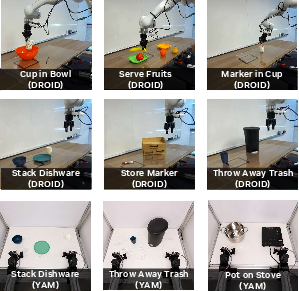
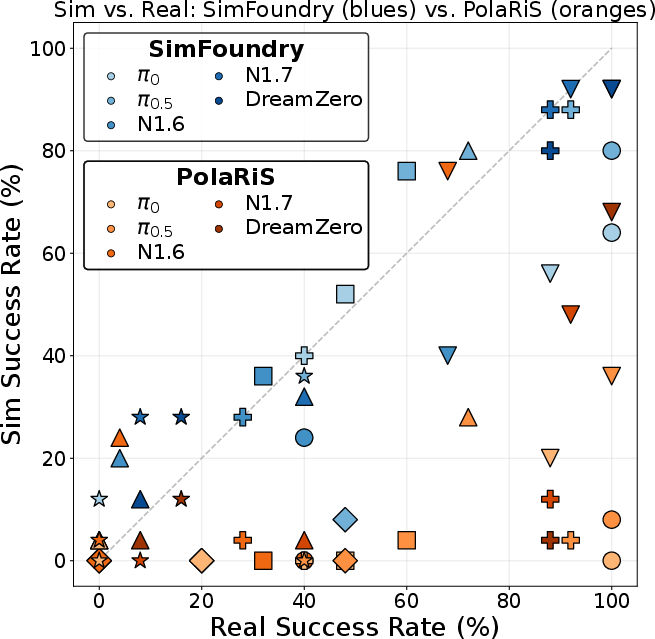
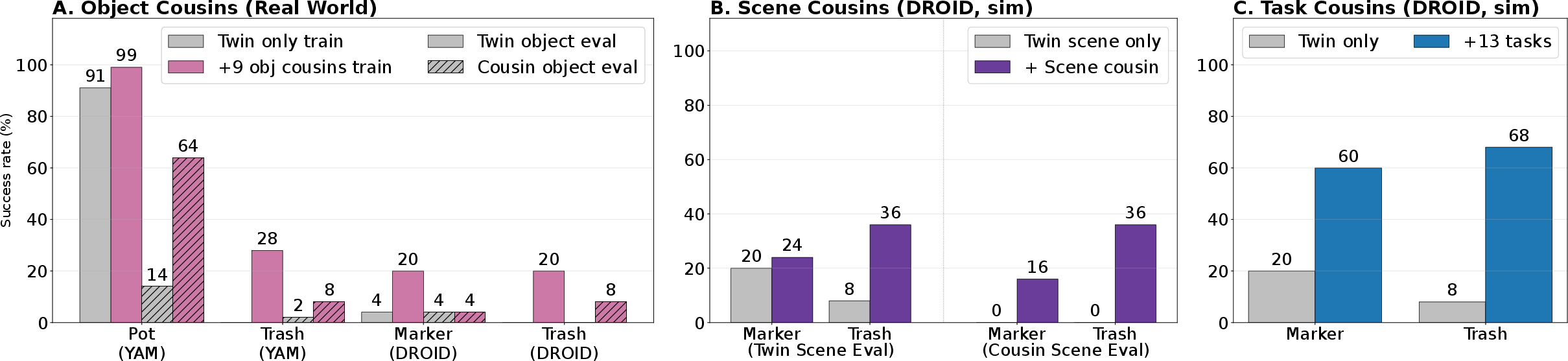
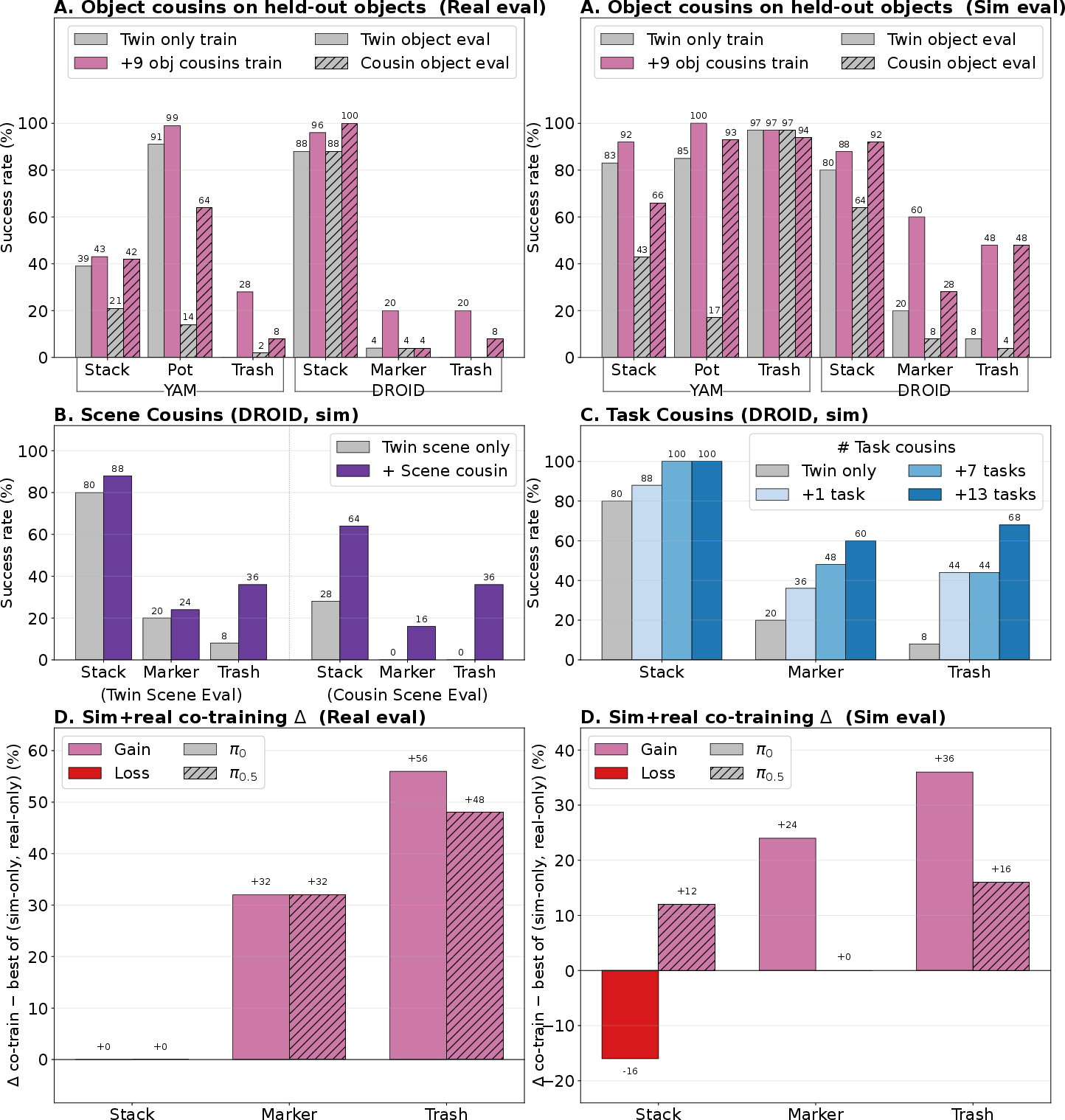
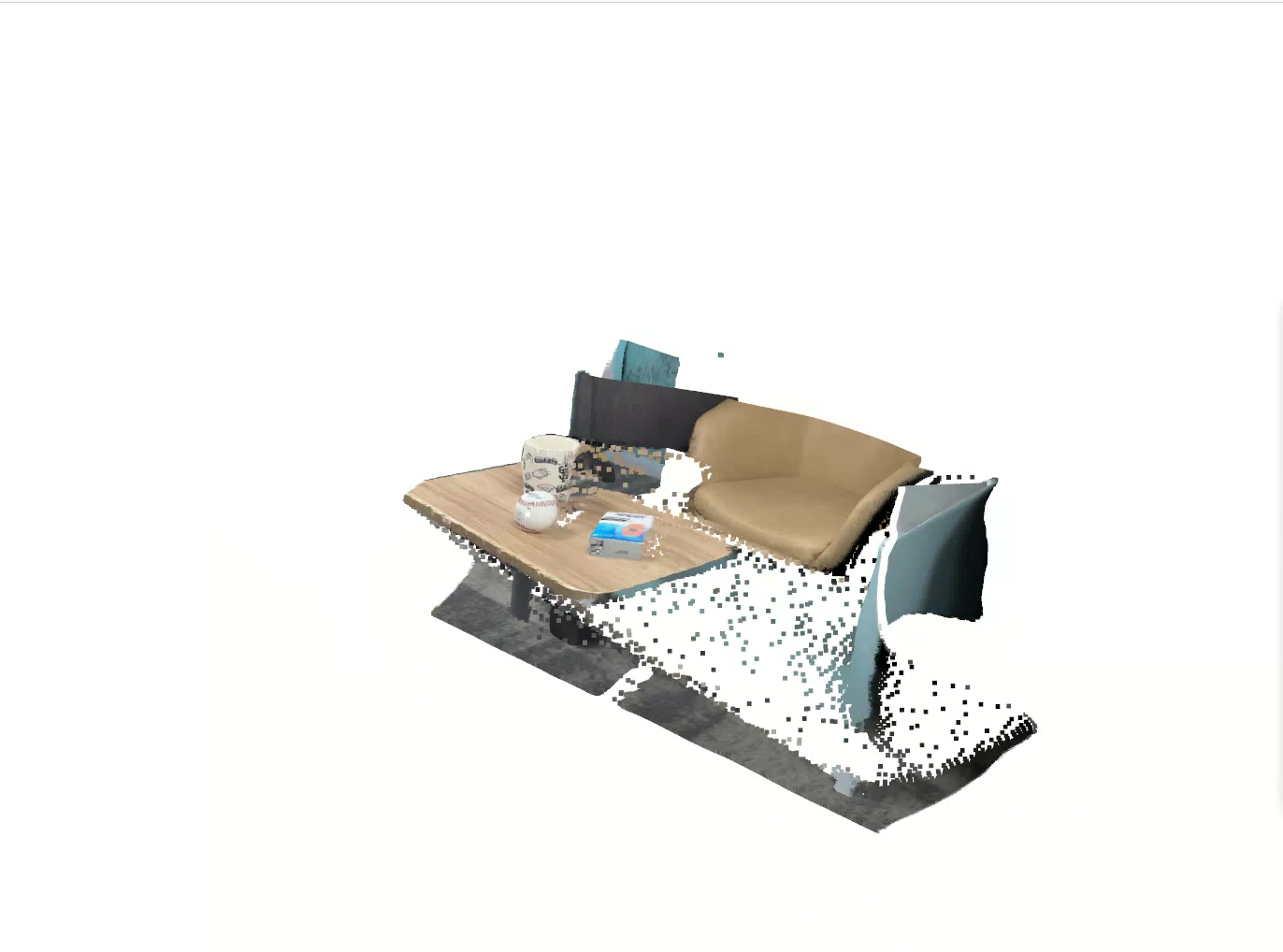
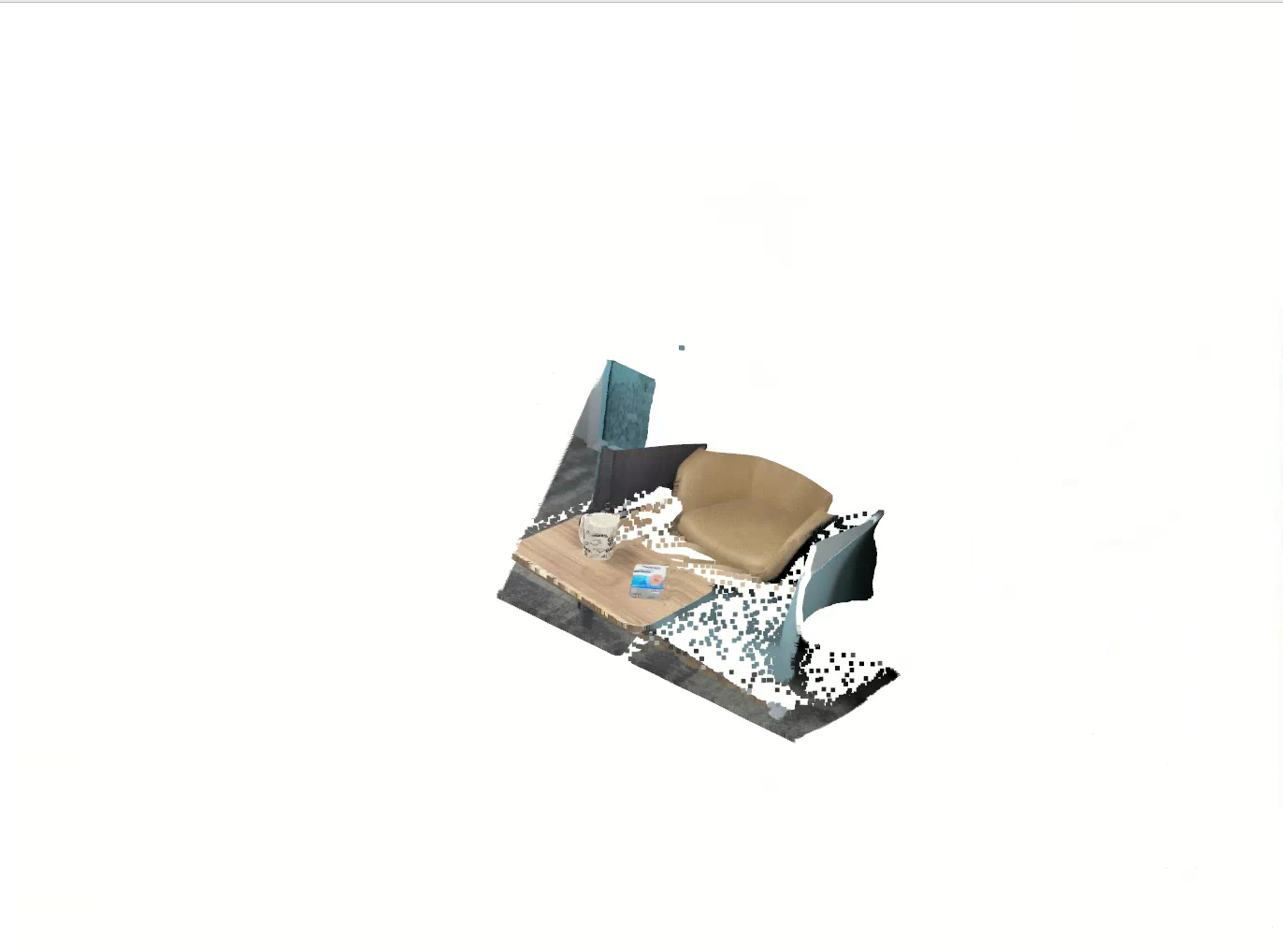
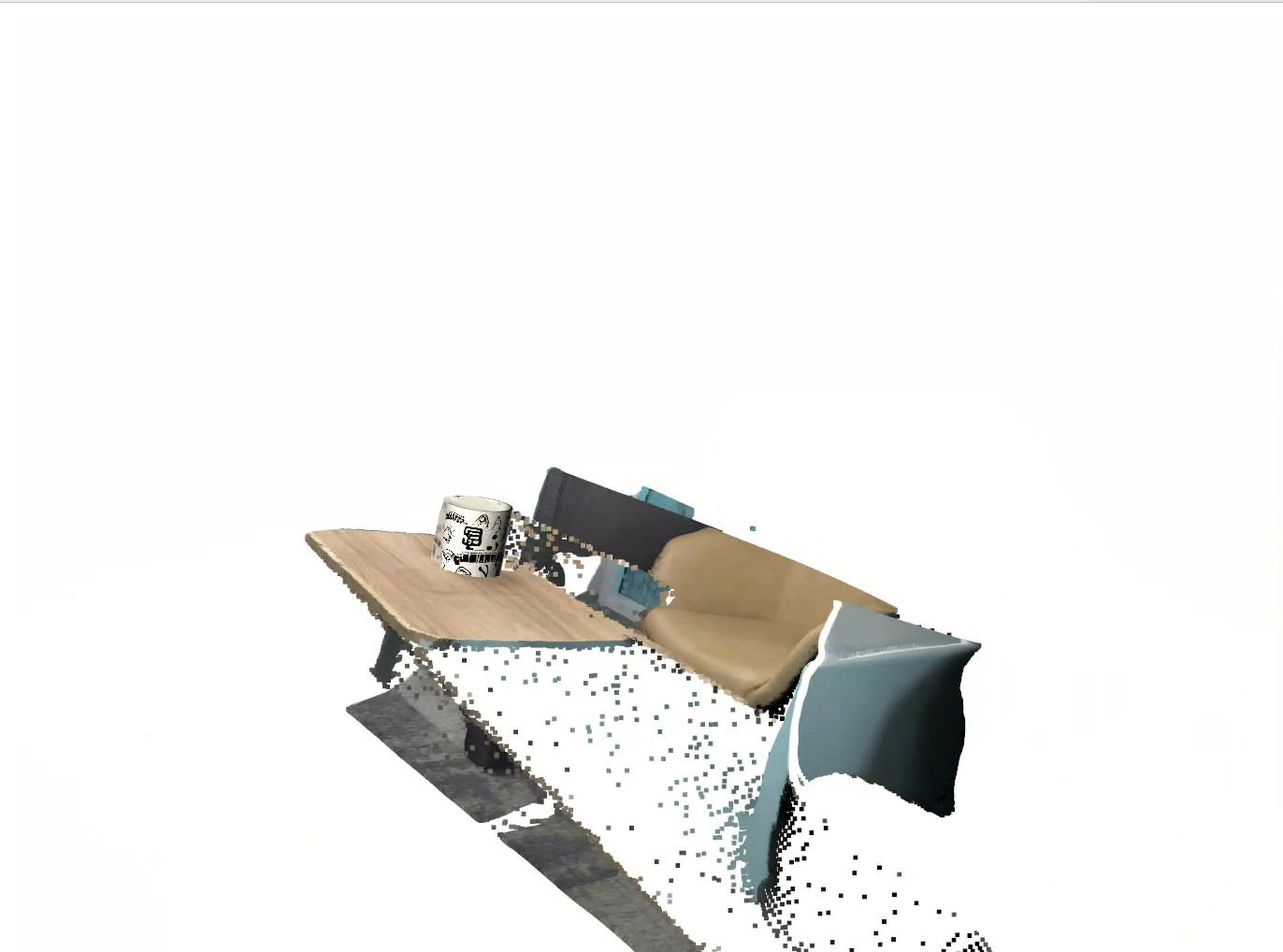
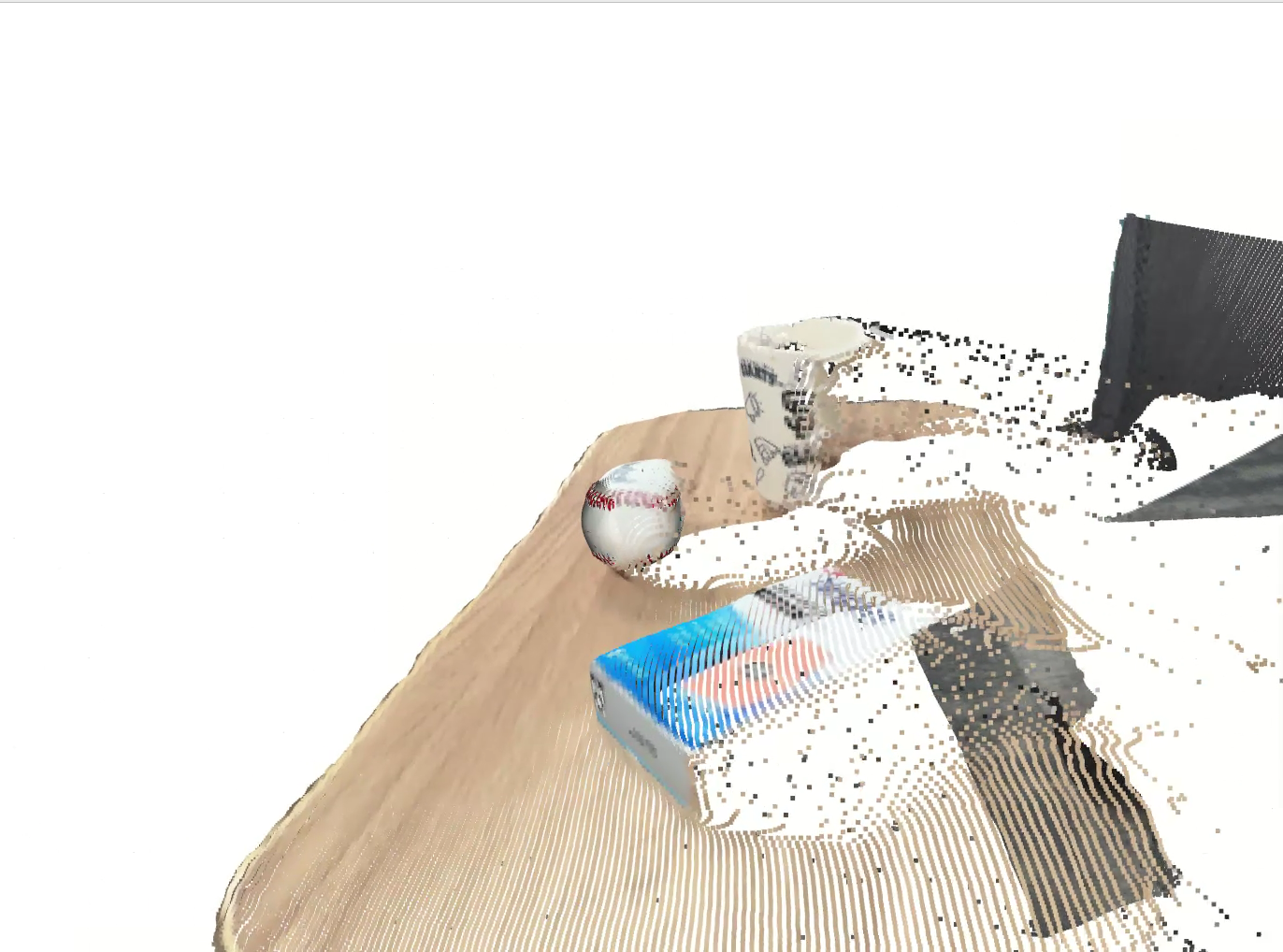
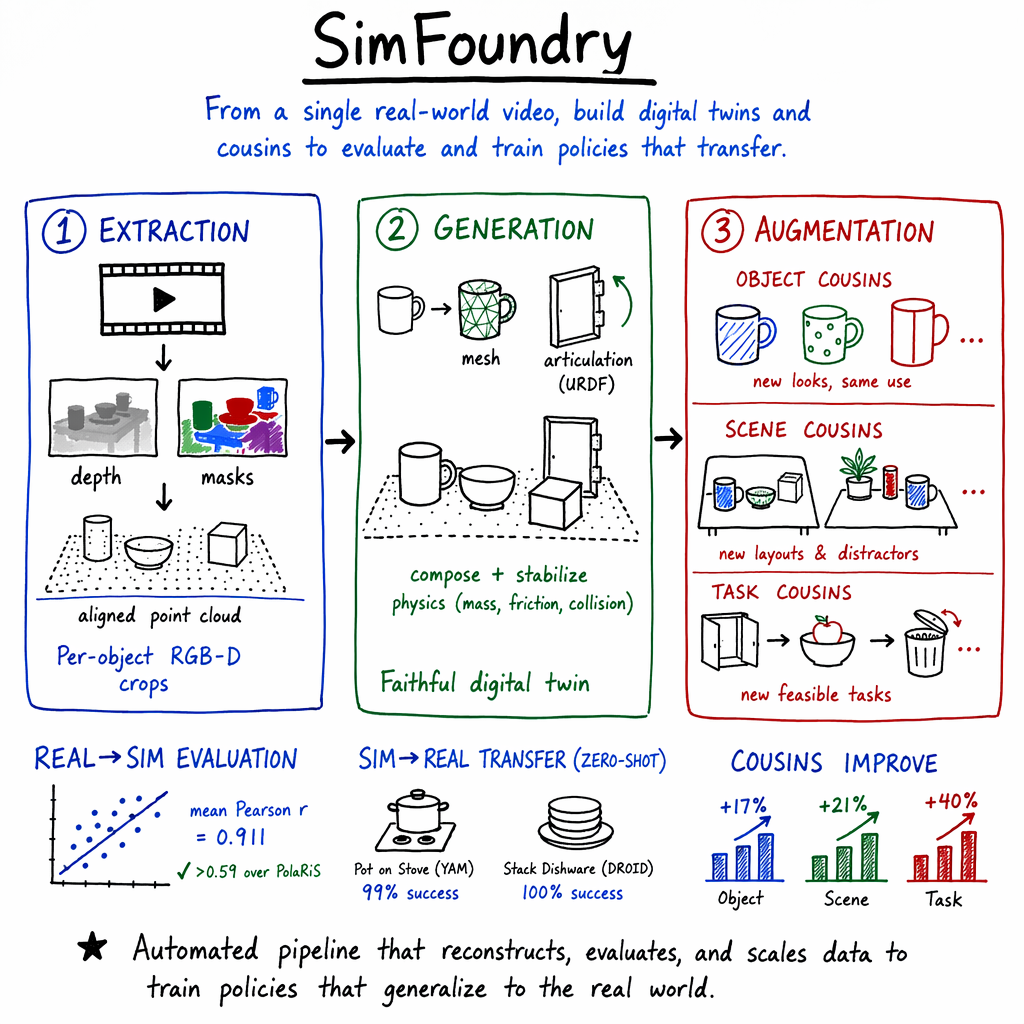
Abstract: Training and evaluating robot policies in the real world is costly and difficult to scale. We introduce SimFoundry, a modular and automated system for zero-shot real-to-sim scene construction from a video. SimFoundry generates sim-ready digital twins and supports object, scene, and task editing, enabling the automated generation of diverse digital cousins: affordance-preserving variations of reconstructed real-world scenes. Policies trained on SimFoundry data transfer zero-shot to challenging real tasks involving multi-step manipulation, articulated object interaction, and bimanual interaction, and its digital cousins (variations of the original scene, objects, and tasks) facilitate generalization to new real-world conditions. Across 7 manipulation tasks and 5 policy architectures, SimFoundry simulation evaluations strongly predict real-world performance, with mean Pearson correlation 0.911 and mean maximum ranking violation 0.018. When evaluating sim-trained policies zero-shot in the real world, policies trained with object, scene, and task cousins in simulation show average task success rate improvements of 17%, 21%, and 40%, respectively. Additional details at https://research.nvidia.com/labs/gear/simfoundry/ .



Paper Prompts
Sign up for free to create and run prompts on this paper using GPT-5.
Top Community Prompts
Explain it Like I'm 14
What is this paper about?
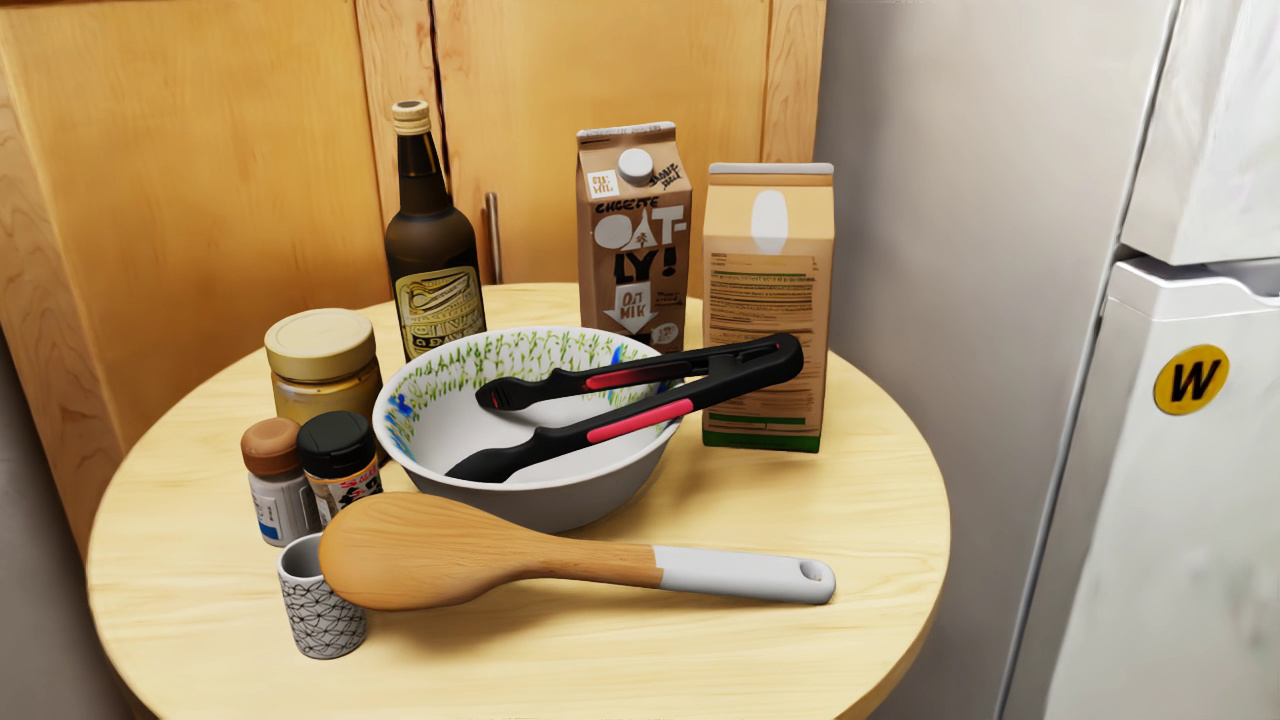
This paper introduces SimFoundry, a tool that can take a single real-world video and turn it into a playable “video‑game” version of that place where a robot can practice. It doesn’t just copy the scene (a “digital twin”); it can also make many smart variations of it (called “digital cousins”) so robots can train and be tested in many different, but still realistic, situations. The goal is to make robot learning faster, cheaper, and safer by doing more in simulation before trying things in the real world.
What questions is the paper trying to answer?
- Can we automatically build a useful, interactive 3D scene from just one real-world video?
- Can robots trained or tested in those scenes perform similarly in the real world?
- Do scene variations (different objects, layouts, and tasks) help robots generalize and perform better when things change?
How does SimFoundry work?
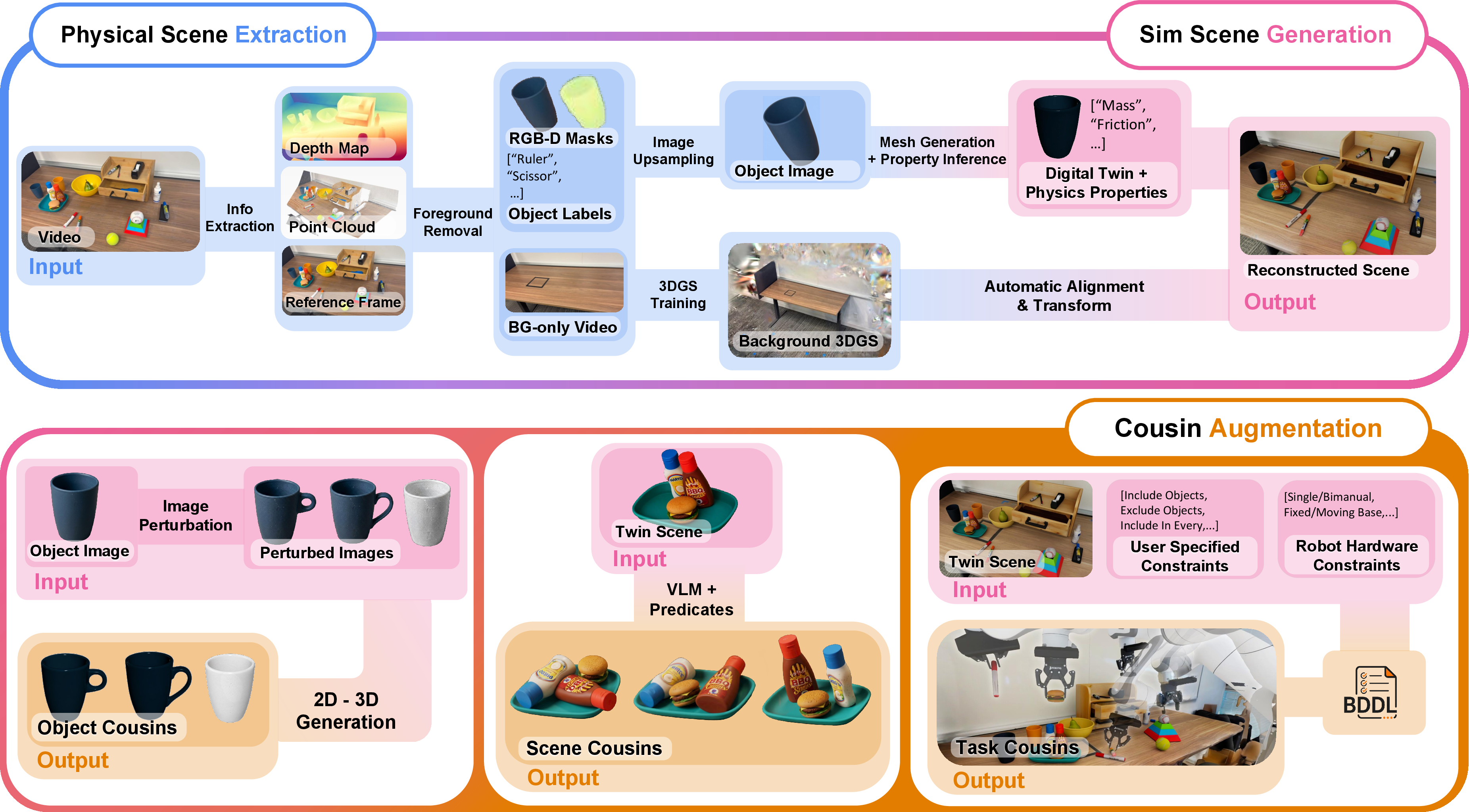
Think of SimFoundry as a three-step factory that turns a video into a robot training ground.
1) Extraction: “Figure out what’s in the scene”
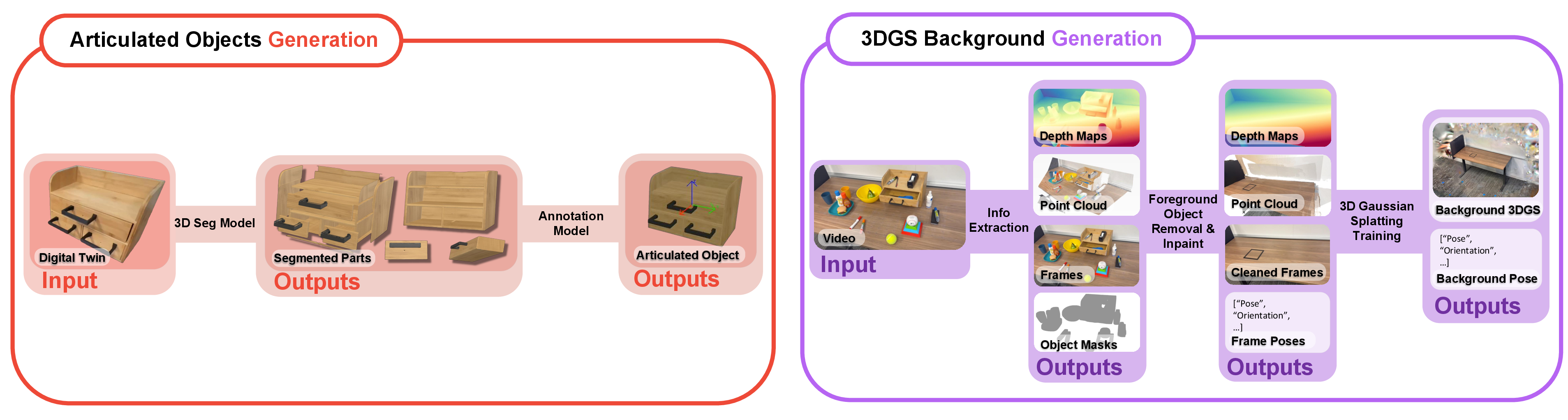
- The system picks a good frame from the video and estimates depth (how far things are).
- It finds and separates objects (like cups, plates, drawers) from the background using image understanding tools.
- It produces a clean, per‑object cutout with both color and depth information.
Everyday analogy: It’s like pausing a movie and tracing each item with a smart highlighter that also knows how far away each item is.
2) Generation: “Build the 3D world you can interact with”
- For each object, it creates a 3D model from the image (like imagining the full shape from a single photo).
- It places each model in the right spot and orientation, and sets physical properties like weight and friction so the objects behave realistically.
- If an object moves in parts (like a cabinet door or a drawer), it detects and adds those joints so a robot can open and close them.
- It checks that the whole scene is physically stable in a simulator (no objects stuck through each other).
Everyday analogy: It’s like turning a photo of a table into a 3D table you can pick up and interact with in a game, including working hinges and sliding parts.
3) Augmentation: “Make helpful variations for practice”
SimFoundry creates “digital cousins,” which are smart variations that keep the scene’s purpose but change the details. There are three kinds:
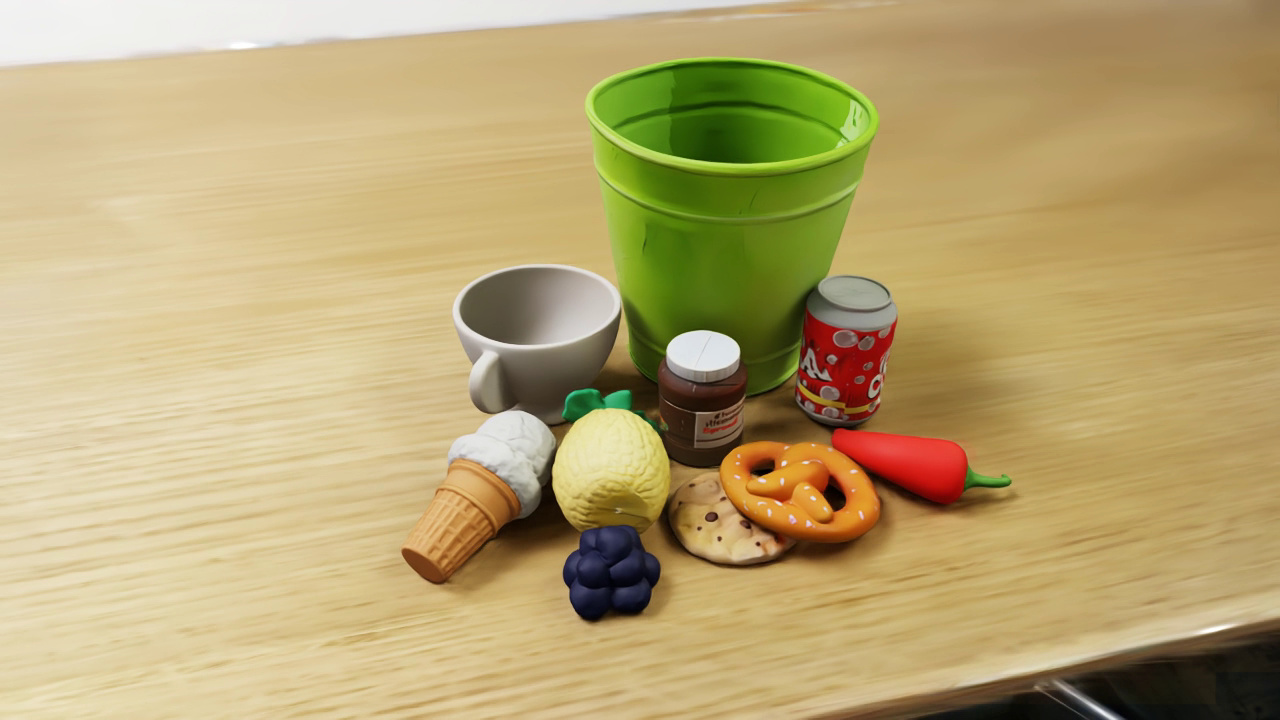
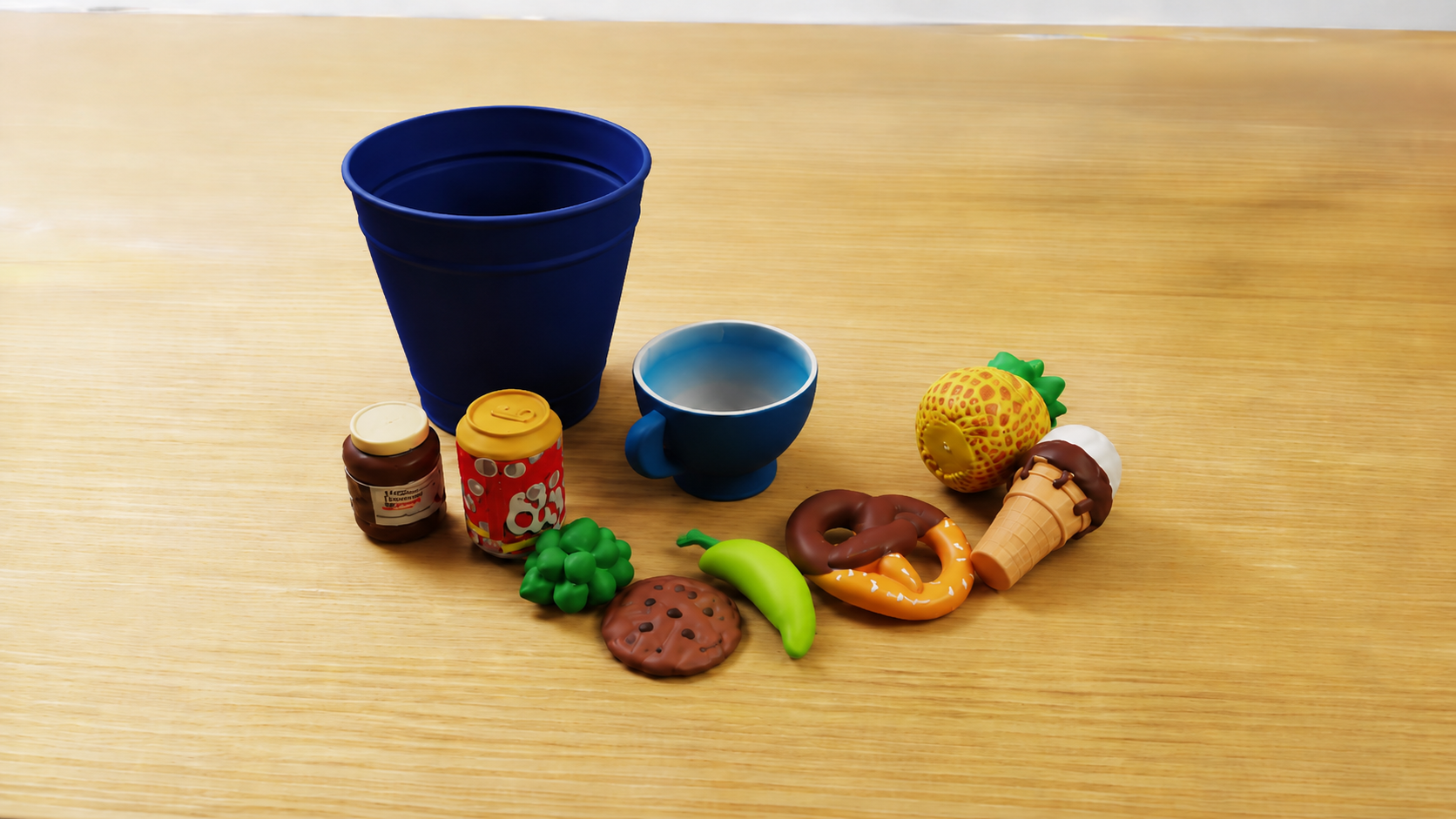
- Object cousins: swap in similar but different objects (e.g., a mug with a different shape or handle) while keeping how you’d use them the same.
- Scene cousins: rearrange the layout meaningfully (e.g., the apple is now inside a bowl instead of next to it), or add realistic distractor items.
- Task cousins: propose related tasks that make sense with the same objects (e.g., not just “put the marker in the cup,” but also “place the marker on the notebook”).
Everyday analogy: If the original is your kitchen, cousins are like new versions of the kitchen with different plates, a moved bowl, or new chores—but you can still cook and clean in them.
What did they find, and why is it important?
Here are the main results in simple terms:
- Strong match between simulation and reality: When they tested different robot “policies” (the robot’s decision-making program—think of it as the robot’s “brain”) in both the simulated scene and the real scene, the scores aligned very closely. The average correlation was about 0.91 (where 1.0 is perfect), and rankings of which policy is best were preserved. This means sim tests can reliably predict real-world performance.
- Training in sim transfers to the real world: Policies trained only in SimFoundry often worked well in the real scene, even on complex tasks like multi‑step actions, opening articulated objects (like drawers), and using two robot arms together.
- Variations make robots more robust:
- Object cousins improved real‑world success by about 17% on average.
- Scene cousins improved success by about 21% on average.
- Task cousins improved success by about 40% on average, especially helping with learning related tasks.
- Fast, mostly automatic scene building: Automatically reconstructed scenes had good geometry (F1 scores around 0.81–0.92), and a tiny bit of quick human tuning (about 3 minutes per object) boosted them to around 0.93–0.99. Scene creation averaged about 5 minutes per object.
- Better than prior methods: SimFoundry’s simulation evaluations predicted real-world results better than a leading baseline, and it handled more complex tasks (like bimanual and multi‑step tasks).
Why it matters: These results show that we can safely and cheaply test and train robots in a “virtual twin” of the real world and expect those lessons to carry over.
What does this mean for the future?
- Faster robot development: Building and testing in sim saves time and money versus doing everything on a physical robot.
- Safer and broader practice: Robots can practice rare, tricky, or risky situations virtually.
- Better generalization: Because SimFoundry creates useful variations, robots learn to handle new objects, layouts, and instructions without starting from scratch.
- Modular and future‑proof: The system is built from interchangeable parts (for vision, depth, 3D modeling, etc.), so it can plug in better models as they are invented.
In short, SimFoundry is like a scene‑building studio for robots: it turns a simple video into a realistic training ground with endless meaningful variations. That helps robots learn more, fail less, and be ready for the real world sooner.
Knowledge Gaps
Below is a single consolidated list of concrete knowledge gaps, limitations, and open questions that remain unresolved in the paper. Each point is phrased to be directly actionable for future work.
- Reconstruction from a single RGB video: How robust is the pipeline to camera motion, rolling shutter, motion blur, or very short/low-FPS clips, and what are the failure rates under these conditions?
- Camera calibration and metric scale: The method assumes known intrinsics and “metric” depth from monocular estimators; quantify absolute scale errors and develop procedures for automatic metric calibration without prior intrinsics.
- Depth/geometry under challenging materials: Robustness to transparent, glossy, reflective, thin, and texture-less objects is not evaluated; identify failure modes and incorporate specialized models or capture protocols.
- Occlusion and clutter: Limits under heavy occlusion, stacked items, or dense clutter are unclear; benchmark reconstruction accuracy as occlusion ratio increases.
- Background reconstruction and physics: 3D Gaussian splat backgrounds are non-physical; how to provide accurate collision geometry and material properties for background surfaces without manual scans?
- Single-view completion vs. multi-view capture: Compare the one-video approach to multi-view or short stereo captures in terms of fidelity, compute, and correlation with real-world policy performance.
- Articulation inference validity: Joint types, axes, limits, and friction/torque are generated automatically but not systematically validated; evaluate against ground-truth articulated assets and real force/torque measurements.
- Kinematic complexity: Support for kinematic loops, coupled joints, underactuated mechanisms, and non-standard joint types (e.g., prismatic with stops) remains untested.
- Deformables and fluids: The system does not handle cloth, cables, foodstuffs, or liquids; define pathways to integrate soft-body simulation and validate on deformable manipulation tasks.
- Physics parameter identification: Mass, friction, restitution, and damping are assigned via VLM queries; quantify parameter errors and their effect on task outcomes, and explore automated parameter identification from real interaction.
- Contact modeling fidelity: Sensitivity of policy evaluation to collision geometry approximations (CoACD convexes) and to different physics engines (PyBullet vs. Isaac/PhysX/MuJoCo) is not analyzed.
- Forceful and precision tasks: Generalization to tight-tolerance insertion, compliant control, or tasks dominated by force sensing (e.g., snap fits) is not shown; evaluate and extend physics realism accordingly.
- Non-tabletop scenes: Current pipeline targets planar/tabletop settings; extend and evaluate on multi-level, non-planar, large-scale indoor scenes (e.g., kitchens, offices, bathrooms) and outdoor setups.
- Large-scale scenes and long horizons: Scalability to scenes with dozens to hundreds of objects and to long-horizon tasks with many sub-goals is not characterized.
- Scene-to-robot frame alignment: The procedure for aligning the reconstructed world to the robot’s real coordinate frame (for deployment and evaluation) is not fully automated; standardize and quantify alignment errors.
- Affordance preservation in cousins: “Affordance-preserving” digital cousins are not validated with explicit affordance tests; develop automatic affordance checks (e.g., graspability, containment, stability) and report rates.
- Cousin diversity vs. task performance: The trade-off between the number/degree of cousins (object, scene, task) and downstream performance/stability is not explored; identify saturation points and negative transfer regimes.
- Task cousin validity: Automatic task proposals risk infeasible or degenerate goals; define feasibility filters and report the proportion of valid, solvable tasks produced.
- Sub-task evaluation generality: Sub-task-based correlations improved on reported tasks; test whether this generalizes to other long-horizon tasks and define a standard sub-task discovery protocol.
- Generalization across embodiments: Results are limited to DROID and YAM; evaluate on more embodiments (parallel grippers, suction, mobile bases, quadrupeds with arms) to test the modularity claim.
- Policy family coverage: Correlation and transfer are shown for a few VLA/world-action models; expand to RL-based policies, diffusion policies with tactile/force inputs, and closed-loop model predictive controllers.
- Dataset breadth and statistical power: Reconstruction evaluation uses 12 scenes and policy evaluation spans 7 tasks; increase breadth, include harder categories, and report confidence intervals/power analyses.
- Manual intervention and human time: Although small (≈3 min/object), human tuning remains; quantify how operator skill and time affect fidelity and downstream results, and aim to eliminate or learn these adjustments.
- Robustness to sensor and environmental variation: Evaluate across varied lighting, HDR scenes, camera lenses (wide/telephoto), and different sensors (RGB-only vs. RGB-D) to bound generalization.
- Reproducibility and standardization: Provide standardized benchmarks/datasets for real-to-sim scene construction and policy correlation, including common tasks, scenes, metrics, and public assets to foster fair comparisons.
- Safety and failure analysis: Identify systematic sim-to-real failure modes (e.g., friction misestimation, joint limit errors) leading to unsafe or damaging robot behavior, and build guardrails/tests to prevent them.
Practical Applications
Immediate Applications
Below are practical, deployable use cases that can leverage SimFoundry’s current capabilities (single‑video real‑to‑sim reconstruction, object/scene/task “cousins,” sim‑based evaluation, and sim‑generated training data), along with sectors, candidate tools/workflows, and feasibility notes.
- Rapid pre-deployment policy benchmarking and A/B testing
- Sectors: robotics (manufacturing, logistics, consumer, lab automation), software (robotics R&D)
- What to do: Capture a short video of the target workstation, auto‑reconstruct a sim-ready digital twin, evaluate candidate policies in the twin and its digital cousins, and pick the highest‑performing policy for on‑robot trials.
- Tools/workflows: Isaac Lab or PyBullet export; automated sub‑task evaluators; correlation metrics (Pearson r=0.911, MMRV=0.018)
- Assumptions/dependencies: Tabletop scenes; single RGB video with sufficient coverage; quality depth/seg/pose FMs; calibrated camera intrinsics; GPU for 3D generation.
- Regression testing and continuous integration for robotic manipulation
- Sectors: software/DevOps for robotics, QA
- What to do: Treat each workstation video as a versioned test asset; replay nightly CI runs over digital twins and cousins to catch performance regressions before field deployment.
- Tools/workflows: “Scene pack” repositories; cousin generators for layout and object diversity; pass/fail dashboards
- Assumptions/dependencies: Stable simulator bridge; deterministic seeds for reproducibility; consistent FM versions.
- Simulation-driven policy selection for new product rollouts
- Sectors: logistics, fulfillment centers, micro‑fulfillment, electronics assembly
- What to do: Evaluate different foundation models (e.g., GR00T variants, Pi-series) on reconstructed line-side tasks (pick‑place, binning, sorting) to select a vendor/model prior to installing hardware.
- Tools/workflows: Automated scenario library with task cousins; ranking reports for procurement
- Assumptions/dependencies: Task criteria defined as end‑to‑end success; physics parameters reasonable for target SKUs.
- Synthetic data augmentation to reduce real demo collection
- Sectors: robotics (general), education/research labs
- What to do: Generate demonstrations via SimFoundry twins plus object/scene/task cousins; finetune existing visuomotor or world‑action models to reduce on‑robot teleop hours.
- Tools/workflows: MimicGen‑style splicing; co‑training (sim + few real demos) workflows
- Assumptions/dependencies: Policy accepts sim sensor streams; sim‑to‑real gap managed via cousins and mild real data; operator time (≈3 minutes/object) improves reconstruction F1 from ~0.81–0.92 to ~0.93–0.99.
- Layout-robust policy training for small floor variations
- Sectors: contract manufacturing cells, lab benches, kitchen/food prep automation
- What to do: Use scene cousins (OnTop/RightOf/Inside, with distractors) to train policies robust to day‑to‑day placement drift and clutter.
- Tools/workflows: Semantic spatial predicate engine; distractor asset libraries
- Assumptions/dependencies: Task affordances preserved; collision geometry via CoACD is adequate.
- Instance-robust manipulation for SKU or utensil swaps
- Sectors: retail backroom robots, hospitality, consumer robotics
- What to do: Train using object cousins to preserve affordances (mugs, plates, bottles, drawers) while changing shape/texture; deploy on held‑out but functionally similar objects.
- Tools/workflows: 2D→3D mesh generation; articulation inference for drawers/cabinets
- Assumptions/dependencies: Affordance‑preservation holds; friction/mass heuristics are close enough for contact‑rich actions.
- Multi-task skill bootstrapping from a single scene
- Sectors: robotics R&D, education
- What to do: In one reconstructed scene, auto‑propose related tasks (task cousins) and collect demonstrations to train generalist policies; improve few‑shot learning on new tasks.
- Tools/workflows: Task library/specification; curriculum generation; few‑shot adapters
- Assumptions/dependencies: Goal conditions specified and auto‑checkable; downstream policy supports multi‑task training.
- Bimanual and articulated-object training in sim
- Sectors: advanced assembly, appliance interaction, lab automation
- What to do: Leverage articulated asset generation and bimanual support to train complex skills (e.g., opening drawers while placing, coordinated two‑arm actions) before limited real trials.
- Tools/workflows: Articulation module; policy architectures validated on YAM/DROID in paper
- Assumptions/dependencies: Accurate joint inference; controller sync for two arms.
- Vendor-neutral evaluation for procurement and model governance
- Sectors: enterprise robotics buyers, system integrators
- What to do: Use standardized SimFoundry scene packs and correlation‑backed metrics to evaluate external vendors’ policies without sharing sensitive facilities or data.
- Tools/workflows: Redacted scene videos; leaderboards; rank‑violation reports
- Assumptions/dependencies: NDAs/IP constraints; alignment on task rubrics.
- Courseware and student labs without physical robots
- Sectors: education (university, bootcamps, online courses)
- What to do: Students capture their desk videos, reconstruct twins, and develop/evaluate policies entirely in simulation with known sim‑to‑real metrics.
- Tools/workflows: Classroom bundle with Isaac Lab export and prebuilt cousin libraries
- Assumptions/dependencies: Entry‑level GPUs; curated FM versions for reliability.
- Facility “what-if” analysis for workstation tweaks
- Sectors: industrial engineering, operations
- What to do: Test how small changes (new bins, barriers, fixtures) affect policy success by generating scene cousins and re‑running tests before making physical changes.
- Tools/workflows: Scene diffing; success heatmaps per layout
- Assumptions/dependencies: Tabletop focus; modest visual fidelity needs.
- Visual content backdrops for HIL demos and XR mockups
- Sectors: sales engineering, XR training content
- What to do: Fuse 3D Gaussian Splat backgrounds with sim foregrounds for photoreal demos of robot behaviors without filming in the facility.
- Tools/workflows: Automatic or manual background pipelines; simulator bridge
- Assumptions/dependencies: Background used for visuals only (not physics); GPU memory for splats.
Long-Term Applications
Below are higher‑impact applications that may require more research, scaling, or architectural extensions (e.g., beyond tabletop, higher‑fidelity physics, broader sensor modeling).
- Home-assistive robotics trained on user-specific environments
- Sectors: consumer/eldercare
- What to do: Users capture living spaces; generate diverse cousins for furniture layouts and object instances; train assistive policies tailored to their homes.
- Dependencies: Beyond tabletop (multi‑level, deformables); privacy‑preserving pipelines; robust articulation/in-hand manipulation.
- Standardized, simulation-backed safety and compliance assessments
- Sectors: policy/regulation, insurance, certification bodies
- What to do: Define certifiable task suites with validated sim‑to‑real correlation; pre‑certify manipulation behaviors before supervised pilots.
- Dependencies: Accepted standards; coverage for edge cases (human‑robot interaction, rare hazards); calibrated physical parameters.
- Digital twin networks for facility-wide planning and reconfiguration
- Sectors: factories/warehouses, micro‑fulfillment
- What to do: Maintain a library of station twins; simulate policy changes, throughput impacts, and rebalancing with cousin‑generated variation at scale.
- Dependencies: Scene graph spanning non‑planar areas; conveyor/fixture kinematics; multi‑station scheduling realism.
- Zero-shot deployment across SKUs and seasonal changes
- Sectors: e-commerce, grocery distribution
- What to do: Auto‑generate extensive object cousins for new SKUs; pre‑train and validate policies for upcoming seasons before inventory arrives.
- Dependencies: Accurate affordance inference for previously unseen categories; scalable object libraries; texture→friction calibration.
- Robotics for small businesses and makers (turnkey “sim‑first” kits)
- Sectors: SMB automation, prosumers
- What to do: Off-the-shelf kits: phone‑video capture → twin → guided cousin generation → auto‑training → deployment recipe for low‑cost arms.
- Dependencies: Packaged compute; simplified UIs; robust defaults for physics and grasping.
- Training and certifying hospital/lab automation workflows
- Sectors: healthcare, biotech
- What to do: Simulate specimen handling, cabinet/drug drawer access, and tool exchanges safely before trials.
- Dependencies: Regulatory acceptance; higher fidelity for liquids, PPE interactions; sterile handling constraints.
- Cross-embodiment generalist policies via large-scale cousin curricula
- Sectors: robotics R&D, foundation model development
- What to do: Generate massive object/scene/task curricula across embodiments; pretrain generalist models that transfer broadly.
- Dependencies: Coverage of diverse embodiments and sensors; scalable sim orchestration; data governance.
- Real-time “in-situ” replanning with fresh reconstructions
- Sectors: field service, construction, disaster response
- What to do: Quick capture → reconstruct → run “what‑if” sim to plan next steps (e.g., clearing, access).
- Dependencies: Non‑tabletop scenes; fast reconstruction under clutter; uncertain physics and deformables.
- Human-robot collaboration training and risk assessment
- Sectors: manufacturing, warehousing
- What to do: Simulate co-bot tasks with human surrogates in reconstructed stations; run policy stress tests with scene/task cousins to identify unsafe failure modes.
- Dependencies: Human dynamics modeling; behavior diversity; safety KPIs and acceptance criteria.
- Synthetic data for vision-only affordance learning and perception QA
- Sectors: perception teams across industries
- What to do: Use cousins to render paired labels for segmentation, depth, pose, and affordance detections; evaluate perception stack robustness to texture/lighting/geometry shifts.
- Dependencies: Photo‑real rendering pipelines; domain gap for lighting/materials.
- Mixed reality operator training with policy-in-the-loop
- Sectors: training and upskilling
- What to do: Trainees interact with reconstructed twins and see policy guidance/effects; iterate on standard operating procedures virtually.
- Dependencies: Low‑latency XR; intuitive authoring of task cousins and performance rubrics.
- Sustainability impact modeling of automation cells
- Sectors: sustainability, industrial engineering
- What to do: Run batches of simulated policies/layouts to estimate cycle times, energy use, and waste for different configurations before physical changes.
- Dependencies: Validated energy/cycle‑time models; integration with MES/EMS.
Cross-Cutting Assumptions and Dependencies
- Scene scope: Current pipeline assumes predominantly tabletop, planar ground alignment, and rigid/articulated objects; multi‑level spaces and deformables need further work.
- Input quality: A single RGB video with adequate viewpoints; camera intrinsics/poses and depth quality significantly affect alignment and physics.
- Foundation models: Relies on segmentation, depth, pose, and 2D→3D generators; inherits their failure modes and dataset biases.
- Physics fidelity: Mass/friction/joints are annotated via heuristics and inference; contact‑rich tasks may require per‑object tuning.
- Compute and tooling: GPU resources for mesh/splat generation; simulator compatibility (Isaac Lab/PyBullet/ROS2 bridges).
- Governance/IP: Facility videos and reconstructed assets may carry IP/privacy constraints; standardized sharing and evaluation require agreements.
These applications map the paper’s core innovations—modular single‑video reconstruction, affordance‑preserving “digital cousins,” strong sim↔real evaluation correlation, and sim‑generated training data—to concrete workflows and products that can be rolled out today, while outlining the extensions needed for broader, high‑stakes deployments.
Glossary
- 2D-to-3D: Models or pipelines that infer 3D geometry (e.g., meshes) from one or more 2D images. Example: "a 2D-to-3D mesh model"
- 3D Gaussian Splat: A 3D scene representation using collections of anisotropic Gaussian primitives optimized for photorealistic rendering. Example: "a 3D Gaussian Splat"
- 6-DoF: Six degrees of freedom describing a rigid body’s full 3D pose (3 for position, 3 for orientation). Example: "6-DoF pose and scale estimation"
- affordance-preserving: Maintaining the functional interaction possibilities of objects or scenes despite changes in appearance or geometry. Example: "affordance-preserving variations"
- articulation module: A system component that detects movable parts of an object and defines their joints for simulation. Example: "articulation module"
- articulated objects: Objects composed of multiple parts connected by joints that can move relative to each other. Example: "articulated objects"
- bimanual: Involving the coordinated use of two robotic arms or hands. Example: "bimanual coordination"
- camera intrinsics: The internal calibration parameters of a camera (e.g., focal length, principal point) used to map pixels to rays. Example: "camera intrinsics"
- Chamfer distance: A metric measuring geometric discrepancy between two point sets or surfaces, often used to evaluate 3D reconstruction quality. Example: "chamfer distance"
- CoACD: An approximate convex decomposition algorithm used to generate collision-friendly convex parts from meshes. Example: "produce collision geometry using CoACD"
- collision geometry: Simplified geometric shapes used by physics engines to detect and resolve contacts efficiently. Example: "collision geometry"
- depth-supervised splat: A Gaussian splatting model trained with depth signals to improve 3D consistency. Example: "depth-supervised splat"
- digital cousins: Affordance-preserving simulated variants of a reconstructed scene that change objects, layouts, or tasks. Example: "digital cousins"
- digital twin: A sim-ready virtual replica of a real scene, matching geometry and layout for interaction. Example: "digital twin"
- F1 score: The harmonic mean of precision and recall, used here to quantify reconstruction accuracy. Example: "F1 scores"
- flow-matching policy: A policy learned via flow-matching (probability flow) objectives, often used in generative modeling for action synthesis. Example: "flow-matching policy"
- foundation models: Large pre-trained models serving as general-purpose components for tasks like depth, segmentation, and pose estimation. Example: "foundation models"
- FoundationPose: A model for 6-DoF object pose estimation used to refine alignment of generated assets. Example: "FoundationPose"
- inpainting: Filling missing regions in images or depth maps to remove objects or complete occluded areas. Example: "image and depth inpainting"
- IsaacLab: A GPU-accelerated robotics simulation framework used for training and evaluation. Example: "IsaacLab"
- Mean Maximum Rank Violation (MMRV): A metric that measures the average worst mismatch in policy rankings between simulation and real-world evaluations. Example: "Mean Maximum Rank Violation (MMRV)"
- object cousins: Variants that replace or modify object instances while preserving their functional affordances. Example: "object cousins"
- Pearson Correlation Coefficient: A statistic measuring linear correlation between two variables; used to compare sim and real performance. Example: "Pearson Correlation Coefficient"
- point cloud: A set of 3D points representing the environment, typically derived from depth and camera intrinsics. Example: "scene point cloud"
- PyBullet: A physics engine and simulation toolkit used to compose and stabilize scenes. Example: "PyBullet"
- real-to-sim: The process of reconstructing real-world scenes into simulation environments for evaluation or training. Example: "real-to-sim"
- rigid transform: A transformation composed of rotation and translation that preserves distances and angles. Example: "rigid transform"
- scene cousins: Variants that alter the spatial arrangement of objects to produce new, meaningful layouts. Example: "scene cousins"
- semantic spatial predicates: Symbolic relations describing object layouts (e.g., OnTop, RightOf) used to construct scene variations. Example: "semantic spatial predicates"
- sim-to-real: Training policies in simulation and transferring them to the physical world without (or with minimal) real-world fine-tuning. Example: "sim-to-real"
- sub-task evaluation: Measuring performance at intermediate steps within a long-horizon task to better diagnose failure and progress. Example: "sub-task evaluation procedure"
- task cousins: Additional feasible tasks proposed within the reconstructed scene that share objects or affordances with the original. Example: "task cousins"
- VLA: Visual-Language-Action model family that maps multimodal inputs to actions. Example: "VLA"
- world-action model: A model that directly predicts actions referenced to the world state rather than low-level controls. Example: "world-action model"
- zero-shot: Deploying or transferring a policy to new tasks or domains without task-specific training in that setting. Example: "zero-shot"
Collections
Sign up for free to add this paper to one or more collections.

