- The paper introduces a novel agent-guided framework (SAGE) that employs a six-step multi-agent pipeline to systematically diagnose and optimize LLM prompts.
- The paper demonstrates that SAGE achieves superior performance on benchmarks like XBRL Formula and AppWorld by effectively tailoring optimization strategies to task-specific error structures.
- The paper shows that continuous cumulative optimization in production settings, such as a mental-health chatbot deployment, yields statistically significant improvements in performance metrics.
Authoritative Review of "SAGE: Stochastic Prompt Optimization via Agent-Guided Exploration"
Context and Motivations
Automatic prompt optimization (APO) for LLMs is recognized as a critical lever for enhancing system performance in real-world deployments, particularly in production contexts where retraining or fine-tuning is undesirable. Previous research, notably "Textual Gradients are a Flawed Metaphor for Automatic Prompt Optimization" (Melcer et al., 15 Dec 2025), has established that textual gradients do not function as true gradients. This insight motivates a shift from gradient-inspired protocols to black-box search paradigms. The prompt optimization landscape, empirically demonstrated to be low-dimensional, semantically smooth, locally dense, and often rugged, suggests that a single search strategy is unlikely to be universally optimal.
Methodological Advances: The SPO Framework and SAGE Architecture
The paper introduces SPO (Stochastic Prompt Optimization), a general-purpose framework for stochastic search across prompt space. Three optimization strategies are instantiated within SPO:
- SPO-RS (Residual Search): High-temperature LLM sampling conditioned on error summaries, enabling error-informed stochastic perturbation.
- SPO-GA (Genetic Algorithm): Evolutionary optimization with LLM-mediated crossover and targeted mutation, balancing diversity and targeting via explicit operator mix.
- SAGE (Agent-Guided Exploration): Multi-agent pipeline with programmatic diagnostic code execution, leveraging the analytical depth of agents, structured error analysis, and parallel investigation to systematically surface, validate, and address error patterns.
SAGE is constructed as a fixed six-step pipeline per iteration, coordinating four agent roles—Analyzer, Orchestrator, Investigator, Generator—with access to computational toolkits. Each agent operates on structured evaluation results, bridging qualitative failure diagnosis and quantitative prompt validation.
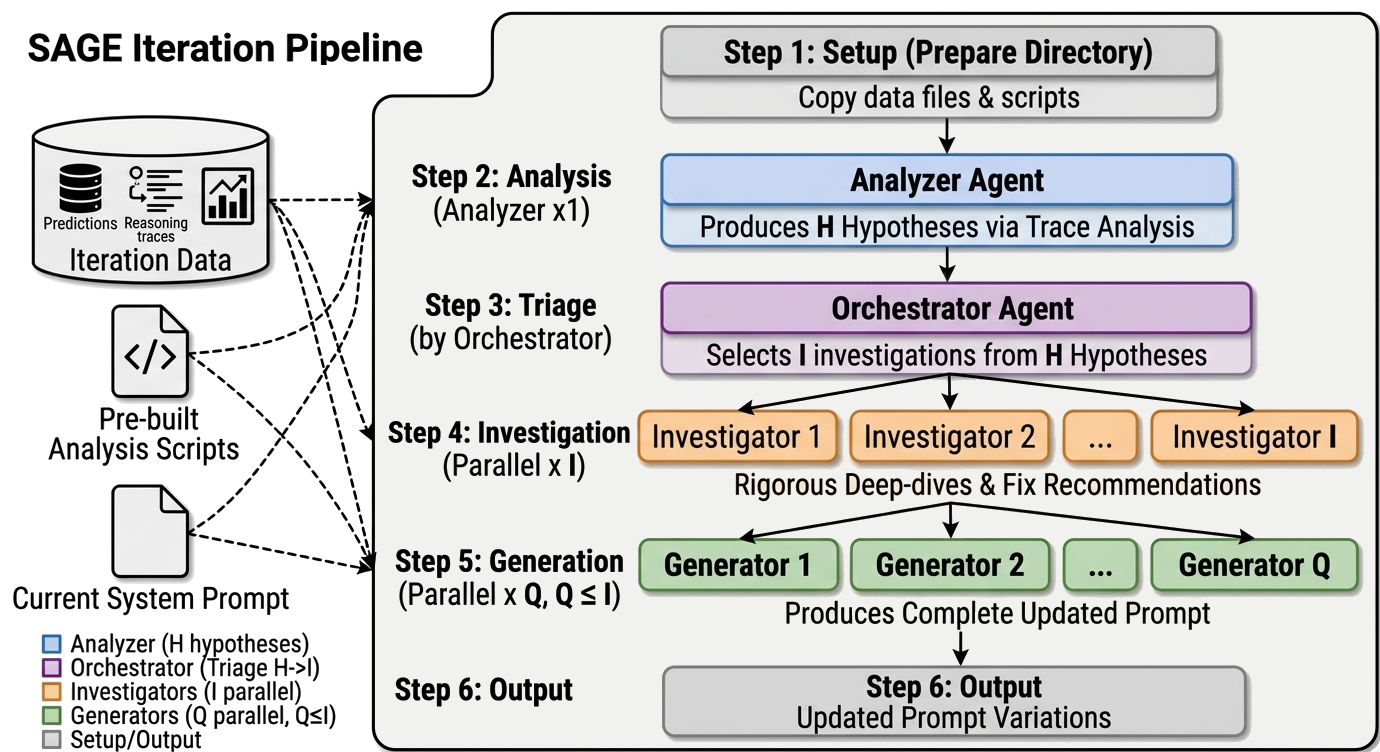
Figure 1: SAGE architecture: a fixed six-step multi-agent pipeline per iteration, progressing from cross-prompt error analysis through parallel hypothesis investigation to prompt generation and hill-climbing selection.
Empirical Evaluation and Numerical Results
The empirical analysis comprises three benchmarks of varying complexity: XBRL Formula (financial reasoning), FiNER (fine-grained NER), and AppWorld (multi-step agent tasks), alongside a production deployment on a mental-health chatbot under a continuous optimization regime.
Benchmark Findings:
- No optimization strategy dominates across tasks; effectiveness is task-dependent.
- On Formula, SAGE achieves the highest training/test accuracy, outperforming prior state-of-the-art methods (ACE, GEPA, MIPROv2), indicating that cascading reasoning errors benefit from deep analytical diagnosis.
- On FiNER, although SAGE attains superior training accuracy, the simpler SPO-RS strategy generalizes better to test set, highlighting that optimizer sophistication should be matched to landscape smoothness and error structure.
- All three SPO variants surpass baselines on AppWorld, demonstrating robust transfer of agentic prompt optimization to complex task-completion environments.
- Landscape ruggedness, quantified via semivariogram analysis, does not directly predict which optimizer will prevail; instead, it is the structure and type of errors that determines optimizer efficacy.
Production Deployment:
- SAGE is deployed on Ash, a mental-health chatbot, running eight cycles of prompt optimization.
- Individually noisy A/B test results are compounded, yielding a statistically robust cumulative gain: +29.4% relative improvement in D1 retention across eight cycles, with significance emerging only when gains are chained.
- Most cycles did not reach classical significance in isolation (P(beat) often < 0.95), emphasizing the practical value of continuous, compounding optimization in production settings with noisy signals.
Theoretical Contributions and Implications
The SAGE framework represents the first instance where diagnostic code execution powers statistical diagnosis—distinct from prior multi-agent works, e.g., MAPGD (Han et al., 14 Sep 2025) or MCE (Ye et al., 29 Jan 2026), where code execution serves procedural construction rather than epistemic analysis. This enables nuanced root-cause reasoning, multi-hypothesis investigation, and context-aware prompt synthesis, which are non-trivial to replicate using monolithic LLM-only optimization protocols.
Landscape analysis extends geostatistical semivariogram methodology to prompt space, providing a robust metric of local structure resistant to clustering artifacts. Two regime distinctions are surfaced: Formula/AppWorld with short decorrelation ranges (rugged), and FiNER with extended autocorrelation (smooth). Crucially, ruggedness alone does not prescribe optimizer; error typology—cascading or procedural—modulates which strategy achieves better generalization versus overfitting.
The continuous optimization paradigm, articulated with statistical rigor, chains weak signals into strong cumulative evidence. This paradigm, validated in the Ash deployment, is essential for open-ended domains lacking crisp correctness signals and where long-horizon behavioral outcomes (e.g., retention, engagement) are the only feasible evaluation proxies.
Practical Limitations and Ethical Safeguards
Three major limitations are acknowledged:
- Evaluation function dependency: Automated evaluation is required, and in domains like mental health, proxies are imperfect and can diverge from ultimate objectives.
- Distribution shift vulnerability: Continuous optimization assumes stationarity, yet user populations evolve, demanding periodic re-grounding.
- Bounded novelty bias: Data-driven diagnosis only refines present behaviors, lacking mechanisms for principled introduction of qualitatively novel strategies without external expert intervention.
Ethical protocols are rigorously enforced in the mental-health application, with domain expert review, real-time safety monitoring, and full IRB compliance.
Future Directions
SAGE unlocks agent-driven prompt optimization for domains where correctness is underspecified and behavioral outcomes are noisy. The results suggest that future research should focus on:
- Integrating human-in-the-loop and LLM judge protocols to surmount evaluation limitations in subjective domains.
- Dynamic adaptation to population shifts, employing active learning or on-policy evaluation.
- Augmenting agentic frameworks with mechanisms for exploratory behavior and expert-guided novelty injection, moving beyond incremental gains bounded by historical data.
Conclusion
"SAGE: Stochastic Prompt Optimization via Agent-Guided Exploration" (2606.18902) advances prompt optimization by formalizing the search as stochastic black-box optimization and operationalizing agent-guided analytical pipelines. Strong empirical results demonstrate that optimizer effectiveness is contingent on task-specific error structure and that agentic analytical depth is most valuable in ill-posed or noisy domains. The continuous optimization paradigm provides a practical recipe for production systems: chain individually-underpowered online A/B tests into robust cumulative evaluation, pairing automated measurement with qualitative agentic diagnosis. Mixed qualitative-quantitative agentic optimization is poised to become central to improving LLM deployments when formal correctness cannot be specified in advance.

