- The paper introduces RLDT, a reinforcement learning algorithm that redefines policy improvement as a density transport problem on the action manifold using SVGD.
- It refines flow-matching policies by aligning pretrained models with high-reward regions through a transport-field approach that stabilizes gradient propagation across ODE steps.
- Experimental results demonstrate faster convergence and improved reward acquisition in both dense and sparse environments when compared to established baseline methods.
Reinforcement Learning with Density Transport for Flow-Matching Policies
Overview
"Reinforcement Learning for Flow-Matching Policies with Density Transport" (2606.08602) introduces RLDT, an online RL algorithm for fine-tuning flow-matching policies in continuous-control domains. The authors present a paradigm shift in RL policy optimization by framing it as a probability density transport problem on the action manifold. RLDT leverages Stein Variational Gradient Descent (SVGD) to construct a transport field from a maximum-entropy RL objective, enabling efficient alignment of pretrained flow-matching policies with high-reward regions in action space. The work directly addresses the challenges inherent to RL for flow-matching models, particularly the intractability of action log-likelihood calculations and unstable backpropagation through multi-step denoising processes.
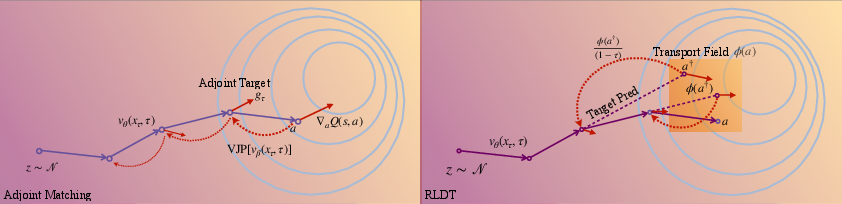
Figure 1: RLDT pipeline schematic comparing adjoint-matching (QAM) and RLDT's transport-field approach for intermediate denoising step updates.
RLDT posits that policy improvement in RL can be mathematically modeled as moving the action marginal density toward regions of higher expected reward. This is instantiated as a transport map T=id+ϵϕ, where ϕ is a velocity field defined by the reward landscape. Flow-matching policies, which generate actions via integration of learned vector fields over multiple ODE steps, naturally align with this transport-centric view. The maximum-entropy RL framework is adopted for reward-based density shaping, yielding the optimal policy:
π∗(a∣s)∝exp(Q(s,a)/κ)
where Q is the soft action value and κ controls entropy regularization.
SVGD provides the transport direction as:
ϕ∗(x)=Ex′∼q[k(x′,x)∇x′logp(x′)+∇x′k(x′,x)]
with k as the kernel function. The loss is applied directly to intermediate denoising steps using expected posterior actions at,τ†, which are analytically computed and correspond to deterministic mappings along the policy's flow field. This enables propagation of learning signals across all ODE steps, circumventing gradient dilution and instability observed in prior approaches.
Algorithmic Contributions and Regularization
The RLDT loss integrates three components:
- RL alignment loss: Matches the policy's flow field to the target SVGD transport direction.
- Consistency loss: Regularizes trajectory alignment to preserve optimal transport properties.
- Constraint loss: Enforces proximity to the pretrained policy using Fisher divergence.
The complete actor loss is:
Lactor=LRL+λ1Lconsist+λ2Lconstraint
Training utilizes ensembles of SVGD particles per state, allowing for robust estimation of transport directions and scalable optimization within simulation environments.
Experimental Evaluation
RLDT was empirically validated across three domains: OpenAI Gym (dense reward), FurnitureBench (long-horizon, sparse reward), and Robomimic (vision-based, sparse reward manipulation). Compared against DPPO, ReinFlow, FPO++, and QAM, RLDT demonstrated higher reward acquisition and faster convergence across all environments.
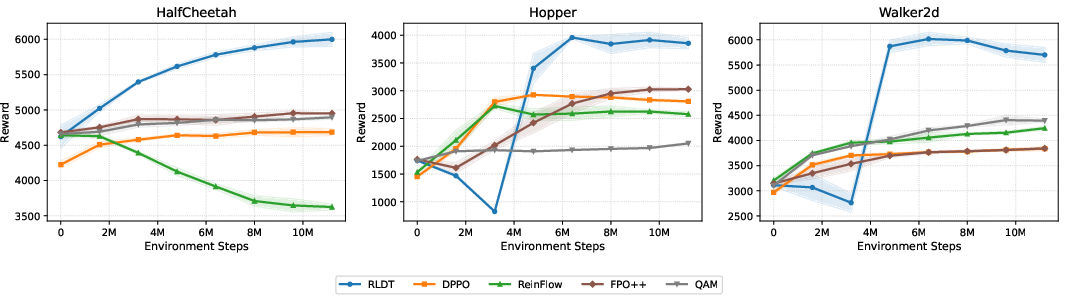
Figure 2: RLDT yields superior reward trajectories in dense-reward continuous-control tasks compared to baselines.
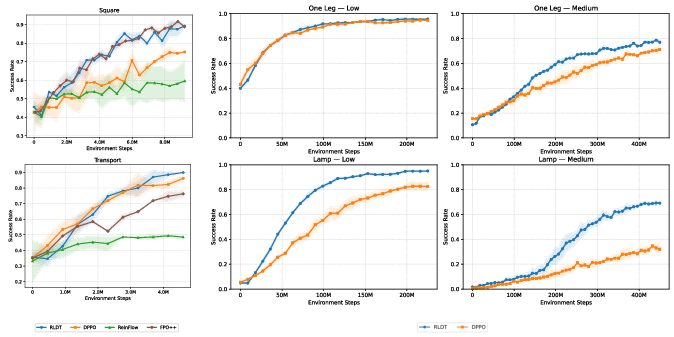
Figure 3: RLDT achieves higher or comparable success rates on sparse-reward vision and state-based benchmarks.
Importantly, RLDT's learning signal remains balanced across ODE denoising steps, providing stable optimization dynamics and avoiding the vanishing gradients seen in adjoint-matching methods. Gradient norm analysis confirms this effect:
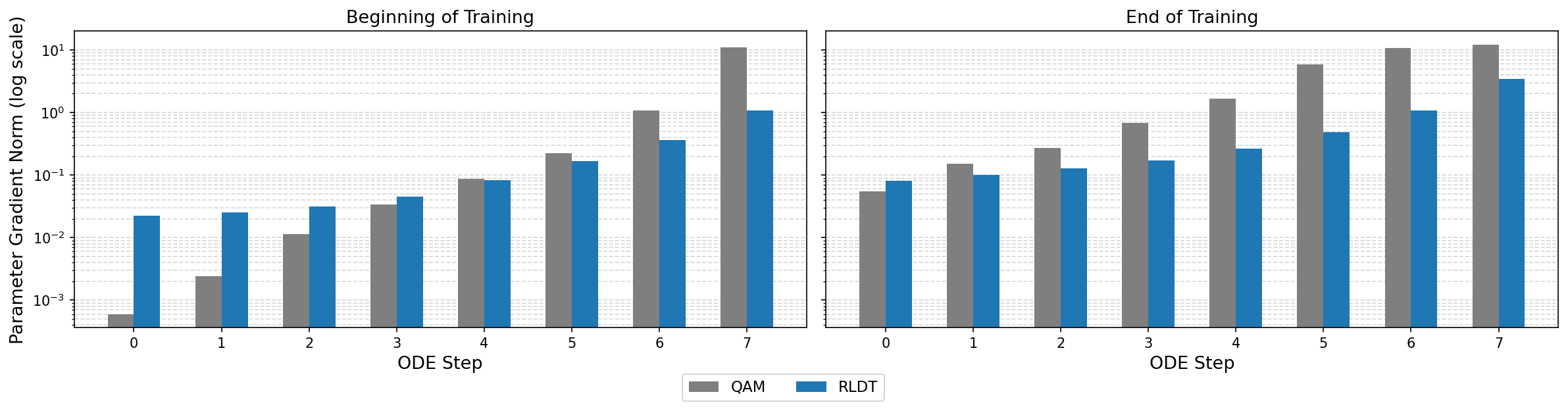
Figure 4: RLDT produces consistent parameter gradient norms across ODE timesteps before and after training, unlike QAM.
Ablation studies on kernel function choice emphasized the impact of SVGD's repulsive term. The RBF kernel promotes exploration and reduces instability in sparse-reward settings, while the delta kernel collapses to pure critic-gradient following, resulting in performance degradation.
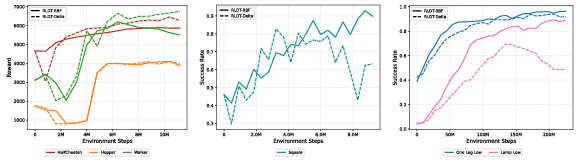
Figure 5: RLDT-RBF kernel outperforms RLDT-Delta kernel in sparse reward tasks, demonstrating robustness and stability.
Further analysis demonstrated robustness of RLDT to temperature and particle count hyperparameters, supporting its practicality in a range of policy architectures.
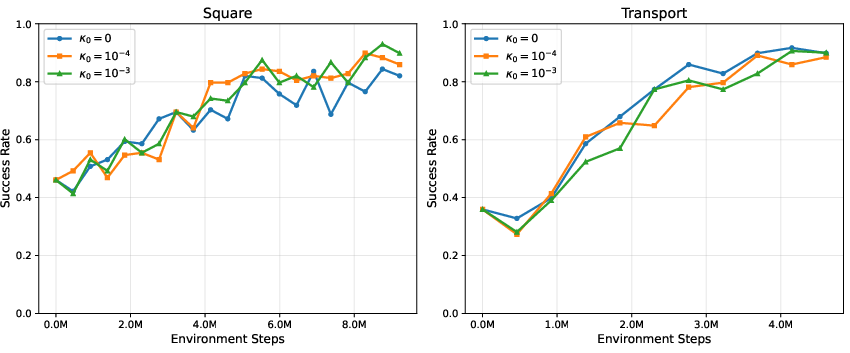
Figure 6: RLDT performance is stable across a range of temperature parameters κ0 in Gym tasks.
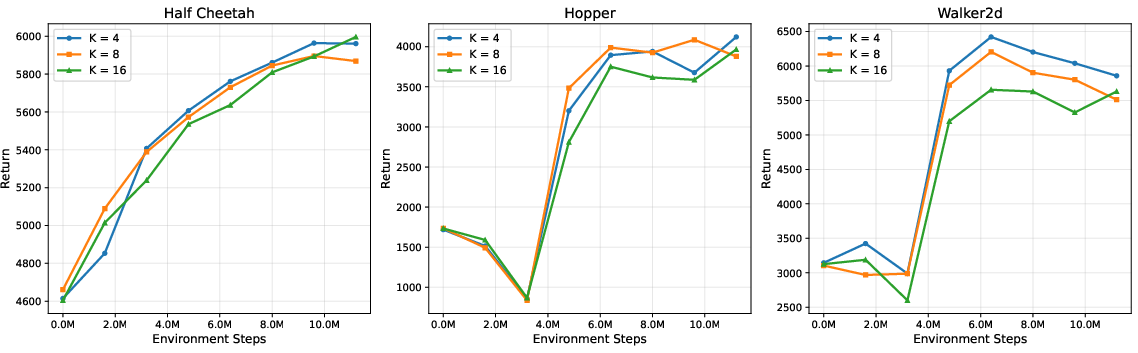
Figure 7: RLDT is not sensitive to ensemble size ϕ0, achieving strong results with few SVGD particles.
Additional statistics confirmed the kernel-induced stability:
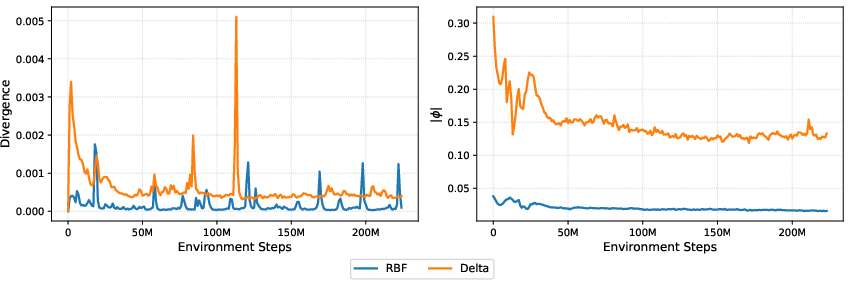
Figure 8: Training statistics for delta vs. RBF kernels highlighting constraint loss and transport velocity norms.
Theoretical and Practical Implications
RLDT advances the theoretical understanding of RL for generative policies by demonstrating that density transport via SVGD is effective for fine-tuning flow models without explicit density estimation or constraining policy structure. Its balanced multi-step signals and sample-based optimization circumvent the main limitations of previous log-likelihood and adjoint-based approaches. Practically, RLDT enables large-scale fine-tuning of foundation flow policies in continuous, high-dimensional, long-horizon robotics settings.
The requirement for multiple parallel SVGD particles introduces computational overhead, but ablations indicate that only four particles suffice, making simulation-to-real applications viable. The density transport perspective may further influence future RL algorithm design, particularly for expressive policy classes where multi-step generation and standard policy gradients are limiting.
Conclusion
RLDT presents a formally principled and empirically validated algorithm for RL-based fine-tuning of flow-matching policies by recasting policy improvement as density transport aligned with reward gradients. It addresses critical challenges in flow policy optimization, including gradient stability and density tractability, and demonstrates strong performance across dense and sparse continuous-control tasks. The approach opens new avenues for RL with generative policies and is anticipated to accelerate development in robotics, vision-language-action adaptation, and simulation-to-real transfer in high-dimensional control systems.

