Humanoid-GPT: Scaling Data and Structure for Zero-Shot Motion Tracking
Abstract: We introduce Humanoid-GPT, a GPT-style Transformer with causal attention trained on a billion-scale motion corpus for whole-body control. Unlike prior shallow MLP trackers constrained by scarce data and an agility-generalization trade-off, Humanoid-GPT is pre-trained on a 2B-frame retargeted corpus that unifies all major mocap datasets with large-scale in-house recordings. Scaling both data and model capacity yields a single generative Transformer that tracks highly dynamic behaviors while achieving unprecedented zero-shot generalization to unseen motions and control tasks. Extensive experiments and scaling analyses show that our model establishes a new performance frontier, demonstrating robust zero-shot generalization to unseen tasks while simultaneously tracking highly dynamic and complex motions.
Paper Prompts
Sign up for free to create and run prompts on this paper using GPT-5.
Top Community Prompts
Explain it Like I'm 14
What this paper is about
Humanoid-GPT is a new “brain” for a humanoid robot that helps it copy human movements in real time. Think of it as a super-smart dance coach: you show it a new move, and without any extra training, it makes the robot follow along smoothly and accurately. The big idea is that by using a lot more data and a better model design, the robot can be both agile (fast, athletic) and good at generalizing (handling new, unseen motions) at the same time.
The main questions the paper asks
Here are the simple, big questions the researchers tackled:
- Can one robot controller learn to follow almost any human motion it hasn’t seen before, without extra training (zero-shot)?
- If we make the training dataset huge and the model stronger, does the robot reliably get better?
- How do we collect and organize motion data so the robot learns not just the common moves, but also rare, tricky ones?
- What kind of model structure works best for real-time control where you can only use past information (not the future)?
How they did it (in everyday terms)
The approach works in three main stages.
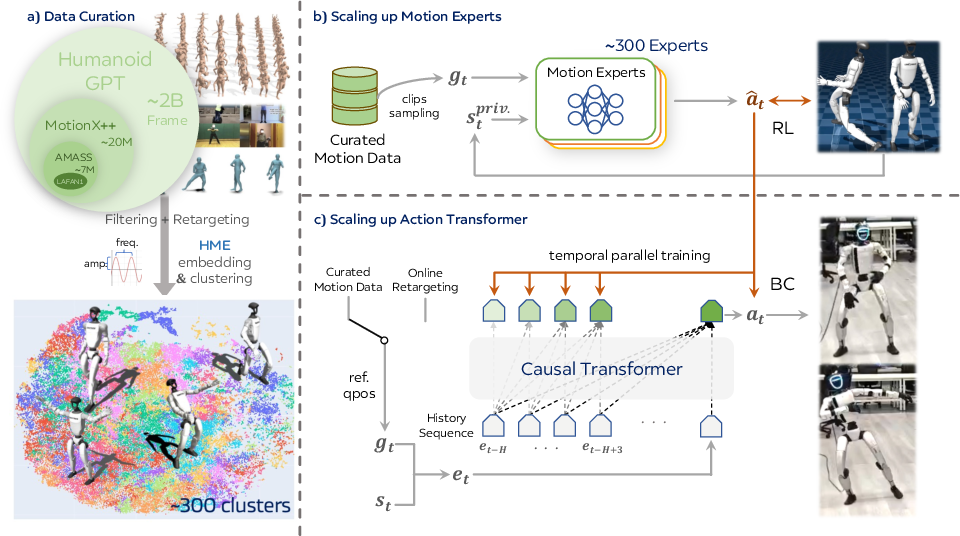
- Build a massive, clean motion library
- Motion capture (mocap) is like recording a person’s moves with sensors, frame by frame.
- The team combined many public mocap datasets plus their own recordings, then “retargeted” all the human motions to the robot’s joints. Retargeting is like translating human body positions into the robot’s body language.
- They filtered out motions that require objects (like sitting on a chair) and used time-warping (speeding up or slowing down clips) to add variety.
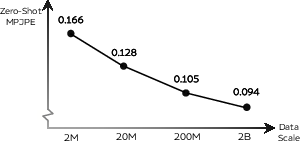
- Result: a giant dataset with about 2 billion frames of motion—over 200 times bigger than what most earlier systems used.
- Make a map of motion diversity (so training stays balanced)
- Most data is full of common moves (like walking) and has fewer rare ones (like complex spins). If you train naively, the robot over-practices the common stuff and struggles with the rare.
- They invented Harmonic Motion Embedding (HME). In simple terms, HME gives each motion a “rhythm fingerprint” (like its beats and amplitudes) and then clusters similar motions together.
- This lets them sample motions in a balanced way during training—so the robot learns both frequent and rare behaviors well.
- Train specialists, then teach a generalist
- First, they trained many “expert” controllers using reinforcement learning (RL). Each expert focused on a cluster of similar motions and learned to track them physically and stably.
- The expert’s reward looked at key body points (like hands, feet, hips) and compared position, rotation, and speed to the reference motion.
- The robot low-level control uses a PD controller—imagine springs and shock absorbers for each joint—to turn targets into smooth torques.
- Next, they distilled all these experts into a single model called Humanoid-GPT, which is a Transformer with causal attention.
- Transformer (GPT-style): like text autocomplete, but for robot movements. It looks at the recent history and predicts the next control commands.
- Causal attention: the model only sees the past, not the future—perfect for real-time control.
- They used a method similar to teachers supervising a student over sequences (DAgger), so the student learns from many experts in parallel and becomes a universal controller.
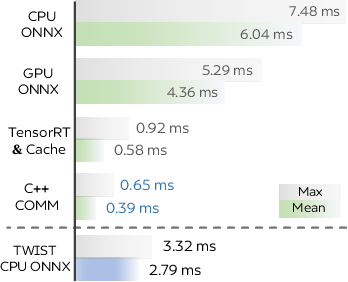
Engineering note: They optimized the final model to run extremely fast (under ~1.5 ms per step) using ONNX/TensorRT and a streaming C++ pipeline, which is crucial for a real robot.
What they found and why it matters
Here are the key results and their importance:
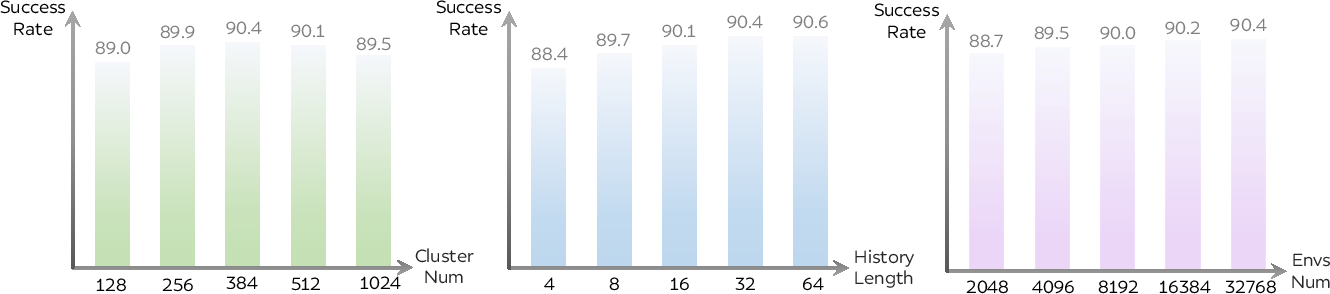
- Scaling laws: More diverse data + bigger Transformer = better robot. As they increased the dataset from millions to billions of frames and made the model larger, the robot tracked motions more accurately and fell less often. This improvement followed clear, predictable trends.
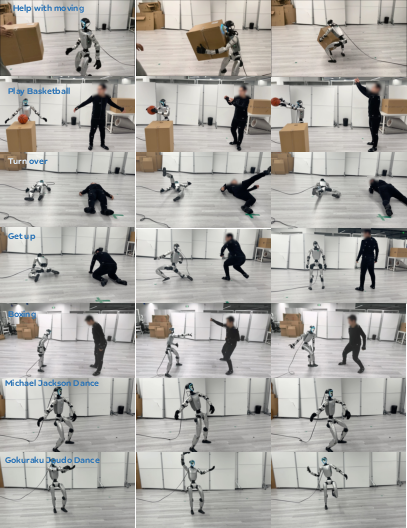
- Zero-shot generalization: The robot successfully followed new, unseen motions—like dynamic dances—without any extra training. This worked in both simulation and on a real Unitree G1 humanoid.
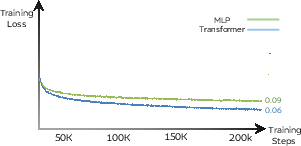
- Agility and generalization at the same time: Earlier systems often had a trade-off (either agile but narrow, or general but sluggish). Humanoid-GPT breaks this trade-off by using both scale and a stronger model design.
- Diversity and balance both matter: Just adding more data isn’t enough. You need the right mix and balanced training. Their HME-based sampling helped the model handle rare but important moves.
- Outperforms strong baselines: Compared to other leading trackers (often based on smaller MLP models), Humanoid-GPT tracked motions more accurately and more robustly, especially as data and model size grew.
- Real-time on real hardware: Despite being bigger and stronger, the model stays fast enough for live teleoperation and motion following.
What this could change in the future
Humanoid-GPT points toward a future where robots learn like powerful language and vision models do—by scaling up data and model size, and by using the right training recipe. That means:
- More general-purpose robot skills: One controller that can handle many tasks and movement styles without being re-trained for each.
- Easier deployment: If a robot can follow new motions zero-shot, it’s faster to put it to work in new settings.
- A foundation for richer abilities: Next steps could include adding vision (to see the world), language (to follow instructions), contact and interaction modeling (to handle tools and people), and longer-term planning. Together, this pushes robots closer to being helpful, adaptable partners in everyday life.
Knowledge Gaps
Knowledge Gaps, Limitations, and Open Questions
Below is a concise, concrete list of what remains missing, uncertain, or unexplored in the paper, framed so future researchers can act on each point.
- Contact-rich tasks and environments are excluded during data curation (e.g., object interactions, stairs, uneven terrain); extend datasets, reward design, and evaluation to multi-contact, environment-aware tracking (hands, feet, support surfaces, tools).
- No explicit modeling or evaluation of ground contact quality (foot slip, contact forces, COM/ZMP stability); add contact-aware supervision, sensing, and metrics to quantify and reduce slip/penetration.
- Terrain generalization is untested (slopes, stairs, compliant/low-friction surfaces); build scenario-specific test suites and randomized terrain training to assess and improve robustness.
- Manipulation and hand use are absent (filtered out); incorporate hand DOFs, grasp/contact modeling, and object-augmented datasets to evaluate bimanual coordination and balance-manipulation coupling.
- Teacher–student information mismatch: experts act with privileged state while the student uses a reduced observation; quantify the performance gap, and test mitigations (privileged distillation, auxiliary predictions of privileged signals, observation randomization).
- Multi-expert arbitration during distillation is under-specified (how conflicts among experts are resolved, confidence weighting, or selection policy); formalize and ablate expert mixing, confidence estimation, and disagreement handling.
- DAgger schedule and aggregation details are not analyzed (roll-in policy, query frequency, data weighting); study schedule variants, on-policy/off-policy mixtures, and stability–performance trade-offs.
- Student never undergoes RL fine-tuning; examine whether post-distillation on-policy RL improves closed-loop robustness and reduces compounding errors, especially under real-world disturbances.
- PD gains appear fixed and hand-tuned; evaluate learning adaptive impedance (gains/damping) or predicting full impedance targets per joint to improve versatility across motions and surfaces.
- Deterministic action prediction ignores uncertainty and multi-modality in human motion; assess stochastic policies, ensembles, or uncertainty-aware control for ambiguous or noisy references.
- Causal context window length H is not ablated; quantify horizon–latency trade-offs, memory scaling, and performance saturation to guide deployment choices under tight real-time constraints.
- Tolerance to noisy or misaligned reference motions (e.g., video-estimated poses) is claimed but not quantified; benchmark noise robustness, latency/offset sensitivity, and retargeting errors across sources.
- HME-based diversity/balance may bias toward periodic motions; compare HME to alternative embeddings (e.g., dynamics- or contact-aware) and evaluate coverage of aperiodic, transient, and reactive behaviors.
- Diversity-aware sampling policy is not precisely defined or validated across schedules; provide sampling weight formulas, perform ablations, and measure long-tail performance vs. frequent-mode overfitting.
- In-house data and full 2B-frame corpus are not publicly available; reproducibility suffers. Provide release plans, proxies, or detailed statistics to enable fair replication and benchmarking.
- Morphology generalization is untested (only Unitree G1, 29-DoF); study cross-robot transfer via morphology-aware conditioning, retargeting to different kinematics/actuators, and domain adaptation.
- Real-world robustness beyond nominal conditions (sensor noise, latency jitter, payload changes, joint backlash, friction variation) is not evaluated; perform push tests, payload/footwear swaps, and latency injection studies.
- Safety, fail-safe behavior, and recovery (fall detection, protective reflexes, safe stopping) are not characterized; define standardized safety tests and integrate supervisory safety layers or controllers.
- Energy/thermal efficiency and torque smoothness are not reported; introduce power/heat budgets and jerk/torque-rate metrics to quantify hardware friendliness over long horizons.
- Long-horizon drift and fatigue effects are unmeasured; run extended trials (minutes to hours) to evaluate drift, cumulative error, overheating, and recovery.
- Scalability analysis lacks a formal law (no explicit functional form, isoFLOP/compute-optimal trade-offs); fit learning curves, derive compute–data–model scaling exponents, and identify diminishing-returns regimes.
- Fair, scale-matched baselines are incomplete: strong large-scale MLP/Transformer baselines (e.g., SONIC) are not re-trained or compared under identical data/retargeting protocols; run apples-to-apples comparisons.
- Evaluation metrics emphasize joint/keypoint errors; add contact accuracy, COM/ZMP margins, foot slip distance, balance recovery time, and task success under perturbations for more complete control quality assessment.
- Generalization benchmark design is ad hoc; establish standardized zero-shot splits with verified de-duplication, motion taxonomy coverage, and OOD categories (rare dynamics, styles, and terrains).
- Teacher library quality control is not quantified (selection/thresholds for “good” experts); measure how teacher fidelity/diversity impact student performance and determine minimal expert coverage.
- Continual learning and model updates are not addressed; design data/teacher expansion protocols that avoid catastrophic forgetting and preserve safety while adding new behaviors.
- Onboard deployment feasibility is unclear (results on RTX 4090); profile on embedded compute (Jetson/CPU-only), and study compression/distillation/quantization to meet power/latency limits.
- OOD detection and fallback are absent; implement runtime OOD detectors on reference/proprioception streams and safe fallback policies when the tracker leaves its competence region.
- Failure modes and qualitative error analysis are missing; catalog common failures (foot slip, oscillations, knee collapse), correlate with data/model factors, and propose targeted mitigations.
Practical Applications
Below is an overview of the paper’s practical, real-world applications derived from its findings, methods, and innovations. The items are grouped by deployment horizon and, where relevant, mapped to sectors with concrete tools/workflows and feasibility notes.
Immediate Applications
- Robotics (humanoids) — Real-time whole-body teleoperation and performance imitation in controlled environments
- What: Drive a humanoid to mirror an actor’s motions (e.g., dance, athletic gestures) without per-task fine-tuning; suitable for stages, labs, and flat-floor demos.
- Potential tools/workflows:
- “Humanoid-GPT Controller SDK” for Unitree-G1-class robots (ONNX/TensorRT-compiled, PD-target outputs).
- Video/MoCap-to-robot retargeting pipeline for live performance or rehearsal playback.
- Show-control integration for media/entertainment venues.
- Assumptions/dependencies:
- Hardware: Unitree-G1 or similar humanoid with comparable DoFs and PD control interface; GPU for 1.5 ms inference (e.g., RTX 4090-class).
- Scene constraints: Flat ground; minimal object interactions (training data filtered out contacts like sitting, stairs, tools).
- Robust retargeting quality and safety supervision.
- Entertainment and Media — Robotic choreography and live shows
- What: Zero-shot robot dance and expressive movements for events, theme parks, and promotional showcases.
- Potential tools/workflows:
- Video-to-motion capture + retargeting + Humanoid-GPT control chain.
- Content pipeline for selecting, filtering, time-warping, and balancing routines via HME-guided curation.
- Assumptions/dependencies:
- Motion rights and licensing for public performance.
- Performer and audience safety standards; fall-risk mitigation.
- Academic Research — Scaling-law benchmarks and reproducible embodied AI studies
- What: Use the paper’s data/model scaling laws and training recipe (RL experts → DAgger → GPT-style tracker) as baselines for generalization research in locomotion/control.
- Potential tools/workflows:
- HME-based dataset analytics for diversity/balance-aware sampling.
- Library of PPO experts per cluster; DAgger distillation scripts; MuJoCo simulation harness.
- Assumptions/dependencies:
- Access to curated motion corpora (2B frames) and compute.
- Rights/ethics around video-estimated motion sources.
- Robotics R&D — Rapid prototyping and regression testing of humanoid hardware
- What: Stress-test platform agility, PD tuning, and stability with standardized zero-shot motion suites; track performance across firmware/hardware iterations.
- Potential tools/workflows:
- Automated test harness that replays a battery of diverse motions (HME-balanced) and logs MPJPE/MPJVE/RootVelErr.
- Assumptions/dependencies:
- Safe test facilities; standardized retargeting for each hardware variant.
- Motion Capture/Animation/Gaming — Robotized playback and physical previsualization
- What: Quickly visualize and physically validate captured or generated human motions on real robots for previs or audience engagement.
- Potential tools/workflows:
- Plug-in from DCC/MoCap suites to robot control (e.g., export → retarget → controller).
- Assumptions/dependencies:
- Motions avoid contact-rich interactions (chairs, stairs, props); IP clearance.
- Education and Outreach — Human motion demonstration via robots
- What: Classroom or museum demos in kinesiology, biomechanics, and robotics illustrating complex motion patterns and stability.
- Potential tools/workflows:
- Prepackaged lesson plans with curated, balanced motion sets using HME to highlight diversity.
- Assumptions/dependencies:
- Controlled, obstacle-free spaces and safety review.
- Data/Tooling for Robotics Teams — Dataset curation and training pipelines
- What: Adopt the paper’s curation stack: aggregate mocap/video-estimated motions, filter/segment, time-warp, retarget, and cluster via HME, then train PPO experts for distillation.
- Potential tools/workflows:
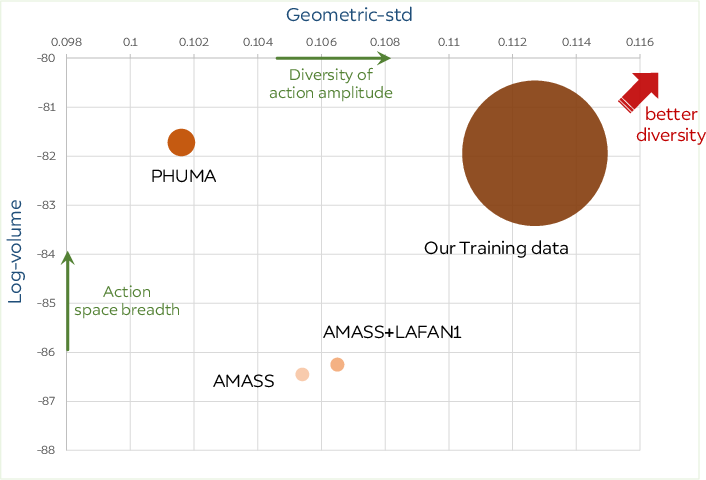
- HME “dataset health” dashboard (gstd, log-volume) to track diversity and balance.
- Retargeting + PPO reward templates (keypoint-level position/velocity/rotation with penalties).
- Assumptions/dependencies:
- Legal/data governance for aggregated datasets; engineering for robust retargeting.
- Policy and Governance — Near-term guidance for public demos of humanoids
- What: Draft safety guidelines and disclosure rules for zero-shot teleoperation in public spaces (e.g., fall-protection, operator-to-robot latency caps).
- Potential tools/workflows:
- Model cards/system cards documenting data sources (including video-derived motion), deployment constraints, and safety mitigations.
- Assumptions/dependencies:
- Institutional oversight; alignment with local regulations and venue safety codes.
Long-Term Applications
- General-Purpose Humanoid Assistance (Healthcare, Home, Hospitality)
- What: Robots that learn from human demonstration in the wild to provide mobility aid, exercise guidance, or simple household tasks.
- Potential tools/workflows:
- Integrate vision and language (VLA) to map high-level instructions to motions; extend training with contact modeling and object interactions (stairs, chairs, tools).
- Safety- and compliance-aware control with force/impedance policies on top of PD targets.
- Assumptions/dependencies:
- Richer datasets with contact and object interactions; perception stacks; regulatory approval (medical, eldercare); rigorous safety certification.
- Industrial Robotics (Manufacturing, Logistics) — Rapid task teaching and adaptation
- What: Teach humanoids new tasks by demonstration (pick, place, carry, collaborate); transfer to new layouts or SKUs without task-specific re-training.
- Potential tools/workflows:
- Multi-stage pipeline: human demonstration capture → retarget to robot → GPT-style controller → manipulation planner; HME to ensure rare task coverage.
- Assumptions/dependencies:
- Reliable perception, grasping/manipulation skills; extensive contact-rich motion data; compliance control and fail-safes; ROI vs. simpler automation.
- Disaster Response and Field Ops (Public Safety, Energy)
- What: Teleoperated/semiautonomous humanoids that mirror human motion robustly across uneven terrain and ad-hoc environments (doors, ladders, rubble).
- Potential tools/workflows:
- Domain randomization pipelines; curriculum leveraging contact-rich experts; online adaptation and terrain-aware policies.
- Assumptions/dependencies:
- Ruggedized hardware; communication resilience; training on diverse contact/terrain datasets; strict operator safety frameworks.
- Human-Robot Collaboration (Cobotics)
- What: Fluent co-manipulation (e.g., carrying bulky items) and dynamic handover learned from human demonstrations and scaled motion libraries.
- Potential tools/workflows:
- Multi-agent distillation (human + robot) with joint reward terms; synchronization via causal attention; social compliance constraints.
- Assumptions/dependencies:
- Sensing for partner intent and force; standards for proxemics and safety; dataset expansion to interactive scenes.
- Telepresence Avatars (AR/VR + Robotics)
- What: Embodied avatars for remote presence where a human’s motion is mirrored zero-shot by a robot; useful for remote inspection, customer engagement, or education.
- Potential tools/workflows:
- Low-latency streaming stack (as in paper’s C++ pipeline) with QoS and fallback behaviors; language-conditioned behaviors for mixed autonomy.
- Assumptions/dependencies:
- Networking reliability; compliance with local laws for teleoperated robots; situational awareness and obstacle handling.
- Cross-Morphology “Universal Controller” Platforms
- What: A general tracker distilled across multiple robot bodies (not just Unitree-G1), exposing a consistent API for different humanoids/exoskeletons/prosthetics.
- Potential tools/workflows:
- Meta-retargeting and morphology-aware tokenization; normalization of PD gains and joint limits; HME variants that factor morphology.
- Assumptions/dependencies:
- Extensive multi-hardware datasets; standardized evaluation and safety benchmarks; actuator-level variance handling.
- Synthetic Data Generation for Manipulation and Planning
- What: Use the tracker to produce physically plausible, torque-labeled trajectories at scale for training downstream manipulation planners or dynamics models.
- Potential tools/workflows:
- Simulation farms generating diverse motion families balanced by HME; automatic labeling of contacts and constraints.
- Assumptions/dependencies:
- High-fidelity simulators with accurate contact/terrain modeling; transferability validated by sim2real metrics.
- Standards, Benchmarking, and Governance (Policy, Academia, Industry Consortia)
- What: Formalize scaling-law benchmarks for embodied AI; data diversity/balance metrics (e.g., HME gstd/log-volume) as part of dataset “nutrition labels.”
- Potential tools/workflows:
- Shared benchmark suites for zero-shot control; transparency documents detailing video-derived motion usage and potential biases.
- Assumptions/dependencies:
- Cross-institutional cooperation; data provenance and privacy frameworks; incentives for open benchmarking.
- Consumer Social Robots and Fitness/Wellness
- What: Social robots that can learn and mirror user motions (dance/fitness) and provide safe, engaging feedback at home.
- Potential tools/workflows:
- On-device inference with compact transformer variants; parental controls and geofenced behaviors; vision-language modules for coaching.
- Assumptions/dependencies:
- Cost-effective hardware; home-safe actuation and compliance; content moderation and privacy safeguards.
- Tooling Products for Data and Training
- What: Commercial-grade “Motion Diversity Analytics” (HME dashboards), “RL Expert Distillation-as-a-Service,” and “Balanced Sampler” libraries for robotics teams.
- Potential tools/workflows:
- Managed pipelines that ingest customer datasets, compute diversity metrics, cluster motions, train experts, and deliver a distillable tracker.
- Assumptions/dependencies:
- Customer data governance; compute provisioning; service-level agreements for safety and performance.
Notes on feasibility across all items:
- The current system excludes object interactions, uneven terrain, and explicit contact-rich tasks in training; many long-term uses require expanding the corpus and reward design.
- Retargeting quality is pivotal; cross-morphology generalization remains an active area.
- Safety certification, human-in-the-loop oversight, and regulatory compliance are mandatory for public and enterprise deployment.
- Compute and hardware availability (GPU, low-latency networking, reliable sensors) materially affect readiness and cost.
Glossary
- AGI (Artificial General Intelligence): Aims for general-purpose reasoning and control across tasks and environments for embodied agents. "AGI for embodied agents is ultimately a generalization problem"
- autoregressive: A modeling approach that predicts the next output conditioned only on past information in the sequence. "parallel sequence supervision and autoregressive temporal predicting"
- causal attention: An attention mechanism that restricts each position to attend only to past (not future) tokens to respect causality in online control. "a GPT-style Transformer with causal attention"
- CVAE (Conditional Variational Autoencoder): A generative model that learns conditional latent representations for structured outputs. "adopts a CVAE-based teacher-student framework"
- DAgger (Dataset Aggregation): An imitation learning algorithm that iteratively collects data under the learner’s policy with expert corrections. "adopting the DAgger~\cite{dagger11} framework"
- Degrees of Freedom (DoF): The number of independent joint variables that define a robot’s configuration space. "the 29-DoFs joint space of the Unitree-G1 humanoid"
- distillation: Transferring behavior or knowledge from one or more expert policies into a single student policy. "we introduce a distillation stage"
- gstd (geometric mean standard deviation): A scalar diversity measure computed as the geometric mean of per-dimension standard deviations in an embedding space. "gstd and log-volume"
- Harmonic Motion Embedding (HME): A learned embedding that summarizes motion sequences via per-joint periodic features to organize and balance diversity. "We introduce Harmonic Motion Embedding (HME) as a representation learning tool"
- keypoint-level rewards: Reward terms defined on positions/velocities/orientations of selected body keypoints to guide physically grounded tracking. "training PPO-based motion experts on clusters with keypoint-level rewards"
- log-volume: The logarithm of the volume of a covariance ellipsoid in embedding space, used to quantify dataset diversity. "gstd and log-volume"
- Mixture-of-Experts (MoE): An ensemble architecture where a gating module routes inputs to specialized expert networks. "GMT~\cite{gmt25} employs Mixture-of-Experts with adaptive sampling"
- MoCap (Motion Capture): Technology that records human motion, often used as reference for tracking or imitation. "a live MoCap stream is continuously retargeted to the G1’s joint space"
- MPJPE (Mean per-Joint Position Error): The average positional error across joints, used to evaluate tracking fidelity. "Mean per-Joint Position Error (MPJPE) (rad)"
- MPJVE (Mean per-Joint Velocity Error): The average angular velocity error across joints, indicating temporal consistency. "Mean per-Joint Velocity Error (MPJVE) (rad/s)"
- MPKPE (Mean per-Keypoint Position Error): The average 3D positional error over tracked body keypoints. "Mean per-Keypoint Position Error (MPKPE) (mm)"
- MuJoCo: A physics engine commonly used for accurate and efficient robot simulation. "we employ MuJoCo\citep{mujoco12} as the physics engine"
- ONNX: An open format for representing machine learning models for cross-framework deployment. "the entire model is exported to the ONNX\citep{onnxruntime24}"
- PD controller (Proportional–Derivative controller): A control law that computes torques from proportional and derivative feedback on tracking errors. "actuator torques through a PD controller"
- Periodic Autoencoder (PAE): An autoencoder that captures periodic structure in sequences via harmonic features. "Periodic Autoencoders~\cite{pae22}"
- proprioceptive: Refers to internal robot sensing (e.g., joint positions/velocities) rather than external observations. "the current proprioceptive state "
- PPO (Proximal Policy Optimization): A reinforcement learning algorithm that stabilizes policy updates via clipped objectives. "training PPO-based motion experts"
- retargeting: Mapping motion from one skeleton (human) to another (robot) while preserving kinematics. "an off-the-shelf motion retargeting framework~\cite{gmr25}"
- Root Velocity Error: The error in the linear velocity of the robot’s base (root) frame. "Root Velocity Error (RootVelErr) (m/s)"
- scaling law: An empirical relationship that predicts performance as a function of data and model size. "We further derive a scaling law for humanoid motion tracking"
- SO(3) log map: A mapping from rotations to their Lie algebra that linearizes orientation errors for computation. "the rotation error induced by the log map."
- TCN (Temporal Convolutional Network): A sequence model using dilated temporal convolutions for long-range dependencies. "TCN (8-layer)"
- teleoperation: Controlling a robot in real time via human input, often providing demonstration data. "the TWIST teleoperation system"
- temporal causal mask: A masking scheme in Transformers that blocks attention to future time steps. "with a temporal causal mask"
- TensorRT: An inference optimizer and runtime for accelerating neural networks on NVIDIA GPUs. "compiled a compute graph using TensorRT\citep{tensorrt24}"
- Transformer: A sequence model based on self-attention mechanisms, here adapted for causal control. "Transformer-based generalist policy"
- Unitree-G1: A specific 29-DoF humanoid robot platform used for experiments. "the 29-DoFs joint space of the Unitree-G1 humanoid"
- zero-shot generalization: Performing well on unseen tasks/motions without task-specific fine-tuning. "unprecedented zero-shot generalization to unseen motions and control tasks"
Collections
Sign up for free to add this paper to one or more collections.