Physical Object Understanding with a Physically Controllable World Model
Abstract: A central challenge in visual intelligence is learning the physical structure of scenes from raw videos: how regions form objects and the laws that govern their interactions. Solving these tasks requires world models capable of inferring distributional states of the world from partial observations - capabilities that current architectures do not provide. We introduce a new class of probabilistic world models that support estimation of the probability of any visual variable, such as appearance and dynamics, conditioned on any other variables. Here, we identify that these models can be trained efficiently with autoregressive sequence modeling, yielding world models from which rich object understanding emerges. First, we demonstrate that our model captures the physical laws governing how objects move by generating multiple plausible future states of the world through sequential inference. Then, by analyzing motion correlations across these futures, we extract objects and articulated object subparts. Having discovered these objects, we show that our world model can manipulate them in 3D. Finally, we demonstrate how physical relationships between objects can be computed from the world model, enabling applications such as Visual Jenga.



Paper Prompts
Sign up for free to create and run prompts on this paper using GPT-5.
Top Community Prompts
Explain it Like I'm 14
What is this paper about?
This paper is about teaching a computer to “understand” the physical world in videos: where objects are, how they move, how their parts are connected, and how they affect each other. The authors build a single, unified “world model” that can answer questions like “if I poke this part, what else moves?” and “what will this scene look like a moment later?”—without needing human-labeled training data.
What questions were the researchers asking?
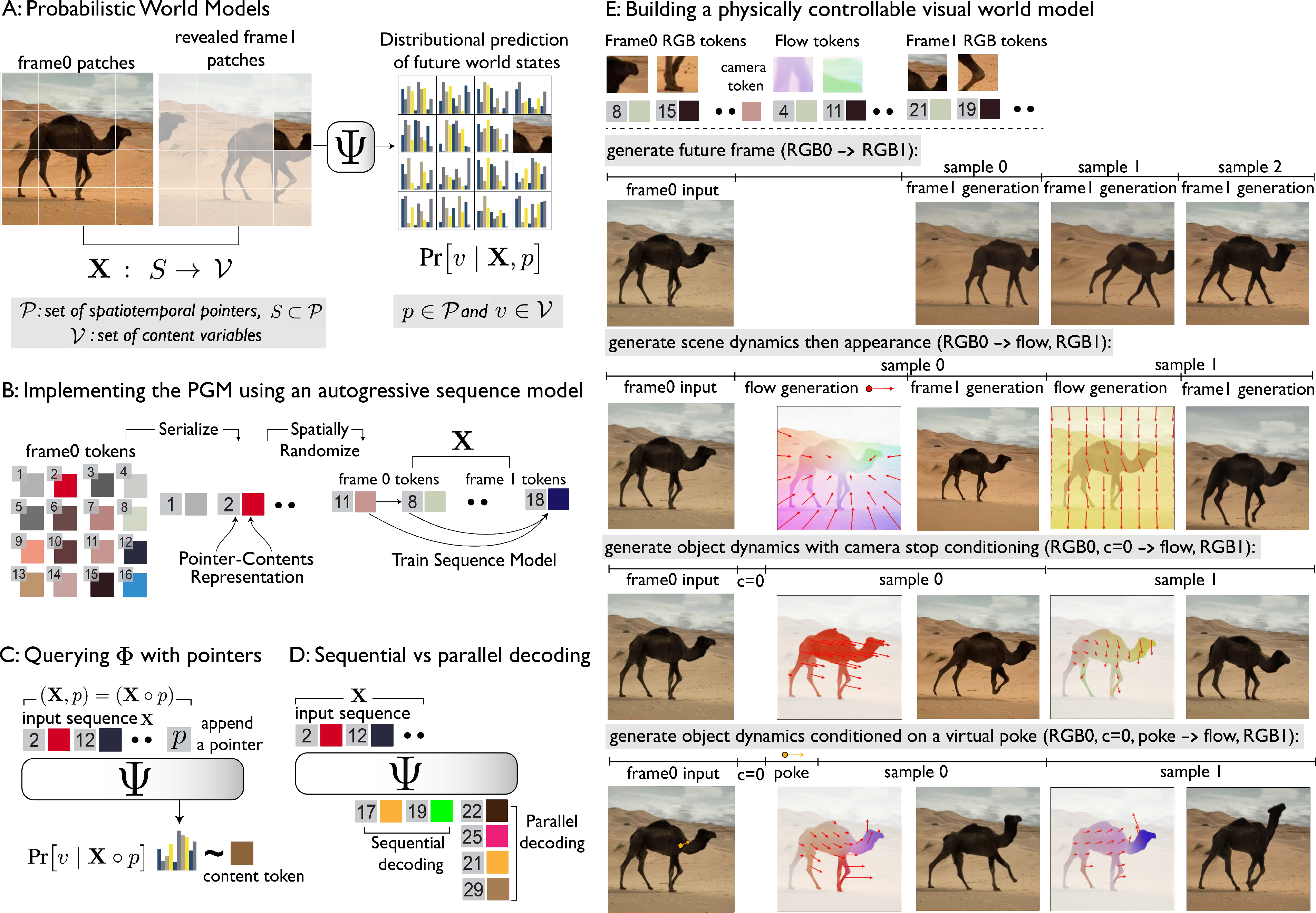
- Can we build one model that can predict many things about a scene—appearance, motion, and camera changes—and let us condition on any of them? (Example: predict future motion from a single image, or predict how a future image will look if we know the motion.)
- Can such a model discover object-like regions on its own, just by noticing which pixels tend to move together?
- Can it find parts that move independently (like a laptop lid vs. base)?
- Can it use that knowledge to edit images in realistic 3D ways (move an object around) and reason about how objects support each other (like a stack of blocks)?
How did they build their model? (Methods in simple terms)
Think of a video frame as a grid of small patches. For each patch, you can store:
- its appearance (color/texture),
- how it moves between frames (a small arrow called optical flow),
- and how the camera moved.
The model turns each patch into simple “tokens,” a bit like letters in a sentence:
- A pointer token says “where” (which patch in space and time).
- A content token says “what” (color token, motion token, or camera token).
Then they train a big GPT-like “autocompleter” on millions of short video clips:
- It sees mixed sequences of these tokens and learns to predict the next token.
- Because the sequence can include any mix of “where” and “what,” the same model learns to answer many kinds of questions. For example:
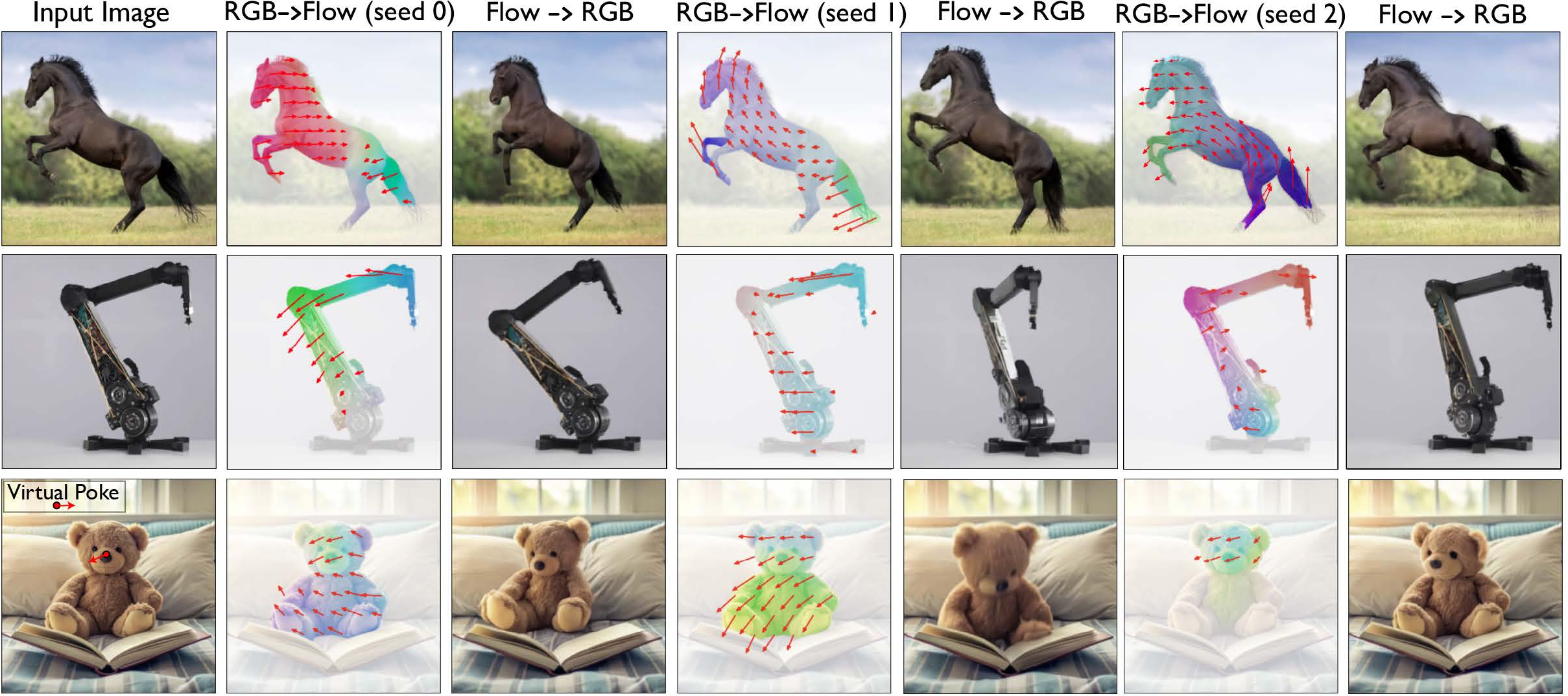
- Give it an image and ask for motion tokens: it predicts how things might move.
- Give it motion tokens and ask for the next image’s appearance: it predicts what the scene will look like after moving.
- Give it a “camera stop” token: it focuses on object motion instead of camera motion.
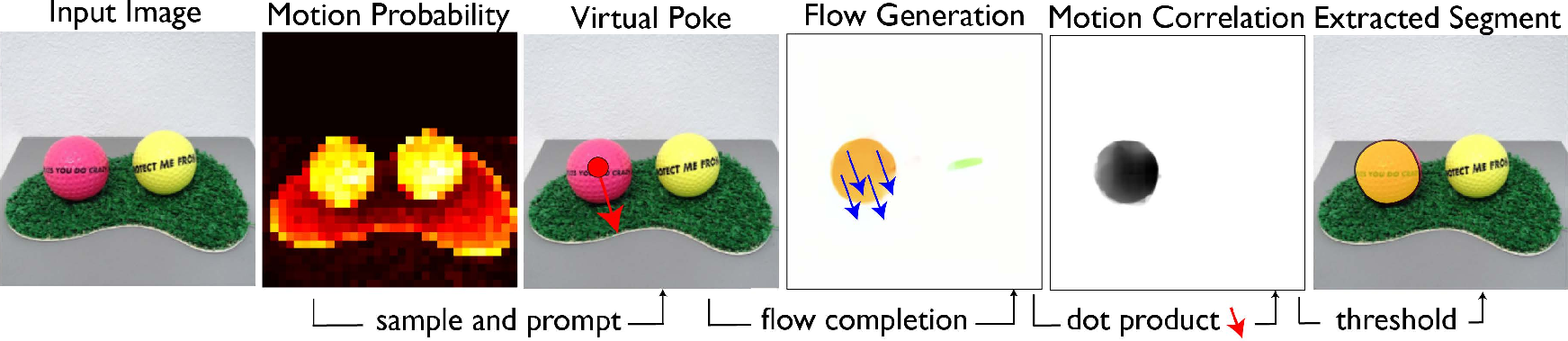
- Give it a “poke” (a few motion tokens at one spot): it completes a full, physically plausible motion field.
Key ideas explained simply:
- Probabilistic: Instead of one answer, the model gives several plausible futures, each with a likelihood. That’s good because the real world is uncertain.
- Optical flow: Tiny arrows that say how each pixel moves between two frames.
- Sequential vs. parallel generation:
- Sequential is like writing a story one word at a time, using what you just wrote to decide the next word—higher quality, slower.
- Parallel is like filling many blanks at once—faster, but it can miss some dependencies.
What did they find?
- The model predicts realistic future motions and appearances
- From a single image, it generates multiple believable ways things could move and look a moment later.
- If you “poke” one spot, it predicts how the rest reacts in a physically consistent way.
- It discovers objects by how they move together
- By sampling several futures and checking which pixels tend to move in sync, the model groups pixels into object-like segments.
- On a benchmark called SpelkeBench (which tests finding “movable objects”), it reaches state-of-the-art performance, beating both self-supervised and some supervised baselines.
- It finds articulated parts (subparts that move independently)
- If you poke a subpart (like a laptop lid), the model can separate that moving part from the rest.
- It performs best on DragAMove, a test for discovering such articulated parts.
- It enables better 3D object manipulation in images
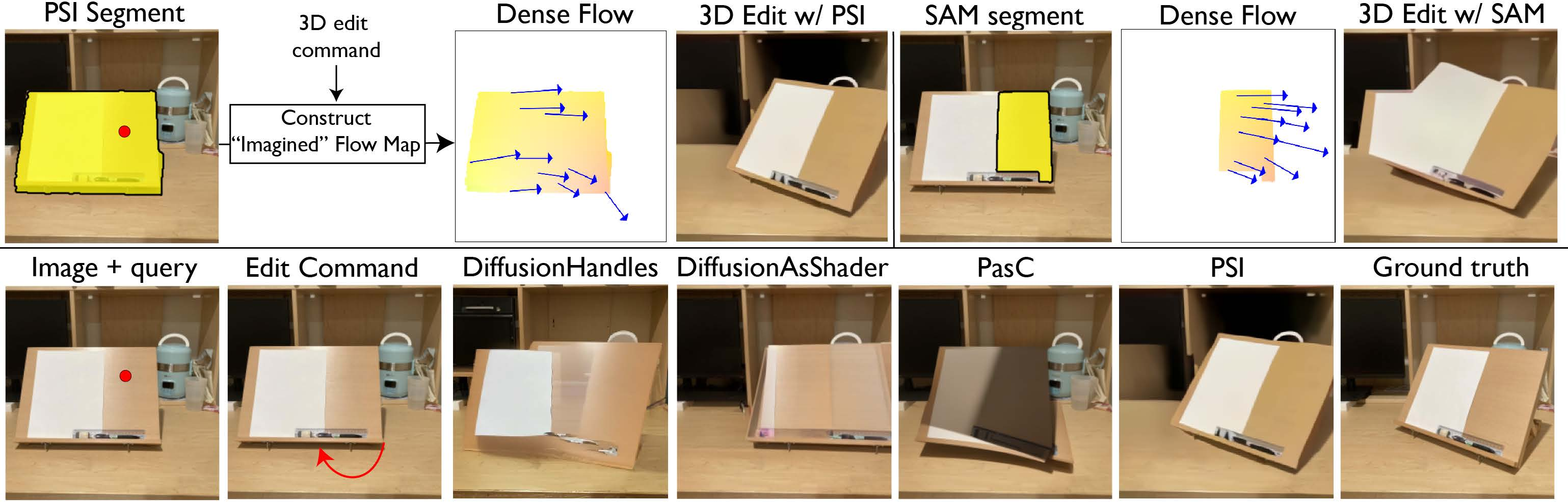
- After finding the object, you can specify a 3D move (like rotate/translate), and the model generates a realistic edited image showing the result.
- On 3DEditBench (which measures edit quality and accuracy), the model achieves state-of-the-art results.
- Using these physically grounded segments beats using off-the-shelf segmentation masks, leading to more believable edits.
- It reasons about object relationships (like support)
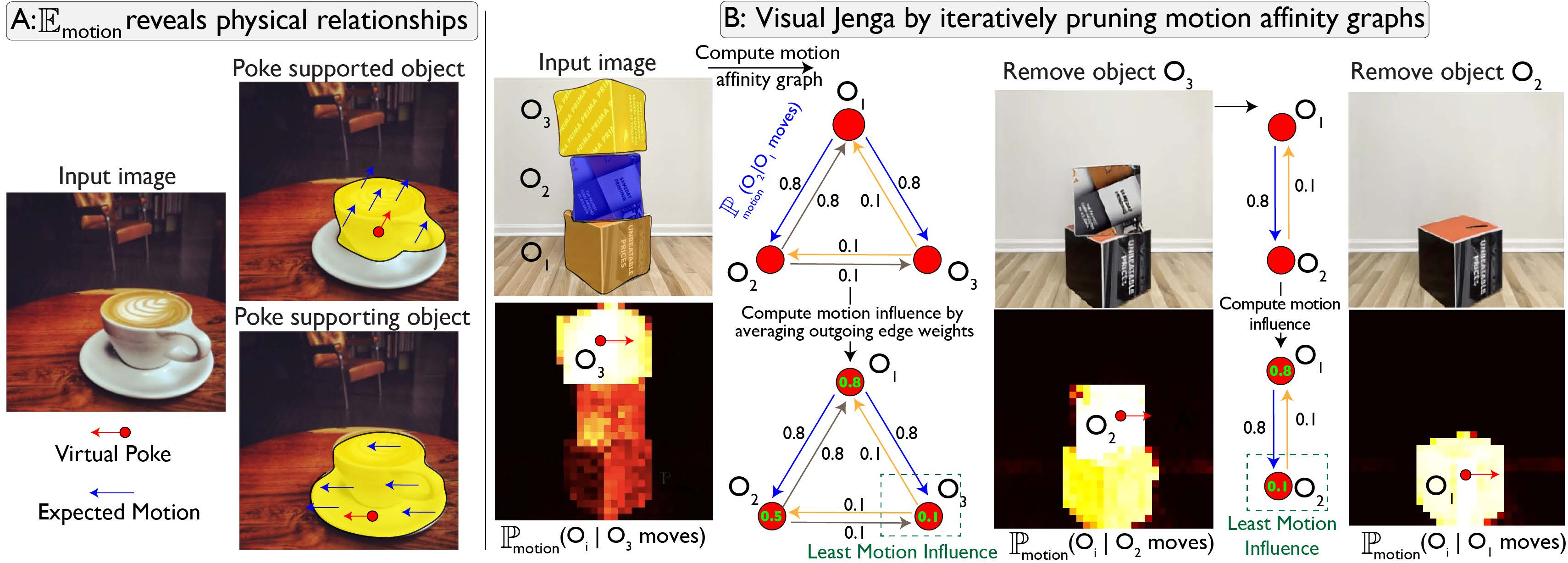
- When you “poke” a block in a stack, the model predicts movement not only of that block but also of blocks it supports.
- It builds a “support graph” that helps with tasks like Visual Jenga: choosing pieces that can be removed with minimal disturbance.
Why these results matter:
- One model, many abilities: predicting motion, generating future frames, discovering objects and parts, 3D editing, and physical reasoning—without task-specific training.
- Physical coherence: It’s not just about what looks like an object; it’s about what moves together and how forces travel through a scene.
Why does this matter?
- For robotics: A robot could “imagine” the results of poking or moving something before acting, helping it plan safer, smarter moves.
- For video editing and AR: More realistic object edits and animations, because the model understands what belongs together and how it should move in 3D.
- For general AI: Shows how a GPT-style model of videos can learn physical structure and cause-and-effect by predicting possibilities, not just single outcomes.
- Beyond everyday scenes: The same idea—discover structure by predicting and probing—could help in areas like medical imaging or materials science, where “objects” and their interactions are less obvious.
In short, the paper introduces a unified, controllable world model that learns from raw video to predict what might happen next and to reveal the hidden structure of objects and their relationships—laying a foundation for more physically aware intelligent systems.
Knowledge Gaps
Below is a consolidated list of concrete knowledge gaps, limitations, and open questions that the paper leaves unresolved. Each point is phrased to suggest actionable next steps for future work.
- Missing explicit 3D geometry: The model operates over RGB and 2D flow tokens without explicit depth, normals, or 3D scene geometry; evaluate adding geometry tokens (e.g., depth, surface normals, NeRF/tri-plane features) and test on occlusion-heavy, multi-view consistency benchmarks.
- Limited temporal horizon: Training sequences appear to use two frames (r0, flow, r1), leaving long-horizon dynamics unaddressed; extend to multi-frame rollouts and quantify stability, error accumulation, and physical consistency over longer horizons.
- Flow as proxy for action: “Virtual pokes” via sparse flow tokens are only correlative proxies for forces/actions; collect and evaluate on action-conditioned datasets with measured contacts/forces to test causal fidelity and close the loop to robotics.
- Quantizer discretization effects: RGB/flow quantization and binned camera tokens may cap fidelity for small motions and fine camera changes; systematically study codebook size, multi-scale quantization, and continuous camera parameterizations, as well as their impact on accuracy and calibration.
- Probability calibration: The paper uses token probabilities to compute motion statistics but does not assess calibration; evaluate ECE/Brier scores, apply temperature scaling or calibration methods, and test robustness under distribution shift.
- Consistency across serializations: Theoretical equivalence between PGMs and autoregressive modeling is asserted but not validated empirically; test whether conditional predictions are consistent across different pointer orderings and prove or diagnose order-invariance violations.
- Parallel inference independence assumption: Parallel predictions assume conditional independence across undecoded locations; quantify the quality-efficiency trade-off, identify failure modes (e.g., articulated bodies), and develop structured parallelization (e.g., blockwise/graph-aware decoding).
- Camera motion handling: Camera tokens are binned 6-DoF and “camera stop” conditioning is central, but sensitivity to camera discretization and errors in camera estimation is not studied; evaluate continuous camera models and performance with non-zero and time-varying camera motion.
- Occlusions and disocclusions: 3D edits require hallucinating newly revealed surfaces; explicitly measure occlusion handling, disocclusion inpainting quality, and temporal coherence under large edits or object motion.
- Physical parameter inference: The model does not infer mass, friction, or stiffness; investigate whether such latent physical properties can be learned or estimated from distributions over futures and used to improve interventional predictions.
- Structural causal validity: Claims of physically controllable inference are not matched with causal identifiability tests; design counterfactual benchmarks and randomized interventions to evaluate whether learned dependencies are causal rather than correlational.
- Kinematic structure discovery: Articulated part discovery is demonstrated but hinge axes, joint limits, and kinematic graphs are not extracted; develop procedures to recover explicit part-joint graphs and evaluate against ground-truth kinematic annotations.
- Multi-object interaction fidelity: Collisions, stacking stability, and contact dynamics are not quantitatively validated; introduce benchmarks with ground-truth support/collision graphs and dynamics (e.g., block towers with labeled supports) and measure prediction fidelity.
- Visual Jenga evaluation: The “support graph” and motion influence score are illustrated but only qualitatively; provide quantitative metrics and datasets with annotated support relationships to validate correctness and reliability.
- Domain generalization: The model is trained on natural videos but not tested in domains like medical imaging or astrophysics as suggested; perform cross-domain evaluations and study transferability, fine-tuning strategies, and failure modes.
- Data provenance and bias: The 3M video corpus and its distribution are not described; document sources, licensing, and demographic/content biases, and study their effects on learned physical priors and object discovery.
- Dependence on external flow quality: Flow tokens likely originate from an external estimator (details relegated to supplement); measure sensitivity to flow noise, compare to self-supervised motion learning, and train with robustness objectives.
- Runtime and scalability: Sequential sampling with multiple pokes (e.g., N=8) and 64+ autoregressive steps per sample is compute-heavy; report end-to-end latency, profile bottlenecks, and explore accelerations (e.g., speculative decoding, distillation, masked parallel decoding).
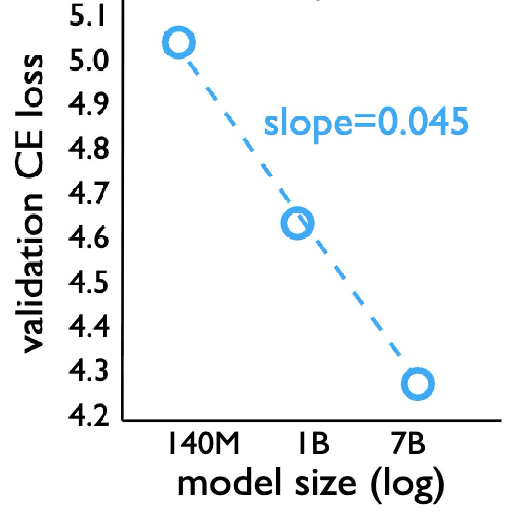
- Scaling laws and model size: Scaling benefits are reported up to 7B parameters without systematic data/compute scaling analysis; derive scaling laws (data, parameters, tokens) and identify diminishing returns and optimal regimes.
- Pointer discretization and resolution: Spatial pointers discretize coordinates and may limit scale/rotation invariance and boundary precision; evaluate multi-resolution grids, learned continuous coordinate encodings, and super-resolution decoders for sharper boundaries.
- Static-object discovery: Motion-correlation segments prioritize movable entities and may miss static but semantically coherent objects; explore integrating appearance/shape priors, affordance cues, or language to discover non-moving objects.
- Robustness to complex materials: Performance on transparent, reflective, thin, deformable, and fluid objects is not analyzed; design targeted benchmarks and augment token vocabularies or training curricula to handle such materials.
- Hyperparameter sensitivity: Segment extraction depends on thresholds (e.g., flow magnitude for “motion tokens,” correlation thresholds) and number of pokes/seeds; provide sensitivity analyses beyond the shown ablations and automated selection strategies.
- Order of modalities and conditioning: Although multiple inference pathways are possible, the coverage of cross-modal conditionals is not systematically tested (e.g., predicting depth from flow or vice versa); enumerate and evaluate a comprehensive set of conditional queries.
- Edit adherence vs. realism trade-offs: 3D editing is evaluated with LPIPS/SSIM/EA but not user studies or perceptual realism under large edits; conduct human evaluations and analyze failure cases (ghosting, texture stretch, identity drift).
- Persistent object identity: The framework does not enforce or evaluate consistent object IDs across rollouts; add identity-tracking objectives and assess temporal consistency in discovered objects and parts.
- Learning with continuous actions: Current “poor man’s actions” rely on discrete tokens (flow/camera); investigate continuous control tokens aligned with physical action spaces and study how this affects interventional fidelity.
- Long-range dependencies in clutter: Articulated and multi-object scenes with long-range constraints (e.g., ropes, chains) are challenging; construct benchmarks and incorporate structured attention or graph priors to capture non-local dependencies.
- Formal uncertainty decomposition: Predicted distributions blend aleatoric and epistemic uncertainty; quantify and disentangle them (ensembles, MC dropout) and study how uncertainty quality affects downstream selection (e.g., Visual Jenga choices).
- Reproducibility of training details: Critical choices (flow estimator, quantizer architecture, token vocab sizes, binning schemes) are deferred to the supplement; provide exhaustive specifications and release training/preprocessing code to ensure reproducibility.
- Integration with language and task goals: The model is not conditioned on text or high-level goals; explore language-conditioned interventions and evaluate instruction-following for physically grounded editing and manipulation.
Practical Applications
Immediate Applications
Below are concrete ways the paper’s findings and methods can be applied today, along with likely sectors, product/workflow ideas, and key dependencies to consider.
- Sector: software/media (VFX, image/video editing), creator tools
- Application: physically coherent object masks for editing
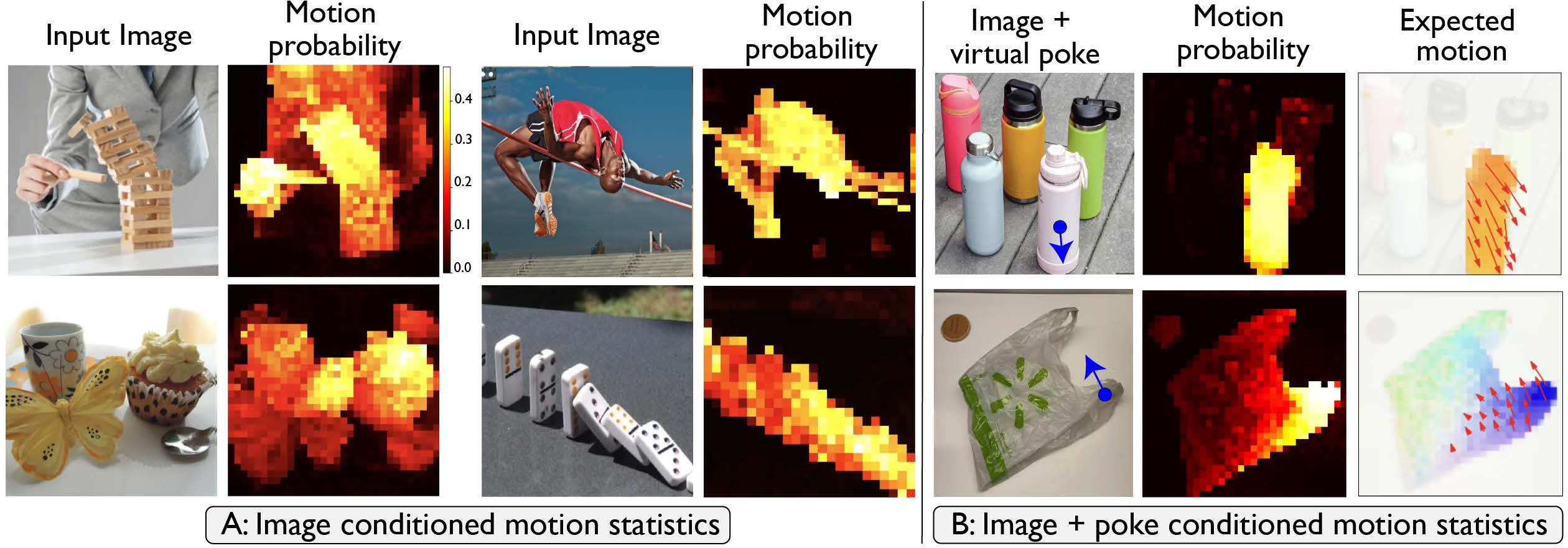
- What it enables: extract “movable object” masks that align with what moves together (better than appearance-only masks), improving cutouts, warps, and 3D-like edits in single images
- Potential tools/products/workflows: Photoshop/After Effects/DaVinci plug‑ins for “Movable Mask,” “Articulation Mask,” and “Flow‑conditioned Warp”; batch processing pipeline for studios
- Assumptions/dependencies: GPU inference for a 7B AR transformer; good generalization to target content; access to flow/RGB quantizers; handling of camera motion token (or assume camera-stop)
- Sector: software/media and AR
- Application: single-image object manipulation with edit adherence
- What it enables: 6DOF transformation of selected objects via dense flow synthesis and re-rendering, with improved edit adherence (EA) and SSIM/LPIPS
- Potential tools/products/workflows: “3D Edit from 1 Image” SDK; mobile photo editor feature “Move/Rotate this object”; AR preview of rearrangements (e.g., furniture)
- Assumptions/dependencies: model’s 2D flow-based edits approximate 3D; occlusion/lighting not fully physically simulated; OOD scenes may degrade
- Sector: robotics (R&D, lab prototyping), automation
- Application: movability heatmaps and expected-motion fields for poke/grasps
- What it enables: choose where to interact; identify movable vs static regions; predict motion field from a virtual poke; reduce trial-and-error in manipulation
- Potential tools/products/workflows: “Poke Planner” module; grasp point selection from motion probability; non-prehensile manipulation planning; active-data collection with virtual pokes
- Assumptions/dependencies: camera-motion compensation; domain shift from internet videos to robot’s camera; not a dynamics model of robot forces; latency on embedded hardware
- Sector: warehouse/logistics, manufacturing
- Application: support graph extraction and “Visual Jenga” unstacking planning
- What it enables: identify which items support others; pick items least likely to destabilize a stack; plan safe unstacking/re-stacking sequences
- Potential tools/products/workflows: “Support Graph Extractor” and “Low-Influence Picker” in bin-picking/palletizing software
- Assumptions/dependencies: uses probabilistic correlations from visual world model, not true mass/friction estimation; requires reliable segmentation of items; camera viewpoint effects
- Sector: e-commerce imagery, marketing
- Application: physically grounded product cutouts and pose variations from a single photo
- What it enables: more plausible repositioning/re-posing of products; background edits with fewer artifacts; cohesive masks for multi-instance categories
- Potential tools/products/workflows: “Product Re-poser” service; ad creative generation pipelines; catalog retouch tooling
- Assumptions/dependencies: generalization to product categories; artifact control on high-frequency textures; brand safety approval for edits
- Sector: academia (computer vision, robotics, cognition), benchmarking
- Application: unified probing for objecthood and articulation without labels
- What it enables: evaluate zero-shot object discovery; measure causal/structural dependencies via motion correlation; create new benchmarks and datasets
- Potential tools/products/workflows: open-source “Movability Heatmap” and “Articulated Part Finder” scripts; dataset bootstrap for segmentation with point prompts
- Assumptions/dependencies: reproducible inference settings; access to code and quantizers; compute budgets for sequential sampling
- Sector: safety engineering (labs, testbeds)
- Application: virtual poke risk pre-checks
- What it enables: anticipate cascades (what else moves if I move this?); pre-emptively identify fragile configurations
- Potential tools/products/workflows: “Motion Influence Score” dashboard for lab staging; pre-task checks for human-robot collaboration
- Assumptions/dependencies: correlations are not guarantees of real-world dynamics; must be validated on in-domain data
- Sector: developer tooling, cloud AI
- Application: world-model inference endpoints
- What it enables: APIs for motion probability maps, expected motion, sequential motion sampling, support graph estimation, flow-conditioned RGB rendering
- Potential tools/products/workflows: “World Model API” with endpoints: /movability, /expected_flow, /sequential_rollout, /support_graph, /render_from_flow
- Assumptions/dependencies: serving costs and latency for 7B model; license/rights for training data; monitoring for misuse (edits that could mislead)
Long-Term Applications
These use cases are plausible but require additional research, domain adaptation, scaling, or systems integration before dependable deployment.
- Sector: robotics (field and household)
- Application: real-time, on-robot physically controllable world model for manipulation
- What it enables: closed-loop planning with uncertainty; selecting actions from model’s “what-if” rollouts; safe multi-object manipulation and tidying
- Potential tools/products/workflows: “Uncertainty-Aware Manipulation Stack” integrating virtual pokes with grasp planners and tactile feedback
- Assumptions/dependencies: substantial model compression/acceleration; integration with control and state estimation; camera intrinsics/extrinsics calibration; robustness to clutter and lighting
- Sector: autonomous driving and mobile perception
- Application: local-variable probabilistic prediction of agent dynamics and scene affordances
- What it enables: uncertainty-aware forecasting in crowded scenes; identifying movable hazards vs static structures
- Potential tools/products/workflows: “Affordance Heatmaps” for planning; “Probabilistic Object Dependency Maps”
- Assumptions/dependencies: domain-specific training (dashcam, LiDAR/depth tokens); safety certification; tight latency constraints
- Sector: digital twins, simulation, and planning
- Application: sim-less “what-if” reasoning layer for virtual environments
- What it enables: predicting plausible outcomes of interventions without constructing full physics simulators; stress-testing stacks/shelves/layouts visually
- Potential tools/products/workflows: “Visual What-If Engine” embedded in CAD/BIM/digital-twin platforms; rapid design iteration
- Assumptions/dependencies: groundedness to real domain; hybridization with physics engines for guarantees; support for multi-view geometry and depth tokens
- Sector: industrial automation and palletizing
- Application: robust stacking/unstacking optimization with learned support/influence graphs
- What it enables: safer, faster pallet operations; fewer collapses; automated reconfiguration planning
- Potential tools/products/workflows: “Stack Stability Planner” co-optimizing order and robot kinematics
- Assumptions/dependencies: incorporation of weights, friction, compliance; multi-view sensing; regulatory safety standards
- Sector: healthcare and scientific imaging
- Application: data-driven structure discovery in modalities beyond natural images (e.g., medical imaging, microscopy, astrophysics)
- What it enables: unsupervised grouping of functional substructures; probing causal/structural relations from observations
- Potential tools/products/workflows: “Probabilistic Structure Integrator” variants with modality-specific tokens (e.g., MR sequences, spectral bands); research tools for hypothesis generation
- Assumptions/dependencies: domain shift is large; clinical/safety validation; privacy and data governance; token design for non-RGB modalities
- Sector: AR glasses and on-device perception
- Application: real-time movability and articulation overlays in the user’s view
- What it enables: assistive guidance (“this hinge moves”), home re-arrangement previews, educational overlays
- Potential tools/products/workflows: “Physical Insight HUD”
- Assumptions/dependencies: edge inference acceleration; energy constraints; privacy-preserving on-device models
- Sector: policy, standards, and governance
- Application: guidelines for physically plausible image/video edits and disclosure
- What it enables: labeling/metadata standards for flow-conditioned edits; audit trails for professional/advertising use; safety pre-checks in robotics
- Potential tools/products/workflows: watermarking and provenance for edits; conformance tests for uncertainty quantification and OOD detection
- Assumptions/dependencies: multi-stakeholder consensus; regulatory alignment (consumer protection, workplace safety); robust misuse detection
- Sector: education and outreach
- Application: interactive physics and perception sandbox
- What it enables: students explore “poke-and-see” consequences and articulation; understand uncertainty and objecthood
- Potential tools/products/workflows: browser-based simulators powered by a distilled model; curriculum modules
- Assumptions/dependencies: cost-effective serving; age-appropriate safety constraints
- Sector: enterprise AI platforms
- Application: turnkey “world-model as a service” for verticals
- What it enables: standardized endpoints for object discovery, articulation, motion prediction, and support reasoning integrated into enterprise workflows
- Potential tools/products/workflows: sector-specific adapters (retail, manufacturing, construction) and deployment recipes
- Assumptions/dependencies: SLAs on latency/accuracy; security/compliance; cost optimization
Cross-cutting assumptions and dependencies
- Data and domain fit: performance depends on similarity between training videos and deployment scenes; domain adaptation or fine-tuning may be required.
- Camera modeling: “camera stop” conditioning assumes correct handling of viewpoint changes; calibration or reliable camera-motion estimates improve results.
- Computational costs: 7B-parameter autoregressive inference can be slow; parallel querying trades quality for speed; quantization/distillation/ONNX/TensorRT may be needed.
- Physical fidelity limits: the model infers correlations and plausible motions via flow; it is not a full physics engine (no mass/friction/force guarantees).
- Safety/ethics: flow-conditioned edits can convincingly alter reality; provenance/watermarking and usage policies should be in place.
- Licensing and governance: ensure rights for training data; comply with privacy and IP standards in deployment.
Glossary
- 3DEditBench: A benchmark for evaluating 3D object editing/manipulation quality in images. Example: "achieving state-of-the-art results on 3DEditBench~\cite{lee20253d}"
- 6DOF transforms: Six degrees-of-freedom transformations (3D rotations and translations) used to describe camera/object motion. Example: "the camera tokens are obtained by binning 6DOF transforms."
- ablation studies: Controlled experiments that systematically vary components or hyperparameters to assess their impact. Example: "Ablation studies"
- action-conditioned predictors: World models that predict future states conditioned on agent actions. Example: "classical world models are typically defined as action-conditioned predictors~\cite{ha2018world}"
- autoregressive framework: A modeling approach that predicts each variable/token conditioned on previously generated ones. Example: "the standard autoregressive framework"
- autoregressive sequence modeling: Training sequence models by predicting the next token given the previous ones. Example: "trained efficiently with autoregressive sequence modeling"
- Average Precision (AP): A detection/segmentation metric that summarizes precision across thresholds. Example: "Average Precision (AP) measures the fraction of predicted segments that end up being matched and detected"
- Average Recall (AR): A detection/segmentation metric that summarizes recall across thresholds. Example: "We also report Average Recall (AR) which measures detection accuracy as the fraction of segments with ."
- binning: Discretizing continuous values into discrete bins for tokenization. Example: "the camera tokens are obtained by binning 6DOF transforms."
- camera stop conditioning: Conditioning the model on zero camera motion to isolate object dynamics. Example: "with camera stop conditioning."
- camera tokens: Discrete tokens that represent camera/viewpoint changes between frames. Example: "camera tokens that encode viewpoint changes between frames."
- conditional independence: An assumption that variables are independent given some conditions; used to justify parallel decoding. Example: "Parallel generation assumes conditional independence between undecoded locations"
- cross entropy loss: A standard loss function for training classifiers and next-token predictors. Example: "train with next-token prediction cross entropy loss"
- directed graph: A graph with directed edges used to model influence/causal relations among objects. Example: "We construct a directed graph "
- Edit Adherence (EA): A metric that measures how accurately the applied edit matches the intended geometric transformation. Example: "include the Edit Adherence (EA) metric introduced in prior work"
- expected motion maps: Maps of probability-weighted average motion vectors across the image. Example: "Expected motion maps."
- flow tokens: Discrete tokens representing optical flow/dynamics between frames. Example: "flow tokens that encode dynamics"
- global scene embeddings: Holistic learned representations of entire scenes used for conditioning/generation. Example: "global scene embeddings~\cite{rombach2022high, agarwal2025cosmos}"
- GPT-style next token prediction: A modeling paradigm that predicts the next token in a sequence as in GPT. Example: "a GPT style next token prediction sequence model"
- instruction-conditioned generations: Generative outputs conditioned on textual or high-level instructions. Example: "performing instruction-conditioned generations~\cite{lin2024video,agarwal2025cosmos}"
- LPIPS: Learned Perceptual Image Patch Similarity, a perceptual metric for image similarity. Example: "PSNR, SSIM, and LPIPS"
- mean Intersection over Union (mIoU): A segmentation metric averaging IoU across classes or instances. Example: "measure segment boundary precision using mean intersection over union (mIoU)."
- motion-correlation analysis: Grouping pixels into objects by correlating their motion responses to interventions. Example: "using motion-correlation analysis to group pixels that move together"
- motion influence score: A score quantifying how much a perturbed object causes other objects to move. Example: "we compute its motion influence score, "
- movability score: A score estimating how freely an object can be moved without disturbing others. Example: "movability score, quantifying how freely an object can move without disturbing others."
- non-maximum suppression: A procedure to remove redundant detections/segments by suppressing similar ones. Example: "via non-maximum suppression"
- optical flow: The apparent pixel-level motion between frames in a video. Example: "optical flow can be generated as an intermediate representation"
- parallel generation: Decoding multiple tokens independently in parallel, trading quality for speed. Example: "Parallel generation assumes conditional independence between undecoded locations, trading off efficiency for quality."
- pointer tokens: Tokens that index specific spatiotemporal locations to be predicted/decoded. Example: "The use of pointer tokens enables sequences to be constructed in arbitrary spatiotemporal order."
- pointer–content representation: A sequence format interleaving location (pointer) and value (content) tokens. Example: "pointerâcontent representation of visual data."
- Probabilistic Graphical Models (PGMs): Structured probabilistic models encoding conditional dependencies among variables. Example: "Probabilistic Graphical Models (PGMs)"
- probabilistic world model: A model that represents and predicts distributions over scene variables and their dependencies. Example: "we construct a probabilistic world model"
- quantizers: Modules that discretize continuous signals (e.g., patches/flows) into token vocabularies. Example: "training shallow convolutional quantizers"
- RGB tokens: Discrete tokens representing appearance/texture content in image patches. Example: "RGB tokens that encode appearance"
- sequential inference: Inference by sampling tokens one-by-one so each prediction conditions on previous ones. Example: "through sequential inference."
- sequential sampling: Token-by-token generation in sequence models for higher fidelity and dependency capture. Example: "uses the standard sequential sampling used in sequence models like LLMs."
- spatiotemporal pointer locations: Discrete indices specifying spatial and temporal positions for token decoding. Example: "spatiotemporal pointer locations "
- support graph: A graph capturing which objects physically support others. Example: "providing a direct estimate of the underlying support graph."
- SSIM: Structural Similarity Index, a perceptual metric for image quality. Example: "PSNR, SSIM, and LPIPS"
- Warmup-Stable-Decay schedule: A learning-rate schedule with warmup, plateau, and decay phases. Example: "Warmup-Stable-Decay schedule~\cite{wen2024understanding}"
- zero-shot: Performing tasks without task-specific training or fine-tuning. Example: "in a zero-shot way"
Collections
Sign up for free to add this paper to one or more collections.