Epicure: Navigating the Emergent Geometry of Food Ingredient Embeddings
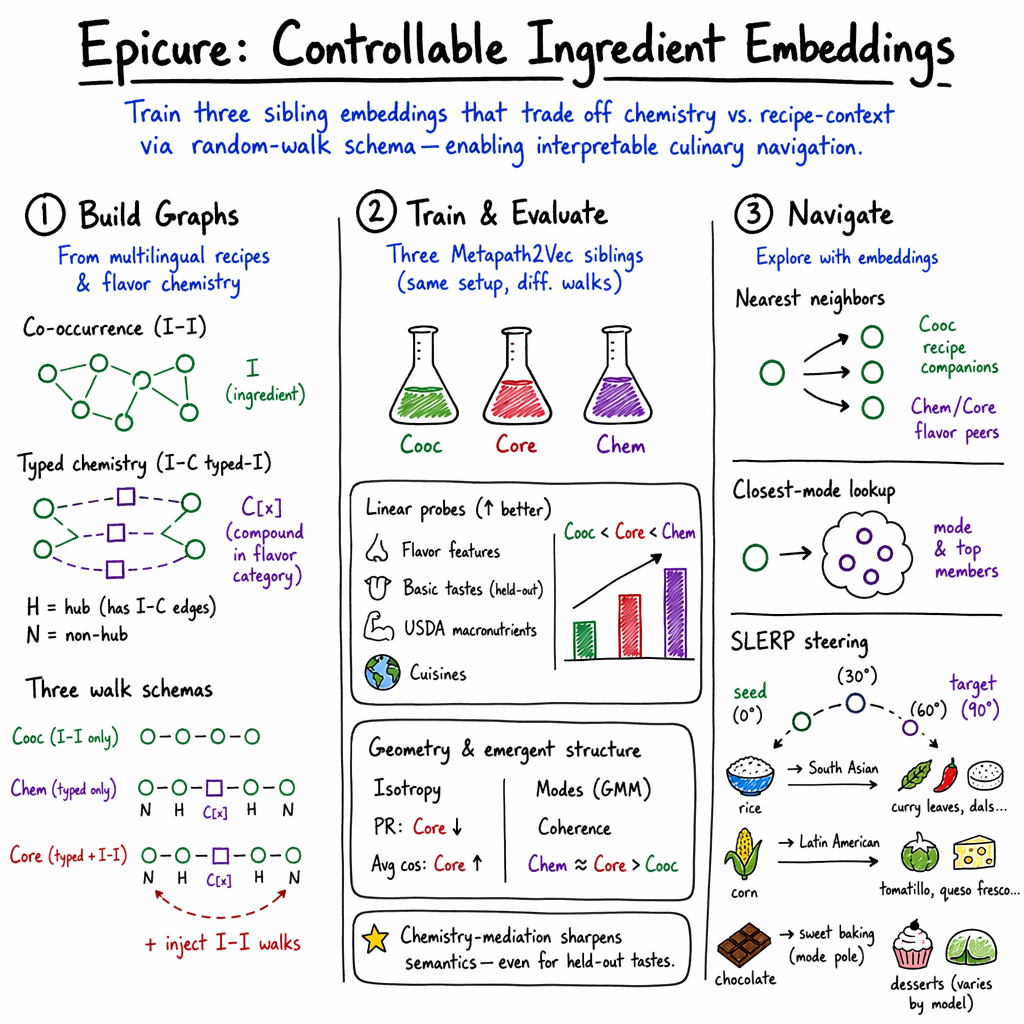
Abstract: We present Epicure, a family of three sibling skip-gram ingredient embeddings retrained from scratch on a multilingual recipe corpus. We aggregate 4.14M recipes from 11 sources spanning seven languages, English, Chinese, Russian, Vietnamese, Spanish, Turkish, Indonesian, German, and Indian-English, and normalise the raw ingredient strings to 1,790 canonical entries via an LLM-augmented pipeline. A 203,508-edge ingredient-ingredient NPMI graph and an 80,019-edge typed FlavorDB ingredient-compound graph, 2,247 typed compound nodes across 15 categories, seed three Metapath2Vec variants that share architecture and hyperparameters and differ only in the random-walk schema: Cooc walks the co-occurrence graph only, Chem walks the typed compound metapaths only, and Core blends both via injected ingredient-ingredient walks at controlled mixing, placing each model at a distinct point on the chemistry-vs-recipe-context spectrum.
Paper Prompts
Sign up for free to create and run prompts on this paper using GPT-5.
Top Community Prompts
Explain it Like I'm 14
What is this paper about?
This paper builds Epicure, a “map of food” that places ingredients as points in a big space based on how they’re used together in recipes and what flavor chemicals they share. The goal is to help people and tools quickly find good ingredient pairings, substitutes, and flavor directions across many cuisines, not just English-language cooking.
Key questions the researchers asked
- Can we train ingredient embeddings (think: coordinates for each food) that capture both recipe habits and flavor chemistry?
- How does changing the balance between “recipe context” (what’s cooked together) and “chemistry” (shared aroma molecules) affect the quality of the map?
- Do simple directions exist in this map for things like cuisine style, taste, and nutrition?
- Can we discover new, meaningful “neighborhoods” of ingredients without using labels, and then smoothly steer a chosen ingredient toward them?
How they did the study
They followed a five-step process you can think of like cleaning a huge recipe library, building a network, and then learning a smart map from it.
- Gather recipes in many languages
- They collected about 4.14 million recipes from 11 sources in seven languages (like English, Chinese, Russian, Vietnamese, Spanish, Turkish, Indonesian, German, and Indian-English).
- Non-English ingredient names were translated to English to make everything comparable.
- Clean and standardize ingredient names
- Real recipe text is messy (“fresh basil leaves,” brand names, typos). Using LLMs and clustering, they boiled ~200,000 raw strings down to 1,790 clean, “canonical” ingredient names (e.g., “basil,” “olive oil,” “soy sauce”).
- Build two kinds of ingredient networks
- Co-occurrence graph: connect two ingredients if they often appear together in the same recipes. They used a statistic called NPMI (think of it as a “how often are these two friends compared to chance” score).
- Chemistry graph: connect ingredients to flavor compounds (like “citrus” molecules or “meaty” molecules) pulled from FlavorDB. Compounds were tagged into 15 types (citrus, fruity, nutty, spicy, etc.), so the model can tell a citrus-citrus overlap from a citrus-earthy bridge.
- Train three sibling models that differ only in what they “walk” through
- Imagine “random walks” as a curious traveler moving from node to node in the network, collecting context. The skip-gram training uses these walks to learn ingredient positions.
- Epicure-Cooc: walks the recipe co-occurrence graph only (pure “what cooks together”).
- Epicure-Chem: walks only the typed chemistry paths through compound nodes (pure “what shares flavor molecules”).
- Epicure-Core: blends both by injecting extra co-occurrence walks into the chemistry paths (a mix of “cooks together” + “shares chemistry”).
- Test and explore the learned maps
- Supervised probes: Check if simple straight-line directions in the map represent known concepts, like basic tastes, macronutrients, and big cuisine regions (e.g., Japanese, Mediterranean).
- Emergent discovery: Use FastICA (a tool that pulls out hidden themes) and GMM (a clustering method) to find natural “factors” and tight “modes,” which act like named neighborhoods such as “Sweet baking,” “South Asian whole spices,” or “Chinese savory pantry.”
- Navigation tools: Show two ways to move around the map:
- Nearest neighbors: “What pairs with X?”
- SLERP rotation: smoothly turn an ingredient toward a target direction (like “South Asian” or “Sweet baking”) by an adjustable angle, so results blend between the original ingredient and the target vibe.
What did they find, and why is it important?
- All three maps capture useful, interpretable directions.
- Taste, nutrition, processing level, and cuisine style can be drawn as straight lines that separate ingredients well. The chemistry-heavy model (Epicure-Chem) usually makes these lines the sharpest, meaning it’s great for flavor-profile searches. The co-occurrence model (Epicure-Cooc) is strongest for “what people commonly cook together.”
- The geometry differs in how “spread out” it is.
- Epicure-Cooc and Epicure-Chem are more evenly spread (isotropic), while Epicure-Core is more “compressed.” This affects how tight clusters look and how strong neighborhood memberships feel. In practice, Core often gives very cohesive groups, while Cooc/Chem keep the space broad and flexible.
- The models naturally organize by food group and cuisine—even without labels.
- Ingredients from the same cuisine cluster together more strongly than purely by USDA food group. For example, East Asian and Mediterranean clusters appear clearly in all three models.
- Unsupervised themes and modes are stable and meaningful.
- Each model recovers around 20 hidden factors and 150–200 named modes that read like real culinary neighborhoods. These are tight groups, much more coherent than random chance, and can be used for browsing and discovery.
- The navigation tools work as intended.
- Nearest-neighbor lookups return sensible pairings. For example, “basil” neighbors in chemistry-forward models are oregano, tarragon, rosemary (herb peers), while in co-occurrence, basil neighbors include olive oil, parmesan, pasta (common cooking partners).
- SLERP “steering” produces label-aligned results. For example, rotating “rice” toward “South Asian” surfaces curry leaf, dal varieties, fenugreek—classic South Asian staples. Rotating “corn” toward “Latin American” yields tomatillo, corn tortilla, queso fresco, salsa.
These findings matter because they show you can control the balance between recipe habits and flavor chemistry when designing ingredient maps. That makes it possible to build smarter kitchen tools: sometimes you want flavor-similar substitutes; other times, you want what’s commonly cooked together or culturally consistent swaps.
What could this mean in the real world?
- Better chef and home-cook assistants
- Suggest compatible ingredients for what’s in your fridge.
- Offer culturally aware substitutions (e.g., take a Mediterranean seed and find its East Asian peer).
- Explore by taste or nutrition: find “high-protein pantry,” “fermented and umami,” or “sweet baking” directions.
- Smarter recipe and menu design
- Rotate ingredients toward a target cuisine or flavor mode to craft new dishes that still feel coherent.
- Blend directions (e.g., “Japanese + less processed + seafood-forward”) to generate focused ingredient sets.
- Food education and discovery
- Visualize global cooking patterns and flavor families across languages and cultures.
- Learn how chemistry and co-occurrence jointly shape cuisines.
Note: The authors did not release code or trained models in this version, but they clearly define the design choices so future work can build on the approach.
Knowledge Gaps
Knowledge gaps, limitations, and open questions
Below is a single, consolidated list of concrete gaps and unresolved questions that future work could address.
- Reproducibility blocker: code, trained embeddings, canonical vocabulary, and preprocessing scripts are not released, preventing independent replication and downstream benchmarking.
- Closed-toolchain dependency: key curation steps depend on non-public LLM deployments (Claude Opus “internal deployment ID 4.6”) and specific Google Gemini embedding models; reproducible alternatives and sensitivity to model/version choices are not assessed.
- Corpus imbalance and cultural coverage: the dataset is dominated by English and Chinese sources (~91% of recipes), with minimal or no representation for Middle Eastern, African, Central Asian, and many regional cuisines; the impact of this skew on embedding geometry and performance remains unquantified.
- Machine translation effects: all non-English ingredients are machine-translated to English; there is no error analysis or ablation to quantify how translation artifacts or synonym conflation affect co-occurrence structure, cuisine signals, and downstream evaluations.
- Ingredient canonicalization noise: the LLM-augmented consolidation pipeline reduces ~200k raw strings to 1,790 canonical entries, but there is no inter-annotator agreement, error-rate audit, or sensitivity analysis on the merge/split decisions (e.g., smoked paprika vs. paprika, fresh vs. dried), which can erase meaningful culinary distinctions.
- FlavorDB matching policy risk: the “entity-unique” mapping (each FlavorDB entity matches at most one canonical) may force lossy alignments for ingredient families with multiple distinct variants; its impact on chemical coverage and direction quality is not measured.
- Limited chemistry coverage: only 523 of 1,790 ingredients have typed ingredient–compound edges after filtering; the representation quality and downstream performance for the remaining 1,267 non-hub ingredients are not analyzed (e.g., probe accuracy stratified by hub vs. non-hub).
- External chemistry integration: Epicure relies on FlavorDB’s coverage and a 15-category taxonomy; integration with larger resources (e.g., FooDB) or finer-grained/alternative sensory taxonomies (and their effect on direction quality and emergent modes) is not explored.
- Cooking-induced chemistry: compound graphs are static; transformations from cooking methods (e.g., Maillard reactions, caramelization) are unmodeled. How incorporating process-aware chemistry would alter the geometry is unknown.
- Walk-schema sensitivity: key design choices (ii_repeat=10 in Core, compound-type replication, template cycling policy, weighting of I–C vs. I–I transitions) are fixed without a systematic hyperparameter sweep; robustness of isotropy, label recovery, and mode coherence to these choices is not established.
- Isotropy collapse in Core: Core shows concentrated geometry (PR ≈ 94/300), but no post-hoc isotropy corrections (“all-but-the-top,” whitening) or training remedies are applied or evaluated to see if concentration can be mitigated without losing signal.
- Negative signal omission: only positive NPMI edges are retained; the potential benefits of incorporating explicit negative co-occurrence (or anti-edges) for debiasing hubs and sharpening directions remain unexplored.
- Pairwise-only co-occurrence: NPMI operates on unordered ingredient sets; effects of modeling recipe structure (roles, amounts, step order, pairwise/triadic motifs, main vs. seasoning weighting) on embedding quality and culinary interpretability are not investigated.
- Data quality and duplication: large corpora (e.g., RecipeNLG, crawled datasets) likely contain duplicates and low-quality or templated recipes; there is no deduplication audit or analysis of how such noise biases NPMI edges and downstream geometry.
- Granularity vs. coverage trade-off: the 1,790-item vocabulary improves cleanliness but might be too coarse for professional use (e.g., specific chilies, soy sauces, fermentation levels); how scaling back up (with controlled modifiers) affects geometry and operators is open.
- Evaluation confined to intrinsic probes: the work demonstrates linear probe recoverability and internal mode coherence but lacks extrinsic task evaluations (e.g., substitution success, menu planning, cross-cuisine adaptation) or comparative user studies with chefs.
- Human validation gap: emergent modes are labeled by an LLM and coherence is measured against random baselines; there is no expert evaluation of mode interpretability, culinary usefulness, or cross-rater consistency.
- GMM stability unchecked: the stability of GMM mode partitions across random seeds, initializations, and K-selection is not reported; sensitivity of the mode atlas to these choices remains unknown.
- Seed variability: embedding training uses a fixed seed; variance across training seeds (for geometry, probes, and modes) is not quantified.
- Comparison breadth: aside from illustrative FlavorGraph neighbor lists, there is no systematic, quantitative comparison with alternative graph-embedding approaches (node2vec, DeepWalk, LINE), GNN-based models, or multi-view/multi-objective formulations on common benchmarks.
- Coverage of held-out or low-resource cuisines: performance for macro-regions with few training recipes (e.g., South Asian, Eastern European, Japanese) shows wide CIs; strategies for data balancing, domain adaptation, or reweighting to improve low-resource regions are not tested.
- Bias and stereotyping risks: strong cuisine separability may encode cultural essentialism; beyond mentioning WEAT in the supplement, there is no main-text audit for cultural biases, stereotyping, or unintended associations in neighbor retrievals and directions.
- OOV and incremental updates: procedures for embedding new or rare ingredients post hoc (cold start), handling evolving vocabularies, or incrementally updating embeddings with new recipes/chemistry are not specified.
- SLERP usability and safety: steering via SLERP is shown qualitatively, but its effectiveness, predictability, and safety (e.g., allergen-aware or dietary constraints) are not tested in user studies or task-based evaluations.
- Multi-constraint composition: while multi-constraint examples are shown (e.g., processed + Western Atlantic), there is no systematic study of composing multiple directions/modes, trade-offs between them, or path dependence in retrieval.
- Nutrient and health applications: nutrient directions exist, but there is no demonstration on constrained optimization tasks (e.g., high-protein/low-sodium substitutions) or integration with dietary guidelines and allergen databases.
- Temporal and regional drift: the corpus aggregates sources across years and locales; the model does not account for temporal changes in culinary trends or regional sub-cuisine variability, and the impact of drift is unmeasured.
- Licensing and provenance: aggregation from 11 sources with varied licenses and scraping policies raises reuse questions; the paper does not detail legal/ethical constraints affecting dataset redistribution and reproducibility.
- Parameter transparency: exact weighting of I–C vs. I–I transitions, template sampling schedules, and other training-time heuristics are not fully specified in the main text; replication fidelity depends on supplemental details that are not included.
Practical Applications
Immediate Applications
The following items translate Epicure’s findings and methods into deployable uses today, assuming a modest engineering effort to replicate the pipeline (the authors have not released code or trained artifacts).
- Chef and menu design copilot
- What it does: Suggests pairings, substitutes, and culturally aligned variations using nearest neighbors, mode membership, and SLERP steering toward cuisine, nutrient, or processing directions.
- Sectors: Hospitality, restaurants, catering; Software.
- Potential tools/products/workflows: “What pairs with X” widget; a cuisine slider (Chem ↔ Cooc) to toggle flavor-profile analogs vs. co-cooked companions; SLERP-driven “make this dish more South Asian/Latin American” transformations; guardrails using cuisine Cohen’s d to keep outputs on-target.
- Assumptions/dependencies: Need a reimplementation of the embeddings or a licensed equivalent; human-in-the-loop QA for culinary safety and brand fit; FlavorDB/USDA data access.
- Grocery and meal-kit recommendation engine upgrades
- What it does: Flavor- and cuisine-aware cross-sell (“buy basil → suggest olive oil, parmesan”), substitution suggestions under stockouts, and basket completion tuned by the chemistry vs. co-occurrence “dial.”
- Sectors: Retail/e-commerce, meal kits, grocery delivery.
- Potential tools/products/workflows: Ingredient-substitution API; dynamic bundle builder; culturally coherent “shop by cuisine” facets.
- Assumptions/dependencies: SKU-to-ingredient mapping using the paper’s normalization approach; inventory and allergy constraints; measurable lift via A/B tests.
- CPG R&D ideation surface
- What it does: Uses emergent modes (e.g., “Mexican & Latin American pantry,” “sweet baking”) as brainstorming canvases; Chem variant for flavor analogs, Cooc for usage contexts.
- Sectors: Food & beverage manufacturing, flavor houses.
- Potential tools/products/workflows: Ideation dashboards; SLERP-guided exploration (e.g., “move toward ‘nutty’ and high protein”); formulation triage for sensory panels.
- Assumptions/dependencies: Sensory-panel and shelf-stability validation; integration with formulation constraints; licensing for compound data.
- Localization and “recipe style transfer”
- What it does: Translates a recipe toward a target cuisine while preserving function (keep texture/technique, swap culturally coherent ingredients).
- Sectors: Media/publishing, edtech, consumer cooking apps.
- Potential tools/products/workflows: “Make it Japanese/Mediterranean” button using SLERP toward macro-region directions; Core vs. Chem toggles to privilege pantry context vs. shared flavor molecules.
- Assumptions/dependencies: Editorial review for authenticity; multilingual ingredient mapping; cultural sensitivity.
- Nutrition-forward cooking assistants
- What it does: Steers ingredients toward high-protein, lower sodium/sugar, or lower NOVA processing while staying within a chosen cuisine mode.
- Sectors: Healthcare, wellness apps, corporate wellness, dietetics.
- Potential tools/products/workflows: SLERP along USDA macronutrient and NOVA directions; “keep it Mediterranean, increase protein” nudges; label-aware swap suggestions.
- Assumptions/dependencies: Not medical advice; validation against dietary guidelines; user-level constraints (allergens, chronic conditions).
- Ingredient normalization and taxonomy cleaning
- What it does: Applies the LLM-augmented canonicalization pipeline to collapse noisy ingredient strings into a clean, canonical vocabulary.
- Sectors: Data engineering, content platforms, retailers with large catalogs.
- Potential tools/products/workflows: Dedup service; canonical vocabulary maintenance; automated linking to USDA/FlavorDB.
- Assumptions/dependencies: Access to strong LLMs/embeddings; cost controls; human curation for edge cases; multilingual coverage.
- Culinary education and cultural analytics
- What it does: Visualizes cuisine clusters and emergent modes to teach flavor families, pantry archetypes, and cross-cultural analogs.
- Sectors: Education, culinary schools, museums, media.
- Potential tools/products/workflows: Interactive “Mode Atlas” explorer; classroom labs comparing Cooc/Core/Chem behaviors; exercises on ingredient axes (taste, texture, processing).
- Assumptions/dependencies: UI build; clear pedagogy around model bias and corpus dominance (English/Chinese heavy).
- Supply-chain substitution planning
- What it does: Recommends functionally plausible alternates under shortages using chemistry-heavy (Chem) similarity or co-occurrence (Cooc) context.
- Sectors: Food service operations, procurement, QSRs, manufacturers.
- Potential tools/products/workflows: Shortage mitigation assistant; cost/availability overlays; compliance checks (allergens, labeling).
- Assumptions/dependencies: Functional-equivalence verification (texture, processability); regulatory constraints; price/COGS integration.
- Search, discovery, and taxonomy improvements
- What it does: Improves recipe/site search relevance and category browsing using canonical ingredient embeddings and cuisine modes.
- Sectors: Software, e-commerce, recipe platforms.
- Potential tools/products/workflows: Embedding-based query expansion; “browse by mode” navigation; de-duplication of long-tail prep variants.
- Assumptions/dependencies: Mapping long-tail SKUs/recipes to canonical set; ongoing quality monitoring.
- Content creation aids for food media
- What it does: Generates culturally coherent variations, pairing sidebars, and substitution callouts grounded in emergent modes and SLERP.
- Sectors: Media, publishing, blogging platforms.
- Potential tools/products/workflows: Editor plug-ins; “X ways to vary this recipe by region” features; automated ingredient sidebars.
- Assumptions/dependencies: Editorial oversight; fact-checking; brand voice alignment.
Long-Term Applications
These use cases require further research, scaling, integration with external data, or productization beyond a single team’s reimplementation.
- Autonomous kitchen planning and smart appliances
- What it could do: Use embeddings to maintain flavor coherence during dynamic substitutions, plan mise-en-place with ingredient analogs, and adjust recipes on-the-fly.
- Sectors: Robotics, IoT appliances, smart kitchens.
- Potential tools/products/workflows: Planner that optimizes for flavor similarity (Chem) subject to pantry constraints; execution policies tied to technique graphs.
- Assumptions/dependencies: Robust perception/manipulation; food safety; action datasets; integration with thermal/texture models.
- Personalized multi-objective nutrition that preserves cultural identity
- What it could do: Optimize meals along macronutrient and NOVA axes while staying within a user’s cuisine modes.
- Sectors: Healthcare, digital therapeutics, insurers.
- Potential tools/products/workflows: SLERP-based solvers balancing HbA1c targets with preferred cuisines; clinician dashboards.
- Assumptions/dependencies: Clinical validation; privacy and consent; bioavailability and meal-level nutrient models.
- Sustainability- and carbon-aware recipe transformation
- What it could do: Replace high-impact ingredients with lower-impact analogs while preserving flavor/cuisine profiles.
- Sectors: Sustainability, food service, corporate ESG, policy.
- Potential tools/products/workflows: Carbon-LCA overlays on embeddings; optimization toward low-impact modes; institutional menu planners.
- Assumptions/dependencies: Reliable ingredient-level LCA; acceptance testing; seasonal availability data.
- Food security and resilience analytics
- What it could do: Map regional substitution networks to anticipate shocks and design culturally acceptable alternates.
- Sectors: Policy, NGOs, supply-chain analytics.
- Potential tools/products/workflows: Country-level “substitutability maps” based on cuisine modes; scenario planning dashboards.
- Assumptions/dependencies: Trade, price, and availability data; cultural acceptance studies; governance for recommendations.
- Flavor design for alternative proteins and precision fermentation
- What it could do: Use chemistry-forward similarity (Chem) to target volatile profiles; explore emergent “meaty,” “nutty,” or “umami” modes for product briefs.
- Sectors: Biotech, CPG, flavor houses.
- Potential tools/products/workflows: Compound-guided flavor matching; SLERP toward desired sensory axes; rapid prototyping pipelines.
- Assumptions/dependencies: Tight coupling to GC-MS/GC-O data; experimental validation; regulatory approvals.
- Standardized Epicure-like API platform
- What it could do: Offer pairing, substitution, mode lookup, and SLERP endpoints with a “chemistry vs. co-occurrence” slider.
- Sectors: Software platforms, developer ecosystems.
- Potential tools/products/workflows: SaaS with rate-limited endpoints; SDKs for retailers and apps; governance on bias/safety.
- Assumptions/dependencies: Model training/retraining ops; licensing for FlavorDB/USDA; service reliability and monitoring.
- Cross-modal taste and texture prediction
- What it could do: Fuse ingredient embeddings with vision, audio (sizzle/boil), and physico-chemical models to predict palatability and texture outcomes.
- Sectors: Academia, R&D labs, appliance makers.
- Potential tools/products/workflows: Multi-modal encoders; lab validation loops; model-based cook-time/technique recommendations.
- Assumptions/dependencies: Datasets linking outcomes to inputs; instrumentation; careful causal evaluation.
- Agentic culinary assistants integrated with LLMs
- What it could do: End-to-end planning (shopping → cooking) with embedding-grounded constraints for culture, nutrients, and processing levels.
- Sectors: Consumer apps, smart home ecosystems.
- Potential tools/products/workflows: Multi-agent planners that call substitution/SLERP APIs; pantry-aware meal plans; voice-first interfaces.
- Assumptions/dependencies: Tool-use reliability; safety filters for allergens/undercooking; household sensor integration.
- Public health menu design and school lunch optimization
- What it could do: Generate culturally acceptable menus that meet nutrition standards and reduce ultra-processed exposure (NOVA).
- Sectors: Policy, education, municipalities.
- Potential tools/products/workflows: District-level planners with cost and procurement constraints; feedback from students and staff.
- Assumptions/dependencies: Procurement realities; cost modeling; stakeholder engagement and equity review.
- Dynamic planograms and aisle design for retailers
- What it could do: Arrange products by culinary modes (e.g., “East Asian savory pantry”) to improve discovery and cross-sell.
- Sectors: Retail, merchandising.
- Potential tools/products/workflows: Mode-based planogram generators; store analytics; seasonal reconfiguration tools.
- Assumptions/dependencies: Product-to-mode mapping at SKU level; in-store testing; shopper behavior analytics.
- Cultural analytics and gastronomy research
- What it could do: Quantify culinary dimensions across regions, track diffusion of ingredients, and study cultural proximity through embedding geometry.
- Sectors: Academia (anthropology, linguistics, computational social science).
- Potential tools/products/workflows: Longitudinal studies using isotropy and NMI metrics; WEAT-style bias audits for culinary domains.
- Assumptions/dependencies: Ethical review; balanced corpora; open reproducible pipelines.
Notes on cross-cutting assumptions and dependencies:
- Model availability: The paper’s artifacts are not released; immediate adoption requires replication or partnership. Reproduction depends on access to multilingual recipe corpora and to FlavorDB and USDA anchors.
- LLM reliance: Canonicalization used proprietary LLMs/embeddings (Claude Opus, Gemini). Substitute with available LLMs and expect manual curation.
- Bias and coverage: The corpus is dominated by English and Chinese sources; cuisine coverage is uneven. Evaluate and correct for representational bias before deployment.
- Safety and compliance: Substitutions affect allergens, nutrition, and labeling; human oversight and regulatory compliance are required for consumer- and health-facing tools.
- Evaluation and guardrails: Use reported metrics (e.g., cuisine d-scores, mode coherence) as acceptance thresholds; monitor for failure cases and drift.
Glossary
- all-but-the-top: A post-hoc debiasing method that removes dominant principal components to improve embedding isotropy. "proposed post-hoc rescue methods (all-but-the-top, whitening) for collapsed geometries;"
- average pairwise cosine: The mean cosine similarity across all vector pairs, used to assess how isotropic an embedding is. "with average pairwise cosine in the 0.10-0.12 band,"
- BIC: Bayesian Information Criterion; a model selection criterion used here to choose the number of mixture components. "Gaussian-mixture-model modes under BIC over K € {3, ... ,7}"
- bootstrap: A resampling-based procedure for estimating uncertainty in metrics. "0.8n subsample bootstrap, 200 iterations."
- canonicalisation: Normalising varied text strings to a single canonical form using automated and manual curation. "An LLM-augmented canonicalisation pipeline uses the Claude Opus family"
- CF (compound-feature): FlavorDB-derived sensory categories used as features/labels for directions. "14 baked-in compound-feature (CF) sensory categories"
- Cohen's d: A standardised effect size measuring separation between groups. "with mean Cohen's d for cuisine separability of 2.43/2.70/3.07"
- cross-validation: A repeated data-splitting protocol for robust performance estimation. "under 5-fold repeated cross-validation."
- FastICA: An independent component analysis algorithm used to extract statistically independent factors. "An unsupervised multi-seed-stable FastICA decomposi- tion on food-group-residualised embeddings recovers 20 interpretable factors per model,"
- FlavorDB: A curated database of food aroma molecules and flavor compounds. "Garg et al. [2017] catalogued the aroma molecules of 936 food en- tities (FlavorDB),"
- FlavorGraph: A heterogeneous graph embedding that fuses ingredient and compound information. "FlavorGraph [Park et al., 2021] is the most comprehensive public food embedding to date,"
- FooDB: A large database of food constituents and metabolites. "FooDB's 70,000 compounds."
- FoodKG: An RDF-based food knowledge graph integrating recipe, nutrition, and ontology data. "FoodKG [Haussmann et al., 2019] integrate recipe, nutrition, and ontology data into RDF knowledge graphs"
- GMM (Gaussian-mixture-model): A probabilistic model that represents data as a mixture of Gaussian components. "and a Gaussian-mixture-model (GMM) partition of each factor's high-quartile"
- Hungarian matching: An assignment algorithm used to align components across random seeds. "Factor identifiability is enforced via Hungarian matching across 10 random seeds;"
- isotropy: The degree to which variance is evenly spread across embedding dimensions. "embedding isotropy is a precondition for stable directional operations"
- Jaccard purity: A cluster-quality metric based on Jaccard similarity between label sets. "kNN@5. Jaccard purity"
- kNN@5: The top-5 nearest-neighbour evaluation metric (k-nearest neighbours). "kNN@5 purity"
- Metapath2Vec: A representation-learning method that performs typed random walks over heterogeneous graphs. "trained with Metapath2Vec;"
- negative sampling: A training technique for skip-gram that contrasts observed pairs with sampled negatives. "The objective is skip-gram with negative sampling [Mikolov et al., 2013]."
- NER (named-entity recognition): Automatic extraction of entity mentions (here, ingredient strings) from text. "Raw named-entity-recognition (NER) extraction across all eleven sources yields roughly ~200,000 unique ingredient strings,"
- NMI (normalised mutual information): A clustering agreement score normalised to [0,1]. "Normalised mutual information (NMI) measures self-organisation around 17 USDA food groups"
- NPMI (normalised point-wise mutual information): A normalised co-occurrence association measure used as edge weights. "normalised point- wise mutual information Bouma, 2009"
- NOVA processing class: A food processing-level taxonomy used as supervised labels/directions. "NOVA processing class,"
- palindromic convention: A walk-template cycling scheme that mirrors sequences; used in prior work and contrasted here. "deviates from FlavorGraph's palindromic convention"
- participation ratio (PR): An effective dimensionality measure of variance spread in embeddings. "Participation ratio (PR) and average pairwise cosine quantify isotropy."
- PCA (Principal Component Analysis): A dimensionality-reduction method used before GMM partitioning. "PCA- reduced space"
- RDF knowledge graphs: Graphs based on the Resource Description Framework for representing structured knowledge. "RDF knowledge graphs"
- random-walk schema: The design of typed/random-walk templates that generate training contexts. "differ only in the random-walk schema"
- residualised embedding: Vectors adjusted to remove variance explained by specified covariates (e.g., food group). "food-group-residualised embedding"
- SLERP: Spherical linear interpolation; rotating a vector on the unit sphere toward a target direction. "SLERP direction arith- metic that rotates a seed toward either a supervised pole vector"
- Silhouette: A clustering-quality metric based on intra- vs. inter-cluster distances. "Silhouette"
- Soft-NMI: A multi-label variant of NMI that handles overlapping label sets. "soft-NMI variant used for the cuisine case is defined in the supplement's Multi-label NMI protocols subsection."
- SparseAdam: A sparse-parameter variant of the Adam optimiser used for training embeddings. "All runs use PyTorch with SparseAdam and a fixed seed."
- Spearman ρ: A rank-correlation coefficient used to evaluate linear direction quality. "Spearman p between an ingredient's projection onto a fold-trained linear direction and its ground-truth score;"
- split-half stability: Reliability measure computed as the agreement between factors learned on split halves of data. "only factors with split-half cosine stability above 0.6 are kept"
- typed metapaths: Structured walk templates that respect node/edge types in heterogeneous graphs. "typed FlavorDB compound- ingredient metapaths"
- UMAP: Uniform Manifold Approximation and Projection; a nonlinear dimensionality-reduction method for visualisation. "2-D UMAP projection (cosine, n_neighbors=30, min_dist=0.03)"
- WEAT: Word Embedding Association Test; a diagnostic for whether semantic associations appear in embeddings. "Word Embedding Association Test (WEAT) provides the stan- dard diagnostic"
- whitening: A transformation that decorrelates features and normalises variance, used to improve isotropy. "proposed post-hoc rescue methods (all-but-the-top, whitening) for collapsed geometries;"
- word2vec: A family of neural embedding models where linear directions capture semantic relations. "semantic relationships emerge as linear directions in word2vec (king - man + woman = queen);"
Collections
Sign up for free to add this paper to one or more collections.

