- The paper introduces D5-brane interpolations that smoothly connect non-supersymmetric and supersymmetric regimes in codimension-2 defect CFTs.
- It employs gauge theory singularities, probe brane embeddings, and bubbling supergravity solutions to validate key aspects of the holographic duality.
- Precise matching of one-point functions and anomaly coefficients supports the universality of the gauge/gravity correspondence in reduced supersymmetry settings.
Holographic Interpolations of Codimension-2 Defect CFTs
Overview and Motivations
The paper "Holographic interpolations of codimension-2 defect CFTs" (2605.14726) reviews and extends the holographic representation of codimension-2 defects in conformal field theories (dCFTs). Codimension-2 defect systems, such as surface operators in N=4 SYM, play a central role in the exploration of gauge/gravity duality, the structure of observables in defect settings, and the universality of AdS/CFT correspondence in regimes with diminished supersymmetry. Using both supersymmetric and non-supersymmetric exemplars, the authors detail the complementarity between field theory and gravity approaches: gauge theory singular configurations, probe brane embeddings, and bubbling supergravity geometries. The principal advance is in outlining holographic interpolations realized by D5-brane configurations, which can smoothly connect non-supersymmetric and supersymmetric regimes, and probing the duality through precise calculations of one-point functions at both weak and strong coupling.
Codimension-2 Defect CFTs: Gauge Theory, Brane, and Bubbling Descriptions
Codimension-2 defects—in particular, Gukov-Witten surface operators—admit three equivalent representations in the context of N=4 SYM:
- Gauge theory singularity: Surface operators are embodied by singular field configurations, with classical scalar vevs exhibiting pole behavior and gauge connections with non-trivial monodromy around the defect. The preserved symmetry is SO(2,2)×SO(2)×SO(4), which determines the structure and expectation values of chiral primary operators (CPOs).
- Probe brane embedding: The dual is a D3-brane wrapping an AdS3×S1 subspace within AdS5×S5, terminating on the boundary along the defect location. The geometric parameters of the brane embedding are directly linked to the field theory defect parameters.
- Bubbling supergravity solutions: Complete Type IIB supergravity backgrounds with appropriate symmetries can be constructed, parameterized by distributions of "charges" in the auxiliary three-manifold. These solutions encode the full backreaction of the defect and recover the singular field configurations and geometric embedding data in the appropriate limits.
One-point functions for CPOs and the stress-energy tensor, computed on both sides of the duality, display exact agreement in certain limits, supporting the robustness of the holographic principle for codimension-2 defect systems.
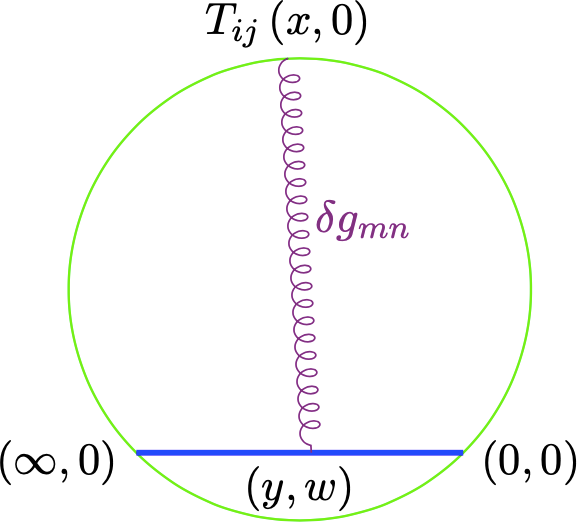
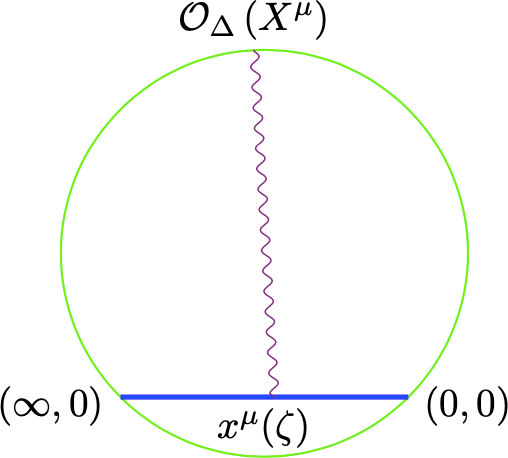
Figure 1: The left panel schematically depicts the one-point function of the energy-momentum tensor (wavy metric fluctuation) in the presence of a defect; the right illustrates the one-point function of a CPO localized at the defect with associated worldvolume coordinates on the probe brane.
Novel D5-Brane Solutions and Holographic Interpolations
A substantial innovation is the construction of D5-brane probe solutions in AdS5×S5 geometry, generalizing the previous codimension-2 paradigm. The D5-brane wraps S2 and extends along an S1 in the internal space, embedding parameters (σ, ρ) control the inclination and winding, and a worldvolume 2-form flux is incorporated to stabilize the configuration. The induced metric is N=40, and, crucially, the solution admits two limiting cases:
- N=41: Maximal N=42, D5-brane geometry dominates, reproducing the regime analyzed in earlier D5-brane defect frameworks.
- N=43: N=44 degenerates, reducing to a D3-brane probe with restored supersymmetry and half-BPS properties.
Through careful analysis of worldvolume stability, the authors delineate regions in the parameter space N=45 where the solution is physically viable.
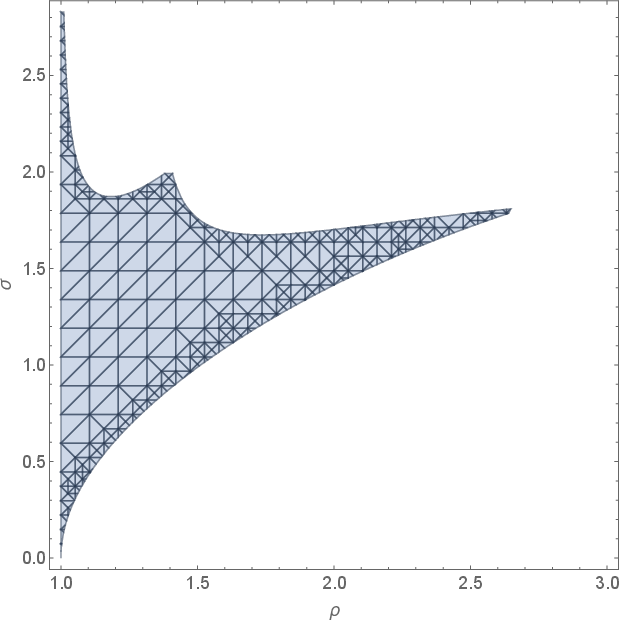
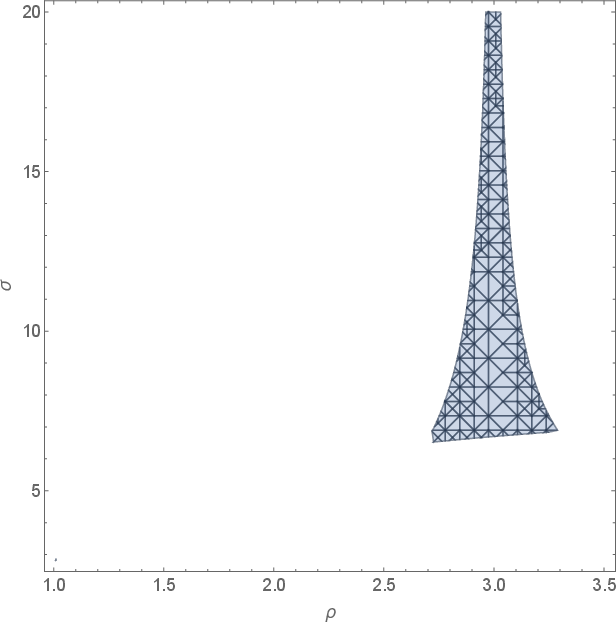
Figure 2: The regions of the N=46 parametric space where the D5-brane solution remains stable and physically valid; the panels correspond to different values/ranges for N=47.
The D5-brane's boundaries necessitate anomaly cancellation, posited to be achieved via D7-brane insertion at endpoints, which does not disrupt bulk scalar vevs but affects defect hypermultiplets.
Dual Field Theory and Classical Solutions
The dual dCFTs are constructed as classical solutions of the N=48 SYM equations, with explicit gauge field singularities reflecting the D5-brane embedding and tailored scalar vevs. The symmetry dictates non-trivial profiles for specific scalar fields and the matrix structure is chosen to match both the brane worldvolume and gauge symmetry breaking patterns.
Interpolations between D3-D3 and D3-D5 systems are realized by varying N=49, with the classical field profiles smoothly transitioning from one regime to another.
One-Point Functions: Energy-Momentum Tensor and Chiral Primary Operators
Energy-Momentum Tensor
The one-point function SO(2,2)×SO(2)×SO(4)0 in the presence of the defect is determined by conformal invariance up to a coefficient SO(2,2)×SO(2)×SO(4)1:
SO(2,2)×SO(2)×SO(4)2
At strong coupling, SO(2,2)×SO(2)×SO(4)3 is computed via the variation of the DBI action for the classical D5-brane embedding and use of the bulk-to-boundary graviton propagator:
SO(2,2)×SO(2)×SO(4)4
At weak coupling, explicit insertion of the classical solution yields
SO(2,2)×SO(2)×SO(4)5
In the BMN-like scaling limit (SO(2,2)×SO(2)×SO(4)6, SO(2,2)×SO(2)×SO(4)7), one finds exact agreement between the strong and weak coupling coefficients:
SO(2,2)×SO(2)×SO(4)8
This non-trivial matching, especially in a regime with broken supersymmetry, represents a stringent test for the universality of the duality. The value of SO(2,2)×SO(2)×SO(4)9 allows direct extraction of the defect Weyl anomaly coefficient AdS3×S10.
Chiral Primary Operators
CPO one-point functions are computed both holographically (DBI and WZ variations against fluctuations of the metric and RR 4-form, integrating the worldvolume embedding and spherical harmonics) and in weak coupling (trace insertion on classical vevs):
Holographic result for AdS3×S11:
AdS3×S12
Weak coupling result:
AdS3×S13
Again, in the scaling limit, the leading terms agree. This matching persists for higher-dimensional CPOs, with analytic expressions verified up to AdS3×S14.
Anomaly Coefficient Evaluation
Recent works expand on the calculation of the defect Weyl anomaly coefficients AdS3×S15 and AdS3×S16 (intrinsic and extrinsic curvature contributions), showing matching between weak and strong coupling results in the scaling regime, and the nontrivial occurrence of negative AdS3×S17 for finite parameter ranges.
Implications and Future Directions
The existence of interpolating D5-brane configurations, with smooth transitions between non-supersymmetric and supersymmetric regimes for codimension-2 defects, underscores the depth of the gauge/gravity duality. The empirical verification—via matching of one-point functions for fundamental observables and anomaly coefficients—suggests that the holographic principle retains predictive power well beyond highly constrained sectors. Practically, these results provide tools for the computation of local and global observables in defect CFTs and for the study of boundary/interface phenomena in higher-dimensional gauge theories. Theoretically, the approach broadens the scope of analytical techniques available for investigating universality and symmetry breaking in AdS/CFT.
Future research avenues include the systematic cataloging of higher-codimension defect systems, detailed exploration of boundary conditions and anomaly inflow, and an extension of computational frameworks for more intricate fields such as non-local correlators, entanglement entropy, and RG flows involving defects.
Conclusion
By establishing and analyzing the holographic duality for non-supersymmetric codimension-2 defect CFTs via D5-brane interpolations, the paper demonstrates a robust correspondence between field theory and gravity descriptions. Rigorous matching of key physical observables in both weak and strong coupling limits validates the universality of the gauge/gravity duality in reduced symmetry settings. The computation of anomaly coefficients and the interpolation between distinct defect types offer new perspectives on the structure of dCFTs and the generality of AdS/CFT. These results contribute significant technical depth and open the path for further explorations of defect phenomena in holographic field theories.