- The paper demonstrates an integrated Yb-doped alumina gain platform achieving high net gain (>28 dB) and on-chip output power >0.5 W.
- It details a co-sputtering fabrication process that controls dopant concentration and minimizes optical losses with a 120 pm RMS roughness.
- The platform supports versatile applications including continuous-wave and ultrafast pulse amplification as well as coherent supercontinuum generation over visible–NIR wavelengths.
Integrated Ytterbium Gain for Visible-Near-Infrared Photonics
Introduction and Motivation
This paper establishes an integrated ytterbium (Yb)-doped gain platform for photonics in the visible and short near-infrared (NIR) spectral domains, addressing a critical gap in the realization of scalable, low-noise, and high-power optical amplifiers and lasers on-chip (2605.13828). Rare-earth gain media underpin the majority of established fiber laser and amplifier technologies, with Yb-doped devices dominating the efficient generation and amplification of light in the NIR due to favorable energy-level structure, high conversion efficiency, and minimal thermal load.
While advances in integrated photonics have unlocked low-loss passive devices across visible to NIR wavelengths, the integration of rare-earth gain with performance exceeding fiber benchmarks remains largely unresolved—especially in the context of quantum hardware, ultrafast optics, and advanced spectroscopy systems that increasingly require on-chip sources and amplifiers. The reported work leverages physical advantages of Yb3+ ions: their simple two-level system, long upper-state lifetime, and broad gain bandwidth near 1 μm, coupled with a high solubility and low nonlinearity in an aluminum oxide (AlOx) host.
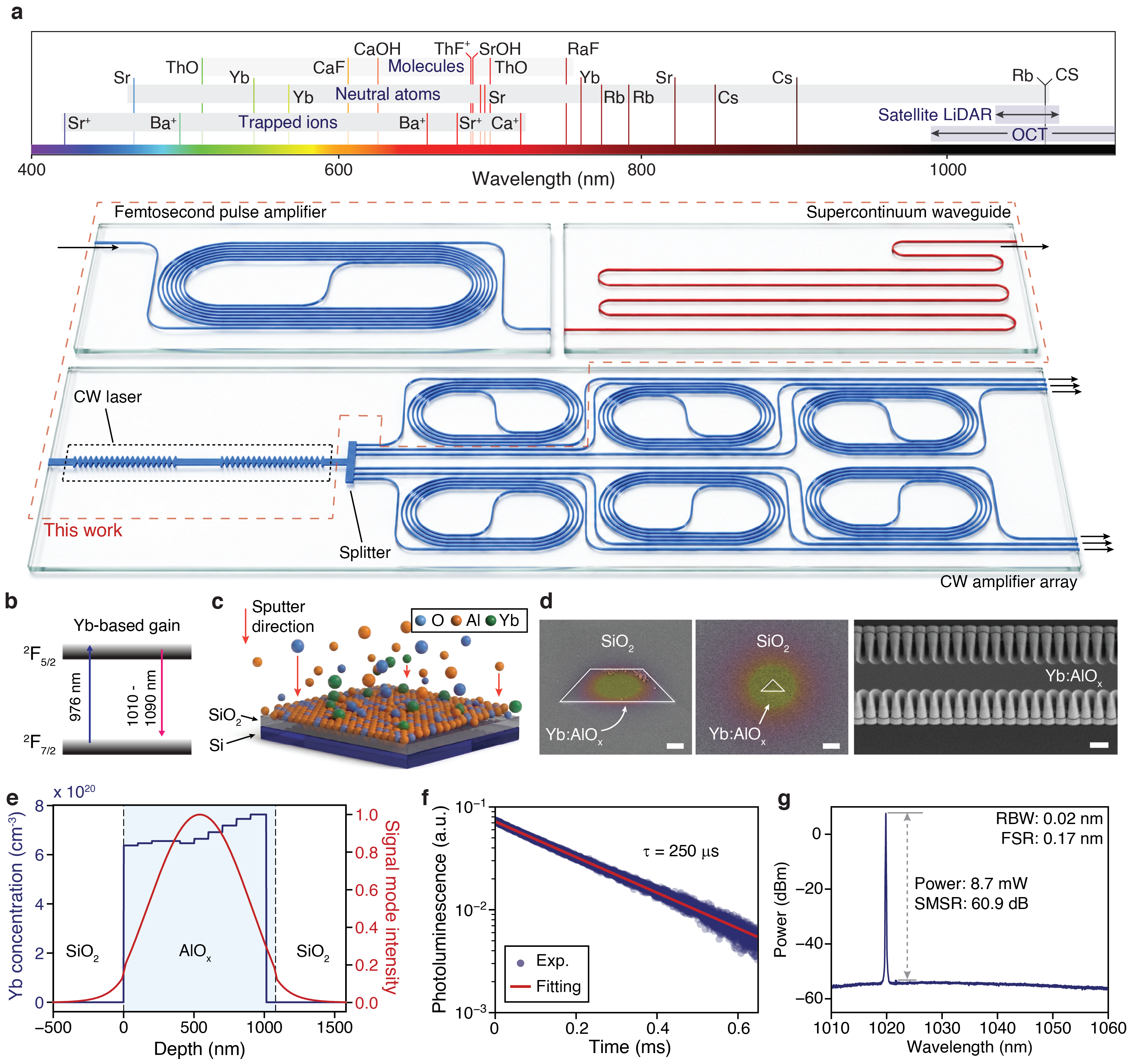
Figure 1: An integrated ytterbium-doped alumina photonic platform outlining spectral coverage, device schematic, energy-level diagram, and physical/optical characterization.
Device Design, Fabrication, and Material Characterization
The gain medium is realized via RF magnetron co-sputtering of Yb-doped AlOx onto thermally oxidized silicon substrates. The fabrication process allows tight control of dopant concentration (0.76 at.% Yb, ∼6.8×10²⁰ atoms/cm3) and produces a waveguide surface with root-mean-square roughness of 120 pm, supporting low optical loss and efficient coupling into UHNA3 fibers (1.0 dB/facet). Lithographically defined 3D inverse tapers minimize facet reflection and insertion loss.
Rutherford backscattering spectrometry (RBS) confirms homogeneous Yb distribution within the device, and photoluminescence measurements establish an upper-state lifetime of 250 μs—shorter than fiber analogs due to higher doping, but consistent with sputtered alumina implementations. Waveguides exhibit a mode area of 1.90 μm2 and a high pump-signal overlap (97.7%), supporting both compact footprint and high gain.
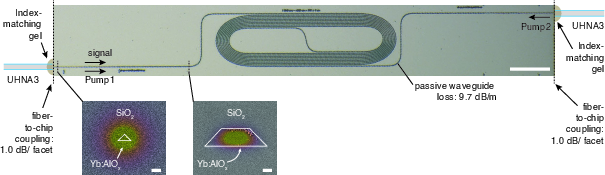
Figure 2: Input and output fiber-coupled Yb-doped amplifier showing polished facets, taper geometry, and cross-sectional SEM images.
Continuous-Wave (CW) Optical Amplification
The platform achieves bidirectional CW pumping of a 55-mm spiral amplifier at 976 nm, delivering net gain from 1010 to 1090 nm. Maximum measured net gain exceeds 28.6 dB (on-chip), corresponding to an off-chip gain of 26.6 dB once coupling losses are accounted for. Large-signal operation enables output powers up to 590 mW with a gain coefficient of 5.2 dB/cm and optical-to-optical conversion efficiency peaking at 71%. The minimum measured on-chip noise figure (NF) is 3.3 dB—approaching the quantum limit for phase-insensitive amplifiers, and signaling minimal spontaneous emission contribution and parasitic lasing.
Notably, these results underscore an efficiency surpassing 70%, output powers >0.5 W, and low noise performance (3.3 dB), thereby providing bold claims about matching or exceeding fiber technology in a chip-scale footprint.
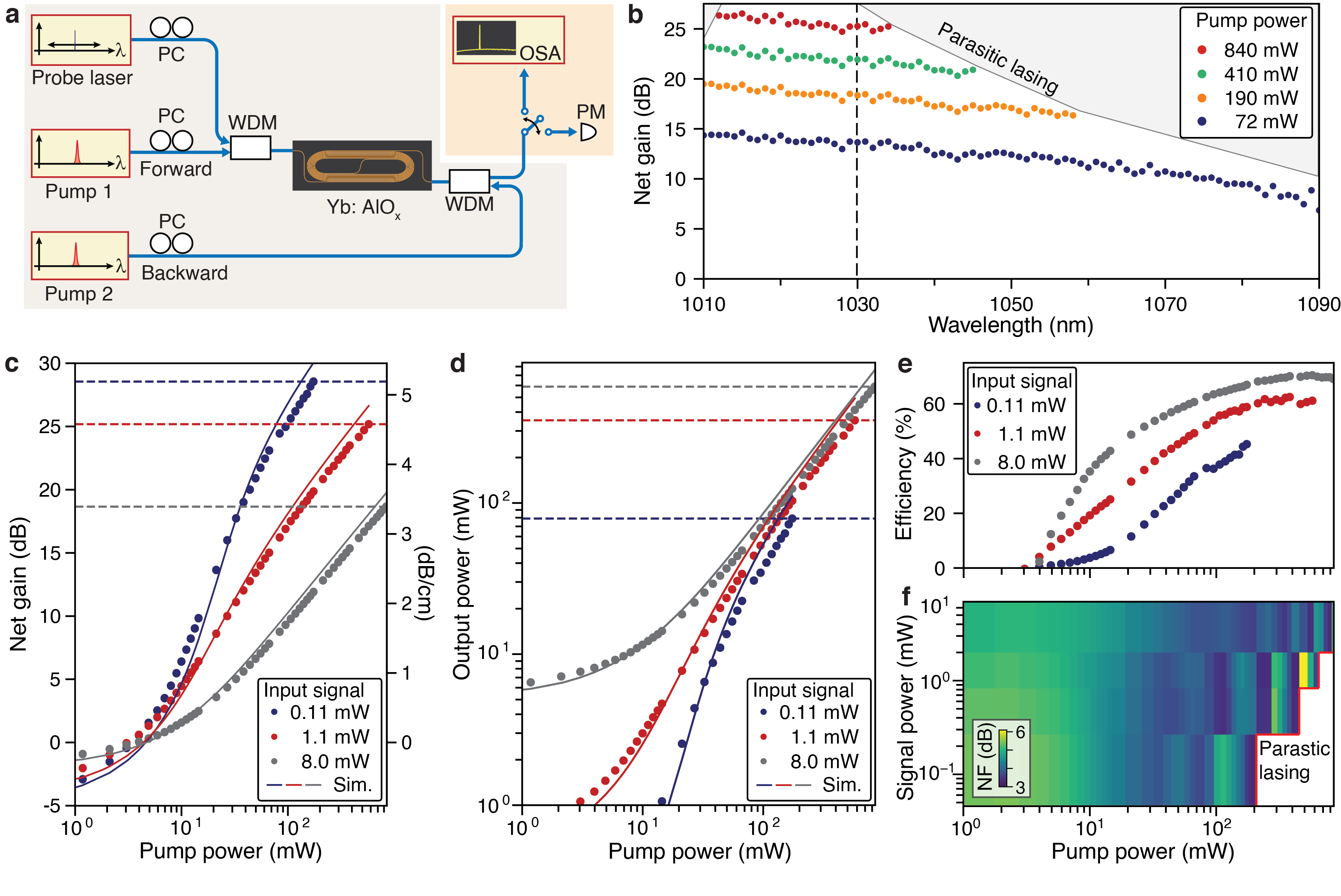
Figure 3: CW optical amplification setup, gain spectra at various pump powers, output power, conversion efficiency, and noise figure as a function of pump power.
Ultrafast Pulse Amplification
Leveraging the low nonlinearity of alumina (n2 = 4.8×10⁻²⁰ m2/W) and large mode area, the platform is utilized for energetic femtosecond pulse amplification. Pulses (5.2 ps duration, pre-chirped) from a Yb-fiber mode-locked laser are amplified to output energies up to 5.3 nJ and peak powers post-compression reaching 14 kW. Net gain for low-energy pulses is 18.9 dB. Nonlinear distortions and chirp broadening become evident at high output energies, but can be mitigated by further dispersion engineering and mode area augmentation.
These results reflect the highest reported peak powers in integrated rare-earth gain media for ultrafast pulse amplification, and enable the generation of broadband coherent light spanning from the NIR deep into the visible.
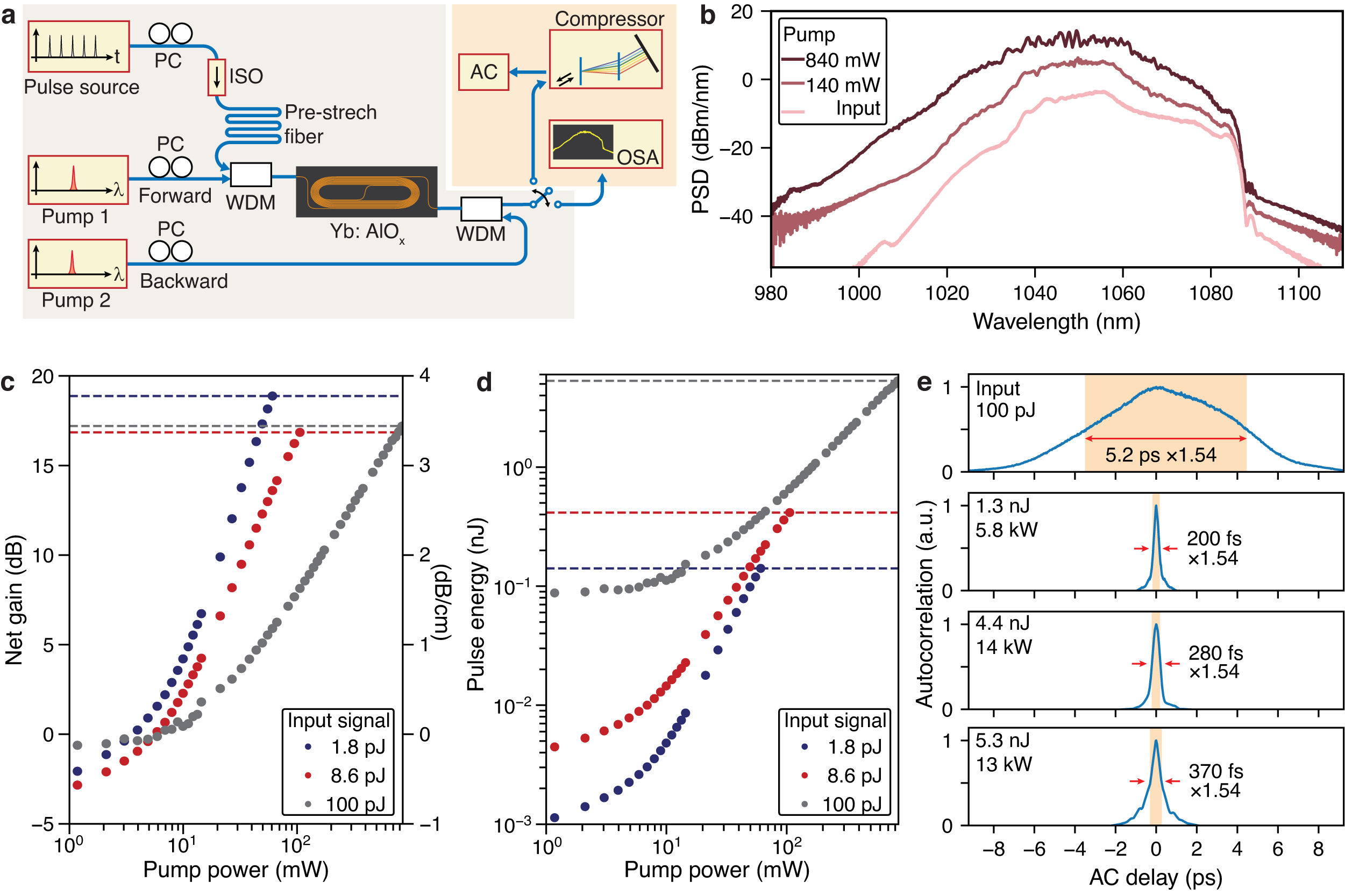
Figure 4: Experimental layout for femtosecond pulse amplification, input/output spectra, net gain and pulse energy, and autocorrelation traces of compressed pulses.
On-Chip Supercontinuum Generation
Amplified femtosecond pulses drive supercontinuum generation in both Six0Nx1 and SiOx2:Tax3Ox4 waveguides, with spectra extending from 600 to 1700 nm (Six5Nx6 system) and visible dispersive waves generated at locations tunable by material composition and waveguide width (down to 476 nm). Repetition-rate beatnote measurements confirm broadband coherence across the entire spectral span, directly enabling applications in optical frequency combs, clocks, and precision metrology.
Integration of Yb-gain amplifiers with nonlinear photonic circuits and on-chip WDMs is feasible; isolation requirements are relaxed with heterogenous integration, further paving the way for compact frequency synthesizers and coherent photonic systems.

Figure 5: Visible-to-NIR supercontinuum generation setup, waveguide cross-sections, spectrum measurement, and repetition-rate beatnotes.
The platform also demonstrates single-mode distributed feedback (DFB) lasing at 1020 nm with 8.7 mW per facet output and side-mode suppression ratios of 60.9 dB. High Bragg mirror reflectivity (93.9%) is achieved, and noise figure calculations adopt a robust ASE/SSE subtraction protocol, with optical spectra corroborating the lowest noise figure measured.
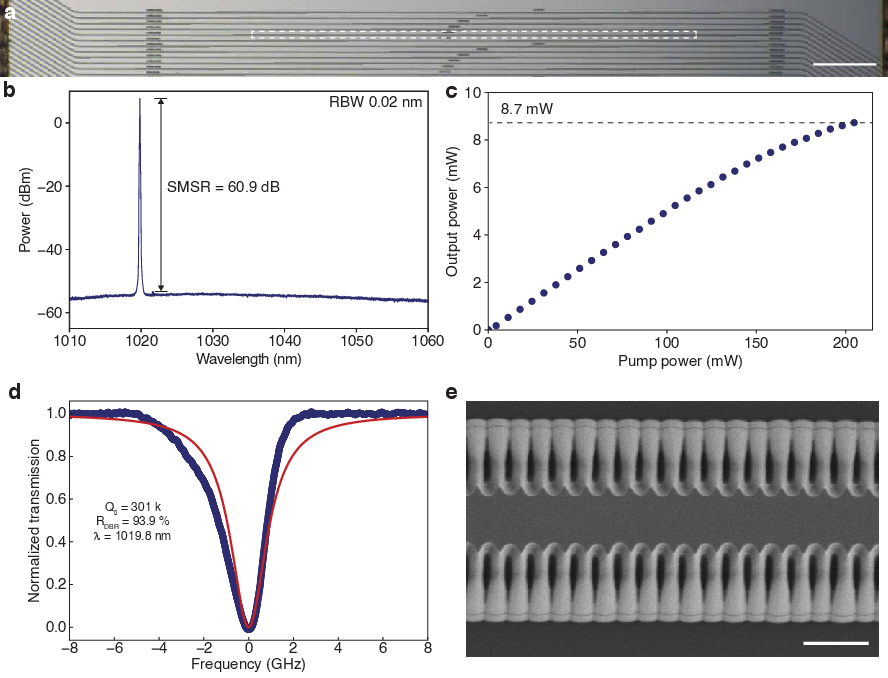
Figure 6: DFB laser characterization montage, showing laser array, emission spectrum, output power, Bragg mirror reflectivity, and SEM detail.
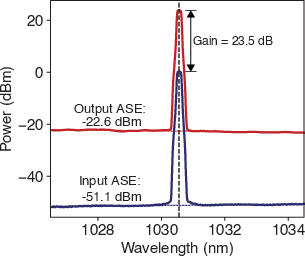
Figure 7: Input and output optical spectra for calculation of minimum noise figure (3.3 dB).
Implications and Future Directions
The demonstrated Yb-doped AlOx platform—the first to establish fiber-like gain, efficiency, and spectral reach in the visible-NIR regime—enables on-chip integration of robust amplifiers, single-mode lasers, energetic pulse sources, and broad supercontinuum generation. The physical characteristics (broad gain bandwidth, low nonlinearity, high saturation energy, and long lifetime) render it compatible with sophisticated architectures such as f-2f comb stabilization via dispersive wave generation, electro-optic and Kerr soliton mode-locked sources, and Mamyshev oscillators. The platform's scalability supports multi-watt amplifier arrays for quantum computing (optical tweezer arrays) and provides a route to frequency conversion regimes needed for atomic cooling and quantum control in advanced experiments.
Further, the co-sputtering fabrication flow is generic and supports codoping or alternative rare-earth ions (Er-Yb for telecom gain, Nd for visible), pushing integrated amplifier performance beyond incumbent limits. Full integration with CMOS electronics is plausible due to low process temperatures.
Conclusion
This work presents an integrated ytterbium-doped alumina photonic platform for visible-NIR amplification and lasing, achieving 28.6 dB small-signal gain, >0.5 W output power, >70% efficiency, and 3.3 dB noise figure. It also realizes energetic femtosecond pulse amplification and coherent supercontinuum generation spanning the NIR into the visible. The platform establishes a robust foundation for scalable photonic circuits, enabling applications in quantum systems, ultrafast optics, precision metrology, and integrated frequency combs.
These results both match and exceed benchmarked fiber performance, and set the stage for future developments in fully integrated, high-power, low-noise, and broadband photonics in the visible-NIR domain.

