- The paper introduces a unified vector-valued RKHS framework that generalizes Bayesian Optimization to handle structured, multidimensional measurements for improved sample efficiency.
- It derives high-probability concentration bounds for kernel ridge regression in the measurement space, enabling robust uncertainty quantification and effective acquisition strategies.
- Empirical results demonstrate that the proposed vvBO algorithm adapts efficiently to changing objectives and outperforms traditional scalar and contextual methods in real-world controller tuning tasks.
Bayesian Optimization with Structured Measurements: A Vector-Valued RKHS Framework
Motivation and Problem Statement
The paper introduces a generalized formulation for Bayesian Optimization (BO) when system outputs are structured, multidimensional, or functional, rather than scalar. Most classical BO methods dissociate from the underlying system structure by utilizing scalar feedback, which diminishes information richness and sample efficiency, especially when objectives correspond to linear functionals of the same output (e.g., different cost signals computed from trajectories in building control or robotics). The authors formulate BO in the context of vector-valued operators lying in a Reproducing Kernel Hilbert Space (RKHS), observed via bounded linear measurement operators, and target objectives as linear functionals of the measurements. This modeling unifies full, partial, and scalar observations in a Hilbert space context, enabling principled leveraging of structured measurements.
RKHS Modeling and Measurement Operators
The vector-valued RKHS formalism encompasses systems where outputs are not directly observable but are measured through a known linear operator. The measurement model permits full observation, finite projections (e.g., basis functionals), or scalar evaluations, naturally generalizing scalar-valued BO. Under this model, each measurement provides information in the measurement space and the objective is expressed as an inner product ⟨m,Mf(x)⟩M. This setting subsumes many practical regimes: point evaluations, integrals, and averages in control and environmental applications.
The authors leverage the Riesz representation theorem to ensure that linear functionals in common Hilbert spaces admit an inner product formulation. The vector-valued kernel induces a measurement space kernel KM(x,s)=MK(x,s)M∗, supporting efficient estimation and uncertainty quantification directly over M without conservatism from unobservable subspaces.
High-Probability Confidence Bounds and KRR
A key theoretical contribution is the derivation of high-probability concentration bounds in the measurement space for kernel ridge regression (KRR). The uncertainty quantification leverages operator-valued kernels and trace-class conditions to produce bounds structurally analogous to classical GP/BO regret analyses, but generalized to infinite-dimensional Hilbert spaces. The bound on prediction error reflects both information gain and posterior variance in M, facilitating principled confidence sets and acquisition strategies.
The framework is rigorously analyzed for separable kernels (e.g., Gaussian, Matérn, linear), yielding sublinear regret bounds that match scalar BO rates in dependence on sample budget T and kernel hyperparameters.
Algorithm: vvBO and Exploration-Exploitation
The proposed algorithm, vector-valued Bayesian Optimization (vvBO), implements a UCB acquisition function exploiting measurement-space KRR confidence bounds. At each iteration, the selection of query points is based on maximizing the upper confidence bound of the target objective, as a function of both estimator mean and uncertainty in M.
The entire procedure operates directly in the measurement space, supporting adaptation across objectives by efficiently reusing prior measurements and transferring confidence sets. This is extended to accommodate time-varying and nonlinear objectives (via Lipschitz continuity).
Empirical Evaluation
Synthetic benchmarks and a real-world controller tuning exercise substantiate the theoretical claims. The experiments demonstrate strong sample efficiency and adaptability to objective changes, especially in multi-objective and time-varying settings. Leveraging structured measurements enables rapid objective tracking, robust information transfer, and significantly reduced cumulative regret relative to scalar, multi-task, and contextual BO baselines.
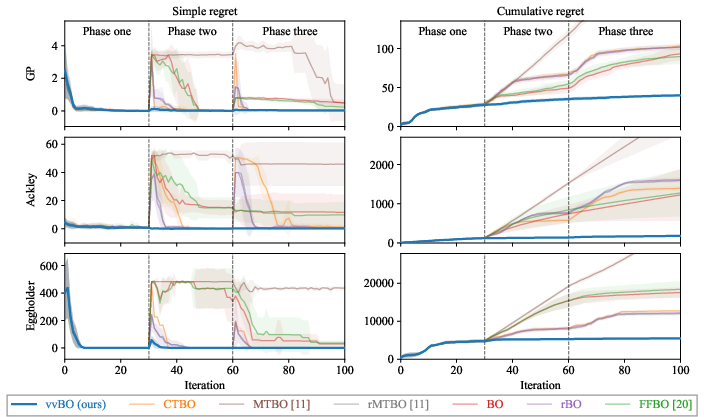
Figure 1: Comparison of simple regret and cumulative regret for three test operators with different baseline methods; vvBO with full trajectory measurements achieves uniformly lowest regret, indicating efficient objective adaptation.
Further results show that, under partial observation (finite-dimensional projections), vvBO maintains superior performance over classical multi-task BO, demonstrating robustness to observation model variation.
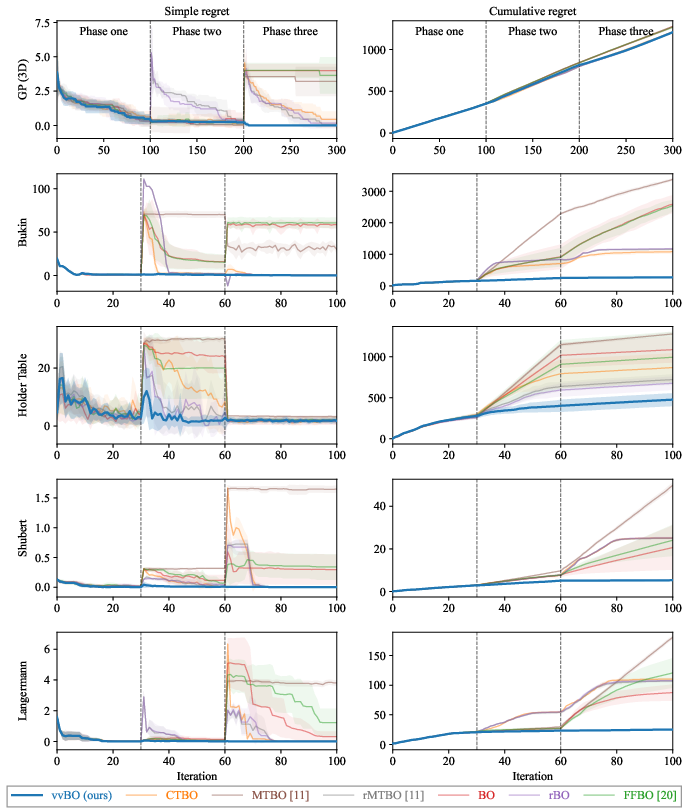
Figure 2: Simple and cumulative regret for additional operators under full measurements (M=I), highlighting vvBO's consistency across diverse structures.
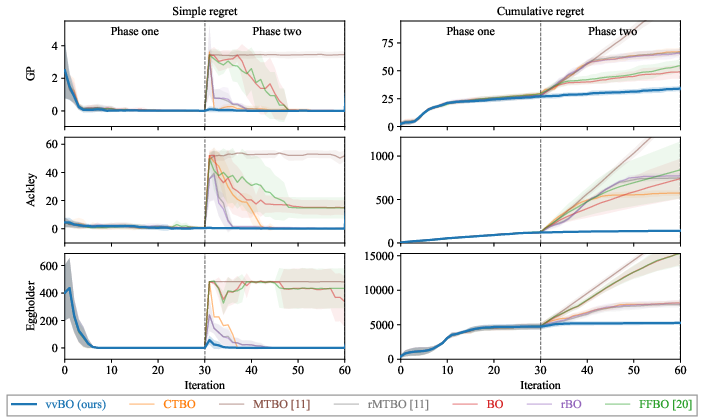
Figure 3: Regret comparison under partial observations (M=Ξ∗), confirming vvBO's advantage even when observation richness decreases.
A detailed comparison against contextual BO (CTBO) reveals that CTBO's performance degrades when objective changes induce substantial shifts in the context space. When context variation is small, CTBO can reuse samples, but for larger changes, exploration costs rise sharply, while vvBO remains insensitive by virtue of direct operator modeling.
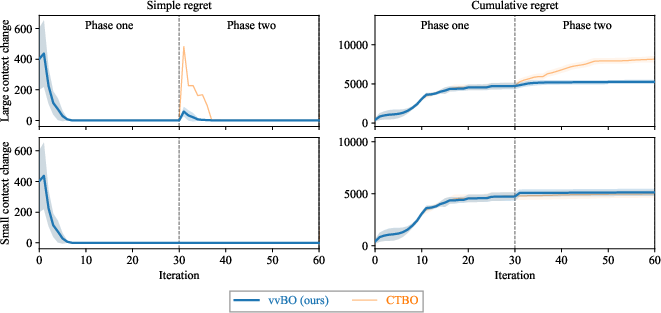
Figure 4: Comparison between vvBO and CTBO for the eggholder operator; CTBO shows higher exploration cost for large context shifts.
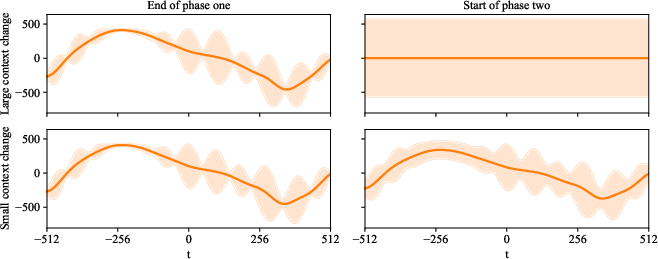
Figure 5: Confidence bounds for CTBO across different contexts; small context changes yield tighter bounds, large shifts cause uncertainty spikes.
Real-World Controller Tuning and Time-Varying Objectives
The application to MPC controller tuning for building climate control further demonstrates practical impact. In the presence of time-varying heating prices and dynamic objectives, vvBO adapts efficiently, minimizing energy cost, carbon emissions, and thermal discomfort by exploiting trajectory measurements and the vector-valued surrogate model.
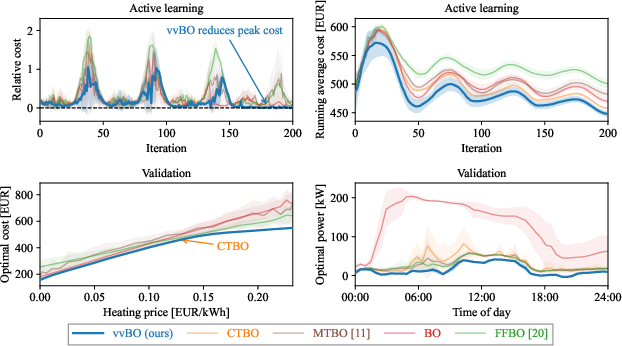
Figure 6: Real-world tuning of an MPC controller in building climate control, with vvBO enabling robust adaptation to time-varying objectives.
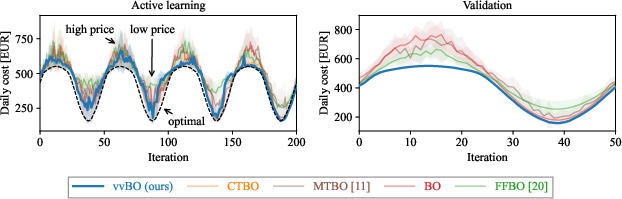
Figure 7: Daily cost during learning and validation phases; vvBO attains lower cost and better generalization across unseen objectives.
Notably, vvBO generalizes to new objectives (e.g., minimizing peak heating power) that are unseen during training, outperforming contextual methods, which require substantially more data to reduce uncertainty.
Theoretical and Practical Implications
The work demonstrates that modeling structured measurements in a vector-valued RKHS facilitates efficient BO in complex, high-information-output systems. The structured measurement approach enables rapid adaptation to changing objectives, effective transfer learning, and robust information-sharing, which are critical in control, scientific experimentation, and multi-objective optimization.
Theoretically, the generalization of confidence bounds, operator-valued kernels, and concentration inequalities is notable, as is the unified characterization of observation regimes (scalar, partial, full) within the RKHS framework. Sublinear regret guarantees for separable kernels reinforce the practical viability.
Practically, the results open avenues for sample-efficient optimization in modern applications requiring adaptation across multiple objectives, time-varying environments, and exploit-rich measurements (e.g., climate control, multi-agent systems, environmental monitoring, and advanced robotics).
Limitations and Future Directions
Despite strong empirical and theoretical results, the framework's performance degrades when the input space is high-dimensional, due to the complexity inherent in BO. Extension to constrained and safety-critical objectives, as well as robustness, privacy, and fairness considerations in deployment, remain open.
Further research may explore scalable algorithms for very large measurement spaces, the inclusion of nonlinear measurement operators, structured constraints, and integration with neural operator methodologies.
Conclusion
The paper systematically generalizes Bayesian Optimization to vector-valued settings with structured measurements, deriving high-probability confidence bounds and proposing a principled algorithm with sublinear regret guarantees. Empirical validation confirms that leveraging structured measurements enables efficient information sharing, rapid adaptation, and superior performance across objectives and changing environmental conditions. This framework is expected to influence future research in operator learning, adaptive control, and sequential optimization, especially in domains where functional and structured measurements are prevalent (2605.09775).

