- The paper establishes that the four-dimensional scalar S-matrix island is sharply bounded in the (c₀,₀, c₁,₀) plane using dual and primal bootstrap methods.
- The paper identifies three distinct phases along the boundary arcs: weak coupling with virtual states, a strongly coupled Regge regime, and fixed-mass decoupling reminiscent of large-Nc theories.
- The paper utilizes rigorous analyticity and unitarity constraints to reveal universal high-energy behavior and non-perturbative insights for potential UV completions of gapped scalar theories.
Phases and Boundaries in Four-Dimensional Scalar S-Matrix Space
Introduction: S-Matrix Bootstrap and the Geometry of Scalar Amplitudes
The S-matrix bootstrap framework provides a non-perturbative characterization of scattering amplitudes in quantum field theory, imposing constraints derived from unitarity, analyticity, and crossing symmetry. In four dimensions, the space of consistent 2→2 scattering amplitudes for massive scalar particles exhibits a rich structure when organized in terms of low-energy Wilson coefficients. This work provides a comprehensive analysis of the four-dimensional scalar S-matrix island, delineating its allowed region, identifying universal boundary behavior, and mapping the emergence of distinct high-energy phases along its boundary arcs.
A core result is the sharp delineation of the allowed region in the (c0,0,c1,0) plane of low-energy data, integrating rigorous dual bootstrap exclusion bounds with high-precision primal constructions. The detailed geometric features of the boundary—cusps, edges, and arcs connecting special points—lead to a phase structure, each phase encoding a characteristic ultraviolet (UV) completion mechanism for a gapped scalar sector.
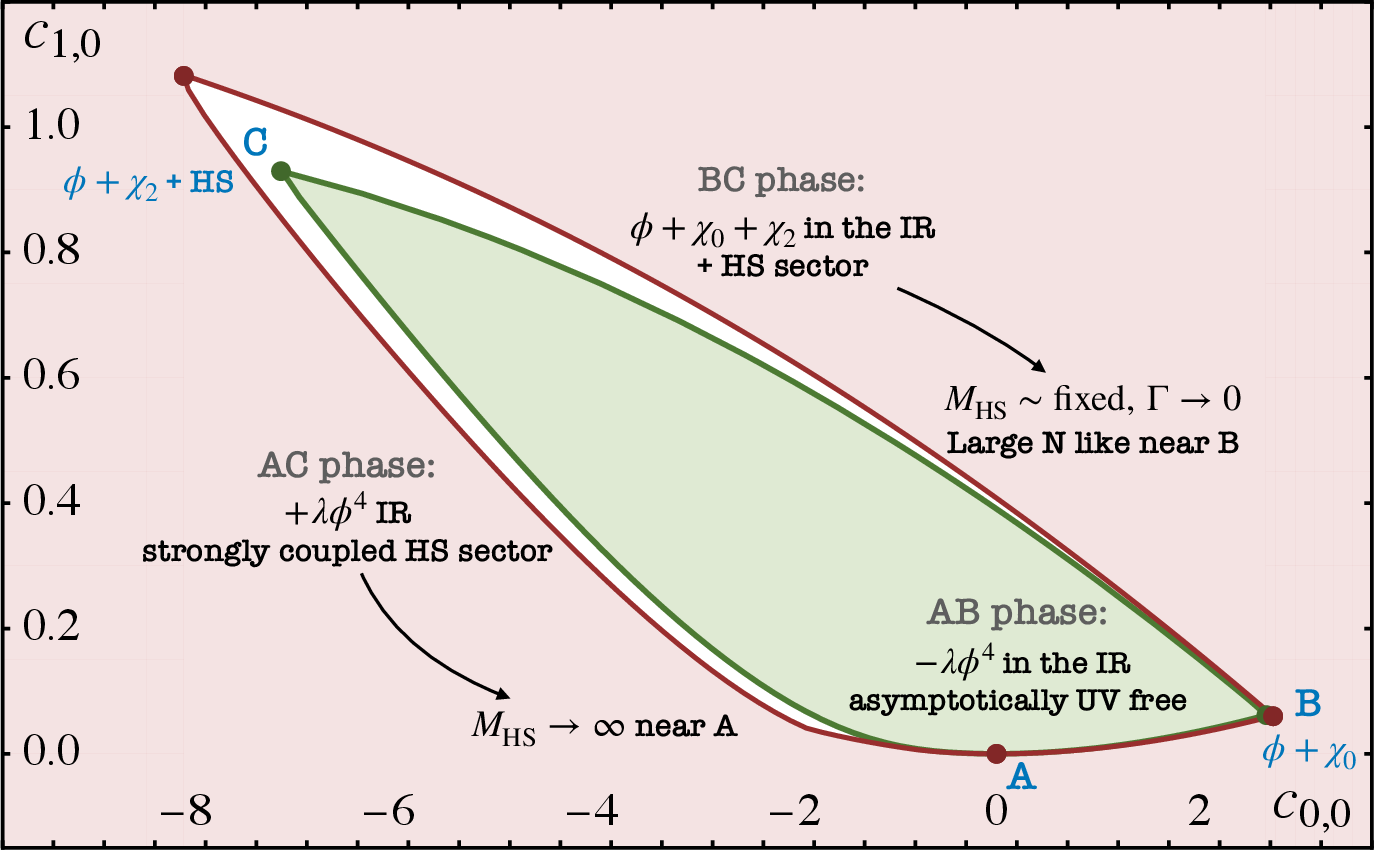
Figure 1: Projection of the four-dimensional scalar S-matrix space onto the (c0,0,c1,0) plane, showing excluded regions (red), explicit extremal amplitudes (green), and notable vertices and boundary arcs.
Bootstrap Methods and Boundary Characterization
The analysis employs both primal and dual bootstrap formalisms. Exclusion regions are established with the fixed-t dual bootstrap, which implements Roy-type dispersion relations and crossing constraints but relies solely on axiomatic analyticity. The primal construction extremizes chosen linear combinations of Wilson coefficients under partial-wave unitarity and full crossing symmetry, assuming maximal (Landau) analyticity. These complementary approaches yield a bounded region in the (c0,0,c1,0) plane, the residual gap reflecting the differing analytic domains of applicability.
The boundary is mapped through maximization at fixed angles in coefficient space, revealing specific vertices: the free theory at the origin; cusp B supporting a spin-zero threshold bound state; and cusp C, the so-called Froissart amplitude, saturating the maximum average total cross-section and supporting a spin-two threshold bound state. The arcs connecting these points—AB,AC, and BC—are the loci of extremal S-matrices, which under detailed analysis are shown to reside in physically and spectrally distinct phases.
Universal Phases: Spectra and UV Completion Mechanisms
A central theme is that each arc supports S-matrices with universal high-energy and spectral properties, i.e., the extremal amplitudes on a given boundary arc display consistent behaviors largely insensitive to microscopic details. Three distinct regimes are identified:
AB Arc: Weak Coupling and Virtual-State Dominance
The AB arc, interpolating between the free theory and the (c0,0,c1,0)0 cusp, displays no resonant structure in the cross-section. Instead, it is characterized by the accumulation of an infinite tower of virtual states, corresponding to zeros of (c0,0,c1,0)1 on (c0,0,c1,0)2 for various spins. The analytic structure is perturbatively accessible from the low-energy EFT, with the running coupling vanishing logarithmically at high energies, indicating an asymptotically free regime dominated by non-resonant scattering and an absence of Regge growth.
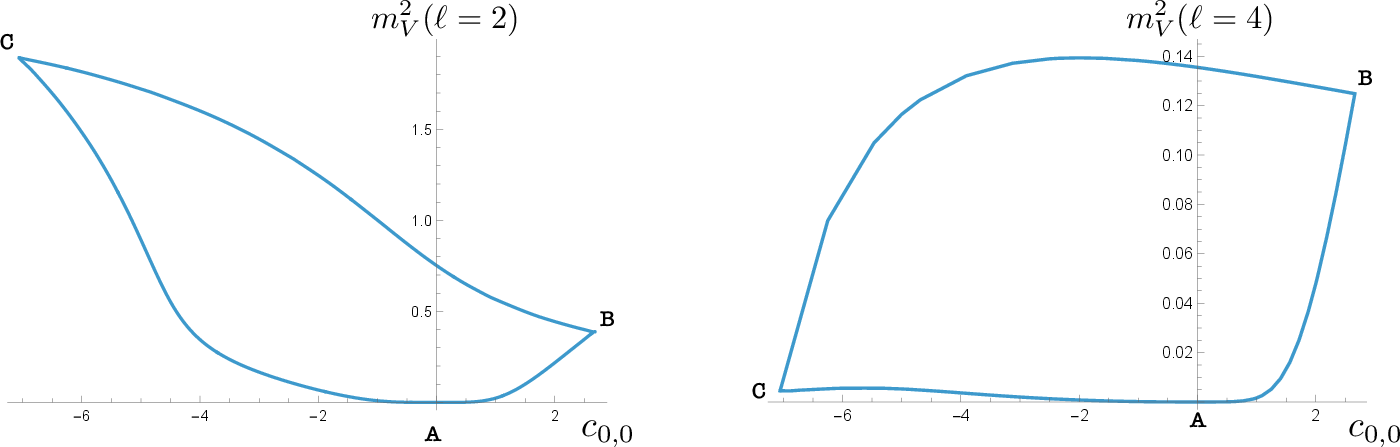
Figure 2: Virtual-state trajectories for spin (c0,0,c1,0)3 (left) and (c0,0,c1,0)4 (right) along the boundary; zeros approach threshold, tracking the evolution from virtual to threshold states.
AC Arc: Strongly Coupled Regge Sector with Energy Decoupling
On the (c0,0,c1,0)5 arc, the S-matrix exhibits conventional Regge asymptotics, with the leading Regge intercept (c0,0,c1,0)6 for amplitudes near cusp (c0,0,c1,0)7. The spectrum is populated by a sequence of massive higher-spin resonances, with poles in the partial waves tracking Regge trajectories in the complex (c0,0,c1,0)8-plane. Importantly, as one approaches the free point, the entire higher-spin resonance spectrum is pushed to arbitrarily high energies, with the width-to-mass ratios remaining finite—there is no decoupling via narrow resonances; decoupling occurs through the collective migration of the strongly coupled Regge sector to high energies.
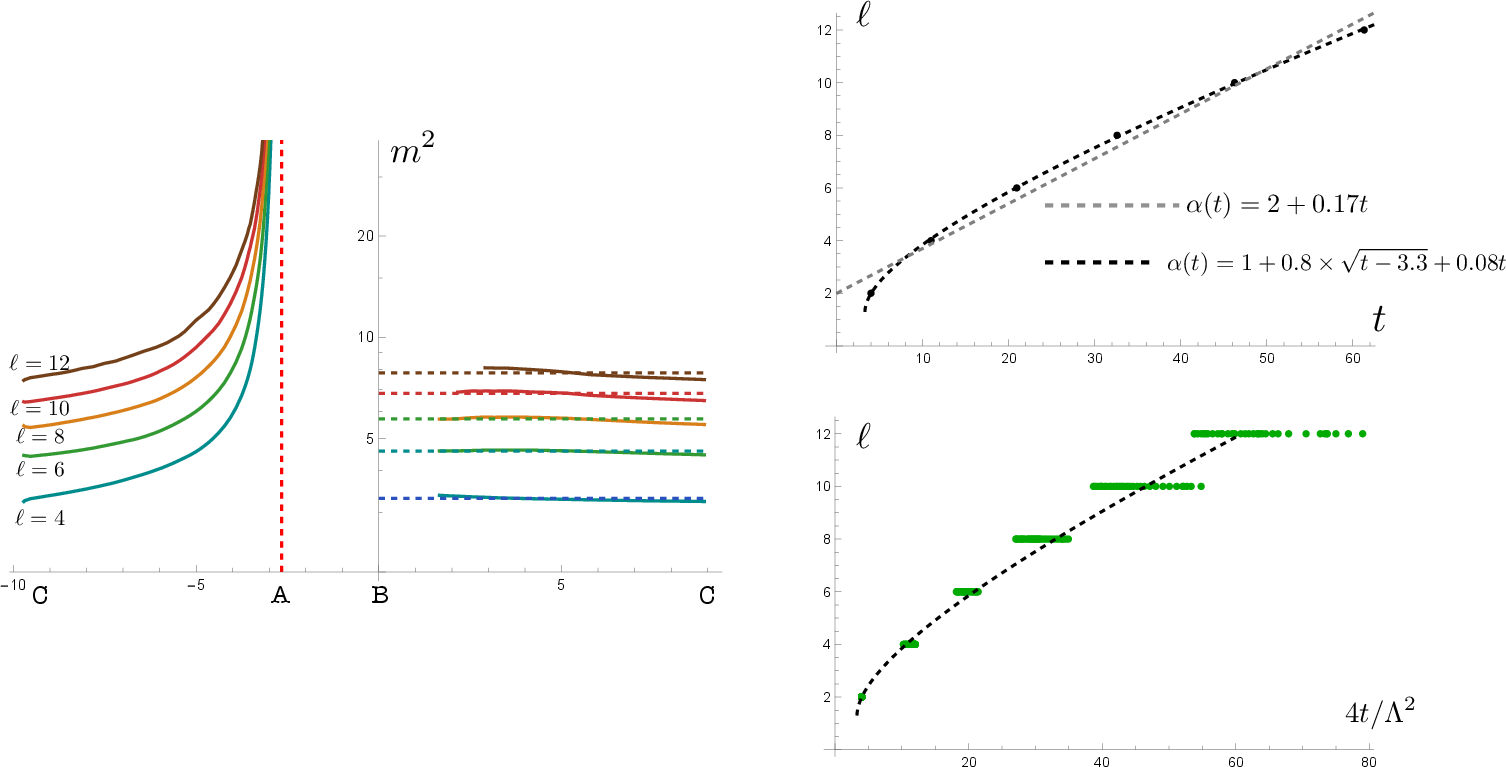
Figure 3: Left—The masses of higher-spin resonances along the boundary; along the (c0,0,c1,0)9 arc, the spectrum is pushed to high energy. Top right—Fit of the leading Regge trajectory with a non-linear functional form. Bottom right—Self-similarity of the decoupling after rescaling by the spin-two mass.
BC Arc: Large-(c0,0,c1,0)0-like Fixed-Mass Decoupling
The (c0,0,c1,0)1 arc exhibits simultaneous threshold bound states in both scalar and spin-two channels within its interior. The scalar threshold pole is continuously removed near (c0,0,c1,0)2 via a zero-pole collision with a virtual state, modeled by a CDD factor. In contrast to (c0,0,c1,0)3, the higher-spin resonance masses remain finite along (c0,0,c1,0)4 but their residues and widths diminish, reminiscent of the large-(c0,0,c1,0)5 suppression mechanism: the spectrum persists at fixed mass, but interactions become weak. This stabilizes the higher-spin contribution while interpolating between two types of threshold behavior.
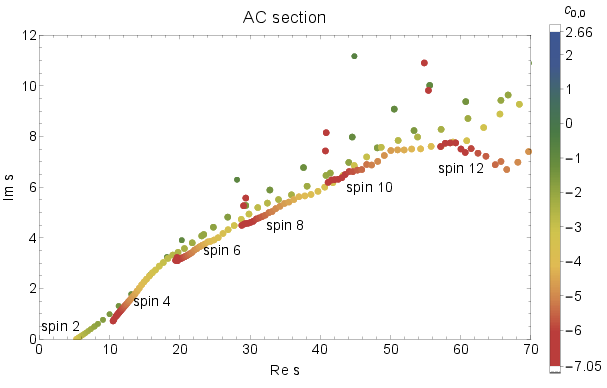
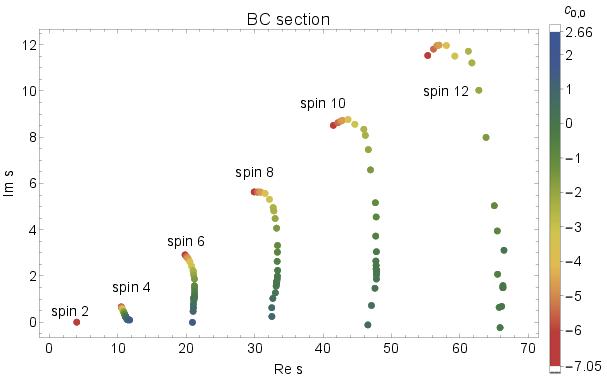
Figure 4: Motion of resonance zeros in the complex (c0,0,c1,0)6 plane; left—decoupling along the AC arc is to high energy, right—along BC, fixed-mass decoupling with narrowing.
Diagnostics: Regge Moments, Threshold States, and Crossing Ratios
The emergence of Regge behavior is diagnosed by introducing Regge moments—contour integrals in the (c0,0,c1,0)7-plane—that extract effective Regge exponents at given energies and truncation order. The stable development of plateaux in these diagnostics provides numerically robust evidence for asymptotic Regge scaling exclusively along the (c0,0,c1,0)8 and (c0,0,c1,0)9 arcs; the t0 arc remains marginal with sub-power-law (logarithmic) growth.
Amplitudes on these arcs are further distinguished by the trajectories of partial wave zeros (virtual states and resonances) and the scaling of threshold scattering lengths. The behavior of ratios of low-energy Wilson coefficients, as well as the effective couplings of threshold poles, indicate discontinuities across the boundary, further distinguishing the three phases.
Higher-Dimensional Amplitude Space and Outlook
Projections into higher-dimensional spaces of Wilson coefficients, such as t1, reveal additional prevertices and complex geometric features, suggesting additional extremal mechanisms not visible in the two-dimensional plane. These higher-codimension edges may be relevant for the analytic bootstrap of multi-component or symmetry-enriched scalar field theories.
The analysis raises critical questions: what UV-complete, possibly Lagrangian, theories saturate the boundaries of the S-matrix island? Large-t2 gauge theories with a light pseudoscalar (e.g., the t3 in QCD), brane-localized Goldstone effective theories, or perhaps more exotic constructions could underlie specific regions of the allowed boundary. The absence of explicit inelasticity in the bootstrap constraints cautions that the full S-matrix island may contain regions not realized in physical quantum field theories unless multiparticle production constraints are imposed.
Conclusion
This study establishes that the boundary of the four-dimensional scalar S-matrix space is universally organized into three arcs, each characterized by distinct UV and spectral behavior: (1) an asymptotically weak phase with virtual states and no resonances, (2) a resonance-dominated Regge regime with collective energy decoupling, and (3) a large-t4-like phase with fixed-mass resonance decoupling. These universalities stem solely from low-energy data and S-matrix axioms, providing non-perturbative insights into possible UV completions of gapped scalar theories. Future work should determine the precise mapping of these phases to physical theories, extend the analysis to include inelastic effects, and chart the structure for amplitudes with additional degrees of freedom or global symmetries.
(2605.06613)