- The paper presents the DASH framework that anticipates satellite handovers by monitoring joint states to optimize task offloading.
- It integrates bandwidth allocation, UAV trajectory planning, and computing resource optimization to achieve significant delay reductions.
- Empirical simulations validate DASH by demonstrating improved resource adaptivity and reduced congestion compared to baseline methods.
Dynamic Task and Resource Scheduling in Space-Air-Ground-Sea Integrated Networks
SAGSIN Architecture and Motivation
The paper introduces a comprehensive network architecture termed Space-Air-Ground-Sea Integrated Network (SAGSIN) to support growing demands for maritime communication and computation, primarily driven by 6G ubiquitous connectivity objectives. The architecture leverages heterogeneous layers: vessel users, UAVs, coastal base stations (BS), high altitude platforms (HAPs), and LEO satellites, with the goal of efficient, adaptive edge computing for resource-limited ocean environments. SAGSIN aims to alleviate constraints imposed by limited vessel computing, sparse maritime infrastructure, and rapidly fluctuating channel and resource conditions.
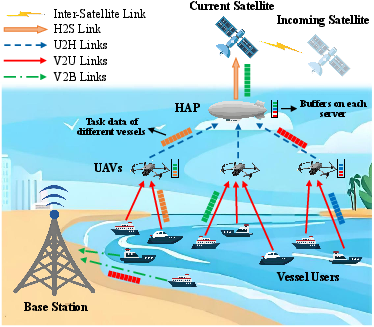
Figure 1: Multi-layer SAGSIN architecture, detailing interconnections among vessels, UAVs, BS, HAPs, and LEO satellites.
The scheduling problem is formulated as a mixed-integer nonlinear programming (MINLP) that jointly optimizes task offloading, UAV-BS bandwidth allocation, computing resource allocation, and UAV trajectory. System dynamics include varying server computing resources, queuing backlogs, fluctuating channel capacities, and network topology changes, all occurring in real-time discrete time slots. Key constraints ensure feasible offloading decisions, bandwidth allocations, computing resource limits, UAV mobility, and collision avoidance.
Satellite Handover-Aware Scheduling: DASH Framework
DASH (Dynamic tAsk and resource Scheduling for green SAGSIN) is proposed to overcome two core challenges: abrupt shifts caused by satellite handovers, and the prohibitive complexity of multi-layer task scheduling under dynamic conditions.
The anticipatory handover strategy distinguishes itself by considering the joint states of both current and incoming LEO satellites—especially their available computing resources and backlog—during a pre-handover interval τhand. Fine-grained weighted sums adaptively regulate offloading volumes to mitigate congestion following satellite transitions. DASH employs informative pressure-based indices (PI) and pressure differentials (PD), computed dynamically per link, integrating task backlog, computing capacity, and network shortest paths. Layer-wise scheduling decomposes the global coordination problem, reducing computational complexity to O(VU).
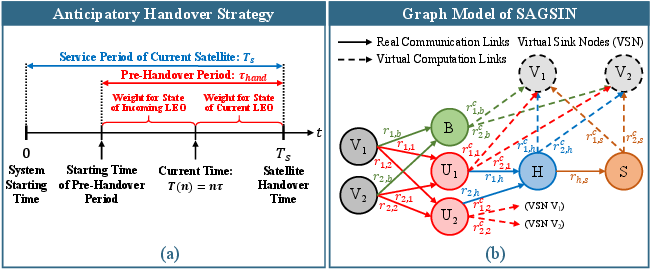
Figure 2: (a) Visualization of anticipatory handover strategy using real-time joint satellite states. (b) SAGSIN graph model reflecting vessels, UAVs, BS, HAP, and LEO satellite nodes.
Joint Resource Optimization: Bandwidth, Trajectory, and Computing
DASH couples bandwidth allocation, UAV trajectory planning, and computing resource allocation for further performance gains:
- The bandwidth allocation subproblem is convex; optimal policies distribute bandwidth in proportion to vessel-channel quality and association, maximizing aggregate transmission rates.
- UAV trajectory optimization uses SCA via first-order Taylor approximations to handle non-convexity and kinematic/safety constraints, positioning UAVs for maximal vessel throughput.
- Computing resource allocation prioritizes vessels with severe backlogs at each server, ensuring resource utilization adheres to real-time demand and upper bounds.
Algorithmic procedures iteratively coordinate layer-wise offloading and resource orchestration, converging to locally optimal solutions.
Empirical Evaluation and Numerical Results
Simulation studies deploy DASH in a 2 km × 2 km maritime region with varied numbers of vessels and six UAVs. Baseline comparisons include DASH without handover optimization, HACO, and FLEC. Key findings:
- Resource Adaptivity: With increasing fluctuations in available computing resources, DASH achieves a 28% reduction in average task delay versus HACO and 25% versus FLEC. This is attributed to DASH's real-time scheduling, which avoids resource-state inconsistency, common in one-shot approaches.
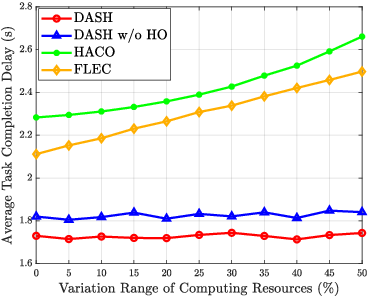
Figure 3: Average task completion delay under varying ranges of server computing resource fluctuation.
- Bandwidth Fluctuations: DASH maintains low, stable task delays even as bandwidth resources vary, outperforming HACO and FLEC by 26% and 23%, respectively.
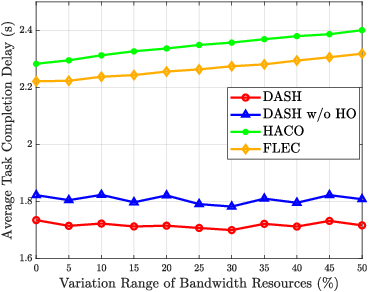
Figure 4: Average task completion delay under varying ranges of bandwidth resource fluctuation.
- Satellite Handover Congestion: The anticipatory strategy within DASH effectively reduces satellite backlog during handover, especially as the incoming satellite's computing capacity decreases, whereas other methods remain insensitive to such gaps.
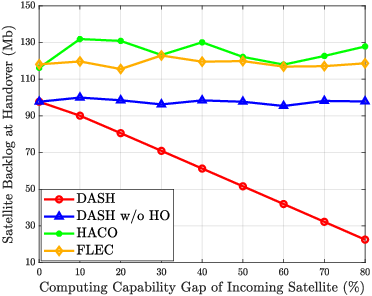
Figure 5: Backlogged satellite data at handover versus computing resource gap of incoming satellite.
Implications, Theoretical Contributions, and Future Directions
The DASH framework demonstrates the efficacy of anticipatory, real-time, layer-wise scheduling in complex, dynamic SAGSIN environments, providing strong evidence for its ability to reduce task delays, improve resource utilization, and suppress congestion during satellite handovers. The decomposition strategy and pressure-driven forwarding model set a precedent for scalable, adaptive optimization in multi-layer edge computing networks.
Practically, DASH's approach is scalable to other integrated network topologies featuring multi-modal mobility and resource heterogeneity. Theoretically, the anticipatory satellite handover mechanism and the pressure index formalism could serve as foundational models for future network scheduling under high dynamics and uncertainty.
Further investigations could extend DASH to scenarios with non-negligible inter-satellite link delays, more sophisticated mobility models, or autonomic, distributed learning-based scheduling under incomplete or delayed state information. Integrating federated computation and advanced network slicing may further refine resource efficiency and support new 6G-enabled maritime applications.
Conclusion
DASH provides a robust, low-complexity framework for dynamic task and resource scheduling in SAGSIN, integrating anticipatory handover management and joint optimization of communication, computation, and mobility resources. Empirical results affirm its superiority in minimizing task delays and managing congestion under challenging fluctuating conditions, highlighting new directions for adaptive, ecological, and scalable networking in future integrated systems.