- The paper introduces a spectral observer design that achieves prescribed exponential convergence rates using a spectral assignment technique for counter-flow heat exchangers.
- It develops a finite-dimensional projection method to stabilize unstable eigenmodes and validates the approach with numerical experiments showing accelerated error decay.
- The study establishes necessary and sufficient spectral conditions for uniform L2 exponential stability, enabling robust observer synthesis in hyperbolic PDE networks.
Spectral Boundary Observer Design for Counter-Flow Heat Exchangers
Introduction and Problem Context
The study addresses the observer design for counter-flow heat exchangers modeled by coupled first-order linear hyperbolic PDEs. These systems describe heat transport in two interacting fluid streams, flowing in opposite directions. Real-time reconstruction of distributed temperature profiles is fundamental to process monitoring and feedback implementation in energy systems, chemical reactors, and thermal engineering applications.
A significant challenge is the development of observers utilizing only limited boundary measurements—here, the cold fluid temperature at a single point—while ensuring not only asymptotic convergence, but the ability to prescribe the exponential convergence rate of the observation error in the L2 norm. Historically, Lyapunov-based and backstepping methods address exponential stability, but they suffer from limitations: Lyapunov approaches yield weak performance guarantees and lack rate tunability, while backstepping is intractable for coupled PDE networks due to the complexity of kernel PDEs.
The current methodology overcomes these deficiencies via a spectral assignment technique, shifting the entire spectrum of the error dynamics' generator into the desired left-half complex plane, thereby directly controlling the convergence rate.
The plant is governed by
{∂tTh=−u1∂xTh−c1(Th−Tc), ∂tTc=u2∂xTc+c2(Th−Tc),
on x∈[0,1], with Dirichlet boundary conditions Th(0,t) and Tc(1,t).
The one-sided observer is
{∂tT^h=−u1∂xT^h−c1(T^h−T^c)+κh(x)(y−y^), ∂tT^c=u2∂xT^c+c2(T^h−T^c)+κc(x)(y−y^),
where y=Tc(0,t) and y^=T^c(0,t). The gains κh, κc are designed spectrally and can be complex-valued.
The core theoretical contributions can be summarized as follows:
- The error dynamics are posed as an evolution equation in the Hilbert space {∂tTh=−u1∂xTh−c1(Th−Tc), ∂tTc=u2∂xTc+c2(Th−Tc),0, governed by a non-self-adjoint generator {∂tTh=−u1∂xTh−c1(Th−Tc), ∂tTc=u2∂xTc+c2(Th−Tc),1.
- The spectrum of {∂tTh=−u1∂xTh−c1(Th−Tc), ∂tTc=u2∂xTc+c2(Th−Tc),2 can be assigned arbitrarily in finite regions via a finite-dimensional projection argument.
- The main technical result is that spectral placement in {∂tTh=−u1∂xTh−c1(Th−Tc), ∂tTc=u2∂xTc+c2(Th−Tc),3 is not only sufficient but necessary for uniform {∂tTh=−u1∂xTh−c1(Th−Tc), ∂tTc=u2∂xTc+c2(Th−Tc),4 exponential convergence at rate {∂tTh=−u1∂xTh−c1(Th−Tc), ∂tTc=u2∂xTc+c2(Th−Tc),5—a property rigorously established by proving that the generator satisfies the Spectral Mapping Property. This is non-trivial, as the equivalence between spectral and exponential (Lyapunov) stability does not generally hold for infinite-dimensional systems, especially those governed by hyperbolic types.
Spectral Design and Main Theorems
A key insight is that infinite-dimensional hyperbolic systems possess only finitely many unstable eigenvalues in any bounded region, so spectral placement is reduced to stabilization of a finite unstable manifold.
Given the generator {∂tTh=−u1∂xTh−c1(Th−Tc), ∂tTc=u2∂xTc+c2(Th−Tc),6 and output structure {∂tTh=−u1∂xTh−c1(Th−Tc), ∂tTc=u2∂xTc+c2(Th−Tc),7, an explicit spectral assignment procedure is formulated:
- Compute the shifted generator {∂tTh=−u1∂xTh−c1(Th−Tc), ∂tTc=u2∂xTc+c2(Th−Tc),8.
- Identify all unstable eigenvalues and construct the projection on the associated generalized eigenspaces.
- Synthesize observer gains by finite-dimensional pole placement (e.g., using LQR or pole assignment) on the reduced system. The gain functions are reconstructed using the biorthogonal basis of the unstable subspace.
Theorem: Spectral stability—i.e., spectrum contained in {∂tTh=−u1∂xTh−c1(Th−Tc), ∂tTc=u2∂xTc+c2(Th−Tc),9—is equivalent to strict x∈[0,1]0 exponential stability at rate x∈[0,1]1.
Numerical Results
Numerical experiments substantiate the theoretical findings. The eigenstructure of the spatially discretized system is computed for different prescribed rates x∈[0,1]2, yielding 1 and 9 unstable modes, respectively. The presented results compare the direct model (x∈[0,1]3) with the spectrally designed observer.
Key findings:
- The observation error norm x∈[0,1]4 converges precisely at the prescribed exponential rate, with significant acceleration compared to the direct model.
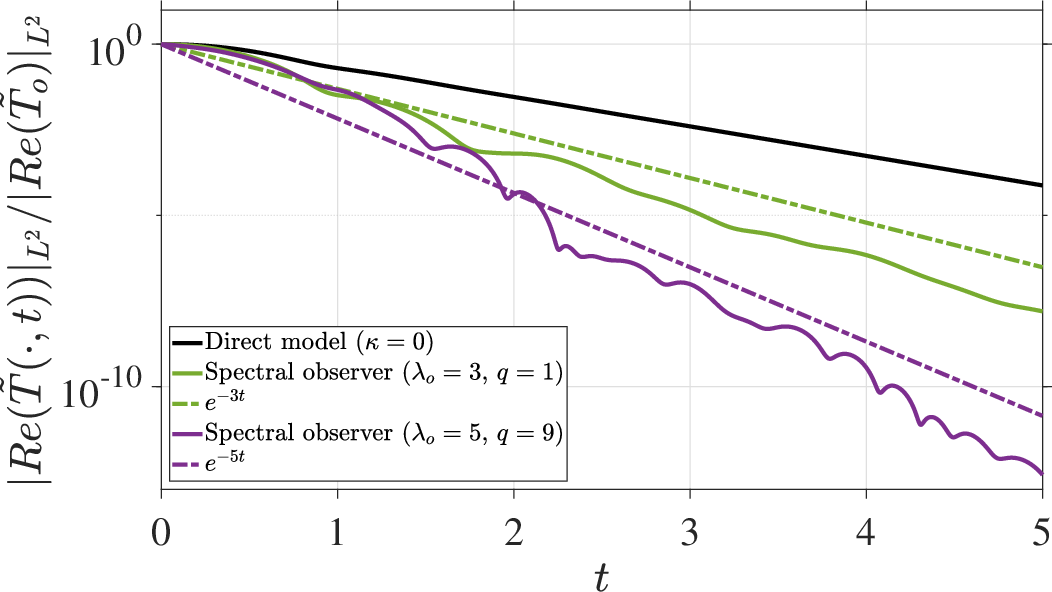
Figure 1: The scaled x∈[0,1]5 norm of the observation error for x∈[0,1]6 (direct model) versus spectral observer with x∈[0,1]7 designed via spectral assignment for varying x∈[0,1]8.
Error transients display bounded overshoot, attributed to the finite gain design. The error dynamics for both hot and cold fluid states are visualized, demonstrating rapid error decay over the entire spatial domain under the spectral observer.
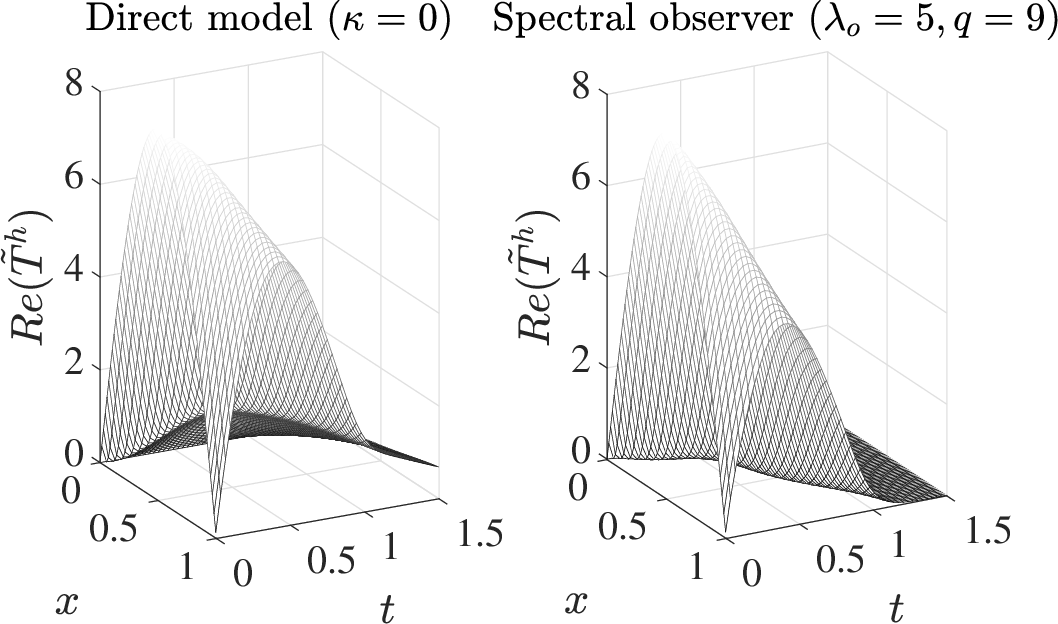
Figure 2: Real part of the hot fluid observation error, comparing direct model (left) and spectral observer (right).
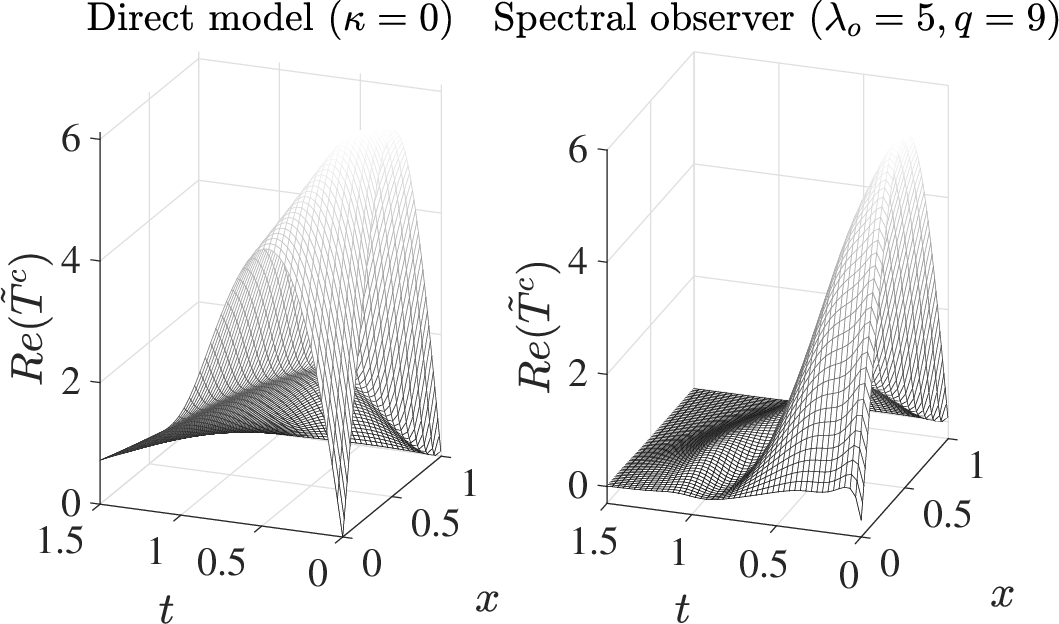
Figure 3: Real part of the cold fluid observation error, comparing direct model (left) and spectral observer (right).
Theoretical and Practical Implications
This work marks a significant advance in boundary observer design for hyperbolic coupled PDEs. The framework enables:
- Arbitrary pole placement and rate tuning for the observation error, which is unattainable with Lyapunov or port-Hamiltonian approaches.
- Full exploitation of the spectral structure of dissipative hyperbolic systems, with rigorous equivalence between infinite-dimensional spectral and exponential stability established via the spectral mapping theorem.
- Observer synthesis that scales to large networks, avoiding the computational cost of backstepping kernel equations.
Limitations include the current restriction to systems with constant coefficients and time-invariant transport velocities, and the reliance on numerical approximation for spectral data.
Future Directions
Key opportunities for future work include:
- Extending the spectral assignment approach to time-varying hyperbolic systems (e.g., under closed-loop flow-rate actuation), which would require non-autonomous spectral theory and analysis of the spectrum's time-evolution under parameter variation.
- Integrated observer-based feedback design for regulation and tracking in distributed parameter systems.
- Robustness analysis vis-à-vis uncertainties in physical parameters and numerical approximation of the spectral subspaces, and adaptive observer extensions for unknown model coefficients.
Conclusion
The paper establishes a rigorous, constructive, and rate-tunable boundary observer synthesis methodology for two-fluid counter-flow heat exchangers, grounded on spectral placement in infinite-dimensional systems. The results have high relevance for control and monitoring in distributed transport processes and offer a template for addressing observer design in more complex coupled PDE networks.
Reference: "Spectral Boundary Observer for Counter-Flow Heat Exchangers" (2604.26863).

