- The paper introduces integrable RSOS models that realize topological defects in non-unitary minimal CFTs.
- It employs numerical diagonalization and analytical constructions to match lattice-extracted spectra with precise CFT predictions.
- The study reveals RG flows, defect entropy variations, and non-Hermitian dynamics, opening avenues for quantum simulation of exotic phases.
Lattice Realizations of Topological Defects in Non-Unitary Minimal Models
Introduction
Topological defects in two-dimensional conformal field theories (2D CFTs) encode information about generalized symmetries, dualities, and quantum criticality. While their study in unitary 2D CFTs has been extensive—often enabled by explicit lattice representations amenable to analytic and numerical analysis—the problem remains less explored for non-unitary counterparts. Non-unitary CFTs exhibit distinctive features including exceptional points, exotic symmetry protected topological phases, and richer renormalization group (RG) flows, central to the statistical physics of disorders, turbulence, and quantum gravity.
This paper constructs and systematically analyzes integrable lattice models (restricted solid-on-solid, RSOS chains) that realize topological defects in non-unitary minimal 2D CFTs. Through analytical constructions and large-scale diagonalization, signatures of these defects in thermodynamic quantities, spectra, and RG flows are computed and matched to CFT predictions.
Lattice Model Construction and Topological Defect Realization
The core framework employs RSOS(m,m′) chains, whose low-energy scaling limits correspond to the non-unitary minimal models M(m′,m) (with coprime 2≤m<m′). The Hamiltonians are expressed in terms of Temperley-Lieb (TL) algebra generators ei, parameterized by q=eiaπ/m′ with a=m′−m. For m′−m>1, critical to the non-unitary case, the TL generators become non-Hermitian but maintain a symmetric structure, ensuring real spectra under appropriate conditions.
Topological (Kramers-Wannier–type) defect lines are introduced by modifying the TL Hamiltonian with an impurity term, parameterized by a defect strength v. In the direct channel, this models a spatially localized impurity; in the crossed channel, this is an operator acting on the periodic chain Hilbert space. This construction interpolates between the identity defect and the Kramers-Wannier (KW) duality defect as v is tuned from 0 to large values.
Spectral Analysis and Fixed Point Characterization
Numerical diagonalization of finite-size RSOS(m,m′) chains with and without topological defects allows for detailed comparison with CFT spectra. The non-Hermitian Hamiltonian and its biorthogonal eigenstates are used to extract scaling dimensions via finite-size scaling,
M(m′,m)0
and corresponding conformal spins. Strong agreement is observed between the lattice-extracted spectra and CFT predictions for both the identity and KW defect fixed points, across various non-unitary series (e.g., Lee-Yang, minimal models with M(m′,m)1).
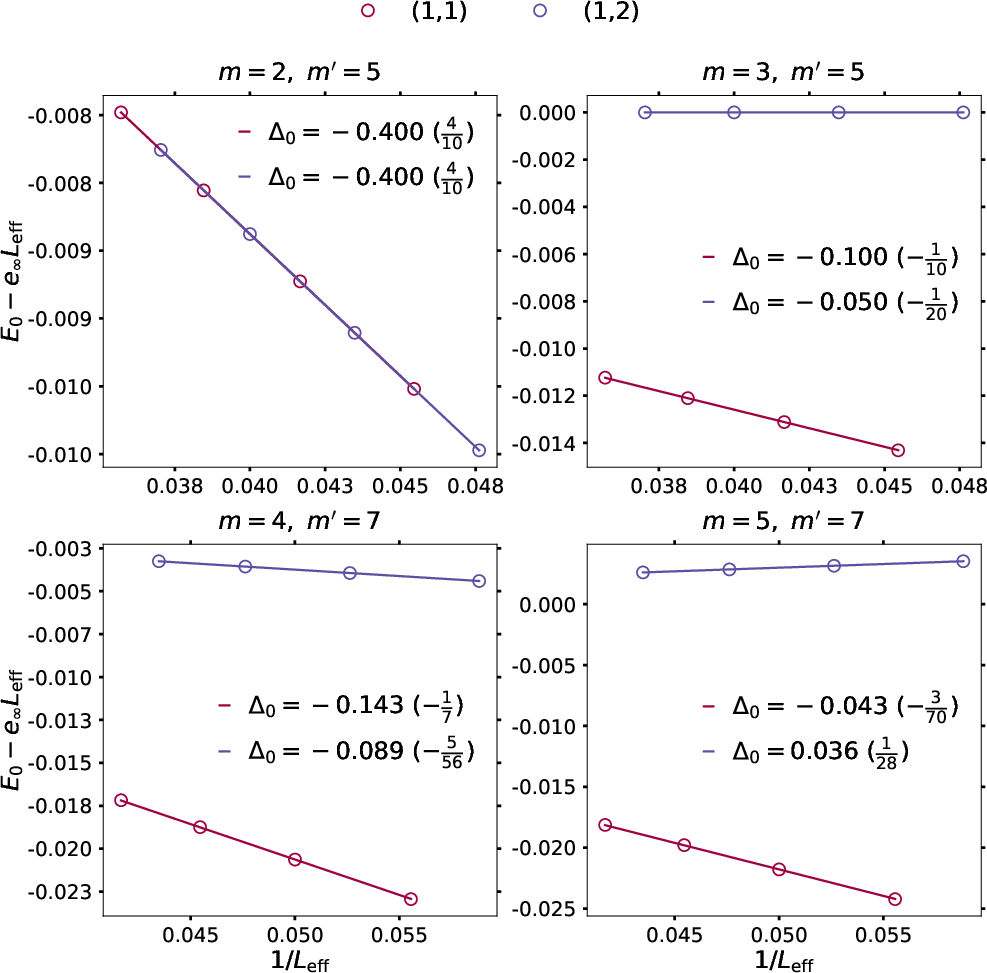
Figure 1: Scaling of the ground state conformal dimension for M(m′,m)2 and M(m′,m)3 defect realizations, highlighting precise agreement between lattice and CFT predictions as M(m′,m)4 is tuned.
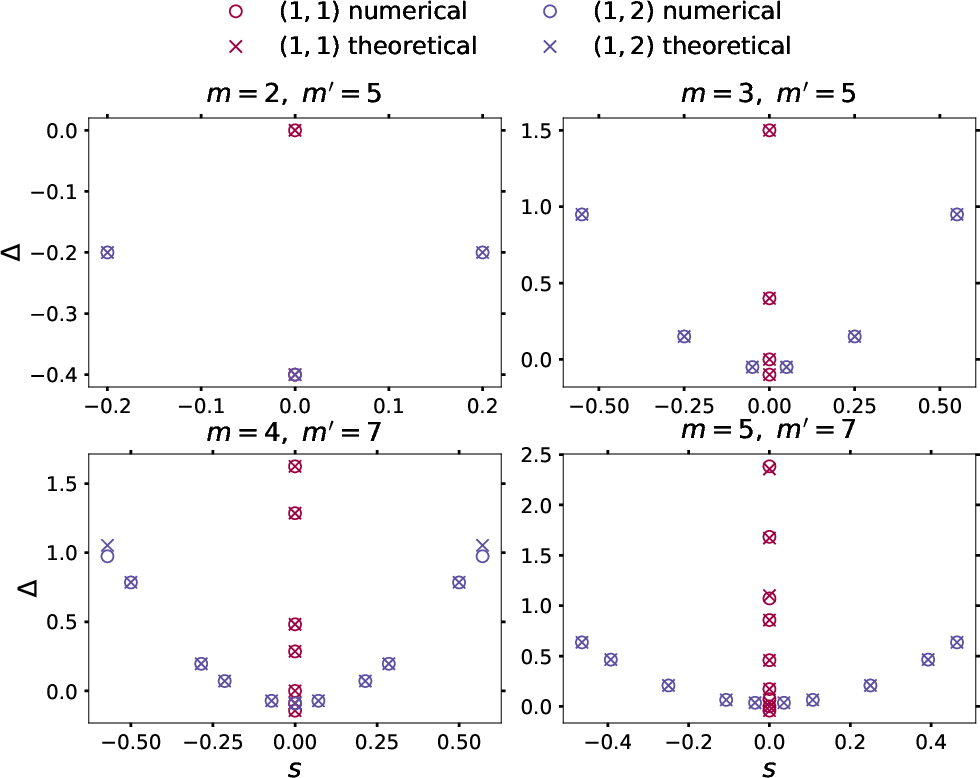
Figure 2: Numerical results for the full operator content at both fixed points (M(m′,m)5, M(m′,m)6), matching the CFT tower structure for various (non-)unitary minimal models.
Furthermore, explicit evaluation of the crossed channel defect (hoop) operator's expectation value on low-energy states establishes exact correspondence with CFT fusion rules and topological signatures, as predicted from ratios of modular M(m′,m)7-matrix entries. This confirms that the constructed lattice defects realize their CFT counterparts exactly for finite systems.
RG Flow and Thermodynamics of Defect Lines
By continuously varying the defect parameter M(m′,m)8, the work tracks RG flows between the UV (identity) and IR (KW) defect fixed points. The non-unitary case yields several distinctive thermodynamic features:
- Defect (boundary) entropy flow: The thermodynamic entropy associated with the defect, computed via the g-function M(m′,m)9, follows a monotonic RG trajectory—similar to the unitary case, but with differences due to non-unitarity and possible 2≤m<m′0.
- Free energy scaling: The finite temperature free energy density is analyzed in both direct and crossed channels, with extraction of effective central charge 2≤m<m′1 matching theoretical expectations.
- Ground state conformal dimension flow: The leading scaling operator along the flow transitions between theoretical values for the two fixed points, verifying both analytical and RG-based CFT predictions.
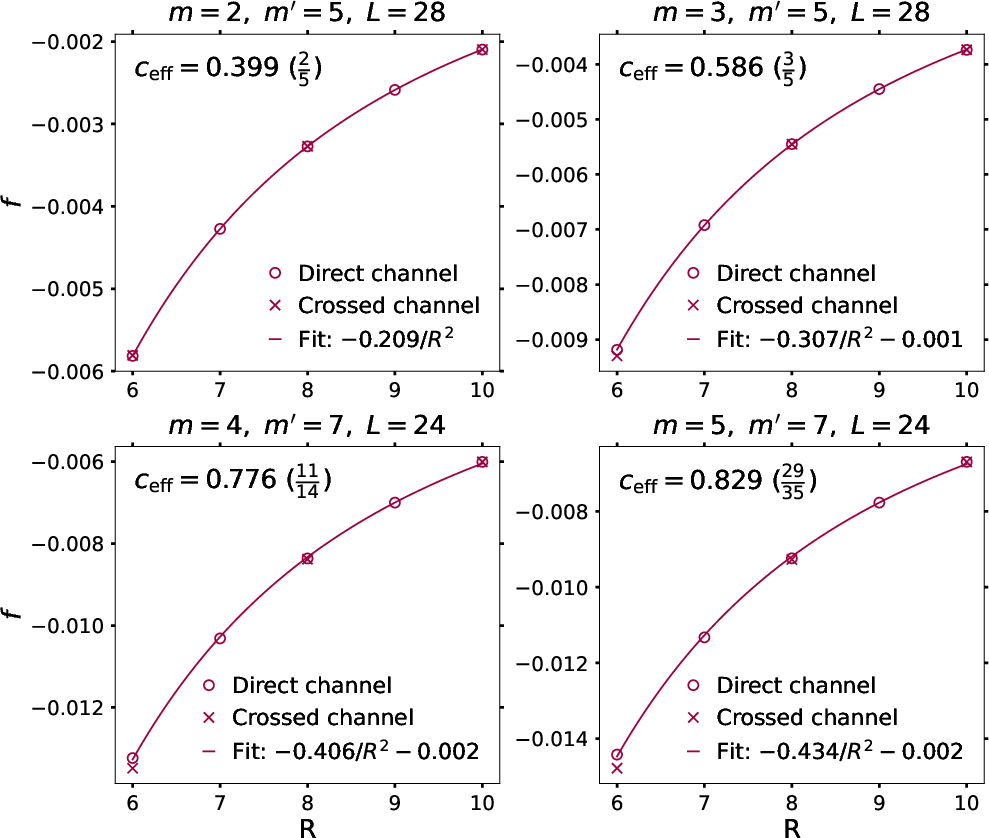
Figure 3: Free energy density versus system size and temperature, in both channels, illustrating the extraction of 2≤m<m′2 and agreement with modular-invariant CFT partition functions.
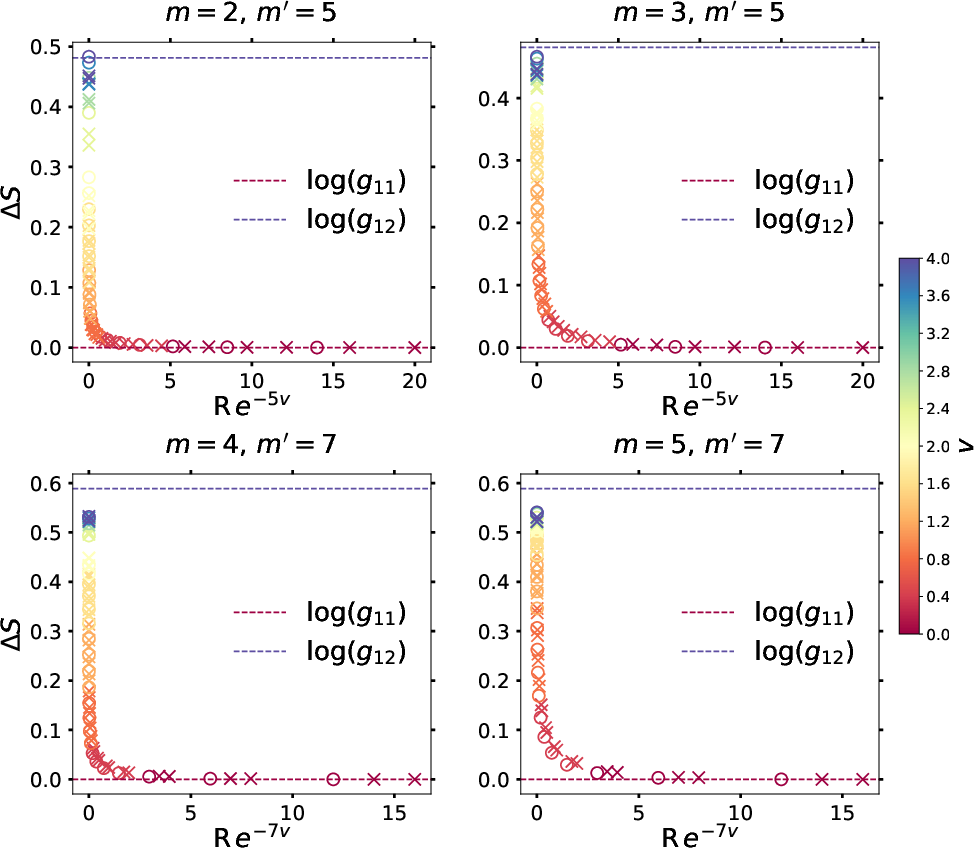
Figure 4: Defect entropy 2≤m<m′3 versus 2≤m<m′4 tracing RG flow between fixed points, showing monotonic, universal behavior within finite-size limitations.
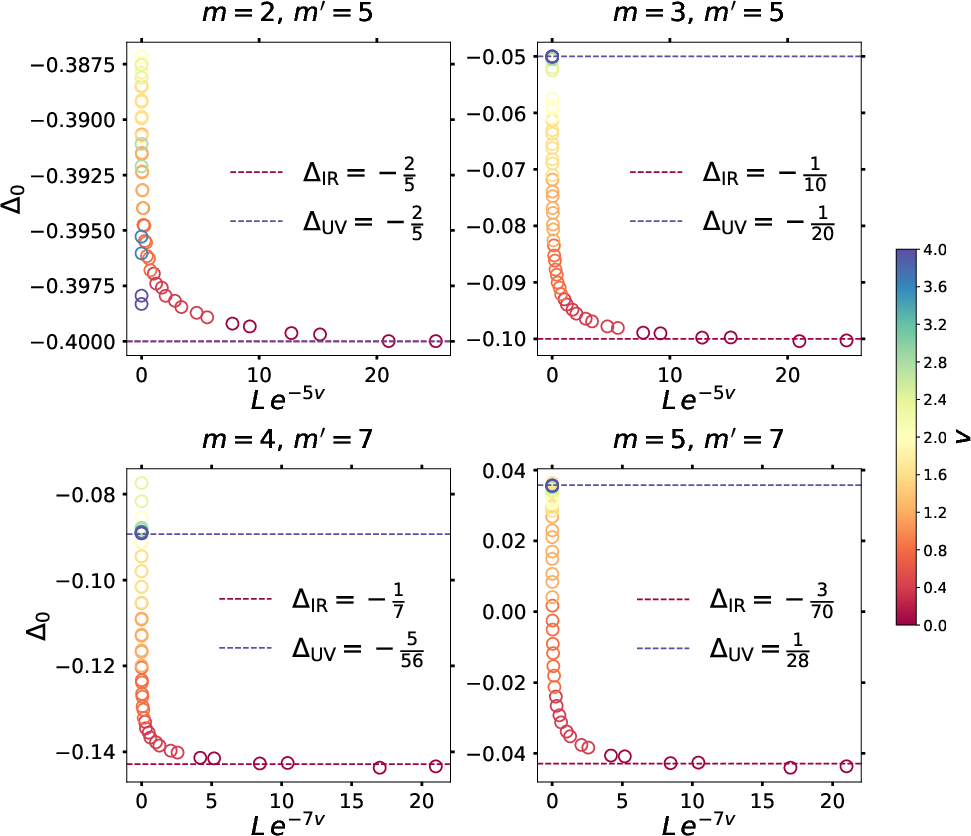
Figure 5: Flow of the ground-state conformal dimension 2≤m<m′5 as 2≤m<m′6 is tuned, revealing non-trivial crossovers between identity and KW defect fixed points.
Implications and Prospects
This work demonstrates that key features of non-unitary minimal model topological defects are explicitly realizable, observable, and quantifiable in integrable lattice models. The strong matching between numerical, analytical, and CFT expectations at spectral, thermodynamic, and topological levels enables several new directions:
- Quantum simulation: The manifestly topological and integrable structure makes these models natural candidates for implementation in solid-state or cold atom settings, and for benchmarking noisy quantum devices operating at small system sizes.
- Extension to other defects and non-invertible symmetries: The general construction opens systematic paths to lattice realizations of more exotic, including non-invertible, defects and their associated categorical symmetries in the non-unitary context, extending recent developments in higher categorical physics and topological quantum computing paradigms.
- RG and entanglement structure: The RG flows and associated entropy changes track CFT predictions, providing a controlled setting for testing generalized 2≤m<m′7-theorem statements and entropic diagnostics in non-unitary systems.
- Non-Hermitian dynamics and Kondo physics: The emergence of Kondo-type RG flows and the connections to non-Hermitian quantum impurity problems motivate further study of dynamical quenches, response, and entanglement growth in non-unitary lattice models.
Conclusion
This paper provides a comprehensive study of lattice realizations of topological defects in non-unitary minimal CFTs, using integrable RSOS models to bridge the field-theoretic and microscopic perspectives. The methods enable ab-initio determination of spectral, thermodynamic, and topological properties of defect lines and the RG flows connecting them. This framework paves the way for further investigation of non-invertible symmetries, quantum simulation of exotic critical phenomena, and the extension of integrability-based tools to a broader class of non-unitary quantum systems.

